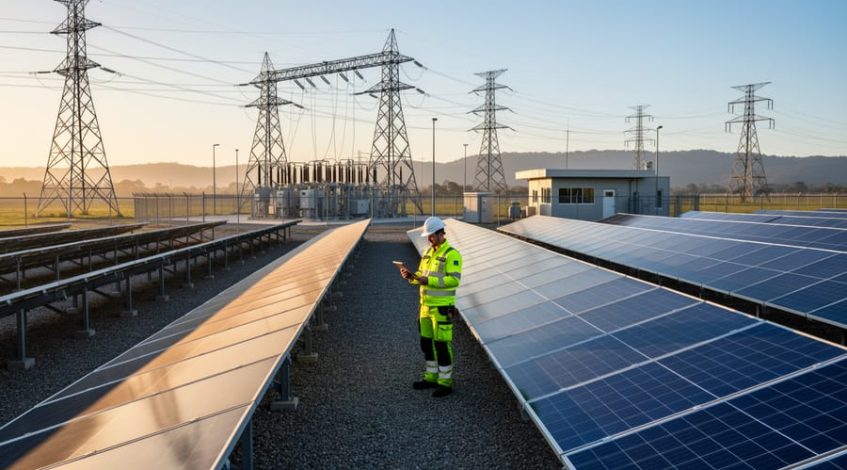
The grid interconnection queue has become the single greatest bottleneck facing commercial solar development today, with projects waiting an average of three to five years for approval—and some facing delays exceeding seven years. Over 2,000 gigawatts of generation capacity currently sit in interconnection queues across the United States and Europe, representing hundreds of billions in stalled clean energy investment. For business owners evaluating solar installations, understanding this challenge is no longer optional; it directly impacts project timelines, financing costs, and return on investment calculations.
The queue exists because every solar project must undergo technical studies proving it won’t destabilize the electrical grid before connecting. As applications have surged—increasing nearly 400% since 2015—grid operators have struggled with outdated review processes designed for an era of centralized fossil fuel plants, not distributed renewable generation. This mismatch creates cascading delays: when one project drops out or requires restudy, subsequent projects must be reevaluated, restarting timelines and multiplying costs.
Recent regulatory reforms and emerging interoperability standards offer tangible solutions. The Federal Energy Regulatory Commission’s Order 2023 and new IEEE standards are restructuring queue management, introducing cluster studies, higher financial deposits to deter speculative applications, and accelerated review pathways for projects meeting specific technical criteria. Grid operators are also implementing automated screening tools that can assess interconnection feasibility within weeks rather than months.
For commercial solar developers, success now depends on strategic positioning within this evolving landscape. Projects that proactively address technical requirements, demonstrate grid compatibility through advanced modeling, and leverage new fast-track provisions can substantially reduce approval timelines. Understanding these mechanisms transforms the interconnection queue from an insurmountable barrier into a navigable challenge with clear pathways to connection.
The Grid Interconnection Queue Crisis: What Business Leaders Need to Know
Understanding the Queue Backlog
The grid interconnection queue represents the formal waiting line that renewable energy projects must join to connect to the electrical grid. When developers submit applications to interconnect solar installations, transmission operators must conduct comprehensive studies to assess system impacts, determine necessary upgrades, and ensure grid reliability. This process has become a significant bottleneck in renewable energy deployment across Europe and globally.
Projects typically encounter delays due to several systemic challenges. The volume of applications has surged dramatically as organizations pursue decarbonization goals, overwhelming grid operators with limited engineering resources. Additionally, the interconnection study process requires sequential analysis of projects, meaning delays in evaluating earlier applications cascade through the entire queue. Technical complexities arise when multiple projects affect the same grid infrastructure, necessitating coordinated planning and potential system reinforcements.
Current statistics reveal substantial regional variations in wait times. In some European markets, commercial solar projects face interconnection timelines extending 24 to 48 months from initial application to final approval. Certain grid-constrained regions experience even longer delays, with projects waiting 36 to 60 months. These extended timelines create significant financial uncertainty for project developers, complicate power purchase agreement negotiations, and delay the realization of clean energy benefits for businesses seeking to reduce operational costs and carbon footprints.
Understanding these queue dynamics is essential for decision-makers planning solar investments. Anticipating potential delays enables more accurate project scheduling, financial modeling, and stakeholder communication throughout the development process.
The Cost of Waiting
For commercial solar projects, interconnection queue delays translate directly to significant financial losses. Each month of delay represents lost energy savings, extended reliance on grid electricity at higher rates, and postponed return on investment. A 100kW commercial installation delayed by 18 months can forfeit $50,000 to $100,000 in potential savings, depending on local electricity rates and system performance.
Financing arrangements add another layer of complexity. Project delays can invalidate loan approvals, cause interest rate fluctuations, or trigger contract renegotiations with equipment suppliers. Tax incentives and government rebates often carry expiration dates, meaning extended queue times may result in missing critical funding windows that justified the initial investment case.
Opportunity costs compound these direct losses. Capital allocated to delayed solar projects remains locked up rather than generating returns, affecting overall business liquidity and investment flexibility. For organizations with sustainability targets, queue delays can jeopardize compliance with corporate environmental commitments or regulatory requirements.
Market volatility introduces additional risk. Extended timelines expose projects to changing equipment costs, evolving grid requirements, and shifting energy policies. Some businesses have experienced situations where technology advances during the wait period, making their approved system design less competitive than newer solutions.
Successfully navigating these challenges requires strategic planning and proactive queue management. Understanding interconnection procedures and working with experienced providers becomes essential for overcoming solar challenges while minimizing financial exposure during the approval process.
How Interoperability Standards Are Reshaping Solar Grid Integration
Key Standards Driving Change
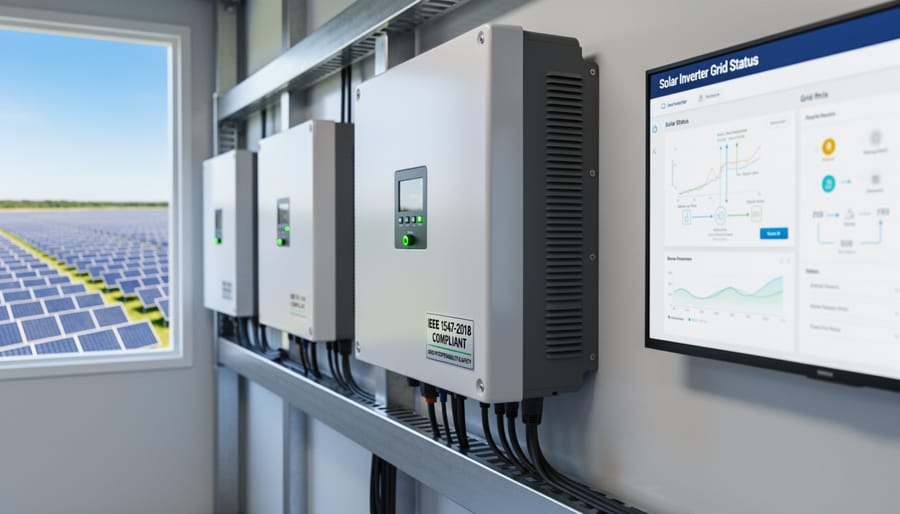
The landscape of grid interconnection is being fundamentally reshaped by updated technical standards, with IEEE 1547-2018 serving as the cornerstone of this transformation. This revised standard represents a significant departure from its 2003 predecessor, introducing advanced capabilities that align with modern grid modernization efforts and the increasing penetration of distributed energy resources.
IEEE 1547-2018 fundamentally changes how solar installations interact with the utility grid. Unlike earlier protocols that required solar systems to disconnect during grid disturbances, the new standard mandates ride-through capabilities, allowing systems to remain connected and even provide grid support during voltage and frequency fluctuations. This shift from passive to active grid participation enables solar installations to contribute to grid stability through functions like voltage regulation and reactive power support.
The standard introduces specific performance categories based on system size and application, with detailed requirements for voltage and frequency ride-through, ramp rates, and communication protocols. For commercial solar projects, this means inverters must now include advanced monitoring and control capabilities, significantly enhancing grid reliability while enabling utilities to better manage distributed generation resources.
Additional standards complementing IEEE 1547-2018 include UL 1741 Supplement A, which provides testing and certification procedures for these advanced inverter functions, and various utility-specific interconnection requirements that build upon the national framework. Together, these standards create a more sophisticated technical environment that, while initially appearing to complicate the interconnection process, ultimately facilitates faster integration of larger-scale commercial projects by providing clear, consistent technical expectations. Understanding these requirements early in project planning helps decision-makers anticipate equipment specifications and avoid costly delays in the interconnection queue.
Technical Requirements Your System Must Meet
Before your commercial solar system can connect to the grid, it must demonstrate compliance with specific technical capabilities that protect both your installation and the broader electrical network. Understanding these requirements helps you work effectively with your installer and utility provider to avoid delays in the interconnection queue.
Voltage regulation stands as a fundamental requirement. Your system must maintain voltage levels within acceptable ranges, typically plus or minus 5% of nominal voltage. This prevents equipment damage and ensures power quality for all grid users. Modern inverters accomplish this through sophisticated power electronics that continuously monitor and adjust output, making voltage compliance largely automatic in quality installations.
Frequency response capabilities ensure your system can detect and respond to grid frequency variations. Commercial systems must disconnect within specified timeframes if frequency deviates beyond safe thresholds, typically 59.3-60.5 Hz in most jurisdictions. This protects generators and sensitive equipment across the network while maintaining synchronization with grid operations.
Anti-islanding protection represents perhaps the most critical safety feature. Your system must detect grid outages within two seconds and cease power export immediately. This prevents dangerous scenarios where your solar array continues energizing lines that utility workers believe are de-energized. Advanced grid stability solutions incorporate multiple detection methods to ensure reliable protection.
Communication protocols enable remote monitoring and control by grid operators. IEEE 2030.5 and SunSpec Modbus have emerged as preferred standards, allowing utilities to curtail generation during emergencies or optimize power flow during peak demand periods. This two-way communication capability increasingly influences approval timelines, as utilities prioritize systems offering operational flexibility.
Working with experienced installers who understand these requirements from project inception significantly reduces the risk of costly redesigns during the approval process.
Strategic Advantages of Standards-Compliant Solar Systems
Faster Approval Times
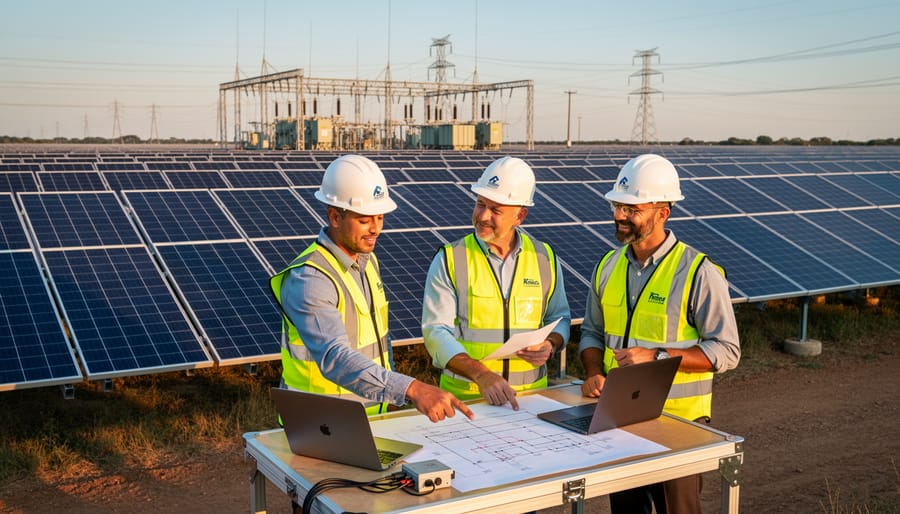
Systems designed with interoperability standards in mind demonstrate significantly shorter approval timelines, offering commercial solar developers a tangible competitive advantage. Grid operators increasingly prioritize applications that meet IEEE 2030.5 and other recognized protocols, as these systems require less technical review and present fewer integration risks.
Compliant installations typically progress through interconnection queues 30-40% faster than non-standard systems. This acceleration occurs because grid operators can validate technical specifications more quickly, reducing the back-and-forth revision cycles that often plague conventional applications. The streamlined documentation required for standards-compliant systems also minimizes administrative bottlenecks.
A manufacturing facility in Bavaria provides a compelling example. After initially submitting a conventional solar application that faced repeated technical queries, the company redesigned its system architecture to incorporate interoperability standards. The revised application received provisional approval within eight weeks, compared to the six-month average for similar-sized projects in their region. The facility manager reported that clear technical documentation aligned with grid operator requirements eliminated three rounds of revisions.
Similarly, a logistics center in the Netherlands leveraged compliant inverters and energy management systems to achieve grid connection in just 45 days. The project developer attributed this success to proactive demonstration of system compatibility with grid communication protocols, which satisfied operator concerns before they became formal objections.
These examples illustrate a broader trend: compliance transforms interconnection from a regulatory obstacle into a predictable process. For businesses evaluating solar investments, this predictability translates directly into reduced project risk and improved return on investment timelines.
Future-Proofing Your Investment
Investing in standards-compliant solar systems today delivers substantial long-term value that extends well beyond initial grid approval. Systems designed to meet current interoperability standards position your organization to capitalize on emerging grid opportunities while minimizing future upgrade costs.
Standards-compliant installations enable seamless participation in evolving grid services markets. As utilities increasingly compensate solar installations for frequency regulation, voltage support, and demand response services, compliant systems can activate these revenue streams with minimal modifications. A manufacturing facility in South Australia recently enhanced its project value by 18% through grid services participation, made possible because their initial installation met IEEE 1547-2018 requirements.
Modern solar energy management systems integrated with compliant infrastructure provide greater flexibility for technology upgrades. When battery storage costs decline or new inverter technologies emerge, standards-based systems accommodate these additions without requiring wholesale replacement of existing components. This modularity protects your capital investment while allowing incremental capability expansion.
Enhanced system monitoring and control capabilities inherent in compliant installations also improve operational efficiency and maintenance planning. Advanced communication protocols enable predictive maintenance, reducing unexpected downtime and extending equipment lifespan by up to 25% according to industry studies.
Perhaps most significantly, standards compliance directly impacts asset valuation. Properties with certified, compliant solar installations command premium valuations during sale or refinancing, as buyers recognize reduced technical risk and regulatory uncertainty. Financial institutions increasingly factor compliance status into lending terms, with compliant projects receiving favorable interest rates and extended financing periods. This compliance premium typically adds 8-12% to system asset value, providing quantifiable returns on the initial investment in quality, standards-compliant equipment and installation practices.
Navigating the Interconnection Process with Your Utility
Pre-Application Best Practices
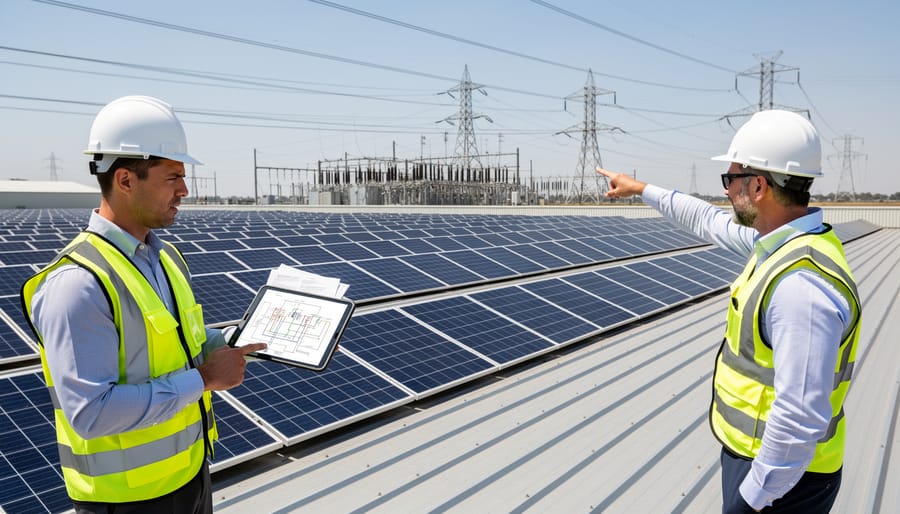
Thorough preparation before submitting your interconnection application can significantly reduce delays and prevent costly rejections. Begin with a comprehensive site assessment that evaluates electrical infrastructure, proximity to existing transmission lines, and available grid capacity in your area. Engage with your utility provider early to understand specific requirements and identify potential constraints before formal submission.
Conduct detailed technical studies, including preliminary load flow analysis and system impact assessments, to identify potential grid impacts proactively. Many successful projects invest in pre-application consultations with experienced electrical engineers who specialize in utility interconnection to ensure technical specifications align with grid standards and IEEE 1547 requirements.
Review your utility’s interconnection procedures carefully, as requirements vary by jurisdiction and project size. Document all existing electrical infrastructure, transformer capacity, and circuit specifications accurately. Incomplete or inaccurate technical data remains a leading cause of application delays.
Consider engaging a qualified interconnection consultant who understands local utility processes and can identify red flags before submission. This investment typically reduces overall project timelines by 3-6 months based on industry data.
Establish clear internal decision-making processes and secure necessary stakeholder approvals before application. Projects with confirmed financing, site control, and executive buy-in progress through queues more efficiently. Additionally, verify that your project team includes personnel with proven interconnection experience, as their expertise navigating utility requirements and technical standards proves invaluable throughout the approval process.
Documentation and Technical Studies
Before connecting your solar installation to the grid, utilities require comprehensive technical studies to ensure system stability and identify necessary infrastructure upgrades. Understanding these assessments helps you prepare documentation efficiently and avoid costly delays.
The process typically involves three progressive studies. The feasibility study provides an initial evaluation of whether your proposed project can connect at the requested location and capacity. It identifies obvious constraints and estimates preliminary costs, usually completed within 30-45 days. This preliminary assessment helps you determine project viability early in the planning process.
If the feasibility study shows promise, the system impact study examines how your installation affects grid reliability, power quality, and protection systems. Engineers analyze fault currents, voltage regulation, and potential impacts on other customers. This detailed analysis considers your project’s integration with smart grid integration technologies and typically requires 60-90 days.
The facilities study follows, specifying exact equipment upgrades needed—transformers, switchgear, protection devices, or line extensions. It provides definitive cost estimates and construction timelines for required modifications.
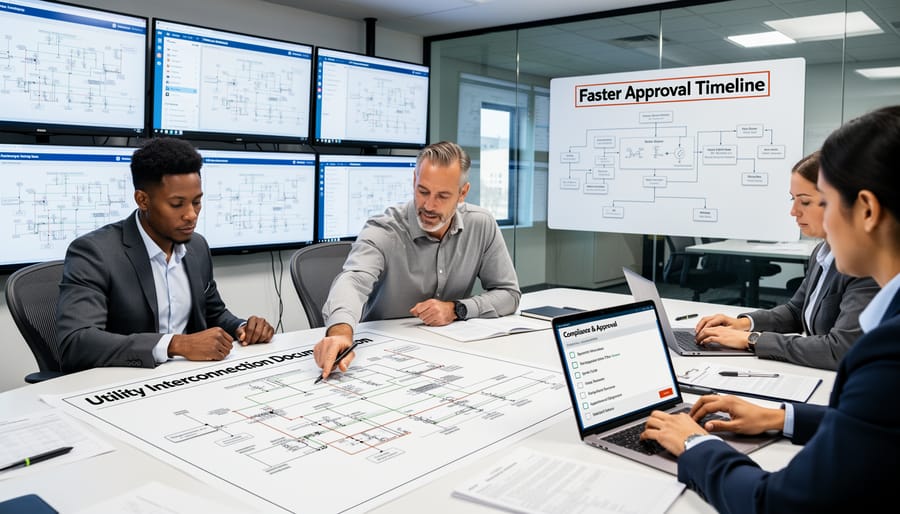
To prepare efficiently, engage experienced electrical engineers early who understand utility requirements. Provide accurate single-line diagrams, equipment specifications, and operational parameters. Consider submitting applications during lower-demand periods when utility engineering resources are more available. Real-world experience shows that well-prepared applications with complete documentation move through the queue 30-40 percent faster than those requiring multiple revision cycles. Front-loading your technical preparation significantly reduces overall project timelines and accelerates your return on investment.
Working with the Right Solar Partner to Minimize Queue Risk
What to Look for in a Solar Installation Partner
Selecting the right solar installation partner significantly impacts your project’s progression through the grid interconnection queue. Prioritize partners with demonstrated experience navigating utility interconnection processes, as they understand the procedural requirements and documentation standards that prevent costly delays. Your installer should possess current knowledge of IEEE 1547-2018 and regional utility specifications, ensuring technical compliance from the outset.
Evaluate their track record with commercial-scale projects similar to yours in size and complexity. Request case studies that detail timeline management, utility coordination, and successful queue navigation. Partners with established relationships with local utilities often expedite approvals and resolve technical issues more efficiently.
Verify their capability to conduct thorough feasibility studies, including grid capacity analysis and impact assessments. These preliminary evaluations identify potential interconnection challenges before formal application submission. Additionally, confirm they provide comprehensive project management throughout the interconnection process, from initial application through final utility approval and commissioning.
The ideal partner maintains transparent communication regarding realistic timelines, proactively addresses technical requirements, and demonstrates problem-solving expertise when encountering queue-related obstacles. Their technical proficiency should extend to power quality management, protection system design, and compliance documentation—critical components for smooth interconnection approval and long-term operational success.
The Value of Professional Project Management
Navigating the grid interconnection queue requires specialized expertise that many organizations lack internally. Professional project management delivers measurable value by coordinating the complex interplay between utility requirements, technical specifications, and regulatory timelines. Expert project coordinators maintain consistent communication channels with utility companies, ensuring that documentation meets evolving standards and submission deadlines are never missed.
Experienced managers understand the technical nuances of interconnection applications, from power flow studies to protection system requirements. They proactively identify potential compliance issues before they cause delays, translating technical utility feedback into actionable steps for engineering teams. This expertise proves particularly valuable when utilities request supplemental information or design modifications, where proper responses can mean the difference between minor adjustments and months of setbacks.
Timeline management represents another critical advantage. Professional coordinators track multiple approval stages simultaneously, anticipate bottlenecks, and develop contingency plans when queue positions shift. Real-world applications demonstrate that projects with dedicated management expertise progress through interconnection queues 30-40% faster than those handled ad-hoc. For commercial solar installations where delayed interconnection directly impacts return on investment, this acceleration translates into earlier revenue generation and improved project economics.
The grid interconnection landscape is undergoing significant transformation as regulatory bodies implement new interoperability standards to address mounting project backlogs. For business leaders considering commercial solar investments, understanding these changes represents the difference between timely project completion and years of costly delays. The interconnection queue, once a straightforward administrative process, now demands careful attention to technical standards compliance from the earliest planning stages.
Organizations that proactively address IEEE 1547-2018 requirements, voltage ride-through capabilities, and advanced inverter functionalities position themselves advantageously within the approval process. The data speaks clearly: projects meeting updated standards progress through interconnection queues 40-60% faster than those requiring subsequent modifications. This timeline differential translates directly to return on investment, with early adopters capturing energy cost savings while competitors remain stalled in approval cycles.
The path forward requires decisive action. Business owners and facility managers should begin by conducting comprehensive site assessments that explicitly evaluate interconnection requirements alongside traditional feasibility metrics. Engaging qualified engineering partners with demonstrated expertise in current interoperability standards proves essential. Request detailed interconnection timeline projections from your utility provider, and factor queue positioning into your financial modeling.
The opportunity cost of delayed decision-making compounds as queues lengthen. Organizations that initiate their solar projects today with standards-compliant designs secure favorable queue positions while benefiting from established regulatory frameworks. The commercial solar landscape rewards informed, proactive planning. Your next step begins with a thorough evaluation of your facility’s interconnection readiness and a clear understanding of the technical requirements that will govern your project’s success.