

Establish dedicated collection channels for photovoltaic waste by partnering with certified e-waste recyclers who possess specialized capabilities for solar panel dismantling and material recovery. Most municipal solid waste facilities lack the infrastructure to process crystalline silicon, cadmium telluride, and other semiconductor materials found in decommissioned panels, requiring separate handling protocols that align with electrical equipment disposal regulations.
Integrate end-of-life planning into commercial solar procurement by requiring manufacturers to provide takeback programs or recycling bonds as part of installation contracts. The European Union’s WEEE Directive mandates producer responsibility for PV waste, but many jurisdictions still treat expired panels as general construction debris, creating significant environmental and economic inefficiencies. Commercial property owners making urban solar investments today must account for 25-30 year disposal costs to avoid substantial liabilities when systems reach end-of-life.
Conduct material audits of existing solar installations to quantify future waste streams and identify recovery opportunities. Silicon wafers retain 85% recyclability, aluminum frames achieve 95% recovery rates, and glass components can be reprocessed into construction materials, yet fewer than 10% of expired panels currently enter proper recycling channels. This gap represents both an environmental challenge and an unrealized revenue stream for municipalities managing commercial solar portfolios.
Implement manufacturer transparency requirements that document panel composition, hazardous material content, and approved disposal methods. Without standardized labeling and material declarations, recycling facilities cannot efficiently sort and process incoming PV waste, leading to landfill disposal of valuable resources. Forward-thinking facility managers now request detailed decommissioning specifications during the procurement phase, ensuring seamless integration with municipal recycling infrastructure when panels eventually require replacement.
The Scale of Urban PV Waste: What Commercial Property Owners Need to Know

Current PV Waste Generation in European Cities
European cities are experiencing a steady increase in photovoltaic waste generation as first-generation commercial installations reach end-of-life. Current estimates indicate that the EU generates approximately 10,000 tonnes of PV waste annually, with projections reaching 130,000 tonnes by 2030. Germany leads in decommissioning volumes, processing roughly 3,500 tonnes per year, followed by Italy and France with 1,800 and 1,500 tonnes respectively.
Urban commercial installations account for approximately 35% of total PV waste in European cities, with the remainder coming from utility-scale projects. Major metropolitan areas such as Berlin, Barcelona, and Amsterdam report decommissioning rates of 2-4% of installed capacity annually, primarily from systems installed between 2005-2010 that have reached their 20-25 year operational lifespan.
Current collection infrastructure remains fragmented across EU member states. Cities like Munich and Rotterdam have established dedicated PV waste collection points at recycling facilities, achieving recovery rates of 85-90% for glass and aluminum components. However, smaller urban centers often lack specialized handling capabilities, with panels frequently entering general electronic waste streams. Industry data shows that approximately 40% of decommissioned commercial panels in European cities currently undergo proper recycling, highlighting significant room for infrastructure development and regulatory enforcement improvements.
Projected Growth Through 2035
Industry analysts project municipal photovoltaic waste volumes will increase exponentially through 2035, driven by the retirement of systems installed during the 2010-2020 solar expansion period. Current estimates indicate global PV waste could reach 8 million metric tons annually by 2030, escalating to 60-80 million metric tons by 2035 as first-generation commercial installations reach their 25-30 year operational lifespan.
Urban centers face particularly acute challenges, with metropolitan areas that adopted commercial solar infrastructure early experiencing concentrated retirement waves. Industrial facilities and commercial properties with large-scale rooftop arrays will generate substantial waste streams requiring coordinated management strategies.
Government officials and facility managers should anticipate this growth trajectory when developing waste management protocols. Cities with robust recycling infrastructure established now will avoid costly emergency measures later. Economic modeling suggests municipalities investing in PV recycling facilities by 2027 could capture significant revenue opportunities from material recovery, with silicon, silver, and aluminum extraction offering compelling returns.
Regional variations will emerge based on installation timelines, with California, Germany, and Japan experiencing earlier peaks than emerging markets. Forward-thinking organizations are already incorporating end-of-life planning into current solar procurement decisions, recognizing that decommissioning strategies implemented today determine tomorrow’s environmental and financial outcomes.
How Municipal Waste Systems Handle PV Panels Today
Collection and Sorting Protocols
Cities have developed increasingly sophisticated collection and sorting protocols for end-of-life photovoltaic panels from commercial installations, though standardization remains limited across jurisdictions. Currently, most municipalities classify decommissioned solar panels as either electronic waste or special commercial waste, depending on local regulations and the presence of hazardous materials like cadmium or lead in certain panel types.
Commercial property owners typically coordinate panel removal through certified waste management contractors who ensure compliance with the European Waste Catalogue classification system. The collection process requires proper documentation, including weight measurements, panel type identification, and manufacturer information to facilitate appropriate recycling pathways. Under the EU WEEE Directive, solar panel producers bear extended producer responsibility, obligating them to finance collection and recycling infrastructure for systems installed after 2012.
Most European cities operate through centralized collection points where certified facilities receive commercial solar waste. Facility managers must arrange transport to these designated locations, with advance notification required for large-scale decommissioning projects exceeding five metric tons. Panels undergo initial sorting to separate crystalline silicon modules from thin-film technologies, as each requires distinct processing methods.
Regulatory requirements mandate tracking through waste transfer documentation, ensuring panels reach authorized treatment facilities rather than general landfills. Cities increasingly require proof of responsible disposal before issuing permits for replacement installations. Forward-thinking municipalities have established partnerships with specialized recyclers, creating streamlined protocols that reduce administrative burden while ensuring environmental compliance. This developing infrastructure reflects growing recognition of solar waste management as integral to sustainable energy transitions.
Processing Challenges for Urban Facilities
Municipal waste recycling facilities face significant technical challenges when processing photovoltaic materials, requiring specialized protocols that differ substantially from standard recycling operations. Current infrastructure designed for conventional waste streams often lacks the equipment and expertise necessary to safely handle decommissioned solar panels.
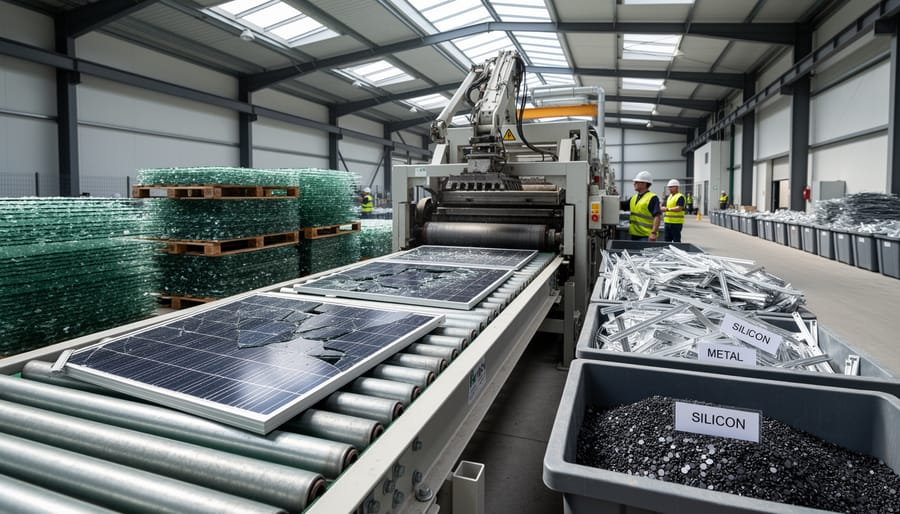
The primary technical obstacle centers on material separation complexity. Modern solar panels contain multiple bonded layers including tempered glass, aluminum frames, silicon cells, polymer encapsulants, and metal conductors. Standard mechanical shredding processes, while effective for traditional recyclables, produce mixed material streams that significantly reduce recovery value and complicate downstream processing. Recovery rates for valuable materials like silver and silicon typically range between 50-70% using conventional methods, substantially lower than the 85-95% achievable through specialized processing.
Hazardous component management presents another critical challenge. Thin-film panels containing cadmium telluride or copper indium gallium selenide require handling protocols comparable to electronic waste due to toxic substance risks. Many municipal facilities lack the necessary containment systems and environmental permits for these materials. Even crystalline silicon panels, while less hazardous, contain lead-based solder and anti-reflective coatings that demand careful processing to prevent environmental contamination.
Infrastructure limitations extend to storage and sorting requirements. PV waste arrives in varying conditions, from intact panels to damaged fragments, necessitating manual inspection and classification before processing. This labor-intensive step creates bottlenecks at facilities already operating near capacity with traditional waste volumes.
Economic viability represents the ultimate challenge. Processing costs typically exceed recovered material value when using existing municipal equipment, creating financial disincentives for facilities to accept PV waste. Successful integration requires either significant capital investment in specialized technology or partnerships with dedicated PV recycling operators who possess the technical capabilities and economies of scale necessary for profitable material recovery.
The Economics of Solar Panel Recycling Infrastructure
Material Recovery Value and Market Dynamics
Solar panels contain valuable materials that create significant economic opportunities when properly recovered through municipal recycling programs. Understanding these material values helps facility managers and government officials justify investment in dedicated photovoltaic waste processing infrastructure.
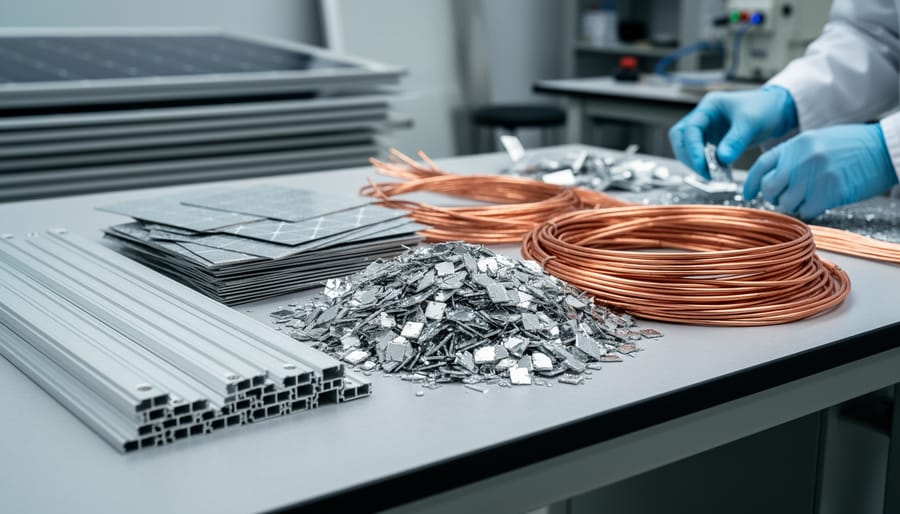
Silicon wafers represent the primary recoverable component, comprising approximately 47% of panel weight. While recycling processes can recover up to 85% of silicon content, the material’s commodity market value fluctuates between $1.50 to $3.00 per kilogram. More economically attractive is silver, used in electrical contacts throughout panels. Each standard panel contains roughly 10-20 grams of silver, valued at approximately $600 per kilogram, making it the most financially significant recovery target.
Aluminum frames account for 8-10% of total panel weight and maintain consistent recycling value at $0.80 to $1.20 per kilogram. Glass, while representing over 70% of panel mass, offers lower per-unit returns at $0.05 to $0.15 per kilogram but generates substantial volume-based revenue. Copper wiring and junction boxes add further material value to the recovery stream.
Current market analysis indicates that comprehensive recycling operations can recover materials worth $12-$15 per panel when processing at scale. Combined with proper regulatory frameworks and processing efficiency, these recovery values offset collection and processing costs, creating economically sustainable recycling programs. Municipalities processing 10,000 panels annually can achieve operational profitability while diverting hazardous materials from landfills, demonstrating the dual environmental and financial benefits of structured photovoltaic waste management systems.
End-of-Life Costs for Commercial Installations
Commercial solar installations require careful financial planning for end-of-life management, with costs varying significantly from traditional waste streams. Business owners should anticipate disposal fees ranging from $15 to $45 per panel, depending on local infrastructure and recycling capabilities. These fees typically cover transportation, hazardous material handling, and materials recovery processes.
When evaluating the total cost of ownership for commercial installations, factor in approximately $0.10 to $0.25 per watt for decommissioning and recycling. For a typical 500 kW commercial system, this translates to $50,000 to $125,000 over the installation’s 25-30 year lifespan.
Compared to conventional waste disposal, solar panel recycling presents both challenges and opportunities. While standard commercial waste costs $50-$100 per ton for landfill disposal, solar panels require specialized processing due to glass, silicon, and trace metals. However, materials recovery can offset 30-50% of recycling costs through the resale of reclaimed aluminum, copper, and silicon.
Smart budgeting strategies include establishing dedicated reserve funds, negotiating extended producer responsibility programs with manufacturers, or selecting installers who offer take-back programs. Several Australian municipalities now provide centralized collection facilities, reducing transportation costs for commercial operators. Facility managers should verify local recycling infrastructure availability and compare regional pricing to optimize long-term budget allocations while ensuring regulatory compliance.
Leading Urban PV Recycling Models in Europe
Germany’s Extended Producer Responsibility Framework
Germany’s Extended Producer Responsibility Framework represents one of Europe’s most comprehensive approaches to photovoltaic waste management, establishing clear accountability throughout the solar panel lifecycle. Under this system, manufacturers bear financial and organizational responsibility for collecting and recycling their products once they reach end-of-life, creating a sustainable circular economy for solar installations.
The German ElektroG law, which implements the EU WEEE Directive, requires PV manufacturers to register with the national Stiftung Elektro-Altgeräte Register foundation before marketing products. This registration obligates producers to finance collection, transport, and proper recycling of their panels through participation in collective take-back schemes. For commercial facility managers, this framework translates into accessible, cost-effective disposal pathways without bearing the full financial burden of decommissioning.
Commercial solar operators benefit from designated collection points established nationwide, where installers and facility managers can deposit decommissioned panels at no charge. The system processes approximately 95 percent of panel materials for recovery, extracting valuable materials including silicon, silver, copper, and aluminum for reintegration into manufacturing supply chains.
Real-world application demonstrates the framework’s effectiveness: a manufacturing facility in Bavaria recently decommissioned a 500 kW rooftop installation after 25 years of operation. Through the EPR system, the company coordinated collection with their original equipment manufacturer, avoiding landfill fees and ensuring regulatory compliance without allocating internal recycling budget. The streamlined process required minimal administrative effort while guaranteeing environmental responsibility.
This producer-financed model provides commercial property owners with predictable, manageable end-of-life planning, eliminating uncertainty about future disposal costs when evaluating solar investments. Understanding these established pathways enables informed decision-making regarding long-term solar asset management.
Belgium’s Regional Processing Centers
Belgium has established a sophisticated network of regional processing centers specifically designed to handle photovoltaic waste from commercial and municipal sources. The country operates five major facilities strategically positioned to serve urban centers, each processing approximately 3,000 to 5,000 metric tons of solar panel waste annually.
The Brussels Capital Region facility serves as the primary hub for commercial properties in the metropolitan area, implementing advanced automated sorting systems that achieve 95% material recovery rates. This center specializes in crystalline silicon panels, which constitute the majority of commercial installations reaching end-of-life status. The facility processes panels through mechanical separation, recovering aluminum frames, junction boxes, and glass components before extracting valuable silicon wafers and trace metals.
Flanders operates two specialized centers in Antwerp and Ghent, serving the region’s extensive commercial solar infrastructure. These facilities have pioneered thermal treatment processes that safely remove encapsulation materials without damaging recoverable silicon cells. Commercial property owners benefit from streamlined logistics, with scheduled collection services integrated into existing waste management routes. The average processing turnaround time stands at 14 days from collection to material recovery certification.
The Walloon region’s processing center in Liège focuses on serving both commercial properties and municipal installations. This facility has demonstrated impressive economic viability, recovering materials valued at approximately 12 euros per panel, which offsets processing costs and reduces disposal fees for commercial clients.
Belgium’s decentralized approach ensures no commercial property is located more than 75 kilometers from a certified processing center, significantly reducing transportation costs and carbon footprint associated with PV waste management. This geographic distribution has become a model for other European nations developing urban solar waste infrastructure.
Regulatory Requirements and Compliance for Commercial Solar
WEEE Directive Implications
The Waste Electrical and Electronic Equipment (WEEE) Directive establishes a comprehensive framework for managing end-of-life solar panels across European Union member states. Under this directive, commercial solar installations fall under Category 4 (large equipment) or Category 5 (small equipment), depending on panel dimensions, requiring manufacturers and installers to implement take-back schemes and meet recycling targets of at least 85% by weight.
For business owners and facility managers, compliance begins at the procurement stage. When selecting solar equipment, verify that manufacturers are registered with national WEEE authorities and have established collection systems. This registration ensures proper documentation throughout the panel lifecycle and facilitates compliant disposal when systems reach end-of-life, typically after 25-30 years of operation.
The directive places primary responsibility on producers, but commercial property owners must maintain records of installed equipment, including WEEE registration numbers and disposal pathways. Government officials should note that local collection infrastructure must accommodate these requirements, often through designated municipal collection points or authorized treatment facilities.
Recent case studies from Germany and the Netherlands demonstrate successful implementation through public-private partnerships, where municipalities coordinate with certified recyclers to create efficient collection networks. These systems reduce disposal costs for businesses while ensuring valuable materials like silicon, silver, and aluminum are recovered, supporting circular economy objectives and reducing reliance on virgin resource extraction.
Documentation and Reporting Requirements
Commercial solar operators must maintain comprehensive documentation throughout the lifecycle of their photovoltaic installations to ensure compliance with evolving municipal waste regulations. Facilities should establish systematic record-keeping protocols that track panel installation dates, manufacturer specifications, serial numbers, and expected end-of-life projections. This inventory management enables accurate forecasting for decommissioning budgets and facilitates smoother transitions when panels reach their operational limits.
When preparing for panel decommissioning, operators are increasingly required to submit detailed waste management plans to local authorities, typically 90 to 180 days before removal activities commence. These plans should identify the recycling facility that will process the materials, transportation methods, and estimated volumes of different panel components. Documentation must demonstrate adherence to hazardous material handling protocols, particularly for panels containing trace amounts of heavy metals.
Many jurisdictions now mandate annual reporting on solar waste generation, creating transparency in the circular economy for PV materials. Forward-thinking facility managers integrate these reporting requirements into their environmental management systems, positioning documentation as a strategic asset rather than regulatory burden. Real-world applications show that operators maintaining robust records experience fewer compliance issues and can leverage their data to negotiate favorable rates with specialized recycling partners, ultimately reducing decommissioning costs while supporting sustainable urban infrastructure development.
Planning for End-of-Life: What to Include in Your Solar Investment
Choosing Manufacturers with Take-Back Programs
When planning commercial solar installations, selecting manufacturers with comprehensive take-back programs significantly reduces future disposal burdens on municipal waste systems. These programs demonstrate a manufacturer’s commitment to circular economy principles and provide facility managers with clear end-of-life pathways.
Begin by requesting detailed documentation of each supplier’s recycling commitments. Leading manufacturers maintain formal take-back schemes that guarantee panel collection and proper recycling at end-of-life, typically 25-30 years post-installation. Verify whether these programs apply to your jurisdiction and understand any associated costs or logistical requirements.
Evaluate manufacturers based on their participation in industry recycling initiatives and compliance with Extended Producer Responsibility regulations. Companies adhering to EU WEEE Directive standards or similar frameworks have established infrastructure for managing solar waste. Request transparency reports showing actual recycling rates rather than theoretical capabilities.
Consider the financial stability of manufacturers, as take-back commitments require long-term viability. A 2023 study found that 40% of solar companies operating in 2010 had ceased operations by 2020, potentially leaving their panels without recycling support. Prioritize established manufacturers with dedicated recycling partnerships and financial guarantees backing their commitments.
Document all take-back agreements within procurement contracts, specifying collection procedures, recycling standards, and cost responsibilities. This proactive approach protects your organization from future disposal liabilities while supporting municipal waste reduction goals.
Building Decommissioning Costs into ROI Calculations
Accurately calculating the return on investment for commercial solar systems requires incorporating end-of-life costs from the initial planning stage. A comprehensive total cost of ownership model should allocate 2-4% of the initial installation expense for decommissioning and recycling activities over the system’s 25-30 year operational lifespan.
Facility managers should establish a dedicated sinking fund with annual contributions beginning in year one, ensuring sufficient capital availability when decommissioning becomes necessary. Current industry benchmarks indicate panel recycling costs ranging from $15-30 per panel, though economies of scale through municipal aggregation programs can reduce individual facility expenses by 30-40%.
Financial projections must also account for potential liability costs associated with improper disposal, which can reach five times standard recycling fees in jurisdictions with strict enforcement. Progressive organizations are negotiating decommissioning clauses with installation contractors, securing fixed-price removal guarantees that protect against future cost escalation.
Real-world application demonstrates this approach: A Sydney commercial property portfolio integrated decommissioning provisions into their 2019 solar investment, setting aside $45,000 over the projected system lifetime. This proactive budgeting eliminated future financial uncertainty while maintaining projected ROI above 14% annually, proving that responsible waste planning enhances rather than diminishes investment attractiveness.

Proactive planning for photovoltaic waste management represents a strategic imperative for commercial solar investors rather than an operational afterthought. As municipal recycling infrastructure continues to evolve across European markets, understanding the current landscape of PV waste processing capabilities directly impacts long-term investment valuations and ensures compliance with increasingly stringent regulatory frameworks.
The commercial solar sector stands at a critical juncture. With the first generation of large-scale installations approaching end-of-life, businesses that integrate decommissioning costs and recycling logistics into their financial modeling today will maintain competitive advantages tomorrow. Municipal waste management systems are developing specialized collection and processing programs, yet significant regional variations persist. Organizations that establish relationships with certified recyclers and understand local regulatory requirements position themselves to avoid future compliance penalties and unexpected disposal costs.
The economic case for early engagement with PV waste planning extends beyond risk mitigation. Forward-thinking businesses can leverage sustainable decommissioning practices as differentiators in corporate sustainability reporting and stakeholder communications. Real-world applications demonstrate that companies incorporating circular economy principles into their solar strategies often discover operational efficiencies and cost savings throughout the installation lifecycle.
Looking ahead, infrastructure development in PV recycling will accelerate as material recovery technologies advance and policy frameworks mature. Commercial solar investors who participate actively in this emerging ecosystem—whether through partnerships with recycling innovators or by influencing municipal planning processes—will help shape sustainable practices while protecting their investments. The question is no longer whether to plan for solar panel recycling, but how strategically organizations will position themselves within this evolving landscape to maximize both environmental and financial returns.