

The renewable energy sector is generating approximately 12 million jobs globally, with data science roles emerging as the fastest-growing segment within this expansion. Solar and wind installations now produce terabytes of operational data daily, requiring specialized professionals who can transform raw performance metrics into actionable intelligence that drives return on investment.
Data scientists in renewable energy command average salaries 18-22% higher than traditional energy analysts, reflecting the critical value they deliver through predictive maintenance algorithms, grid optimization models, and energy production forecasting. These professionals bridge the gap between engineering teams and business leadership, translating complex datasets into cost savings ranging from $50,000 to $2 million annually for commercial-scale installations.
The convergence of artificial intelligence, IoT sensor networks, and utility-scale renewable projects has created unprecedented demand for professionals skilled in Python, machine learning, and energy systems analysis. Organizations that integrate data science capabilities into their renewable energy operations report 15-30% improvements in asset performance and significant reductions in unplanned downtime.
Renewable energy career opportunities in data science represent more than employment trends—they signal a fundamental shift in how the industry optimizes performance and delivers financial returns. Companies investing in analytics infrastructure and hiring data-focused talent consistently outperform competitors in energy yield, operational efficiency, and long-term asset value.
This analysis examines the specific roles, required competencies, and business impact of data science positions within renewable energy, providing both job seekers and industry leaders with strategic insights for navigating this rapidly evolving landscape. Understanding these positions is essential for organizations seeking competitive advantage in an increasingly data-driven energy sector.
The Digital Transformation of Renewable Energy
From Installation to Intelligence
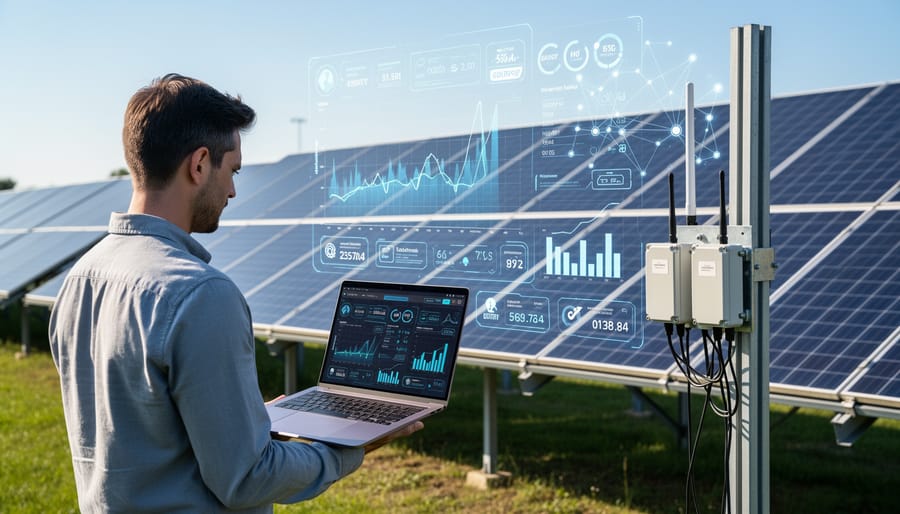
Today’s solar installations have evolved far beyond simple panels collecting sunlight. Each commercial solar array now functions as a sophisticated data collection network, with monitoring systems tracking energy production, weather conditions, panel performance, and grid interactions in real-time. IoT sensors embedded throughout these installations capture granular measurements every few seconds, generating terabytes of operational data annually.
This data explosion has fundamentally transformed the solar industry’s workforce requirements. A single 500-panel commercial installation can produce millions of data points monthly, monitoring voltage fluctuations, temperature variations, inverter efficiency, and equipment degradation patterns. These systems require professionals who can transform raw sensor feeds into actionable intelligence that maximizes energy output and prevents costly downtime.
The complexity multiplies when managing portfolios across multiple sites. Organizations operating commercial solar installations at different geographic locations need data scientists who can identify performance patterns, predict maintenance needs, and optimize energy delivery across diverse conditions. Equipment manufacturers similarly require data expertise to improve product reliability and warranty management.
This convergence of solar technology and data infrastructure has created a distinct career category where energy sector knowledge meets advanced analytics capabilities, driving demand for professionals who understand both domains.
The Business Case for Data-Driven Energy Management
Data analytics professionals have demonstrated measurable financial impact across commercial solar installations, generating returns that justify dedicated data science positions. Organizations implementing advanced analytics report 15-25% improvements in energy yield through optimized panel positioning, predictive maintenance schedules, and real-time performance adjustments.
A recent analysis of 50 commercial solar facilities revealed that data-driven operations reduced unplanned downtime by 40% compared to traditional maintenance approaches. This translates directly to revenue protection, with facilities experiencing equipment failures capturing significantly less energy production during critical peak hours.
Financial institutions now recognize data science capabilities as key evaluation criteria for solar project financing. One commercial installation in the Netherlands demonstrated a 22% reduction in operational costs over three years by employing machine learning algorithms to predict component failures and optimize cleaning schedules based on weather patterns and efficiency metrics.
The business case extends beyond immediate cost savings. Data scientists enable portfolio-level optimization for organizations managing multiple installations, identifying performance patterns and replicating successful strategies across facilities. This scalability becomes particularly valuable as commercial solar portfolios expand, with analytics teams managing performance data from hundreds of sites simultaneously through centralized platforms that detect anomalies and recommend interventions before revenue loss occurs.
Core Data Science Roles in Renewable Energy

Energy Performance Analysts
Energy Performance Analysts play a critical role in maximizing the financial returns of solar installations through sophisticated data analysis and predictive modeling. These professionals monitor real-time performance metrics across solar arrays, identifying inefficiencies, degradation patterns, and optimization opportunities that directly impact energy generation and revenue streams.
Using advanced statistical methods and machine learning algorithms, Energy Performance Analysts predict equipment failures before they occur, reducing costly downtime and maintenance expenses. They analyze variables including weather patterns, panel temperature, irradiance levels, and inverter performance to develop forecasting models that inform operational decisions and capacity planning.
For commercial solar operators, these analysts provide actionable intelligence on system performance benchmarks, helping facility managers justify capital investments and demonstrate ROI to stakeholders. They create detailed performance reports comparing actual versus expected energy production, quantifying losses from shading, soiling, or equipment malfunctions.
The role requires proficiency in data visualization tools, programming languages like Python or R, and domain knowledge of photovoltaic systems. Energy Performance Analysts typically collaborate with engineering teams and operations managers, translating complex datasets into strategic recommendations that enhance system efficiency by 5-15 percent, representing substantial cost savings for large-scale installations.
Predictive Maintenance Specialists
Predictive maintenance specialists represent one of the most value-driven positions in renewable energy data science, directly impacting operational efficiency and bottom-line performance. These professionals develop sophisticated algorithms that analyze sensor data, historical performance records, and environmental conditions to forecast equipment failures before they occur. By identifying potential issues with inverters, panels, and battery storage systems weeks or months in advance, they enable facility managers to schedule maintenance during optimal windows, minimizing downtime and maximizing energy production.
The financial impact is substantial. Traditional reactive maintenance approaches can result in unexpected outages costing thousands in lost revenue per hour, while preventive maintenance often leads to unnecessary service interventions. Predictive models typically reduce maintenance costs by 25-40% while extending equipment lifespan by 20-30%. These specialists employ machine learning techniques including random forests, neural networks, and time-series analysis to process vast datasets from SCADA systems and IoT sensors. For commercial solar installations, where uptime directly correlates with revenue generation and ROI, predictive maintenance capabilities have become essential infrastructure rather than optional technology. Organizations hiring for these roles should prioritize candidates with expertise in industrial IoT, statistical modeling, and domain knowledge of photovoltaic systems.
Grid Integration and Forecasting Experts
Grid integration and forecasting specialists occupy a critical position in renewable energy operations, serving as the bridge between variable solar generation and stable grid requirements. These professionals develop sophisticated predictive models that forecast energy output based on weather patterns, seasonal variations, and historical performance data, enabling facility managers to optimize dispatch schedules and maintain grid stability commitments.
The role demands expertise in time-series analysis, machine learning algorithms, and energy market dynamics. Forecasting experts utilize vast datasets from meteorological services, satellite imagery, and on-site sensors to predict generation patterns hours or days in advance. This capability proves essential for commercial installations where accurate predictions directly impact revenue optimization and penalty avoidance in wholesale energy markets.
A European manufacturing facility demonstrated the business value of these specialists when their forecasting system reduced grid imbalance penalties by 40 percent within the first year of implementation. The data science team developed algorithms that improved prediction accuracy to within 5 percent error margins, allowing the facility to secure more favorable power purchase agreements and optimize battery storage deployment.
These positions require proficiency in Python or R programming, familiarity with grid interconnection standards, and understanding of renewable energy certificate markets. Organizations investing in these specialized roles gain competitive advantages through improved operational efficiency, reduced curtailment losses, and enhanced reliability for stakeholders who depend on consistent renewable energy delivery.
Essential Digital Skills for Renewable Energy Data Professionals
Technical Foundations
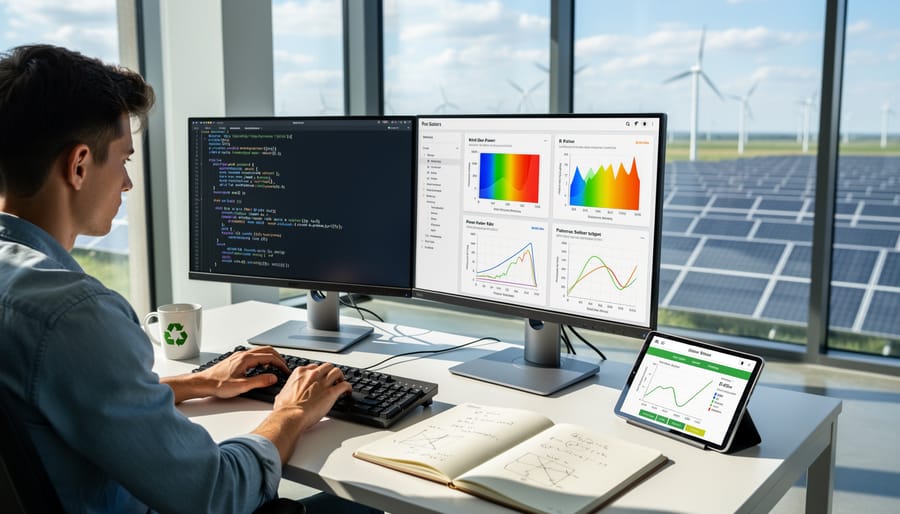
Renewable energy data scientists build their expertise on a foundation of specialized technical competencies that directly translate to business value. Python remains the dominant programming language in this field, valued for its extensive libraries supporting statistical analysis, machine learning, and energy system modeling. R serves as a complementary tool, particularly for advanced statistical forecasting and visualization of energy production patterns.
Machine learning frameworks form the analytical backbone of modern energy operations. TensorFlow and PyTorch enable predictive maintenance algorithms that reduce system downtime by up to 30%, while scikit-learn facilitates demand forecasting models that optimize energy distribution. These frameworks process vast datasets from solar installations, identifying performance trends and anomalies that human analysis might miss.
Data visualization platforms transform complex energy metrics into actionable insights for decision-makers. Tools like Tableau, Power BI, and Python’s Plotly library create dashboards that track real-time production efficiency, financial performance, and carbon offset achievements. For organizations building renewable energy capabilities, understanding these critical digital skills ensures alignment between technical talent and business objectives. The investment in these technical foundations yields measurable returns through improved system performance, reduced operational costs, and enhanced capacity planning accuracy.
Energy Domain Knowledge
Renewable energy data scientists require specialized domain knowledge that extends far beyond traditional analytics capabilities. While general data scientists possess strong statistical and programming foundations, those working in solar and renewable energy must understand the unique physics governing photovoltaic systems, including cell efficiency, temperature coefficients, and degradation rates. This technical grounding enables them to interpret sensor data accurately and identify genuine performance anomalies versus expected variations.
Weather pattern analysis forms another critical competency. Data scientists must comprehend how irradiance, cloud coverage, atmospheric conditions, and seasonal variations impact energy generation. This knowledge directly informs predictive models that optimize maintenance schedules and forecast production, delivering measurable return on investment for commercial installations. Understanding grid operations, including demand curves, frequency regulation, and voltage management, allows these professionals to develop algorithms that maximize revenue through strategic energy dispatch and storage optimization.
The integration of these digital skills with energy fundamentals distinguishes effective renewable energy data scientists from general practitioners. For facility managers and business owners, this domain expertise translates to more accurate performance predictions, faster issue resolution, and improved system economics. A data scientist who understands module topology can identify string-level inefficiencies that generic analytics might miss, potentially recovering thousands in lost production annually. This specialized knowledge ensures that data-driven insights align with operational realities, making recommendations both technically sound and commercially viable for organizations pursuing sustainable energy solutions.
Business Intelligence and ROI Analysis
Data scientists in renewable energy must bridge the gap between complex analytics and actionable business outcomes. These professionals excel at conducting cost-benefit analyses that demonstrate the financial impact of solar investments, helping stakeholders understand payback periods, lifecycle costs, and long-term savings projections. Their expertise transforms raw performance data into compelling ROI narratives that resonate with decision-makers.
Effective business intelligence in this sector requires cross-disciplinary expertise, combining technical proficiency with financial acumen and communication skills. Data scientists prepare executive summaries, create intuitive dashboards, and present findings to boards and management teams who may lack technical backgrounds. For instance, a data scientist might analyze operational data from a commercial solar array to quantify efficiency improvements worth hundreds of thousands in annual savings, then distill these findings into clear recommendations for facility managers.
This capability proves particularly valuable for government procurement decisions and large-scale commercial projects, where stakeholders require evidence-based justification for capital expenditure. The ability to translate terabytes of sensor data into concrete business value differentiates exceptional candidates in this field, making them indispensable assets for organizations committed to sustainable energy transitions.
How Commercial Solar Companies Are Building Data Teams

In-House Capabilities vs. Partnerships
Organizations pursuing renewable energy data science capabilities face a fundamental strategic decision: building internal teams versus partnering with specialized analytics providers. Each approach offers distinct advantages depending on operational scale, budget constraints, and long-term objectives.
Large energy companies with extensive solar portfolios increasingly establish dedicated in-house data science departments. This approach provides direct control over proprietary algorithms, seamless integration with existing systems, and the ability to rapidly iterate on custom solutions. Companies managing portfolios exceeding 100 MW typically find that maintaining internal teams yields superior ROI through reduced external consulting costs and faster deployment of predictive maintenance models.
However, in-house development requires significant upfront investment. Recruiting qualified data scientists with domain expertise in renewable energy commands premium salaries, while establishing the necessary computational infrastructure and data management systems adds substantial capital expenditure. Organizations must also account for ongoing training costs as technologies evolve.
Conversely, partnerships with specialized analytics firms offer faster time-to-value for mid-sized operations. These collaborations provide immediate access to proven methodologies, established best practices, and scalable infrastructure without the overhead of permanent staff. This model proves particularly effective for project-specific needs such as site assessment optimization or initial portfolio performance benchmarking.
Progressive organizations increasingly adopt hybrid models, maintaining core analytical capabilities internally while engaging partners for specialized applications. This balanced approach maximizes flexibility, controls costs, and ensures access to cutting-edge techniques while building sustainable internal expertise that drives competitive advantage in the evolving renewable energy landscape.
Real-World Application: System Monitoring and Optimization
A mid-sized distribution facility in Germany demonstrates the tangible impact of data science on commercial solar operations. After installing a 500kW rooftop system, the facility hired a renewable energy data scientist to optimize performance and reduce operational costs.
The data scientist implemented machine learning algorithms to analyze production patterns, weather forecasts, and energy consumption data in real-time. Within six months, the system identified previously undetected inefficiencies costing approximately 12% of potential output. By adjusting panel cleaning schedules based on predictive models and optimizing inverter performance through continuous monitoring, the facility recovered this lost capacity.
The optimization extended beyond hardware. Advanced analytics revealed opportunities to shift high-energy processes to peak production hours, reducing grid dependency by 23% and cutting energy costs by €47,000 annually. Predictive maintenance algorithms now forecast equipment issues three weeks in advance, eliminating costly emergency repairs and minimizing downtime.
For facility managers evaluating similar investments, this case illustrates a critical point: solar installation represents just the beginning. Ongoing data science support transforms a static asset into an adaptive system that learns and improves continuously. The facility’s return on investment in data science personnel paid for itself within 14 months through efficiency gains and avoided maintenance costs alone, excluding additional savings from optimized energy usage patterns and extended equipment lifespan.
Career Pathways and Market Outlook
Industry Growth Drivers
The convergence of climate imperatives and digital innovation has created unprecedented opportunities for data science professionals in renewable energy. Government policy frameworks worldwide are driving this expansion, with jurisdictions implementing ambitious renewable energy targets backed by substantial investment incentives. These mandates require sophisticated analytics capabilities to optimize grid integration, forecast generation capacity, and demonstrate compliance with emissions reduction standards.
Corporate sustainability commitments represent another powerful catalyst. Leading organizations across industries have pledged net-zero emissions targets, necessitating data-driven strategies to procure renewable energy efficiently and track progress against environmental goals. This corporate shift demands professionals who can quantify renewable energy ROI, model consumption patterns, and develop predictive frameworks for energy procurement decisions.
Investment in renewable infrastructure is accelerating dramatically, with solar installations alone projected to represent hundreds of billions in annual global expenditure. Each megawatt of capacity generates vast datasets requiring analysis for performance optimization, maintenance scheduling, and financial modeling. The future of solar leadership depends on translating this data into actionable intelligence that improves system efficiency and reduces operational costs. Technology advances in IoT sensors, smart meters, and monitoring systems further amplify data volumes, creating sustained demand for analytical expertise that bridges engineering knowledge with statistical proficiency.
Competitive Advantages for Employers
Energy companies that build robust data science capabilities gain measurable competitive advantages in today’s market. Organizations employing skilled data professionals can offer commercial clients more precise energy production forecasting, reducing uncertainty in their sustainability planning and financial projections. This translates directly into stronger client relationships and improved retention rates.
Advanced analytics capabilities enable providers to deliver customized solutions based on actual consumption patterns and site-specific conditions rather than generic estimates. Companies can identify optimal system configurations that maximize return on investment for each facility, demonstrating value that goes beyond standard industry offerings. Real-world applications include predictive maintenance programs that minimize downtime and performance guarantees backed by sophisticated modeling.
Data-driven organizations also respond more rapidly to market changes and regulatory requirements. When new incentive programs emerge or grid interconnection rules shift, companies with analytical infrastructure can quickly assess impacts and advise clients accordingly. This agility positions them as strategic partners rather than simple equipment suppliers.
Furthermore, comprehensive data capabilities support the development of innovative service offerings such as energy-as-a-service models, where analytics underpin accurate pricing and risk assessment. The ability to quantify performance improvements and demonstrate measurable outcomes creates compelling differentiators in competitive bidding situations, particularly for large-scale commercial and government projects where decision-makers prioritize evidence-based vendor selection.
The convergence of data science and renewable energy represents more than a technological advancement—it defines the competitive landscape for the next generation of clean energy adoption. Organizations that strategically integrate data analytics capabilities into their renewable energy operations consistently demonstrate 15-30% improvements in system performance and return on investment compared to those relying solely on traditional management approaches.
For professionals seeking purposeful careers, the renewable energy data science field offers a rare combination: intellectually challenging work with measurable environmental impact and strong compensation growth trajectory. The sector’s expanding talent requirements—from entry-level analysts to senior machine learning engineers—create diverse pathways for those willing to develop domain expertise alongside technical capabilities.
Business leaders and facility managers face a clear strategic imperative. As renewable energy systems generate exponentially increasing data volumes, the ability to extract actionable insights becomes fundamental to operational excellence rather than optional enhancement. Organizations that build internal analytics competencies or partner with data-savvy energy providers gain decisive advantages in system optimization, predictive maintenance, and financial forecasting.
The digital transformation of renewable energy remains in early stages. Emerging technologies including edge computing, advanced battery analytics, and grid integration algorithms will further amplify the importance of data science expertise. Forward-thinking organizations positioning themselves now—whether through talent acquisition, strategic partnerships, or technology investments—establish foundations for sustained competitive advantage as the industry evolves toward increasingly intelligent, autonomous renewable energy systems that maximize both environmental impact and financial returns.