The commercial solar industry faces a critical bottleneck: grid connection delays that can stretch projects from months into years, threatening financial viability and derailing sustainability commitments. As renewable energy installations accelerate, utility infrastructure struggles to accommodate the surge, creating a paradox where the solution to our energy transition becomes its own obstacle. Traditional adversarial relationships between developers and utilities have compounded these challenges, but a fundamental shift is underway.
Grid integration through collaborative frameworks is transforming how solar projects connect to the power network. Rather than approaching utilities as gatekeepers to overcome, forward-thinking developers are establishing public-private partnerships that align technical requirements with business objectives from project inception. These partnerships address interconnection bottlenecks through shared investment in infrastructure upgrades, coordinated planning that anticipates capacity needs, and standardized processes that reduce approval timelines.
The evidence is compelling: projects developed through utility-developer collaboration achieve commercial operation 40-60% faster than those following conventional pathways, directly impacting return on investment timelines and reducing capital exposure. For business owners and facility managers evaluating solar investments, understanding these partnership mechanisms is no longer optional—it determines whether your project achieves financial close or stalls indefinitely in interconnection queues. This article examines proven collaboration models, quantifies their impact through real-world case studies, and provides actionable guidance for structuring partnerships that accelerate your path to grid connection.
Understanding Grid Integration: What It Means for Commercial Solar
The Technical Requirements
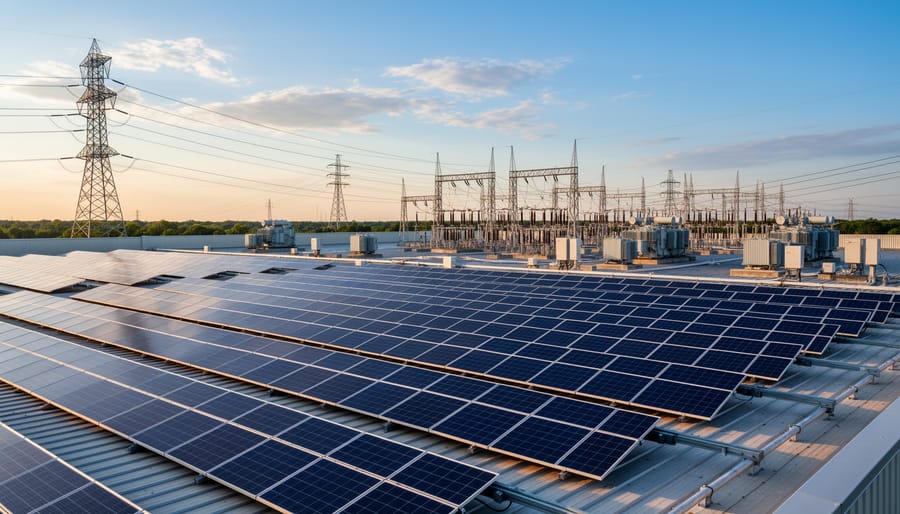
Successful grid integration requires commercial and industrial solar installations to meet stringent technical standards that ensure system reliability and safety. These requirements form the foundation of utility-developer partnerships and determine whether projects receive interconnection approval.
Voltage regulation stands as a primary concern, as solar systems must maintain output within acceptable ranges—typically ±5% of nominal voltage—to prevent equipment damage and power disruptions. Advanced inverters with smart grid capabilities automatically adjust reactive power output to stabilize voltage fluctuations, particularly important for larger installations that can significantly impact local distribution networks.
Frequency stability requirements mandate that solar systems operate within narrow parameters, usually 59.3-60.5 Hz in North America, and disconnect during grid disturbances to protect utility infrastructure. Modern installations employ sophisticated monitoring systems that respond to frequency deviations in milliseconds, ensuring seamless coordination with grid operators.
Power quality standards address harmonics, power factor, and flicker limits established by IEEE 1547 and similar international protocols. Commercial installations must demonstrate compliance through detailed engineering studies and field testing before receiving permission to operate. These standards prevent interference with sensitive equipment and maintain service quality for all grid users.
Interconnection protocols outline the technical specifications for metering, protection schemes, and communication systems that enable real-time data exchange between solar facilities and utility control centers. Projects typically undergo multiple review stages, from initial feasibility studies through witness testing, with utility engineers verifying that installations meet all safety and performance criteria. Understanding these requirements early in project planning helps developers anticipate costs, timeline considerations, and necessary equipment specifications that impact overall project economics.
Regulatory and Compliance Frameworks
Navigating the regulatory landscape for grid integration requires understanding three critical components that directly impact project timelines and costs. The permitting process varies significantly by jurisdiction, typically involving applications to local authorities, state energy commissions, and environmental agencies. Facility managers should anticipate 3-12 month permitting timelines depending on project scale and regional requirements.
Utility interconnection agreements represent the formal contract establishing technical and operational terms between solar producers and the distribution network. These agreements specify connection points, power quality standards, metering protocols, and cost allocation for necessary infrastructure upgrades. Leading utilities now offer standardized agreements for commercial installations under 5MW, significantly reducing negotiation complexity and legal expenses.
Regional grid operators, including Independent System Operators and Regional Transmission Organizations, maintain specific technical requirements for larger installations. Compliance mandates typically address voltage regulation, frequency response capabilities, and communication protocols for grid stability. Working with experienced developers familiar with your regional operator’s requirements proves essential for avoiding costly redesigns or delayed commissioning. Many successful commercial projects now incorporate early utility engagement strategies, establishing collaborative relationships during feasibility studies rather than after design completion. This proactive approach reduces interconnection costs by an average of 15-20 percent while accelerating approval timelines.
The Traditional Challenges: Why Grid Integration Has Been a Barrier
Infrastructure Limitations and Capacity Constraints
The United States electric grid faces significant modernization challenges that directly impact solar energy deployment. Much of the existing infrastructure was designed decades ago for one-way power flow from centralized generation facilities to end users, not for the distributed, bidirectional energy flows that solar installations create. According to the American Society of Civil Engineers, approximately 70 percent of transmission lines and power transformers are over 25 years old, creating reliability concerns and capacity limitations for new renewable energy connections.
These aging systems frequently lack the necessary capacity to accommodate large-scale solar projects, particularly in regions experiencing rapid growth in renewable energy adoption. Substations in high-demand areas may already be operating near maximum capacity, leaving little room for additional distributed generation. The situation is especially acute in rural and semi-rural locations where solar farms are often proposed, as these areas traditionally had minimal infrastructure investment due to lower historical electricity demand.
Capacity constraints manifest in several ways that affect project timelines and costs. Developers may face lengthy interconnection queues, sometimes waiting years for grid studies and necessary upgrades. In some cases, utilities require project developers to fund substantial infrastructure improvements, including transformer replacements or transmission line upgrades, which can add millions to project budgets. These bottlenecks have created an urgent need for collaborative solutions between utilities and developers, where shared investment in grid modernization benefits both parties while accelerating the transition to renewable energy sources.
The Cost and Timeline Uncertainty Problem
Interconnection costs represent one of the most significant financial wildcards in commercial solar development. While initial feasibility studies might estimate modest grid connection expenses, final bills can escalate dramatically—sometimes reaching hundreds of thousands or even millions of dollars—depending on required infrastructure upgrades, transformer capacity, and distance to suitable interconnection points. These unexpected costs can fundamentally alter project economics, transforming what appeared to be a compelling investment into a marginal proposition.
The timeline unpredictability compounds this financial uncertainty. What utility companies initially project as 6-12 month approval processes frequently extend to 18-36 months or longer, particularly for larger installations requiring detailed impact studies. Each month of delay represents deferred revenue, escalating soft costs, and potential changes in available incentives. For facility managers operating on capital budget cycles, these delays can force project cancellations even after substantial planning investments.
This uncertainty creates serious financing challenges. Lenders require clear cost projections and realistic timelines before committing capital. When interconnection variables remain unknown deep into the development process, securing favorable financing terms becomes difficult or impossible. Some projects face situations where final interconnection costs aren’t confirmed until immediately before construction, leaving developers scrambling to restructure deals or absorb unexpected expenses.
These factors collectively undermine investor confidence and slow renewable energy adoption across commercial sectors. Without predictable costs and timelines, calculating accurate return on investment becomes problematic, making solar projects harder to justify compared to conventional energy solutions with more transparent cost structures.
The Partnership Model: How Utilities and Developers Are Working Together
Proactive Planning and Capacity Mapping
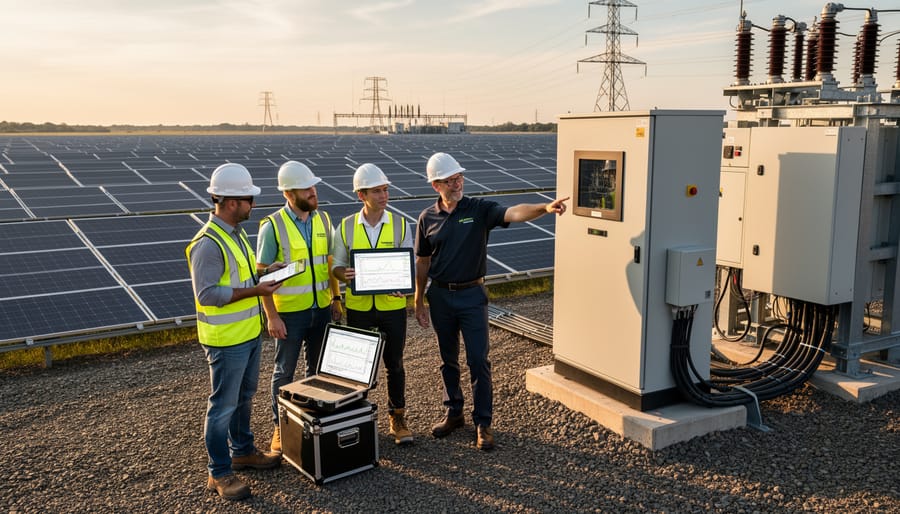
Forward-thinking utilities are transforming the interconnection process by publishing detailed grid capacity maps and hosting capacity analyses earlier in project development cycles. This transparency enables solar developers and commercial energy buyers to identify optimal locations before investing significant resources in feasibility studies and applications. Pacific Gas & Electric’s Integration Capacity Analysis portal, for example, provides real-time data on available capacity at specific substations and distribution circuits, reducing preliminary assessment timelines from months to days.
These mapping tools reveal not only where capacity exists but also anticipated future availability based on planned infrastructure upgrades. Commonwealth Edison in Illinois publishes quarterly updates showing transmission constraints and planned grid improvements through 2030, allowing developers to coordinate project timelines with utility enhancement schedules. This proactive approach has reduced interconnection queue withdrawals by approximately 30% in participating utility territories.
The strategic value extends beyond simply avoiding congested areas. Developers can now cluster projects in high-capacity zones, achieving economies of scale while utilities benefit from concentrated renewable integration that maximizes existing infrastructure investments. Government agencies and large commercial buyers leveraging this data report 15-20% reductions in total project development costs through more informed site selection.
Streamlined Interconnection Processes
Leading utility-developer partnerships have implemented several proven mechanisms to accelerate interconnection timelines. Fast-track approval systems categorize projects by size and complexity, enabling smaller installations under 500 kW to receive expedited review within 30-45 days rather than the traditional 6-12 month timeline. Hawaiian Electric, for example, reduced average approval times by 60% through their tiered fast-track program.
Standardized interconnection agreements eliminate redundant negotiations by establishing pre-negotiated terms for common project scenarios. California’s Rule 21 provides template agreements that developers can implement immediately upon approval, removing weeks of back-and-forth correspondence. These standardized frameworks reduce legal costs by approximately 40% while ensuring consistent safety and technical requirements.
Pre-approved equipment lists represent another significant advancement. Utilities maintain databases of inverters, transformers, and protective devices that meet their technical specifications. When developers select from these certified lists, equipment reviews proceed automatically, eliminating 3-6 week evaluation periods. New York’s Standardized Interconnection Requirements include an extensive pre-approved equipment registry that has shortened review cycles for over 2,000 commercial installations. These streamlined processes translate directly to faster project completion, improved return on investment, and reduced soft costs for commercial solar installations.
Shared Investment in Grid Upgrades
Co-investment frameworks represent a pragmatic solution to grid connection obstacles, aligning utility and developer interests through shared financial responsibility. Under these arrangements, solar developers contribute capital toward transformer upgrades, line extensions, or substation enhancements that benefit both the specific project and broader grid reliability. The utility assumes operational control of these assets while the developer gains expedited connection and potentially reduced ongoing interconnection fees.
These successful partnership models typically allocate costs based on proportional benefit analysis. A developer might fund 60-70% of a substation upgrade if their project drives primary capacity needs, while the utility covers remaining costs that support system-wide improvements. This approach accelerates infrastructure deployment that might otherwise face lengthy regulatory approval or budget allocation delays.
Several Australian jurisdictions have implemented standardized co-investment frameworks, establishing transparent formulas for cost-sharing and asset ownership. For commercial solar investors, these arrangements transform grid constraints from project barriers into manageable capital considerations with predictable timelines. Financial modeling becomes more straightforward when infrastructure costs are defined upfront rather than discovered during lengthy interconnection studies.
Real-World Applications: Partnership Success Stories
Case Study: Commercial Industrial Park Solar Integration
A 2.8 MW solar installation at the Riverside Commerce Center in Southern California demonstrates how proactive utility coordination can accelerate project timelines and optimize system performance. The developer engaged the local utility provider during the preliminary planning phase, eighteen months before construction commenced.
This early collaboration revealed critical capacity constraints at the nearest substation, which would have delayed interconnection by up to two years under a traditional approach. Instead, the utility shared detailed grid mapping data and load forecasting models, enabling the developer to modify the system design to align with planned infrastructure upgrades.
The partnership yielded measurable benefits across multiple dimensions. The interconnection timeline compressed from an estimated 26 months to just 14 months, reducing carrying costs by approximately $340,000. The utility approved a streamlined application process after reviewing the collaborative design, eliminating three rounds of technical revisions that typically extend approval cycles.
System optimization through shared data access resulted in a 12 percent improvement in export capacity compared to the original design. The developer strategically phased installation to match the utility’s substation upgrade schedule, ensuring each array segment achieved full functionality upon completion.
The Riverside project established a replicable framework now used by the utility for commercial solar applications exceeding 1 MW. Both parties formalized quarterly coordination meetings for future projects, creating a structured pathway that benefits subsequent developers while maintaining grid reliability standards. This case demonstrates that treating utilities as strategic partners rather than regulatory obstacles produces superior economic and operational outcomes for commercial solar investments.
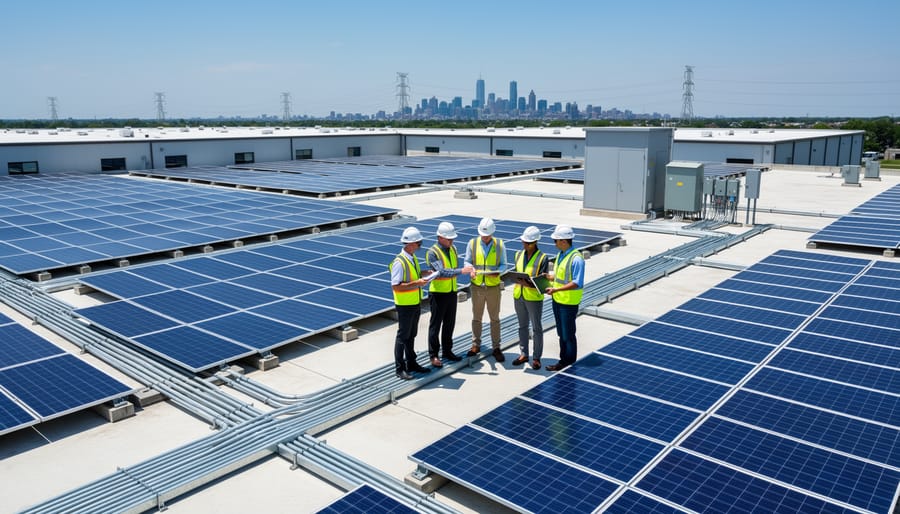
Case Study: Municipal Government Solar Program
A mid-sized regional council in New South Wales successfully deployed 2.8 MW of solar capacity across 14 municipal facilities through a strategically coordinated partnership with their local distribution network operator. The initiative demonstrates how effective utility collaboration can streamline complex municipal solar programs while maintaining grid stability.
The council faced a common challenge: each facility required individual grid connection assessments, threatening project timelines and budget certainty. Rather than pursuing installations independently, the council engaged their utility partner early in the planning phase to develop a coordinated integration strategy.
The utility conducted a comprehensive network capacity study, identifying optimal installation sequences that would minimize infrastructure upgrades. This proactive approach reduced connection costs by 23 percent compared to initial projections. The utility also provided technical specifications for inverter settings and power quality requirements, ensuring all systems met network standards before installation commenced.
Key to the project’s success was establishing a single point of contact within the utility for all 14 sites. This eliminated communication bottlenecks and enabled rapid resolution of technical queries. The utility scheduled connection assessments in clusters, reducing inspection timelines from an estimated eight months to just four.
The coordinated approach delivered measurable benefits: the council achieved energization of all facilities within budget and on schedule, while the utility gained valuable data on distributed generation impacts across multiple connection points. Annual energy savings now exceed 410,000 dollars, with predictable grid performance and no network stability issues reported since commissioning.
Advanced Technologies Enabling Better Integration
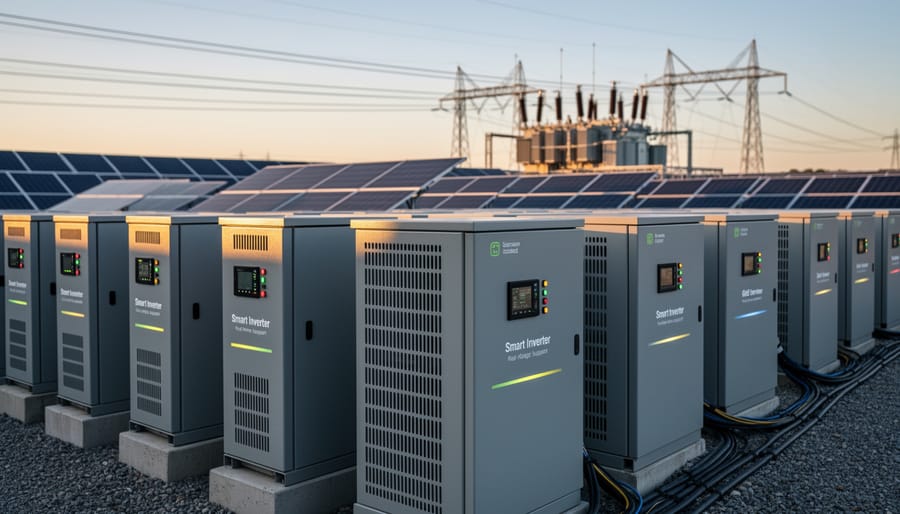
Smart Inverters and Grid Services
Modern inverters have evolved far beyond simple DC-to-AC conversion devices, now serving as intelligent grid assets that provide essential services utilities increasingly value. These smart inverters actively support grid stability through advanced capabilities that were previously available only from traditional power plants.
Voltage support represents a primary function, with smart inverters automatically adjusting reactive power output to maintain optimal voltage levels within their local distribution network. This capability reduces the need for costly voltage regulation equipment and helps utilities manage power quality across diverse load conditions. During periods of high solar generation, inverters can absorb reactive power to prevent voltage rise, while supplying it during low-generation periods to maintain stability.
Frequency regulation services allow inverters to respond rapidly to grid frequency fluctuations, either curtailing output or injecting stored energy within milliseconds. This fast response time exceeds what conventional generators can achieve, making solar installations equipped with battery storage particularly valuable for grid balancing.
Modern inverters also provide fault ride-through capabilities, remaining connected and supporting the grid during disturbances rather than disconnecting and compounding problems. Many utilities now require these grid-forming capabilities in interconnection agreements, recognizing their contribution to overall system resilience. For facility managers and business owners, these enhanced capabilities can translate into favorable interconnection terms, reduced upgrade costs, and potential revenue streams through grid service agreements with utilities.
Energy Storage as a Grid Integration Tool
Energy storage systems have emerged as essential components in utility-scale solar integration, addressing the inherent variability of solar generation while delivering measurable grid benefits. Battery energy storage systems paired with solar installations enable utilities and developers to transform intermittent solar output into dispatchable, reliable power that aligns with grid demand patterns.
Modern lithium-ion battery systems excel at smoothing solar output fluctuations caused by cloud cover or atmospheric conditions, maintaining consistent power delivery to the grid. This smoothing capability reduces voltage fluctuations and frequency deviations that can compromise grid stability, particularly in networks with high renewable penetration. Facility managers and grid operators report significant improvements in power quality metrics when storage is integrated with solar generation.
Peak shaving represents another critical application, where stored solar energy is discharged during high-demand periods, reducing strain on transmission infrastructure and lowering capacity costs. Commercial-scale projects demonstrate demand charge reductions of 20-40% through strategic storage deployment, delivering substantial cost savings while enhancing grid reliability.
Storage integration also provides valuable ancillary services including frequency regulation, voltage support, and reactive power control. These capabilities allow utilities to maintain grid parameters within acceptable ranges while accommodating variable renewable generation. Forward-thinking partnerships between utilities and developers increasingly incorporate storage requirements into interconnection agreements, recognizing that combined solar-plus-storage solutions offer superior grid compatibility compared to generation-only installations. This collaborative approach accelerates project approvals while ensuring long-term system reliability.
What This Means for Your Organization
Evaluating Your Utility’s Integration Approach
Understanding your utility’s stance on grid integration before finalizing solar investment decisions can save significant time and capital. Progressive utilities demonstrate specific characteristics that signal a collaborative approach to commercial solar projects.
Key indicators include published interconnection timelines with clearly defined milestones, transparent fee structures available on their website, and dedicated commercial renewable energy liaison staff. Utilities with progressive integration policies typically offer pre-application consultations, provide detailed technical requirements documentation, and maintain online portals for application tracking. The presence of streamlined processes for projects under specific capacity thresholds, such as expedited review for installations below 1 MW, indicates an experienced utility partner.
Leading utilities also participate in industry working groups, publish annual interconnection reports, and showcase completed commercial projects as case studies. For example, Pacific Gas & Electric’s Fast Track program processes qualifying applications in under 30 business days, demonstrating institutional commitment to efficient integration.
Engage your utility early by scheduling a preliminary meeting 6-12 months before planned installation. Prepare facility load profiles, proposed system specifications, and site electrical diagrams. Request copies of their interconnection standards, recent queue times, and any upcoming grid modernization plans that might affect your timeline.
Ask specific questions about their experience with similar commercial installations in your area, available incentive programs, and whether they offer technical assistance during the design phase. Utilities with mature integration programs often provide valuable input on optimal system sizing and placement that can improve both project economics and approval timelines. This proactive engagement establishes the foundation for a successful utility-developer partnership.
Choosing a Developer with Strong Utility Relationships
Selecting a solar developer with established utility relationships can significantly streamline your grid integration process and mitigate project risks. Companies that have cultivated strong working relationships with utility providers benefit from institutional knowledge of specific interconnection requirements, expedited review processes, and direct communication channels that can resolve technical issues quickly.
Developers with proven utility partnerships understand the nuances of each utility’s engineering standards, documentation requirements, and approval workflows. This expertise translates directly into fewer application rejections, reduced revision cycles, and shorter timelines from contract signing to energization. For commercial projects where delays can impact financial models and energy savings projections, these advantages are substantial.
Furthermore, experienced developers often have pre-approved equipment lists and standard design templates that utilities recognize and trust, eliminating lengthy technical reviews. Their track record provides utilities confidence in system safety and grid compatibility, reducing scrutiny that might otherwise slow approvals. These solar energy partnerships also position your project favorably during capacity allocation decisions when multiple applications compete for limited grid availability.
When evaluating potential solar partners, request specific examples of completed projects with your local utility, average interconnection timelines they’ve achieved, and references from similar commercial installations. A developer’s relationship strength with your utility provider should be considered a critical selection criterion, as it directly influences project success probability, schedule certainty, and ultimately your return on investment.
Utility-developer partnerships are fundamentally reshaping the commercial solar landscape by dismantling traditional grid integration barriers that have historically delayed or prevented projects from reaching completion. These collaborative frameworks deliver measurable benefits across all stakeholder groups: utilities gain visibility and control over distributed generation resources, developers secure streamlined interconnection processes and reduced project timelines, and end customers access clean energy solutions with greater reliability and cost predictability. The evolution from adversarial relationships to strategic partnerships represents more than procedural improvement—it signals a structural shift toward truly integrated clean energy infrastructure.
The momentum behind these collaborative models continues to accelerate as regulatory frameworks mature and technical standards become more sophisticated. Organizations evaluating commercial solar investments now have access to partnership structures that address grid capacity constraints, voltage regulation requirements, and interconnection complexities through proactive coordination rather than reactive problem-solving. This transformation reduces financial risk, shortens development cycles, and improves project outcomes.
For decision-makers considering solar deployment, the path forward is clear: engage with experienced solar partners who understand grid integration complexities and maintain established utility relationships. These partnerships provide the technical expertise, regulatory knowledge, and collaborative framework necessary to navigate interconnection challenges efficiently while maximizing the operational and financial performance of your solar investment. The transition to integrated clean energy infrastructure is underway—strategic partnerships ensure your organization participates effectively in this transformation.