
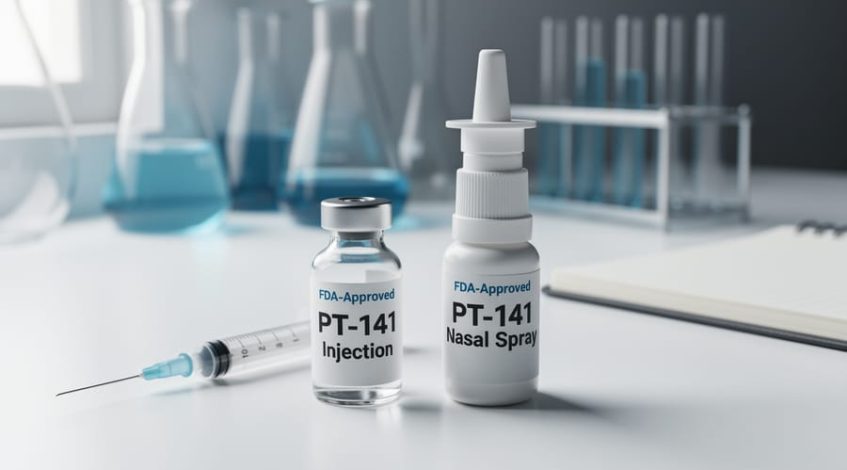
For research purposes, the injectable format is the clear choice: it’s the only PT-141 (bremelanotide) format with FDA approval and a defined dose. The approved product is a prescription solution given subcutaneously, 1.75 mg in the abdomen or thigh at least 45 minutes before sexual activity, indicated for hypoactive sexual desire disorder (HSDD) in premenopausal women. There is no FDA-approved nasal version, and any PT 141 nasal spray format sits outside the approved framework.
That gap matters. Its absorption, dosing, safety, and effectiveness can’t be assumed to match the injection. Published intranasal work exists, including a study that gave bremelanotide spray 10 minutes after participants consumed a placebo drink or 0.6 g/kg ethanol, but that evidence doesn’t make the two routes interchangeable.
This comparison is built for researchers, program leads, and evaluators who need to document what is verified and what isn’t before choosing a format. Think of it like specifying equipment: you want the rated, tested option as your baseline, and any alternative judged against it on documented evidence rather than assumption. The sections below set the formats side by side on route, regulatory status, dosing, absorption, safety, and effectiveness, then spell out who should choose which.
Nasal vs. Injectable PT-141 at a Glance
The core difference is simple: one format is an approved, prescription product with a labeled dose, and the other is not. The table below sets the two side by side, and where the evidence does not establish a point, it says so rather than filling the gap.
| Dimension | Injectable bremelanotide | PT-141 nasal spray |
|---|---|---|
| Route | Subcutaneous injection in the abdomen or thigh | Intranasal spray |
| Regulatory status | FDA-approved; prescription only | No FDA-approved product exists |
| Documented dosing | 1.75 mg at least 45 minutes before sexual activity | No established, approved dose |
| Absorption and equivalence | Defined by the approved product | Equivalence to the injection not established |
| Safety and effectiveness evidence | Supports use for HSDD in premenopausal women | Controlled intranasal pharmacokinetic and safety work exists; equivalence of safety and effectiveness not established |
A few points deserve emphasis. The approved injectable is a solution prescribed to treat hypoactive sexual desire disorder (HSDD) in premenopausal women, and its dosing is fixed by the label. Intranasal bremelanotide, by contrast, has appeared in controlled research, such as a study in which a spray or placebo was given 10 minutes after a placebo drink or 0.6 g/kg ethanol. That kind of work is distinct from the compounded or online sprays sold outside a clinical framework.
The practical consequence is that a compounded or online nasal spray should not be assumed equivalent to the approved injection in absorption, dosing, safety, or effectiveness. Treat any claim of equivalence as unverified until supported by data.
What Each PT-141 Format Is
The Injectable Format: Prescription Bremelanotide
The approved injectable is a prescription-only solution, and bremelanotide injection is used to treat hypoactive sexual desire disorder (HSDD) in premenopausal women. That regulated status gives researchers a fixed reference point: a defined product, a defined indication, and a defined dose. The labeled 1.75 mg subcutaneous dose is injected into the abdomen or thigh at least 45 minutes before sexual activity.
Terminology often trips people up, so it helps to pin down the terms before comparing formats:
- PT-141
- The research name commonly used for the peptide that became bremelanotide.
- Bremelanotide
- The generic name for the compound in the approved injectable product.
- Vyleesi
- The brand name under which bremelanotide is marketed as an injection.
- Injectable bremelanotide
- The prescription solution given subcutaneously, with the labeled 1.75 mg dose and 45-minute timing.
- PT-141 nasal spray
- Compounded or online preparations that have no FDA approval and should not be treated as equivalent to the injection.
For anyone designing a study, the practical value is consistency. A standardized, regulated product with a labeled dose and timing removes much of the guesswork that variable preparations introduce, much like specifying a certified component in a commercial project.
The Nasal Format: Intranasal Research and Unapproved Sprays
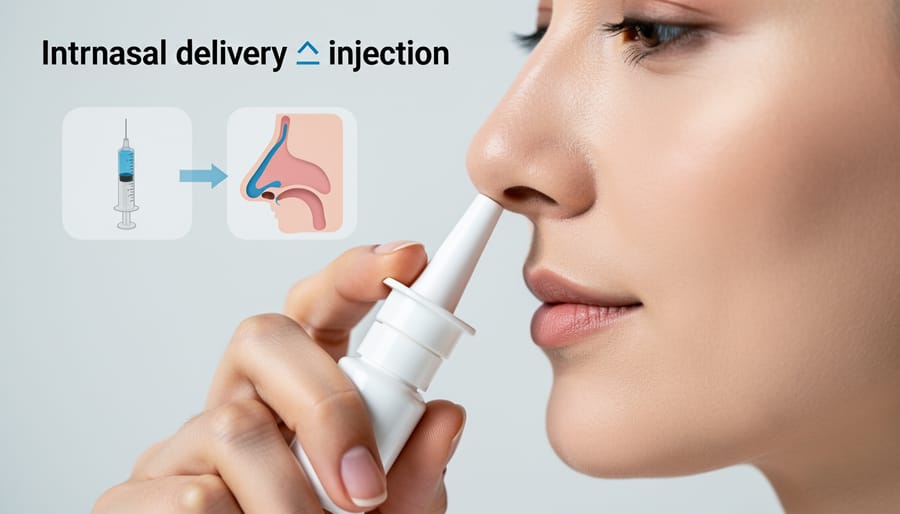
There is no FDA-approved PT-141 nasal spray. That single fact shapes everything else about how the intranasal format should be evaluated.
Intranasal bremelanotide has appeared in controlled research settings, though. In one pharmacokinetics and safety study, participants received an intranasal bremelanotide or placebo spray 10 minutes after placebo drink or 0.6 g/kg ethanol. That design tells you what this work is: a structured protocol with defined conditions, oversight, and a placebo comparison, built to answer specific questions about how the compound behaves and how safe it is.
The compounded and online nasal sprays marketed under the PT-141 name sit in a different category. They are not the same thing as that research, and they carry none of its controls. Such products should not be assumed equivalent to the approved injection in absorption, dosing, safety, or effectiveness.
For anyone weighing formats, the distinction is practical. Controlled intranasal research can inform study design. An unverified spray cannot serve as a reliable reference point, and it cannot be treated as a stand-in for either the research formulation or the approved product.
Nasal vs. Injectable PT-141, Dimension by Dimension
Route of Administration and Regulatory Status
The two formats sit in very different regulatory positions, and that difference shapes everything that follows. Bremelanotide given by subcutaneous injection is an approved, prescription-only product. It is supplied as a solution and is used to treat hypoactive sexual desire disorder (HSDD) in premenopausal women. Because it is a regulated product, it can be traced to a defined source, documented against its labeling, and cited as a reference point in a study.
Intranasal delivery has no such footing. There is no FDA-approved PT-141 nasal spray. Intranasal bremelanotide has appeared in controlled research settings, where a spray or placebo was given 10 minutes after a placebo drink or 0.6 g/kg ethanol. That work is distinct from a compounded or online spray, which carries none of the same oversight.
For study design, the practical consequence is straightforward. An approved injectable gives you a documented, citable baseline. A nasal preparation requires additional justification, careful sourcing, and clear records of what was used and why.
Dosing and Absorption
The approved injectable gives researchers a fixed reference point. The labeled dose of bremelanotide is 1.75 mg, injected subcutaneously in the abdomen or thigh at least 45 minutes before sexual activity. That specificity matters in study design: dose, route, injection site, and timing are all defined, which makes protocols easier to standardize and results easier to compare.
The nasal side has no such anchor. Because there is no FDA-approved PT-141 nasal spray, there is also no established, approved nasal dose to cite. What exists is controlled research work, such as intranasal bremelanotide or placebo spray given 10 minutes after a placebo drink or 0.6 g/kg ethanol. That is a specific experimental protocol, not a dosing standard, and it shouldn’t be read as one.
The practical implication is straightforward. A compounded or online PT-141 nasal spray should not be assumed equivalent in absorption, dosing, safety, or effectiveness to the approved injection. Matching a milligram figure on a label doesn’t establish matching absorption, since the delivery route changes how a compound reaches the body. Any protocol that substitutes one format for the other without evidence of equivalence introduces a variable that undermines the comparison it was meant to support.
Safety and Effectiveness Evidence
The evidence base is uneven, and that unevenness is the real finding. The injectable format, prescribed for hypoactive sexual desire disorder (HSDD) in premenopausal women, rests on a defined 1.75 mg subcutaneous dose and an approved regulatory pathway. The nasal format has no equivalent foundation, because no FDA-approved PT-141 nasal spray exists.
What intranasal evidence does exist comes from controlled settings. In one pharmacokinetics and safety study, participants received either an intranasal bremelanotide spray or a placebo spray 10 minutes after a placebo drink or 0.6 g/kg ethanol. That design tells researchers something useful about how the compound behaves alongside alcohol, but it is narrow in scope. It does not establish an approved dose, and it does not demonstrate that a nasal spray performs like the injection.
This is why equivalence cannot be assumed. A compounded or online nasal spray should not be treated as interchangeable with the approved injection in absorption, dosing, safety, or effectiveness. Evaluators who apply rigorous safety risk management to a capital project would recognize the principle: unverified assumptions are where risk accumulates, so evidence should be matched to each format individually.
Quality, Consistency, and Documentation in Research Settings
Reproducibility starts with knowing exactly what was given. A regulated product has a defined formulation and a labeled dose, so another team can repeat the work. Variable preparations, including compounded or online sprays, offer no such guarantee, and they should not be assumed equivalent in absorption, dosing, safety, or effectiveness to the approved injection.
Facility managers know this logic well. When specifying certified, accredited components for a commercial solar project, they avoid common selection mistakes by demanding traceable documentation. Research deserves the same discipline, and research protocol rigor is what makes a study credible.
Consider a hypothetical, clearly labeled illustration: a team picks a format for convenience, then cannot document where the material came from. Reviewers would reasonably question every result. Before settling on a format, confirm:
- The source is identifiable and the sourcing is documented.
- The formulation is known, such as the approved solution form.
- The dose is verified against a labeled reference, like 1.75 mg subcutaneously.
- The timing protocol is written down, for example 45 minutes before activity.
- Safety monitoring is planned and recorded.
Which PT-141 Format Fits Which Research Need?
Format selection works best when you match the tool to the use case, the same way you’d choose by performance criteria instead of by price or convenience. The verified facts point to three distinct situations.
- Researchers who need a regulated, well-defined dosing reference: choose the injectable, since the labeled dose is 1.75 mg subcutaneously, at least 45 minutes before sexual activity, but it is prescription-only.
- Teams exploring intranasal delivery: use the nasal route only within controlled, properly overseen protocols, and recognize that no FDA-approved PT-141 nasal spray exists.
- Readers weighing compounded or online sprays: do not assume equivalence in absorption, dosing, safety, or effectiveness to the approved injection.
The first group gets the clearest baseline. A prescription product with a labeled dose and a stated indication, hypoactive sexual desire disorder in premenopausal women, gives you something concrete to document and cite.
The second group is doing legitimate work, but the context matters. Intranasal bremelanotide has appeared in controlled pharmacokinetic and safety research, and that setting is very different from an unverified spray bought online.
If you fall into the third group, the safest move is to stop and reassess. A spray that looks similar is not a substitute for the studied product. Match the format to your need, rely on what’s verified, and avoid promising more than the evidence supports.
Key Takeaways on PT-141 Format Selection
Format selection comes down to a handful of verified points. Injectable bremelanotide is prescription-only and carries a defined 1.75 mg subcutaneous dose given at least 45 minutes before sexual activity. No FDA-approved PT-141 nasal spray exists, and intranasal bremelanotide has appeared only in controlled research settings.
Treat equivalence as something a rigorous protocol must demonstrate, not something to presume.
Frequently Asked Questions About Nasal and Injectable PT-141
People often ask a handful of practical questions when comparing these two PT-141 formats. The answers below stick to what is verified.
Is there an FDA-approved PT-141 nasal spray?
No. There is no FDA-approved PT-141 nasal spray. Intranasal bremelanotide has appeared only in controlled research settings, such as a pharmacokinetics and safety study.
What is the approved injectable dose and timing?
The recommended dose is 1.75 mg injected subcutaneously in the abdomen or thigh at least 45 minutes before sexual activity.
Are nasal and injectable PT-141 equivalent?
They should not be assumed equivalent. A compounded or online nasal spray cannot be presumed to match the approved injection in absorption, dosing, safety, or effectiveness.
What does the approved injectable treat, and does it need a prescription?
Bremelanotide injection is used to treat hypoactive sexual desire disorder (HSDD) in premenopausal women. It is available only with a doctor’s prescription.
The pattern across these answers is consistent: the injectable has a defined indication, dose, and prescribing pathway, while the nasal format does not. When evaluating a format for a study or protocol, treat that gap in documentation as a real constraint rather than a detail to be worked around.
Format choice should follow the evidence, not the path of least resistance. Right now, that evidence points one way: the injectable is the only prescription-only, approved format with a defined 1.75 mg subcutaneous dose, while no FDA-approved PT-141 nasal spray exists. Intranasal bremelanotide has been studied in controlled settings, but compounded or online sprays can’t be assumed equivalent in absorption, dosing, safety, or effectiveness.
Treat this decision like any significant investment. Verify regulatory status, insist on defined dosing, and weigh the quality of the data before committing. Convenience is a poor substitute for rigor.