

Scrutinize force majeure clauses and termination rights before signing any commercial solar installation contract, as these provisions determine your exit strategy if the contractor fails to meet performance benchmarks or regulatory requirements change mid-project. Verify that your agreement explicitly defines system ownership, specifies equipment warranties separate from installation guarantees, and establishes clear remediation procedures for code violations—ambiguity in these areas creates significant financial exposure during inspections and interconnection approvals.
Demand performance guarantees tied to measurable output metrics rather than estimated production figures, with liquidated damages provisions that compensate you if the system underperforms. Your contract must address prevailing wage requirements, Davis-Bacon Act compliance for federally funded projects, and local permitting responsibilities to prevent costly delays. Include detailed schedules for milestone payments that release funds only after third-party verification of completed work phases, protecting your capital if the contractor encounters financial difficulties.
Negotiate indemnification clauses that transfer liability for design defects, property damage, and regulatory non-compliance to the installer, ensuring your business remains insulated from third-party claims. The most effective contracts incorporate mandatory arbitration provisions and specify jurisdiction for dispute resolution, significantly reducing legal costs compared to litigation. When you transition to solar energy, these contractual safeguards prove essential for maintaining operational continuity and protecting your investment against contractor default, equipment failure, and evolving regulatory standards that could otherwise compromise project viability and financial returns.
Understanding the Regulatory Landscape for Commercial Solar
Federal Compliance Requirements
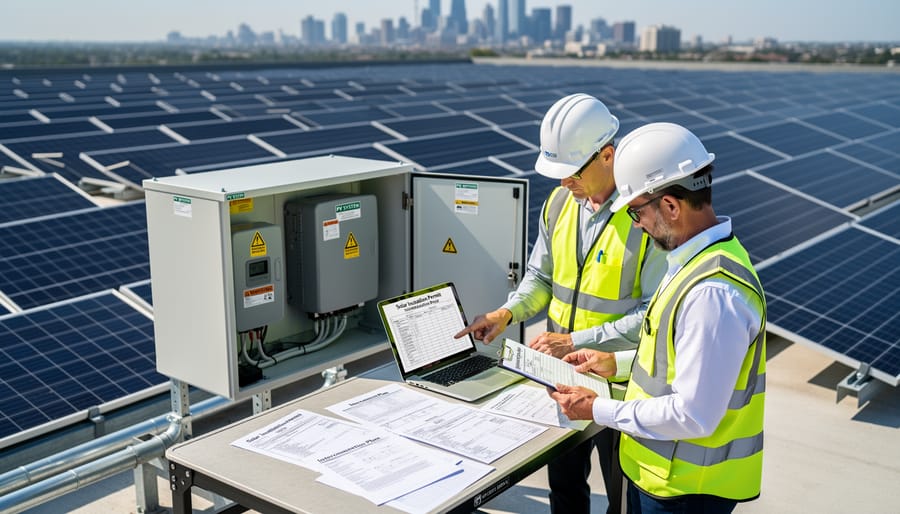
Commercial solar installation contracts must address several critical federal compliance requirements to ensure both legal conformity and financial benefits. The Investment Tax Credit (ITC) represents a primary federal incentive, currently allowing businesses to deduct a percentage of solar installation costs from federal taxes. Your contract should explicitly state the contractor’s responsibility for providing IRS Form 5695 documentation and certifying that all equipment meets eligibility requirements for these credits.
National Electrical Code (NEC) compliance is non-negotiable, as installations must meet Article 690 standards for photovoltaic systems. Contracts should specify that the contractor assumes responsibility for obtaining necessary permits and ensuring adherence to NEC guidelines, including proper grounding, disconnects, and system labeling. The Federal Energy Regulatory Commission (FERC) regulations may also apply if your system connects to the grid or exceeds certain capacity thresholds.
Additionally, contracts should address Modified Accelerated Cost Recovery System (MACRS) depreciation benefits, which allow businesses to recover investments through accelerated depreciation schedules. Include provisions requiring contractors to provide documentation supporting the depreciable basis of your solar assets. Environmental compliance with federal laws, including proper disposal and recycling protocols for solar components, should also be contractually mandated to mitigate future liability exposure.
State and Local Permitting Obligations
Commercial solar installation contracts must explicitly address state renewable energy standards, local building codes, and utility interconnection requirements to protect all parties from regulatory delays and compliance failures. State-level renewable portfolio standards (RPS) and solar renewable energy certificate (SREC) programs directly impact project economics and timelines, making it essential that contracts specify which party holds responsibility for regulatory filings and maintaining compliance throughout the system’s operational life.
Local building codes, zoning ordinances, and fire safety regulations vary significantly by jurisdiction and can affect system design, installation methods, and project costs. Your contract should clearly delineate the installer’s obligation to obtain all necessary permits, including structural, electrical, and land-use approvals, while establishing timelines for permit acquisition and remedies if delays occur. Many facility managers have encountered costly project extensions when installers underestimated local permitting complexity.
Utility interconnection agreements represent another critical contract element, as grid connection requirements differ across service territories. The contract must specify responsibility for interconnection application fees, technical studies, equipment upgrades, and compliance with utility-specific safety standards. Experienced installers typically assume these obligations, but contracts should include clear provisions addressing cost overruns if utility requirements exceed initial estimates. Understanding these regulatory layers ensures your organization avoids unexpected liabilities while maintaining project momentum toward operational commissioning.
Industry Standards and Certifications
Your commercial solar installation contract should explicitly reference compliance with established industry standards to ensure quality and safety. Key certifications include International Electrotechnical Commission (IEC) standards, which govern photovoltaic system performance and safety requirements globally. Equally important are Underwriter Laboratories (UL) certifications, particularly UL 1703 for solar panels and UL 1741 for inverters, which verify equipment meets rigorous safety and reliability benchmarks.
Contracts should specify that all installed equipment carries appropriate certifications and that installers maintain professional accreditations such as North American Board of Certified Energy Practitioners (NABCEP) certification. This credential demonstrates technical competency and adherence to best practices throughout the installation process.
Additionally, verify that your contractor’s work complies with IEEE 1547 interconnection standards and National Electrical Code (NEC) Article 690 requirements. These standards protect your investment by ensuring the system integrates safely with existing electrical infrastructure and grid connections.
Request documentation proving compliance at project milestones, including equipment certification sheets and installer credentials. A case study from a California manufacturing facility showed that explicit contractual requirements for NABCEP-certified installers reduced post-installation issues by 40 percent and accelerated utility interconnection approval. Including these specifications protects your organization from substandard installations and positions you for optimal system performance and longevity.
Essential Compliance Clauses in Solar Installation Contracts
Permitting and Approval Responsibilities
A well-drafted commercial solar installation contract must clearly delineate permitting and approval responsibilities to prevent project delays and cost overruns. Typically, the solar contractor assumes responsibility for obtaining all necessary permits, including building, electrical, and zoning approvals, while maintaining compliance with local, state, and federal regulations. The contract should specify exact timelines for permit submissions and expected approval windows, with accountability measures if the contractor fails to secure permits within the agreed timeframe.
Key provisions should address who bears the cost of permit fees, inspection charges, and any required upgrades to electrical infrastructure for utility interconnection approval. Most contracts stipulate that the contractor coordinates all inspections with the Authority Having Jurisdiction (AHJ) and utility companies, ensuring the system meets National Electrical Code standards and passes final commissioning tests.
Business owners should verify that contracts include provisions for handling permit denials or required modifications, including cost allocation and timeline adjustments. The agreement should also outline documentation delivery requirements, ensuring you receive copies of all approved permits, inspection reports, and interconnection agreements. In a recent case, a manufacturing facility avoided a three-month delay by negotiating expedited permit processing timelines into their contract, demonstrating how proactive planning protects project schedules and budgets.
Interconnection Agreement Management
Interconnection agreement management represents a critical component of your commercial solar contract, governing how your system connects to the utility grid. Your contract should clearly delineate responsibilities for navigating the utility’s interconnection application process, including submission of technical specifications, engineering studies, and compliance documentation. Ensure the installer assumes liability for delays caused by incomplete or inaccurate submissions, as interconnection timelines can significantly impact project completion and your return on investment.
The contract must specify which party handles interconnection costs, which vary considerably by utility provider and system size. These expenses may include application fees, system impact studies, and grid infrastructure upgrades. Comprehensive contracts include provisions requiring the installer to provide realistic timeline estimates based on your utility’s historical approval periods and to maintain regular communication throughout the process.
Protection clauses should address scenarios where the utility denies or delays interconnection approval. Your agreement should require the installer to promptly resolve any technical deficiencies identified by the utility and specify remedies if interconnection cannot be achieved. Additionally, verify that the contract guarantees system design compliance with IEEE 1547 standards and local utility requirements. A manufacturing facility in Ohio recently avoided a six-month delay by ensuring their contract mandated pre-application utility consultations, demonstrating the value of proactive interconnection planning in commercial solar agreements.
Safety and Code Compliance Guarantees
Your commercial solar installation contract must explicitly guarantee compliance with the National Electrical Code (NEC), local building codes, and fire safety standards established by the National Fire Protection Association (NFPA). The contract should specify that all electrical work will be performed by licensed electricians and meet Article 690 requirements for photovoltaic systems. Additionally, the installer must provide documentation that structural calculations have been reviewed by a certified professional engineer to verify that your building can support the additional weight and wind loads.
Workplace safety provisions are equally critical. The contract should require adherence to OSHA regulations, including fall protection protocols and electrical safety standards for construction workers. Contractors must carry adequate workers’ compensation insurance and maintain safety certifications throughout the installation period.
Request written confirmation that all equipment bears appropriate UL certifications and that the system design has passed local Authority Having Jurisdiction (AHJ) review. The installer should guarantee obtaining all necessary permits and scheduling required inspections. Consider including a provision requiring the contractor to remedy any code violations discovered during final inspection at no additional cost, protecting your organization from unexpected expenses and ensuring your system operates safely and legally from day one.
Environmental and Zoning Compliance
Your commercial solar installation contract should explicitly address environmental and zoning compliance requirements to protect your business from regulatory delays and potential penalties. The contract must specify which party holds responsibility for obtaining necessary environmental impact assessments, particularly for installations exceeding certain capacity thresholds or located in environmentally sensitive areas. Include clear provisions regarding municipal setback requirements, which dictate minimum distances from property lines, roads, and structures. These specifications vary significantly by jurisdiction and can impact system design and placement.
The agreement should require the installer to verify compliance with local land-use regulations, including conditional use permits and special exceptions that may apply to commercial solar arrays. Ensure the contract includes warranties that the installation meets current zoning ordinances and building codes, with provisions for addressing any compliance issues discovered during or after installation. For example, a warehouse facility in Oregon successfully negotiated contract terms requiring the installer to manage all environmental reviews and local permits, preventing project delays when unexpected wetland buffer requirements emerged. Request documentation confirming that the proposed system design complies with height restrictions, ground coverage limits, and aesthetic guidelines established by local planning authorities before signing any agreement.
Warranty and Performance Guarantees That Protect Compliance
Equipment Warranties and Regulatory Standards
Equipment warranties represent a critical risk mitigation component in commercial solar installation contracts, directly impacting long-term system performance and return on investment. Standard manufacturer warranties for solar panels typically guarantee 85-90% efficiency at 25 years, while inverter warranties generally span 10-25 years depending on the manufacturer and model. Your contract should explicitly specify warranty coverage for all major components, including panels, inverters, racking systems, and monitoring equipment.
Beyond manufacturer warranties, installation workmanship guarantees typically range from 5-10 years and should be clearly delineated from equipment coverage. Verify that all equipment meets applicable regulatory standards, including UL certification for electrical safety and compliance with local building codes. The contract must detail warranty transfer procedures if ownership changes and clarify responsibility for labor costs associated with warranty claims.
For government and large commercial installations, consider requiring equipment certifications that exceed minimum regulatory requirements, such as IEC 61215 for panel quality or IEEE 1547 for grid interconnection. A 2022 case study involving a municipal facility in Colorado demonstrated the value of comprehensive warranty coverage when early inverter failures resulted in full replacement at no cost to the owner, preserving projected energy savings. Ensure your contract includes provisions for warranty enforcement, including designated response times and remediation procedures.
Installation Workmanship Warranties
Installation workmanship warranties serve as your primary protection against defective installation practices and ensure compliance with local electrical codes, building regulations, and Australian Standards. These warranties typically span five to ten years and explicitly guarantee that all work meets AS/NZS 5033 standards for photovoltaic array installation.
Your contract should specify that the installer assumes full liability for any code violations discovered during inspection or operation. This includes responsibility for remediation costs, permit resubmission fees, and any penalties imposed by regulatory authorities. The warranty must cover both material defects and improper installation techniques that compromise system performance or safety.
Key elements include coverage for electrical connection faults, structural mounting issues, roof penetration waterproofing, and proper grounding procedures. The installer should guarantee that all work passes Clean Energy Council inspections and complies with local network operator requirements for grid connection.
Documentation requirements are essential for protecting your solar investment. Request that your contract mandate photographic evidence of installations, as-built drawings, and certification of electrical testing results. This documentation proves compliance if disputes arise and supports warranty claims.
Consider requiring professional indemnity insurance coverage that extends beyond the warranty period, protecting against latent defects that emerge years after installation. Verify the installer maintains adequate coverage limits proportional to your project value.
Financial Incentive Compliance and Documentation
Investment Tax Credit (ITC) Requirements
Your commercial solar installation contract must explicitly address Investment Tax Credit (ITC) requirements to maximize federal incentives. The ITC currently provides significant tax benefits, but eligibility depends on strict IRS compliance. Your contract should clearly state the installer’s responsibility for providing all necessary documentation, including IRS Form 5695 completion assistance and certified cost basis statements.
Ensure the agreement specifies that equipment meets “beginning of construction” requirements and that the installer warrants system components qualify under current IRS guidelines. The contract should outline documentation timelines, as delayed paperwork can jeopardize your credit claim. Additionally, require the installer to provide detailed breakdowns of qualifying costs versus non-qualifying expenses, particularly for integrated projects involving roof replacement or electrical upgrades.
Include provisions requiring the installer to maintain records for seven years, supporting potential IRS audits. The agreement should also address contingency plans if equipment initially specified becomes ITC-ineligible, ensuring alternative solutions maintain your tax benefits. When evaluating commercial solar financing options, coordinate with your tax advisor to ensure contract terms align with your overall tax strategy. Many businesses have recovered substantial costs through properly documented ITC claims, making this contractual protection essential for project economics.
State Incentive Program Compliance
Your commercial solar installation contract should clearly define each party’s responsibilities for securing and maintaining state-specific incentive programs. These provisions protect your investment by establishing accountability for navigating complex regulatory requirements that vary significantly across jurisdictions.
The contract must specify which party will handle application submissions for tax credits, grants, and rebate programs. Many states require detailed documentation and strict adherence to installation timelines, making it essential to designate a responsible party with expertise in local requirements. Include provisions requiring the installer to provide all necessary technical specifications, certifications, and performance data needed for incentive applications.
Renewable Energy Certificate tracking provisions are equally critical. Your contract should address REC ownership, registration procedures with state tracking systems, and ongoing reporting obligations. Consider whether you’ll retain RECs for your sustainability goals or monetize them separately, as this decision impacts your project’s financial returns.
Real-world application demonstrates the importance of these provisions. A warehouse operator in Massachusetts successfully recovered installation costs two years ahead of schedule by ensuring their contract included specific language about SMART program compliance and quarterly REC reporting. Conversely, facilities that neglect these details often face delayed incentive payments or disqualification, undermining project economics. Establish clear communication protocols and documentation requirements to maintain ongoing compliance throughout the system’s operational life.
Risk Allocation and Liability for Non-Compliance

Indemnification Clauses
Indemnification clauses establish clear accountability when installation companies fail to meet regulatory standards. These provisions protect your organization from financial penalties, legal fees, and operational disruptions caused by the installer’s non-compliance with building codes, electrical standards, or environmental regulations. A comprehensive indemnification clause should require contractors to assume full responsibility for code violations, permit issues, and any resulting fines imposed by regulatory authorities.
Effective solar project risk management includes provisions covering third-party claims arising from workmanship defects, safety violations, or property damage during installation. The clause should explicitly state that installers will defend, indemnify, and hold your business harmless from all claims, damages, and expenses related to their performance. Consider requiring minimum insurance coverage amounts that align with your project’s scope and potential liability exposure. Real-world applications demonstrate that businesses with robust indemnification provisions recover costs more efficiently when compliance issues arise, maintaining their operational continuity and financial stability throughout the solar system’s lifecycle.
Insurance Requirements
Comprehensive insurance coverage forms a critical protective layer in commercial solar installation contracts. Contractors should maintain general liability insurance with minimum coverage of $2-5 million, protecting against property damage and bodily injury claims during installation. Workers’ compensation insurance is mandatory in most jurisdictions, covering employee injuries on-site and demonstrating the contractor’s commitment to workforce safety.
Professional indemnity insurance, often called errors and omissions coverage, protects against design flaws, miscalculations, or negligent advice that could impact system performance. Many contracts specify minimum coverage of $1-2 million for this protection. Additionally, contractors should carry builder’s risk insurance during the construction phase, covering equipment and materials against theft, vandalism, or weather damage.
Request certificates of insurance directly from the contractor’s insurer, verifying current coverage and naming your organization as an additional insured party. This provision ensures your business receives direct notification if policies lapse or cancel. Review the contractor’s loss history and claims record as indicators of operational reliability. Facility managers should coordinate with their risk management teams to verify that coverage limits align with project scale and potential exposure, particularly for large-scale installations exceeding one megawatt capacity.
Real-World Case Study: Compliance Success in Action
A mid-sized manufacturing facility in Ohio provides an instructive example of how comprehensive contract terms prevented significant compliance complications during their 500kW rooftop solar installation. The company faced a complex regulatory environment requiring coordination between state renewable energy standards, local building codes, and utility interconnection requirements.
The primary challenge emerged when the local utility mandated specific equipment certifications that differed from the installer’s standard specifications. Additionally, mid-project building code revisions required structural reinforcement calculations that weren’t anticipated in the original scope. Without proper contract protections, these changes could have resulted in substantial cost overruns and project delays.
The contract’s detailed compliance warranty clause proved essential. It explicitly designated the installer as responsible for maintaining all necessary permits and ensuring adherence to applicable codes throughout the project lifecycle. When the utility requirements changed, the contract’s force majeure and regulatory change provisions clearly delineated responsibility. The installer absorbed the costs of equipment substitution because the contract specified that all components must meet prevailing utility standards at the time of interconnection, not just at contract signing.
The structural reinforcement issue was resolved through the contract’s change order process, which established predetermined procedures for addressing unforeseen compliance requirements. The facility manager and installer negotiated a cost-sharing arrangement based on the contract’s fair pricing mechanism for additional work, avoiding disputes that typically arise from scope changes.
This installation achieved commercial operation within 10 percent of the original timeline and budget despite regulatory obstacles. The success hinged on contract provisions that assigned clear responsibility for compliance monitoring, established protocols for handling regulatory changes, and provided transparent mechanisms for resolving unforeseen requirements. The facility now operates with full regulatory compliance and generates projected energy savings without lingering legal exposure.

A well-structured commercial solar installation contract focused on regulatory compliance represents far more than legal paperwork—it’s a strategic investment protection mechanism. Throughout this examination of contract essentials, we’ve highlighted how compliance-focused agreements safeguard your financial commitment, ensure optimal system performance, and establish clear accountability frameworks that protect your organization for decades to come.
The business value of comprehensive contracts extends beyond risk mitigation. These agreements establish measurable performance benchmarks, define maintenance responsibilities, and create enforceable standards that directly impact your return on investment. When contracts explicitly address Clean Energy Council guidelines, Australian Standards compliance, grid connection requirements, and warranty provisions, they eliminate ambiguity that could otherwise lead to costly disputes or system underperformance.
Organizations that prioritize compliance-focused contracts consistently report higher satisfaction rates, fewer post-installation complications, and stronger long-term system performance. The upfront investment in thorough contract review and negotiation pays dividends through reduced operational risks and enhanced system reliability.
As you move forward with your commercial solar project, we strongly recommend partnering exclusively with accredited installers who demonstrate commitment to regulatory compliance throughout their contracting process. Verify CEC accreditation, review previous client outcomes, and ensure your contract addresses all elements discussed in this commercial solar energy guide. Your due diligence today creates the foundation for sustainable energy savings and operational excellence tomorrow.