
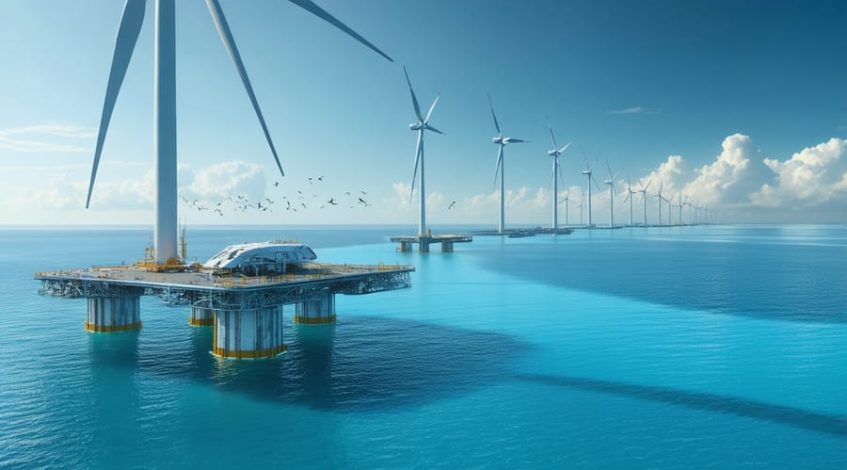
Offshore wind energy stands at the forefront of renewable power innovation, offering unprecedented potential to transform global energy markets. With wind speeds 25% higher and more consistent than onshore locations, offshore installations can generate up to twice the electricity of their land-based counterparts. Leading markets like the UK, Netherlands, and China have already demonstrated the commercial viability of offshore wind, achieving costs as low as $50 per megawatt-hour – a figure competitive with traditional fossil fuels.
The global offshore wind market is projected to exceed $100 billion by 2030, driven by technological advances in floating turbines, improved grid integration, and supportive government policies. These developments have opened new opportunities in previously inaccessible deep-water locations, effectively tripling the potential installation capacity worldwide.
For businesses and governments seeking sustainable energy solutions, offshore wind presents a compelling proposition: reliable power generation, minimal land use, and significant job creation potential. With over 35 GW of installed capacity globally and projects in development set to add another 200 GW by 2030, offshore wind energy has moved beyond proof-of-concept to become a cornerstone of the renewable energy transition.
The Untapped Power of Offshore Wind Resources
Wind Speed Advantages at Sea
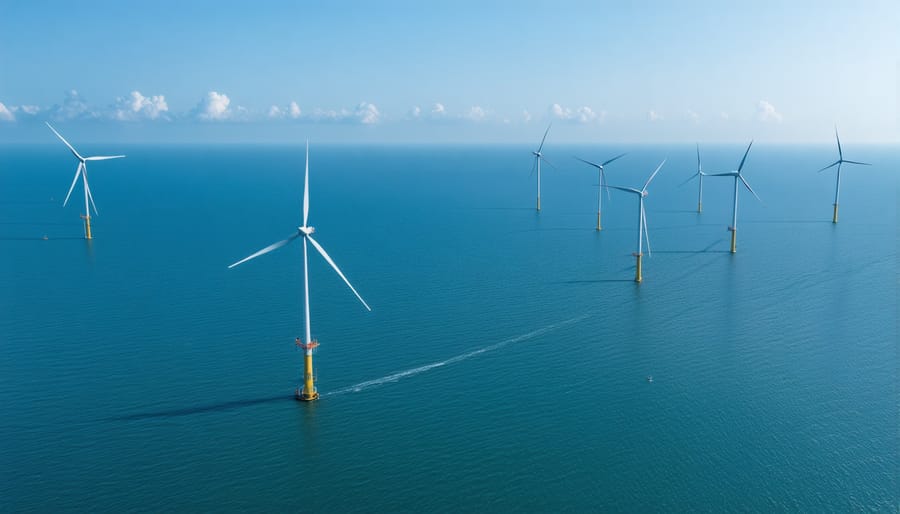
Offshore wind resources offer superior characteristics compared to their onshore counterparts due to unique atmospheric and oceanographic conditions. Over open water, wind speeds are typically 25-50% higher than on land because of the absence of physical obstacles and the smooth surface of the water. This phenomenon is enhanced by thermal differences between land and sea masses, creating consistent wind patterns that are particularly favorable for energy generation.
The stability of offshore winds is another crucial advantage. While onshore wind patterns often fluctuate throughout the day due to temperature variations and topographical influences, offshore winds maintain more consistent speeds and directions. This steadiness results in capacity factors of 40-50% for offshore turbines, significantly higher than the typical 25-35% achieved by onshore installations.
Additionally, coastal areas experience reliable daily wind cycles driven by temperature differentials between land and sea. During daytime hours, warm air rises over land creating a sea breeze, while at night, the process reverses. This predictable pattern enables more accurate power generation forecasting and stable grid integration, making offshore wind particularly valuable for utility-scale power production.
Geographic Opportunities
Several coastal regions worldwide offer exceptional potential for offshore wind energy development. The North Sea, particularly around the United Kingdom, Denmark, and Germany, has proven to be a prime location due to its consistent wind patterns and shallow waters. The United States’ Atlantic Coast presents significant opportunities, with numerous offshore wind development projects already underway from Maine to North Carolina.
The Asian Pacific region, especially areas off the coasts of China, Japan, and South Korea, offers vast untapped potential due to their extensive coastlines and strong wind resources. These areas benefit from relatively shallow continental shelves, making turbine installation more cost-effective.
Emerging markets in India, Vietnam, and Taiwan are also showing promise, with their governments implementing supportive policies for offshore wind development. Australia’s southern coastline presents significant opportunities, particularly in areas where strong winds coincide with proximity to major population centers and existing grid infrastructure.
These locations typically share key characteristics: consistent wind speeds above 7 meters per second, water depths under 60 meters, and proximity to power grids and ports.
Technical Innovations Driving Offshore Wind Growth
Floating Wind Platforms
Floating wind platforms represent a groundbreaking advancement in offshore wind technology, enabling wind farm development in deeper waters where traditional fixed-bottom foundations are impractical. These innovative structures can be deployed in depths exceeding 60 meters, significantly expanding the potential areas for offshore wind energy generation.
Three primary floating foundation designs dominate the market: spar-buoy, semi-submersible, and tension leg platforms. Each design offers unique advantages depending on water depth, seabed conditions, and local weather patterns. Semi-submersible platforms, for instance, provide excellent stability and are particularly suitable for moderate water depths, while spar-buoy designs excel in deeper waters.
Recent technological improvements have enhanced the cost-effectiveness of floating platforms, with manufacturing expenses decreasing by approximately 40% since 2015. Projects like Hywind Scotland, the world’s first commercial floating wind farm, demonstrate the viability of this technology at scale, achieving capacity factors exceeding 55%.
The adoption of floating platforms is driving innovation in mooring systems, dynamic cable designs, and installation methodologies. Industry projections suggest that floating wind installations could account for up to 20% of all offshore wind capacity by 2050, particularly benefiting regions with deep coastal waters such as Japan, the U.S. West Coast, and parts of Europe.
For developers and investors, floating platforms offer access to stronger and more consistent wind resources, potentially increasing energy yield and improving project economics despite higher initial capital costs.
Grid Connection Solutions
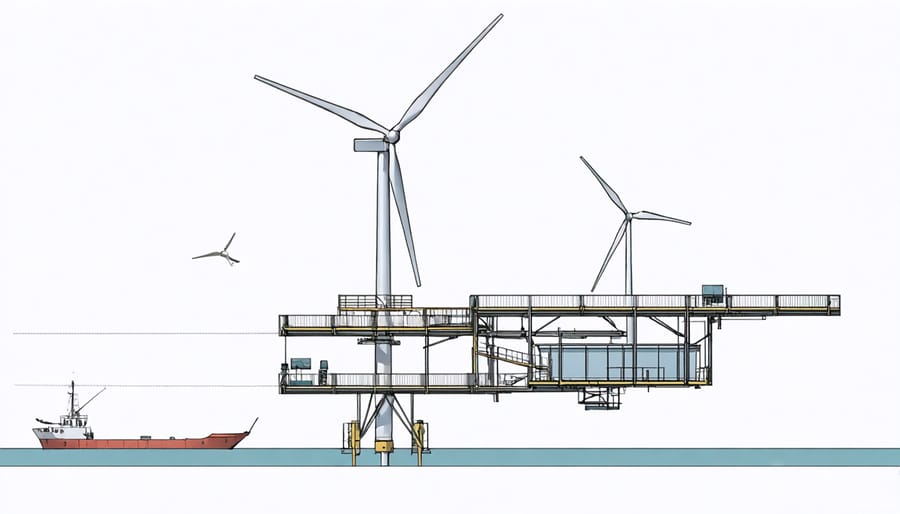
The successful deployment of offshore wind farms hinges critically on robust grid connection infrastructure. Modern transmission systems employ High Voltage Direct Current (HVDC) technology, which significantly reduces power losses over long distances from offshore installations to onshore substations. These advanced systems, coupled with sophisticated wind energy storage solutions, ensure consistent power delivery even during variable wind conditions.
Cutting-edge smart grid integration technologies enable seamless coordination between offshore wind farms and existing power infrastructure. Dynamic line rating systems optimize transmission capacity, while advanced power electronics manage voltage and frequency stabilization. This infrastructure includes offshore substations that transform power to higher voltages for efficient transmission and onshore converter stations that ensure compatibility with the existing grid.
Recent innovations in submarine cable technology have enhanced reliability while reducing installation and maintenance costs. These cables feature advanced insulation materials and sophisticated monitoring systems that detect potential issues before they become critical. Grid operators can now implement real-time load management and predictive maintenance strategies, significantly improving system reliability and reducing operational costs.
The integration of multiple offshore wind farms through interconnected grid systems creates redundancy and improves overall system resilience. This approach also facilitates power trading between regions, maximizing the economic benefits of offshore wind investments.
Economic Benefits and ROI Analysis
Cost Trends and Projections
The offshore wind energy sector has experienced significant cost reductions over the past decade, with levelized cost of electricity (LCOE) falling by approximately 60% since 2010. Current industry analysis indicates costs ranging from $80-100 per MWh, with projections suggesting further decreases to $50-70 per MWh by 2030.
These cost reductions are primarily driven by technological advancements in turbine design, improved installation methods, and economies of scale. Larger turbines, now exceeding 14 MW capacity, have substantially reduced per-unit installation costs. The standardization of manufacturing processes and the development of specialized installation vessels have also contributed to declining capital expenditures.
Operating costs are following a similar downward trajectory, with maintenance expenses decreasing by roughly 20% since 2015. The implementation of predictive maintenance strategies and automated monitoring systems has improved operational efficiency while reducing labor costs.
Industry forecasts suggest that offshore wind will achieve cost parity with conventional power sources in most markets by 2025. This trend is supported by increasing competition among developers, improved supply chain efficiency, and continued technological innovation. The emergence of floating wind technology is expected to further reduce costs in deeper waters, opening new market opportunities while maintaining competitive pricing structures.
Market Growth Opportunities
The offshore wind energy market is experiencing unprecedented growth, with analysts projecting a compound annual growth rate of 12.3% through 2030. Emerging markets in Asia-Pacific, particularly Vietnam, Taiwan, and South Korea, are presenting substantial opportunities for investors and industry stakeholders. These regions combine favorable wind conditions with strong governmental support and increasing energy demands.
Europe continues to lead market expansion, with new developments in floating wind technology opening previously inaccessible deep-water locations. The UK, Netherlands, and Germany are implementing ambitious offshore wind programs, creating numerous opportunities for supply chain development and technological innovation.
The United States market is rapidly evolving, with the Biden administration’s goal of deploying 30 gigawatts of offshore wind capacity by 2030 driving significant investment potential. This has created opportunities in port infrastructure development, vessel construction, and workforce training programs.
Emerging economies in South America and Africa are showing increasing interest in offshore wind development, particularly in Brazil and South Africa. These markets offer unique opportunities for early movers, including joint ventures with local partners and technology transfer agreements.
Investment opportunities extend beyond direct project development to include grid infrastructure, energy storage solutions, and maintenance services, creating a diverse portfolio of market entry points for interested stakeholders.
Environmental and Social Impact
Carbon Reduction Potential
Offshore wind energy represents one of the most effective carbon reduction strategies available today, with significant potential for decreasing greenhouse gas emissions. A typical 500MW offshore wind farm can offset approximately 850,000 metric tons of CO2 annually, equivalent to removing 180,000 passenger vehicles from the road. Studies indicate that expanding offshore wind capacity to 200GW by 2030 could reduce global carbon emissions by over 200 million metric tons annually.
The environmental impact becomes even more substantial when considering the full lifecycle benefits. Offshore wind farms typically achieve carbon payback within 5-12 months of operation, after which they generate completely clean energy for their 25-30 year lifespan. Additionally, modern offshore installations demonstrate a carbon footprint of just 7-9 grams CO2 per kilowatt-hour produced, significantly lower than fossil fuel alternatives which can range from 400 to 1,000 grams CO2 per kilowatt-hour.
For businesses and organizations committed to sustainability targets, offshore wind presents a viable pathway to achieve substantial emissions reductions while maintaining reliable power generation capabilities.
Community and Stakeholder Benefits
Offshore wind energy projects generate substantial economic benefits for coastal communities through direct and indirect employment opportunities. Construction phases typically create hundreds of local jobs in manufacturing, assembly, and marine operations, while ongoing maintenance and operations provide long-term employment stability. Studies indicate that a typical 500MW offshore wind farm creates approximately 750 full-time equivalent positions during construction and 100 permanent jobs throughout its operational lifetime.
Local businesses benefit from increased economic activity through supply chain opportunities, port services, and support infrastructure development. Communities often see growth in hospitality, transportation, and technical service sectors. Additionally, offshore wind projects contribute significantly to local tax revenues, which can fund public services and infrastructure improvements.
Stakeholders also benefit from workforce development programs and educational partnerships established by wind energy developers. These initiatives create pathways for local residents to gain specialized skills in renewable energy technologies. Property values typically remain stable or increase in areas with offshore wind development, particularly when projects incorporate community benefit agreements that ensure local interests are protected and enhanced through direct investment in community programs.
Implementation Strategies for Businesses
Organizations looking to invest in offshore wind energy should follow a systematic approach to implementation. Begin with a comprehensive feasibility study that evaluates wind resources, site conditions, and regulatory requirements specific to your location. This initial assessment should include detailed wind speed measurements, seabed analysis, and environmental impact studies.
Next, develop a robust financial model that accounts for capital expenditure, operational costs, and projected revenue streams. Consider partnerships with experienced developers or utilities to share risks and leverage expertise. Many successful projects utilize public-private partnerships or power purchase agreements (PPAs) to ensure stable returns.
Technical planning should focus on infrastructure requirements, including grid connection capabilities, port facilities, and specialized vessels needed for installation and maintenance. Create a detailed timeline that accounts for permitting processes, which typically take 2-3 years in most jurisdictions.
Supply chain management is crucial for success. Establish relationships with key equipment manufacturers and service providers early in the planning phase. Consider local content requirements and how they might affect procurement strategies.
Risk mitigation strategies should address construction challenges, weather-related disruptions, and potential technical issues. Insurance coverage must be comprehensive, covering both asset protection and business interruption scenarios.
Stakeholder engagement is essential throughout the implementation process. Develop a communication strategy that addresses concerns from local communities, environmental groups, and maritime industries. Regular consultation with regulatory bodies helps ensure compliance and smooth project progression.
Finally, establish clear operational protocols and maintenance schedules before commissioning. This includes training programs for personnel and emergency response procedures. Regular performance monitoring and optimization strategies will help maximize return on investment once the facility is operational.
Offshore wind energy stands poised to play a transformative role in the global energy landscape. As technology continues to advance and costs decrease, the sector presents unprecedented opportunities for sustainable power generation and economic growth. The expanding global market, coupled with improving infrastructure and installation capabilities, signals a robust future for offshore wind development.
Key market indicators suggest that offshore wind capacity will grow exponentially over the next decade, with projections showing potential for over 200 GW of installed capacity by 2030. This growth is supported by increasing government commitments, improved regulatory frameworks, and rising private sector investment in the industry.
The success of established markets in Europe, combined with emerging opportunities in Asia and North America, demonstrates the scalability and viability of offshore wind projects. Technological innovations, including floating turbines and advanced maintenance systems, are opening up new possibilities for deployment in previously inaccessible areas.
For stakeholders considering investment in offshore wind energy, the timing has never been more favorable. With levelized costs of energy continuing to decline and efficiency improvements driving better returns, the business case for offshore wind is increasingly compelling. As the industry matures, standardization of processes and supply chain optimization will further enhance project economics and operational reliability.
Looking ahead, offshore wind energy’s role in achieving global climate goals while delivering sustainable economic benefits positions it as a cornerstone of the future energy mix.