
Renewable Portfolio Standards (RPS) mandate that utilities generate or purchase a specific percentage of their electricity from renewable sources by set deadlines—currently driving over $120 billion in clean energy investments across 38 U.S. states and territories. These regulatory frameworks directly impact your organization’s energy procurement strategy, compliance obligations, and bottom line, whether you’re a facility manager evaluating long-term contracts or a business owner seeking to capitalize on renewable energy credits.
Solar carve-outs, specialized provisions within RPS policies, require utilities to source a designated portion of renewable energy specifically from solar installations. This creates a parallel market for Solar Renewable Energy Certificates (SRECs), tradable commodities that solar system owners generate and sell to utilities needing compliance credits. In states with aggressive solar carve-outs like New Jersey, Massachusetts, and Washington D.C., SREC values have reached $200-$400 per megawatt-hour, transforming solar installations from simple energy-saving measures into revenue-generating assets with accelerated payback periods.
Understanding how RPS policies function in your jurisdiction determines whether your organization can access performance-based incentives, negotiate favorable power purchase agreements, or monetize renewable attributes from on-site generation. The regulatory landscape varies significantly—some states impose substantial non-compliance penalties on utilities (creating robust SREC markets), while others offer voluntary programs with minimal financial impact. California’s 60% RPS target by 2030 and New York’s 70% by 2040 represent among the nation’s most ambitious mandates, creating substantial demand for commercial-scale solar projects.
For decision-makers evaluating solar investments, RPS policies and solar carve-outs represent the regulatory foundation that converts sustainability initiatives into quantifiable financial returns, competitive advantages, and long-term energy price stability.
What Are Renewable Portfolio Standards?

The Mechanics Behind RPS Compliance
Understanding how utilities meet Renewable Portfolio Standards requirements is essential for organizations evaluating their energy strategy. Utilities typically satisfy these obligations through three primary mechanisms: direct ownership of renewable generation facilities, power purchase agreements with renewable energy providers, or the acquisition of Renewable Energy Certificates.
RECs serve as the currency of RPS compliance, representing proof that one megawatt-hour of electricity was generated from a qualifying renewable source. This unbundling of the environmental attributes from physical electricity creates a tradable commodity that utilities can buy and sell to meet their mandates. When a solar installation generates power, it produces both electricity and RECs, which can be sold separately in most markets.
The separation of RECs from physical power creates market dynamics that directly affect commercial energy consumers. In states with aggressive RPS targets and solar carve-outs, REC prices typically increase as utilities compete to secure sufficient renewable attributes. These compliance costs often flow through to customer electricity rates. However, organizations that install on-site solar generation can capture significant value by selling their RECs to utilities while reducing their electricity purchases.
For facility managers and business owners, understanding this mechanism reveals a dual revenue opportunity. Your solar installation not only reduces energy costs but also generates tradable certificates with market value. In a 2022 case study, a New Jersey manufacturing facility generated approximately $180,000 in additional revenue over three years by selling Solar Renewable Energy Certificates while simultaneously cutting utility expenses by 40 percent. This dual-benefit structure fundamentally improves project economics and accelerates return on investment.
Current RPS Landscape Across the U.S.
As of 2024, 30 states plus Washington D.C. and several U.S. territories have enacted mandatory Renewable Portfolio Standards, while an additional eight states maintain voluntary renewable energy goals. These policies create a patchwork of requirements that significantly impact energy purchasing decisions across different regions.
RPS targets vary substantially by jurisdiction. Leading states like California mandate 60% renewable energy by 2030, while New York requires 70% by the same deadline. Other states have adopted more modest goals, with requirements ranging from 10% to 50% by their respective target dates. These variations reflect regional resource availability, political priorities, and economic considerations.
Implementation timelines extend from 2025 to 2050, with many states establishing interim benchmarks to ensure steady progress. Utilities serving multiple jurisdictions must navigate these differing requirements, often accelerating renewable procurement to meet the most stringent obligations.
For organizations operating across state lines, understanding regional RPS mandates is essential for strategic energy planning. States with robust RPS policies typically offer complementary state solar incentives that enhance project economics, creating opportunities for facility managers to align sustainability goals with cost reduction objectives while ensuring regulatory compliance.
Understanding Solar Carve-Out Policies
How Solar Carve-Outs Drive Market Value
Solar carve-outs within renewable portfolio standards create a specialized market mechanism that generates substantial financial returns for solar system owners through Solar Renewable Energy Certificates (SRECs). When your facility’s solar installation produces one megawatt-hour of electricity, it generates one SREC—a tradable certificate that utilities must purchase to meet their compliance obligations under state-mandated solar carve-out requirements.
The SREC market operates on supply and demand principles, with pricing determined by the gap between mandated solar capacity targets and actual solar generation within a state. In markets with aggressive solar targets and limited supply, SREC values can reach several hundred dollars per certificate, creating revenue streams that significantly enhance project economics beyond electricity savings alone. This pricing mechanism makes solar carve-outs particularly effective among various solar energy incentives available to commercial facilities.
Consider a 500-kilowatt commercial installation producing approximately 650,000 kilowatt-hours annually, generating 650 SRECs. In states like New Jersey, where SREC prices have historically ranged from $200 to $300, this translates to $130,000 to $195,000 in annual SREC revenue—substantially improving return on investment timelines.
The compliance-driven nature of SREC markets provides stability that many business owners find attractive. Utilities facing significant penalties for non-compliance—often exceeding $300 per SREC shortfall—maintain consistent demand, creating predictable revenue projections for solar investors. However, market values fluctuate based on solar deployment rates, policy changes, and compliance period dynamics, making it essential to work with experienced solar partners who understand regional market conditions and can structure financial models accordingly.
This market-based approach effectively monetizes environmental attributes while reducing compliance burdens for regulated utilities, demonstrating how well-designed policy frameworks align economic incentives with sustainability objectives.

States Leading with Solar Carve-Out Programs
Several states have established robust solar carve-out programs within their renewable portfolio standards, creating distinct opportunities for businesses to reduce energy costs while contributing to sustainability goals. Understanding these state-specific requirements is essential for making informed investment decisions.
New Jersey leads with one of the most aggressive solar carve-out programs, requiring 5.1% of electricity to come from solar sources by 2026. The state’s Solar Renewable Energy Certificate (SREC) market has generated substantial returns for commercial solar installations, with businesses earning tradeable certificates for every megawatt-hour of solar electricity produced. Manufacturing facilities and warehouse operators in the state have particularly benefited from combining energy savings with SREC revenue streams.
Massachusetts established a 3,600 MW solar generation target through its Solar Massachusetts Renewable Target (SMART) program. The declining block incentive structure rewards early adopters while maintaining long-term predictability for project financing. Municipal facilities and healthcare organizations have successfully leveraged these incentives to achieve payback periods of 6-8 years on commercial installations.
Maryland’s solar carve-out mandates 14.5% solar generation by 2028, creating significant compliance demand. Businesses with large roof spaces or available land have monetized these assets through solar development, generating passive income through SREC sales while reducing operational expenses.
Pennsylvania requires approximately 0.5% solar generation, and though modest compared to neighboring states, offers stable pricing for Solar Alternative Energy Credits. Distribution centers and commercial real estate portfolios have utilized this program to enhance property values while meeting corporate sustainability commitments. These state programs effectively transform solar installations from capital expenditures into strategic revenue-generating assets.
The Direct Impact on Your Energy Costs
Why Utility Rates Will Continue Rising Under RPS Mandates
Utilities operating under Renewable Portfolio Standards face significant costs to achieve compliance, including purchasing renewable energy credits, investing in grid infrastructure upgrades, and implementing administrative tracking systems. These expenses are typically passed directly to ratepayers through base rate adjustments and renewable energy surcharges appearing as line items on monthly bills.
Recent data from states with established RPS programs illustrates this upward trend. California ratepayers have experienced average increases of 3-5% annually since the state’s RPS target increased to 60% by 2030. Similarly, New York utilities project residential rates will rise by approximately 23% over the next decade as the state pursues its 70% renewable energy goal by 2030. Massachusetts residents already pay among the highest electricity rates in the continental United States, partly attributed to aggressive renewable energy targets.
The rate impact varies based on several factors, including the stringency of RPS requirements, the availability of cost-effective renewable resources within the state, and existing grid infrastructure. States with limited renewable resources often face higher compliance costs, as utilities must purchase out-of-state renewable energy credits or invest in more expensive renewable technologies.
For business owners and facility managers, these projected increases create both challenges and opportunities. While utility rates continue climbing, organizations that generate their own renewable energy through on-site solar installations can lock in predictable energy costs and reduce exposure to future rate escalations. This strategy transforms regulatory pressure into competitive advantage, positioning forward-thinking organizations to control long-term operating expenses while meeting corporate sustainability objectives.
The Financial Advantage of Self-Generation
Installing commercial solar systems offers businesses a strategic hedge against the persistent upward trajectory of utility electricity costs. By generating power on-site, organizations can significantly reduce their grid dependence, locking in predictable energy costs over the system’s 25-30 year lifespan. This financial stability proves particularly valuable for businesses operating on tight margins or those seeking to forecast long-term operational expenses with greater accuracy.
Beyond immediate utility bill reductions, businesses in jurisdictions with solar carve-out provisions can monetize their renewable generation through Solar Renewable Energy Certificates. Each SREC represents one megawatt-hour of solar electricity produced, creating an additional revenue stream that accelerates return on investment. In markets with strong RPS requirements and limited solar supply, SREC values can reach substantial levels, sometimes contributing 20-40% of total project returns during the early years of operation.
The financial advantage becomes particularly compelling when combining utility savings with SREC income. A typical commercial installation might reduce annual electricity costs by 40-70% while generating several thousand dollars in SREC revenue annually. This dual-benefit structure transforms solar from a sustainability initiative into a profit-generating asset. Additionally, as utilities inevitably increase rates to fund their own renewable compliance obligations, self-generating businesses maintain stable energy costs while competitors absorb these increases, creating a sustained competitive advantage in their respective markets.
Real-World Applications: Businesses Capitalizing on Solar Carve-Outs
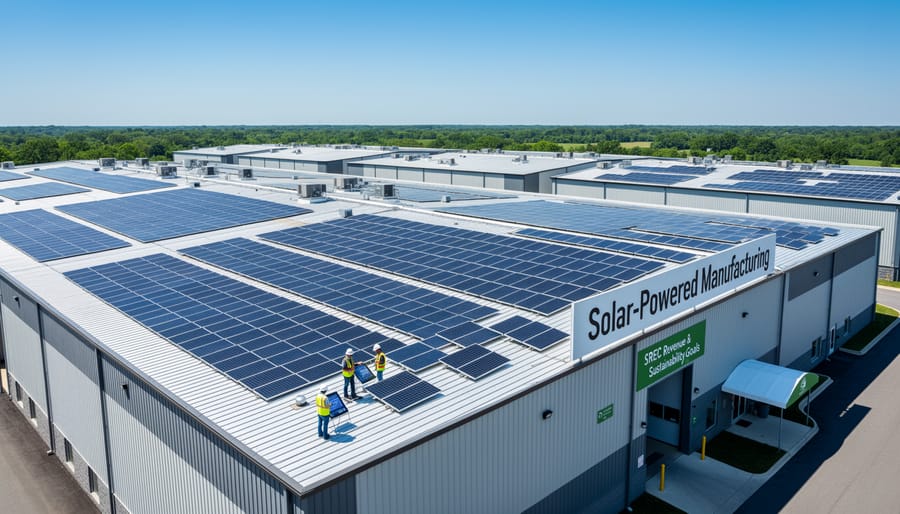
Manufacturing Facility Achieves 40% Energy Cost Reduction
A mid-sized automotive components manufacturer in New Jersey exemplifies the financial advantages of combining solar installation with Renewable Portfolio Standards compliance. The facility installed a 750 kW rooftop solar array in 2021, which now generates approximately 900,000 kWh annually, covering 65% of the plant’s daytime energy consumption.
The implementation delivered immediate and sustained financial returns through multiple revenue streams. Direct energy savings reduced the facility’s electricity costs by $108,000 annually at current utility rates. Additionally, the company generates Solar Renewable Energy Certificates through New Jersey’s solar carve-out program, selling approximately 900 SRECs per year. With SREC market prices averaging $220 per certificate, this creates an additional $198,000 in annual revenue.
Combined, these benefits produce a 40% reduction in overall energy costs, translating to $306,000 in annual savings and revenue. The project achieved a return on investment within 4.8 years, well below the system’s 25-year operational lifespan. The predictable SREC income stream proved particularly valuable for financial planning, as the state’s long-term RPS commitment provides market stability.
Beyond financial metrics, the installation reduced the facility’s carbon footprint by 630 metric tons annually while insulating operations from utility rate volatility. The facility manager noted that fixed solar production costs enable more accurate budgeting compared to fluctuating grid electricity prices, providing operational advantages beyond simple cost reduction.
Government Institution Meets Sustainability Goals While Lowering Budgets
The City of Portland’s Water Bureau provides a compelling demonstration of how solar carve-out incentives can transform government operations. Facing pressure to reduce its $4.2 million annual electricity expenditure while meeting Oregon’s ambitious renewable energy mandates, the Bureau leveraged state Solar Renewable Energy Certificate (SREC) programs to install a 1.8-megawatt solar array across multiple water treatment facilities in 2019.
Through strategic utilization of government solar programs and solar carve-out provisions within Oregon’s Renewable Portfolio Standard, the Bureau secured additional revenue streams beyond standard electricity savings. The SREC market provided an extra $180,000 annually during the program’s first five years, effectively reducing the project’s payback period from 12 years to 8.5 years.
The financial impact extended beyond direct savings. The installation reduced the Bureau’s grid electricity consumption by 32 percent, insulating operations from volatile utility rate increases that averaged 4.8 percent annually in the region. By year three, the facility was realizing $620,000 in combined electricity cost reductions and SREC revenue.
This case demonstrates how government entities can strategically navigate renewable portfolio standards to achieve dual objectives: meeting regulatory compliance requirements while generating measurable budget relief. The Bureau’s approach serves as a replicable model for municipal facilities nationwide, particularly those operating in states with active solar carve-out provisions and established SREC markets.
Strategic Planning: Positioning Your Business to Benefit

Evaluating Your Location and Eligibility
Understanding which renewable portfolio standards apply to your organization requires evaluating both your geographic location and operational characteristics. RPS policies vary significantly by state and jurisdiction, with each establishing unique compliance requirements, renewable energy credit markets, and solar carve-out provisions.
Begin by identifying the specific RPS requirements in your state or region. Most jurisdictions provide online resources through their public utility commissions or energy offices that outline applicable regulations. Determine whether your organization falls under mandatory compliance categories, which typically include utilities and large electricity suppliers, or if voluntary participation programs exist for commercial entities.
Next, assess your eligibility for solar-specific incentives within these frameworks. Solar carve-outs create dedicated markets for solar renewable energy certificates, often commanding premium prices compared to general renewable energy credits. Organizations with suitable roof space, land availability, or parking areas may qualify for accelerated incentive programs designed to meet solar-specific targets.
Consider consulting with a qualified energy advisor who can analyze your facility’s energy consumption patterns, available incentives, and potential return on investment. Many utilities and state agencies maintain databases of pre-qualified installers and financial programs that streamline the evaluation process. Documentation requirements, interconnection standards, and metering arrangements will influence project feasibility and timeline, making thorough upfront assessment essential for successful implementation.
Calculating Total ROI Including SREC Revenue
A comprehensive return on investment (ROI) calculation for solar projects under renewable portfolio standards requires analyzing multiple revenue streams. The methodology begins with quantifying direct energy savings by calculating the difference between current utility costs and projected post-solar expenses over the system’s 25-year lifespan. This baseline figure provides the foundation for understanding operational cost reductions.
Next, incorporate federal tax incentives such as the Modified Accelerated Cost Recovery System (MACRS), which allows businesses to depreciate solar investments over five years. This accelerated depreciation significantly reduces tax liability in the early years of operation, improving cash flow and shortening payback periods.
The critical component for states with solar carve-outs is SREC revenue projection. Calculate annual SREC generation by dividing system output (in kilowatt-hours) by 1,000, as one SREC typically represents one megawatt-hour of solar production. Multiply this figure by current market SREC prices, factoring in historical price trends and remaining compliance years for your state’s RPS program.
To determine total ROI, sum the 25-year energy savings, tax benefits, and projected SREC income, then subtract total system costs including installation and maintenance. Divide this net benefit by initial investment to establish your ROI percentage. Many commercial installations achieve ROI exceeding 150 percent when all three revenue streams align favorably, with payback periods ranging from five to eight years.
Future Outlook: What’s Coming for RPS and Solar Policies
The renewable energy regulatory landscape is entering a period of significant transformation, with several trends pointing toward more ambitious RPS targets and enhanced solar carve-out provisions. Business leaders and facility managers should prepare for both opportunities and compliance challenges in the coming years.
Most states with existing RPS programs are evaluating target increases, with many considering 100% clean energy mandates by 2040-2050. California, New York, and several northeastern states have already committed to these goals, creating a roadmap that other jurisdictions are likely to follow. This progression suggests that organizations delaying renewable energy investments may face steeper compliance costs and fewer favorable incentive programs as deadlines approach.
Solar carve-outs are expected to evolve beyond simple percentage requirements toward more nuanced policy mechanisms. Emerging trends include carve-outs for specific technologies like solar-plus-storage systems, provisions for community solar projects, and enhanced credits for installations on brownfields or contaminated sites. These refinements aim to address grid reliability concerns while maximizing the economic and environmental benefits of distributed generation.
Federal policy developments will increasingly influence state-level RPS implementation. Recent legislation has introduced tax incentives and financing mechanisms that complement existing state programs, creating stacking opportunities for commercial solar projects. Organizations should monitor how federal renewable energy credits interact with state SREC markets to optimize financial returns.
The regulatory emphasis is shifting toward verification and accountability. Expect stricter reporting requirements, enhanced tracking systems, and more robust enforcement mechanisms. Businesses should implement comprehensive energy management systems now to ensure compliance readiness and capitalize on early-mover advantages in evolving markets.
For organizations considering solar investments, the strategic imperative is clear: early adoption positions businesses to capture maximum financial benefits while meeting increasingly stringent renewable energy requirements. Working with experienced solar development partners ensures projects align with both current regulations and anticipated policy directions.
Renewable Portfolio Standards and solar carve-out policies represent more than regulatory compliance requirements—they create substantial financial opportunities for organizations ready to embrace solar energy. As these mandates expand across jurisdictions, businesses that adopt solar early position themselves to capture multiple value streams: reduced electricity costs, renewable energy credit revenue, insulation from utility rate increases, and enhanced corporate sustainability credentials.
The competitive landscape is shifting rapidly. Organizations that delay solar adoption face increasing REC costs as utilities purchase compliance instruments on the open market, expenses ultimately passed to ratepayers. Conversely, early adopters generate their own renewable energy, creating revenue streams from excess production while stabilizing long-term energy expenses. The case studies presented demonstrate that facilities implementing solar under current carve-out programs achieve payback periods of five to seven years, with decades of subsequent savings.
Solar carve-out provisions create time-sensitive advantages. As solar penetration increases within each jurisdiction, SREC values naturally decline due to supply dynamics. Forward-thinking organizations recognize that today’s favorable economics may not persist indefinitely. The combination of federal tax incentives, state carve-out provisions, and declining installation costs creates an optimal window for solar investment.
The pathway forward is clear: assess your organization’s solar potential now. Conduct a comprehensive site evaluation, model the financial returns under your jurisdiction’s RPS framework, and develop an implementation timeline. The organizations that thrive in tomorrow’s energy landscape are making strategic decisions today. Your solar assessment begins with understanding your facility’s unique potential within the regulatory environment that increasingly favors renewable energy adoption.