

Renewable energy policies are reshaping the global business landscape, driving unprecedented opportunities for organizational growth while advancing climate action goals. As governments worldwide accelerate their transition to sustainable energy systems, decision-makers face increasingly complex policy frameworks that directly impact operational strategies and investment decisions. From tax incentives and regulatory compliance to grid integration requirements, these policies create both challenges and opportunities for businesses adapting to a low-carbon future.
The intersection of policy, technology, and market forces has created a dynamic environment where proactive organizations can gain significant competitive advantages. Forward-thinking companies are leveraging renewable energy policies to reduce operational costs, enhance energy security, and strengthen their market position. Understanding these policies – and their implications for business operations – has become essential for leaders seeking to navigate the evolving energy landscape successfully.
This comprehensive analysis examines current renewable energy policies, their impact on business operations, and strategies for maximizing available incentives while ensuring compliance. Whether you’re a facility manager evaluating solar installations or a CEO developing long-term sustainability strategies, grasping these policy frameworks is crucial for making informed decisions that drive both environmental and economic benefits.
Current Renewable Energy Policy Landscape
Key Policy Frameworks
Several key policy frameworks have shaped the renewable energy landscape globally, driving significant market growth and technological innovation. The European Union’s Renewable Energy Directive (RED II) stands as a cornerstone policy, mandating that member states achieve 32% renewable energy consumption by 2030. In the United States, the Investment Tax Credit (ITC) and Production Tax Credit (PTC) have catalyzed substantial private sector investment in solar and wind energy projects, demonstrating impressive clean energy policy results across multiple states.
China’s Renewable Portfolio Standard (RPS) has established mandatory renewable energy quotas for power companies, while Australia’s Renewable Energy Target (RET) scheme has successfully promoted large-scale renewable energy projects through certificate trading mechanisms. These frameworks typically combine financial incentives, regulatory requirements, and market-based instruments to accelerate renewable energy adoption.
Additionally, feed-in tariffs and auctions have emerged as effective tools for promoting renewable energy deployment, with numerous countries implementing variations of these mechanisms to achieve their sustainability goals while ensuring cost-effectiveness and market stability.

Implementation Timeline and Targets
The implementation of renewable energy policies typically follows a phased approach, with specific targets and deadlines established for different sectors. Most jurisdictions begin with a 3-5 year initial compliance period for large industrial facilities, followed by medium-sized commercial operations in years 5-7, and smaller businesses thereafter.
Key industrial targets generally require 20% renewable energy adoption by 2025, scaling to 50% by 2030, and achieving carbon neutrality by 2050. Large corporations must submit detailed transition plans within 12 months of policy enactment and demonstrate measurable progress through annual reporting.
Utility companies face accelerated timelines, with requirements to source 30% of their energy from renewables by 2025 and 60% by 2035. Government facilities often serve as early adopters, with mandatory solar installation deadlines typically set within 24 months of policy implementation.
Financial incentives and tax credits are usually front-loaded in the first five years to encourage early adoption, with gradual phase-outs planned over subsequent years. Compliance monitoring systems are implemented within the first year, with full enforcement mechanisms activated by year three.
Industrial Sector Impact Analysis
Manufacturing Sector Adaptations
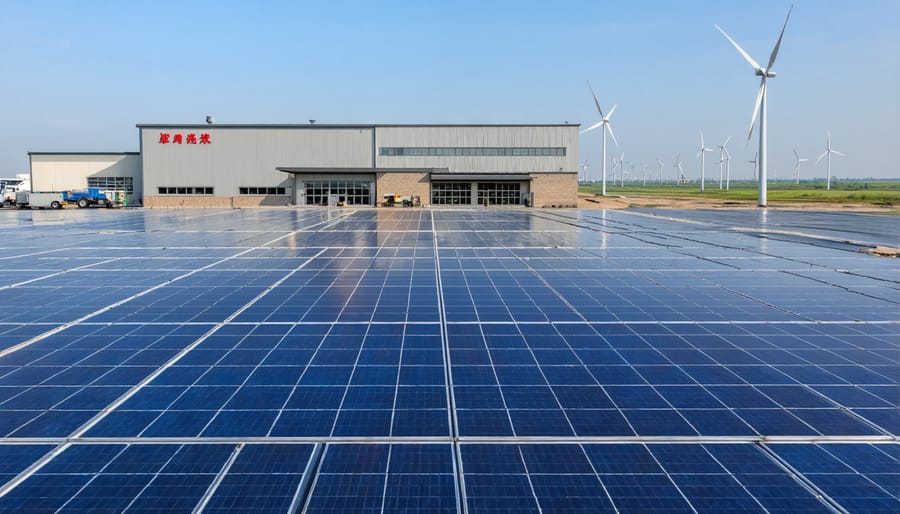
Manufacturing industries are rapidly evolving their operations to align with new renewable energy policies, implementing significant changes across their production processes and facility management. Large manufacturers are increasingly adopting renewable energy through power purchase agreements (PPAs) and on-site generation facilities, while smaller operations are exploring collaborative solutions and energy-efficient retrofits.
Leading automotive manufacturers have established solar arrays and wind farms to power their assembly plants, with some facilities achieving up to 80% renewable energy usage. The steel industry has begun incorporating hydrogen-based reduction processes powered by renewable sources, marking a significant shift from traditional coal-dependent methods.
Chemical manufacturers are investing in smart grid technologies and energy storage systems to optimize their renewable energy consumption and manage peak load demands. These adaptations often include the installation of advanced energy management systems that can adjust production schedules to maximize renewable energy usage during periods of high availability.
Textile and food processing industries are implementing combined heat and power systems that utilize renewable sources, improving both energy efficiency and production costs. Many facilities are also upgrading their equipment with variable frequency drives and smart controls to better accommodate the variable nature of renewable energy sources.
These adaptations are supported by government incentives and tax credits, making the transition more financially viable for manufacturers of all sizes. Industry leaders report average energy cost reductions of 15-30% after implementing comprehensive renewable energy solutions, demonstrating the strong business case for adaptation.
Commercial Real Estate Transformations
Renewable energy policies are fundamentally reshaping commercial real estate markets, driving significant changes in property valuations and operational requirements. As sustainability becomes increasingly central to urban development transformation, commercial properties with robust renewable energy installations are commanding premium market positions.
Building owners are experiencing a dual benefit: reduced operational costs through energy savings and increased property values through sustainability certifications. Recent market analyses indicate that green-certified buildings typically command 7-10% higher rental rates and maintain stronger occupancy levels compared to conventional properties.
Energy performance standards and renewable requirements are becoming mandatory in many jurisdictions, compelling property owners to retrofit existing buildings with solar installations, energy storage systems, and smart building management technologies. These mandates, while initially representing a capital investment, are proving to generate substantial returns through reduced utility costs and enhanced tenant attraction.
Insurance companies and financial institutions are also adapting their policies, offering preferential rates for properties with renewable energy infrastructure. This trend reflects the reduced operational risks and increased resilience associated with buildings that maintain independent power generation capabilities.
Forward-thinking property developers are now incorporating renewable energy systems into their initial design phases, recognizing that early adoption of sustainable technologies provides a competitive advantage in an increasingly environmentally conscious market.
Heavy Industry Compliance Strategies
Heavy industries are adopting diverse strategies to meet increasingly stringent renewable energy policy requirements while maintaining operational efficiency. Leading manufacturers are implementing combined approaches that include on-site renewable energy generation, power purchase agreements (PPAs), and energy efficiency improvements.
Steel manufacturers and cement producers are investing in industrial-scale solar installations and wind farms to offset their substantial energy consumption. For example, ThyssenKrupp’s steel division has reduced its carbon footprint by 30% through a combination of renewable energy adoption and process optimization. Chemical companies are leveraging waste-to-energy systems and biomass facilities to meet compliance requirements while managing costs.
Energy-intensive industries are also forming consortiums to negotiate better renewable energy rates and share implementation best practices. The RE100 initiative, comprising over 300 major corporations, demonstrates how collective action can drive industry-wide transformation and policy compliance.
Key compliance strategies include:
– Phased implementation of renewable energy systems
– Investment in energy storage solutions
– Development of smart grid integration
– Implementation of energy management systems
– Strategic partnerships with renewable energy providers
Companies are finding that early adoption of these strategies not only ensures compliance but often results in long-term cost savings and improved market positioning. Many are exceeding policy requirements, recognizing that proactive investment in renewable infrastructure provides competitive advantages in an increasingly sustainability-focused market environment.
Cost-Benefit Analysis
Implementation Costs
The implementation of renewable energy policies requires careful consideration of both upfront investments and long-term operational costs. Initial capital expenditures typically include infrastructure development, equipment procurement, and system integration costs. For utility-scale projects, these investments can range from $1-3 million per megawatt of capacity, while smaller commercial installations may require $100,000-500,000 depending on scope and location.
Policy compliance often necessitates investments in monitoring and reporting systems, staff training, and consulting services. Organizations must also factor in costs for environmental impact assessments, permitting fees, and grid connection charges, which can account for 5-15% of total project costs.
Ongoing expenses include system maintenance, insurance premiums, and administrative costs for policy compliance reporting. However, these costs are often offset by reduced energy expenses and potential revenue from renewable energy certificates (RECs) or carbon credits. Many organizations report achieving ROI within 5-7 years through reduced operational costs and policy incentives.
Government incentives, tax credits, and grants can significantly reduce implementation costs. For example, the federal Investment Tax Credit (ITC) can offset up to 30% of solar installation costs, while state-level programs may provide additional financial support. Organizations should conduct thorough cost-benefit analyses, considering both direct expenses and potential savings through policy compliance and energy efficiency improvements.
Long-term Returns and Benefits
The strategic implementation of renewable energy policies yields substantial long-term returns that extend beyond immediate cost savings. Studies show that organizations implementing comprehensive renewable energy strategies typically achieve ROI within 5-7 years, with continued benefits extending decades into the future. These renewable energy implementation benefits include reduced operational costs, enhanced energy security, and improved market competitiveness.
Financial analysis indicates that businesses adopting renewable energy policies experience average energy cost reductions of 20-30% over ten years, with some achieving savings of up to 40% through optimized system design and policy incentives. Additionally, organizations gain significant competitive advantages through price stability, as renewable energy costs remain relatively constant compared to fluctuating fossil fuel prices.
The long-term benefits also encompass increased property values, enhanced corporate reputation, and improved stakeholder relations. Companies with robust renewable energy policies typically see a 10-15% increase in customer loyalty and brand value. Furthermore, these organizations often qualify for various government incentives, carbon credits, and tax benefits, creating multiple revenue streams while contributing to sustainability goals.
Early adopters of comprehensive renewable energy policies have demonstrated particular success, with documented cases showing cumulative returns exceeding initial investments by 200-300% over 15-20 years when factoring in all financial benefits and incentives.
Future Policy Trends and Recommendations
Upcoming Policy Changes
Several significant policy changes are expected to reshape the renewable energy landscape in the coming years. Recent green energy policy trends indicate a shift toward more aggressive renewable energy targets and enhanced incentive programs.
Key developments include the proposed expansion of feed-in tariff schemes, with rates expected to increase by 15-20% in major markets. Commercial property owners should anticipate new building energy efficiency standards that will require minimum renewable energy integration for both new construction and retrofits.
Tax incentives for renewable energy investments are likely to be enhanced, with predictions suggesting up to 30% increased deductions for commercial solar installations. Additionally, regulatory frameworks for energy storage systems are expected to be streamlined, making it easier for businesses to implement comprehensive renewable energy solutions.
Grid integration policies are also evolving, with new regulations aimed at simplifying the connection process for commercial-scale renewable energy systems. This includes proposed standardized interconnection requirements and expedited approval processes for systems under 500kW.
Organizations should prepare for mandatory carbon reporting requirements, which may extend to medium-sized businesses within the next two years. These changes will likely drive increased adoption of renewable energy solutions as companies seek to comply with stricter environmental regulations while optimizing their energy costs.
Strategic Planning Guidelines
To effectively implement renewable energy policies, organizations should follow a structured approach that maximizes benefits while minimizing transition challenges. Begin by conducting a comprehensive energy audit to establish baseline consumption patterns and identify opportunities for renewable integration. This assessment should include both current energy needs and projected future requirements.
Develop clear, measurable objectives aligned with both organizational goals and regulatory requirements. These targets should specify desired renewable energy adoption rates, emission reduction goals, and timeline milestones. Consider implementing a phased approach, starting with pilot projects before scaling to full deployment.
Create cross-functional teams responsible for policy implementation, including representatives from operations, finance, and sustainability departments. This ensures comprehensive oversight and helps address potential challenges from multiple perspectives. Establish regular monitoring and reporting mechanisms to track progress and adjust strategies as needed.
Invest in workforce development and training programs to build internal capacity for managing renewable energy systems. This includes technical training for maintenance staff and awareness programs for all employees to foster organization-wide support for sustainability initiatives.
Develop contingency plans for potential policy changes or market fluctuations. Include risk assessment protocols and mitigation strategies in your planning process. Consider establishing partnerships with renewable energy providers and industry experts to stay informed about emerging technologies and best practices.
Regular review and updates of strategic plans ensure continued alignment with evolving regulations and market conditions. Document successes and challenges to build an institutional knowledge base for future initiatives.
Proactive compliance with renewable energy policies is crucial for long-term business success and environmental sustainability. Organizations that stay ahead of regulatory requirements while implementing comprehensive renewable energy strategies position themselves for significant competitive advantages. By understanding and adapting to evolving policy frameworks, businesses can maximize available incentives, reduce operational costs, and demonstrate environmental leadership. Regular policy monitoring, stakeholder engagement, and systematic implementation of renewable energy solutions ensure sustainable growth and regulatory compliance. As the renewable energy landscape continues to evolve, organizations that embrace these policies as opportunities rather than obligations will be better equipped to thrive in an increasingly sustainable economy. The future of business success lies in aligning operational strategies with renewable energy policies while maintaining focus on both environmental stewardship and financial performance.