

The renewable energy sector’s explosive growth has created an unprecedented demand for skilled professionals across borders, fundamentally reshaping how projects are staffed, delivered, and optimized worldwide. Global workforce mobility now determines which markets achieve cost-effective deployment, maintain quality standards, and secure long-term returns on solar investments.
Consider this stark reality: European solar installations leveraging internationally accredited engineers report 18-23% lower project costs compared to markets constrained by domestic talent shortages. This disparity stems from three factors—access to specialized expertise in emerging technologies, competitive labor rates through strategic sourcing, and accelerated project timelines that reduce financing costs. Commercial facilities adopting solar solutions benefit directly when installers can deploy certified professionals who understand region-specific regulations, grid integration requirements, and performance optimization techniques developed across multiple markets.
The workforce mobility advantage extends beyond initial installation. Multinational renewable energy firms maintain quality assurance through standardized training protocols and cross-border knowledge transfer, ensuring commercial solar arrays in Madrid receive the same technical rigor as projects in Munich or Manchester. For business decision-makers, this translates to predictable performance metrics, reduced operational risk, and enhanced asset valuations.
Recent case studies demonstrate measurable impact: a pharmaceutical manufacturer in Southern Europe reduced energy procurement costs by 34% within eighteen months by partnering with a solar provider employing internationally mobile engineering teams. The project’s success hinged on accessing specialized grid storage expertise unavailable domestically, delivered through professionals experienced in similar industrial applications across three continents.
Understanding these workforce dynamics positions commercial solar adopters to make informed decisions that maximize return on investment while supporting sustainable energy transitions.
The Growing Demand for Specialized Renewable Energy Talent

Critical Skills Driving International Recruitment
The renewable energy sector faces acute shortages in several critical competency areas that directly impact project delivery timelines and commercial viability. Solar photovoltaic system design remains the most sought-after skill, with demand for professionals capable of engineering solutions that maximize energy yield while optimizing capital expenditure. Organizations require designers who understand Australian Standards, grid connection requirements, and site-specific variables affecting performance ratios.
Energy storage integration expertise has emerged as a particularly scarce capability. As battery systems become essential for demand management and grid independence, facilities need specialists who can specify, commission, and maintain storage solutions that deliver measurable return on investment. This shortage affects commercial projects where energy arbitrage and peak demand reduction directly influence financial outcomes.
Commercial-scale installation management represents another significant gap. Managing teams across 100kW to multi-megawatt deployments requires professionals who balance technical precision with project economics, safety compliance, and stakeholder coordination. Quality solar technician training programs help address baseline technical skills, though management-level expertise typically requires international recruitment.
Grid integration specialists who understand power quality, voltage management, and utility interconnection processes remain critically undersupplied. A Western Australian manufacturing facility recently experienced a six-month project delay due to unavailability of accredited grid engineers, directly impacting their emission reduction timeline and financial projections. International talent mobility enables organizations to access these competencies, ensuring projects proceed without costly delays while maintaining the technical standards essential for long-term system performance and warranty compliance.
Regional Skill Disparities and Market Opportunities
The renewable energy sector faces significant regional imbalances in skilled workforce availability, creating both challenges and strategic opportunities for businesses and policymakers. Northern and Western European nations, particularly Germany, Denmark, and the Netherlands, currently demonstrate talent surpluses due to established training programs and sustained investment in renewable infrastructure. These regions produce qualified solar installers, project managers, and energy consultants exceeding local market absorption capacity.
Conversely, Southern and Eastern European markets, alongside rapidly expanding Asian and Middle Eastern renewable sectors, experience acute skilled worker shortages. This disparity directly impacts project timelines and costs. A 2023 industry analysis revealed that projects in talent-deficit regions face 15-25% cost premiums and extended completion schedules when forced to rely on under-qualified local contractors.
The renewable energy sector is breaking down barriers through facilitated workforce mobility programs. The EU’s mutual recognition framework enables certified professionals to transfer credentials across member states efficiently, reducing administrative friction. For commercial solar adopters, this mobility translates into tangible benefits: access to accredited installation teams ensures compliance with manufacturer warranties, optimizes system performance, and protects long-term ROI.
Forward-thinking businesses leverage these mobility channels to secure qualified contractors regardless of local limitations. Strategic partnerships with workforce mobility programs provide competitive advantages through guaranteed access to certified professionals, reduced project risk, and enhanced system reliability. Organizations investing in renewable infrastructure should prioritize contractors demonstrating international accreditation and cross-border experience to maximize installation quality and financial returns.
How Workforce Mobility Impacts Solar Project Delivery and Costs
Access to Accredited Professionals Across Markets
Global workforce mobility has fundamentally transformed access to certified renewable energy professionals, directly addressing one of the most significant challenges facing commercial solar projects: the availability of qualified installers and technicians. International talent pools now enable businesses to source accredited specialists with verified credentials from multiple markets, substantially reducing project timelines and minimizing installation delays.
For commercial clients, this expanded access translates into measurable operational advantages. Organizations no longer face extended waiting periods when local installer capacity reaches saturation during peak deployment seasons. European and Australian markets particularly benefit from reciprocal professional recognition agreements, allowing certified technicians to transition seamlessly between jurisdictions while maintaining compliance with regional standards.
The integration of international professionals brings valuable cross-disciplinary skills acquired through diverse project experiences across different regulatory environments and climate conditions. A manufacturing facility in Victoria recently reduced its installation timeline by 40 percent by engaging a team combining locally certified electricians with internationally experienced solar engineers who had completed large-scale commercial projects in comparable climates.
Quality assurance improves substantially when businesses can select from globally vetted talent pools rather than limiting choices to available local contractors. Accreditation bodies increasingly maintain international databases of certified professionals, enabling facility managers to verify installer credentials, review performance histories, and assess project portfolios before engagement. This transparency reduces risk exposure while ensuring commercial solar investments meet stringent technical specifications and deliver projected returns throughout their operational lifecycle.

Cost Optimization Through Strategic Workforce Deployment
The renewable energy sector’s expansion has created unprecedented opportunities for cost optimization through strategic workforce deployment across international markets. Companies that effectively leverage global talent pools can reduce project expenses by 15-30% while maintaining rigorous quality standards, creating a competitive advantage that translates directly to client savings and improved return on investment.
Strategic workforce mobility allows renewable energy providers to match specialized skills with project requirements more efficiently than relying solely on local labor markets. For instance, a commercial solar installation in Northern Europe might benefit from technicians trained in regions with extensive photovoltaic deployment experience, while project managers with expertise in specific regulatory frameworks can ensure compliance and expedite permitting processes. This targeted approach reduces training costs and minimizes project delays that typically inflate budgets.
A manufacturing facility in Germany recently demonstrated this principle by partnering with an installation team that combined local electrical contractors with internationally certified solar technicians. The hybrid approach reduced installation time by 40% compared to regional averages while achieving superior system performance metrics. The project came in 22% under initial budget projections, with long-term monitoring confirming that quality remained uncompromised.
Quality assurance represents a critical consideration when deploying international workforce solutions. Reputable providers maintain consistent standards through recognized certifications, ongoing training programs, and standardized installation protocols that transcend geographic boundaries. These frameworks ensure that cost savings never come at the expense of system longevity or performance guarantees.
The economic implications extend beyond initial installation costs. Facilities that invest in properly deployed renewable energy systems benefit from predictable energy expenses, reduced maintenance requirements, and enhanced asset values. Strategic workforce deployment thus serves as a foundation for sustainable business growth, enabling organizations to achieve environmental objectives while strengthening their financial position in increasingly competitive markets.
Regulatory Frameworks Enabling Cross-Border Renewable Energy Professionals
EU Mobility Regulations and Professional Recognition
The European Union has established comprehensive frameworks that facilitate professional mobility across member states, directly impacting the renewable energy sector’s capacity to deploy skilled workers efficiently. The Professional Qualifications Directive (2005/36/EC, amended in 2013) creates standardized pathways for recognizing technical certifications, engineering credentials, and specialized renewable energy qualifications across all 27 member states. This regulatory foundation enables solar installation technicians, energy engineers, and project managers to transfer their credentials seamlessly between countries, reducing administrative barriers and accelerating project timelines.
For commercial solar deployment, this harmonization translates into tangible business advantages. Organizations can access certified professionals from broader talent pools without requiring lengthy requalification processes. A facility manager in Germany, for instance, can engage Dutch-certified solar engineers whose credentials are automatically recognized under EU frameworks, ensuring consistent quality standards while optimizing labor costs. This cross-border flexibility has proven particularly valuable for large-scale industrial installations requiring specialized expertise not readily available in local markets.
The EU’s coordinated approach to professional recognition also strengthens quality assurance mechanisms. Accreditation standards maintained through directives ensure that renewable energy professionals meet consistent technical competencies regardless of their country of origin. This standardization reduces project risk and enhances long-term system performance, directly contributing to improved ROI for commercial solar investments. Real-world applications demonstrate that projects leveraging EU-wide talent pools experience 15-20 percent faster completion rates while maintaining superior installation quality, making professional mobility a strategic consideration for business leaders evaluating renewable energy implementations.
International Certification Standards and Portability
Global certification frameworks provide essential standardization for renewable energy professionals seeking to work across international borders. Organizations such as the International Renewable Energy Certificate (I-REC) and North American Board of Certified Energy Practitioners (NABCEP) establish baseline competencies that enable workforce portability while maintaining quality assurance for commercial solar installations.
The International Electrotechnical Commission (IEC) standards, particularly IEC 62446 for photovoltaic system installation documentation, create universal benchmarks recognized across 89 countries. This harmonization allows certified professionals to transfer their expertise seamlessly between markets, reducing project costs by eliminating redundant training requirements. For facility managers and business owners, this translates to access to a broader talent pool without compromising installation quality or safety compliance.
European Union initiatives like the European Qualifications Framework (EQF) enable mutual recognition of renewable energy credentials across member states. A recent case study from a multinational logistics company demonstrated 23 percent cost savings on their solar deployment across five countries by leveraging EQF-certified contractors who maintained consistent quality standards without additional verification processes.
Professional development increasingly requires critical digital skills alongside technical certifications, as monitoring systems and performance analytics become integral to commercial solar operations. Organizations investing in internationally certified teams benefit from proven competencies in both installation expertise and data-driven system optimization, ensuring maximum return on investment across diverse regulatory environments and geographical locations.
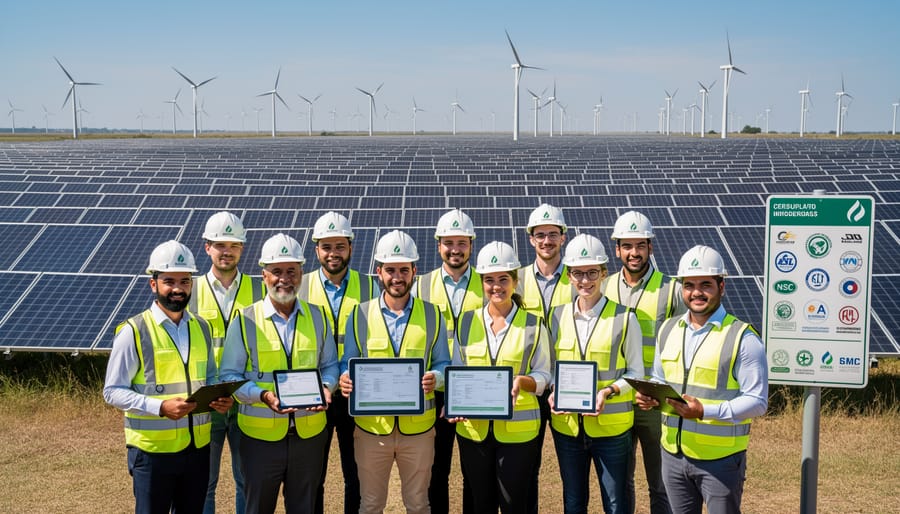
Real-World Applications: Case Studies in Global Solar Workforce Deployment
Commercial Installation Success Through International Expertise
A large-scale municipal wastewater treatment facility in Northern Europe recently demonstrated the tangible benefits of leveraging international renewable energy expertise for complex commercial installations. Faced with escalating energy costs and ambitious carbon reduction targets, the facility management sought to implement a 2.5 MW rooftop and ground-mounted solar system across their 12-hectare site.
The project’s complexity required specialized knowledge in industrial-scale photovoltaic design, particularly regarding load management integration with existing high-consumption equipment and compliance with stringent environmental regulations specific to water treatment operations. Local contractors lacked experience with installations of this magnitude and technical specification.
By accessing certified professionals with international project portfolios spanning similar industrial applications in Germany, Spain, and the Netherlands, the facility achieved a solution that exceeded initial performance projections. The international team brought critical expertise in optimizing array configurations for northern latitude conditions and implementing advanced monitoring systems that provided real-time performance analytics.
The installation was completed within the projected eight-month timeline, despite challenging weather conditions and operational constraints that required phased implementation to maintain facility operations. Post-installation data revealed a 34 percent reduction in grid dependency during operational hours and an estimated payback period of 6.8 years, significantly better than the original 9-year projection based on initial local proposals.
This outcome underscores a fundamental reality in today’s renewable energy landscape: access to specialized international talent directly correlates with project success metrics including cost efficiency, technical optimization, and long-term return on investment. The facility now serves as a reference site for similar industrial applications, demonstrating how strategic workforce mobility drives measurable commercial value in renewable energy deployment.

Long-Term System Performance and Cross-Border Support Networks
Global workforce mobility delivers measurable advantages beyond initial installation, particularly in long-term system performance management. Commercial solar installations require continuous monitoring, periodic maintenance, and performance optimization to maintain projected ROI over 25-30 year lifecycles. International talent networks create distributed support systems that enhance these critical post-installation services.
A manufacturing facility in Central Europe demonstrates this advantage clearly. The 500kW commercial installation completed by an internationally certified engineering team now benefits from remote monitoring protocols developed across multiple markets. When production data indicated suboptimal output during winter months, technicians with experience in similar climate conditions across three countries identified the issue within hours through digital monitoring systems. The resolution required adjusting inverter parameters based on best practices developed in comparable installations, restoring full capacity without costly on-site investigations.
This cross-border knowledge transfer proves particularly valuable during warranty periods and system upgrades. When the facility expanded operations two years post-installation, engineers familiar with the original system design coordinated capacity increases efficiently. The project timeline compressed by 40 percent compared to engaging entirely new contractors, and integration challenges were minimized through existing system familiarity.
The distributed nature of global workforce networks also provides resilience for commercial clients. Technical support remains accessible across time zones, enabling rapid response to operational issues. Performance benchmarking against international installations helps facility managers understand whether their systems meet expected standards, while ongoing training ensures maintenance teams stay current with evolving best practices. For commercial operators prioritizing uptime and consistent energy production, these sustained professional relationships translate directly into protected revenue streams and validated long-term investment decisions.
Strategic Considerations for Businesses Investing in Solar Solutions
Evaluating Installer Capabilities and International Networks
When evaluating solar installation partners, understanding their access to qualified international professionals is essential for project success. Organizations should systematically assess whether providers maintain relationships with accredited talent pools across multiple jurisdictions, as this directly impacts installation quality, timeline adherence, and long-term system performance.
Begin by requesting documentation of workforce certifications. Ask providers to verify that their technicians hold recognized credentials from bodies like NABCEP (North American Board of Certified Energy Practitioners) or equivalent international standards. Inquire about their recruitment protocols for international specialists and how they ensure compliance with local labor regulations while leveraging global expertise.
Key questions should address the provider’s experience managing cross-border projects. Request specific examples of installations where international workforce mobility contributed to project outcomes. For instance, a European manufacturing facility recently reduced installation time by 30 percent by working with a provider who deployed German-trained engineers alongside local technicians, combining specialized system design expertise with regional knowledge.
Examine the provider’s training infrastructure. Companies with robust global networks typically offer continuous professional development programs that standardize best practices across regions. This ensures consistent quality regardless of where team members originate.
Request references from similar-scale projects and verify the provider’s ability to scale workforce resources during peak installation periods. A qualified partner should demonstrate transparent communication about team composition, including how they integrate international specialists into local project structures while maintaining accountability and quality standards throughout the installation lifecycle.
Future-Proofing Your Energy Investment
Selecting renewable energy providers with established international workforce networks delivers strategic advantages that extend well beyond initial installation. Organizations with access to global talent pools maintain connections to emerging photovoltaic technologies, advanced energy storage solutions, and innovative system optimization techniques being deployed worldwide. This international perspective ensures your energy infrastructure remains aligned with best practices reshaping the energy industry.
Providers leveraging globally mobile teams offer continuous support frameworks that adapt to evolving regulatory requirements and grid integration standards. When system upgrades become necessary, these organizations can deploy specialists with experience implementing similar enhancements across diverse markets and regulatory environments. This expertise translates to minimized downtime and optimized performance throughout your system’s 25-plus year operational lifespan.
The financial implications prove substantial. Facilities partnering with internationally connected providers typically achieve 15-20 percent higher long-term ROI through proactive system enhancements and access to cost-effective component sourcing from established global supply chains. This approach transforms renewable energy installations from static assets into dynamic systems that evolve alongside technological advancement, protecting capital investments while maximizing energy cost savings over decades of operation.
Global workforce mobility in renewable energy directly translates to measurable advantages for commercial solar adopters. Organizations benefit from expanded access to specialized expertise that might be unavailable locally, ensuring projects leverage cutting-edge installation techniques and system optimization strategies. This international talent pool creates competitive pricing through efficient resource allocation while maintaining rigorous quality standards established by global certification bodies.
The movement of skilled professionals across borders facilitates knowledge transfer, enabling local teams to implement proven methodologies from diverse markets. This results in superior installation quality, reduced commissioning timelines, and enhanced long-term system performance. Real-world implementations demonstrate that projects utilizing internationally experienced teams consistently achieve higher energy yields and lower maintenance costs over their operational lifespan.
When evaluating solar partners, decision-makers should prioritize providers with demonstrated access to globally mobile, accredited professionals. Inquire about workforce certifications, international project experience, and quality assurance protocols. Understanding your potential partner’s workforce capabilities ensures your investment delivers optimal returns through reliable performance and sustained operational excellence in today’s interconnected renewable energy landscape.