Renewable energy crowdfunding has emerged as a transformative financing mechanism that democratizes solar investment while providing businesses with capital access outside traditional banking structures. This model connects project developers directly with investors through digital platforms, enabling commercial solar installations to secure funding from pooled contributions of individuals and institutions seeking sustainable returns.
The market dynamics are compelling: European renewable energy crowdfunding reached €1.2 billion in 2023, with solar projects representing 63% of successfully funded initiatives. Unlike conventional project finance requiring extensive collateral and lengthy approval processes, crowdfunding platforms can mobilize capital in 30-90 days with minimum investment thresholds as low as €100, attracting diverse investor profiles from retail participants to institutional backers.
Three primary crowdfunding models serve commercial solar projects. Equity crowdfunding offers investors ownership stakes and dividend participation, typically yielding 6-9% annual returns over 10-20 year periods. Debt crowdfunding structures loans with fixed interest payments, providing 4-7% returns with defined maturity dates. Revenue-sharing arrangements distribute project income proportionally, aligning investor returns with actual energy production and pricing.
Platform selection proves critical to campaign success. Established marketplaces like Abundance Investment, Trine, and Econeers have collectively facilitated over €800 million in renewable energy projects, maintaining default rates below 2.3%. These platforms handle regulatory compliance, investor relations, and payment processing while charging 4-8% of total capital raised.
For facility managers and business owners evaluating financing alternatives, renewable energy crowdfunding presents distinct advantages: preserved credit capacity, accelerated deployment timelines, and enhanced stakeholder engagement through community investment opportunities. Understanding platform mechanics, investor expectations, and campaign requirements enables informed decisions about whether this innovative financing approach aligns with specific solar project objectives.
The Capital Barrier: Why Traditional Solar Financing Falls Short
Commercial solar installations typically require substantial upfront capital investment, with systems ranging from $50,000 for small facilities to several million dollars for large-scale operations. While the return on investment remains compelling—with many projects achieving payback periods of 5-7 years and generating positive cash flow for 25+ years—the initial capital requirement creates a significant barrier for otherwise qualified businesses.
Traditional financing mechanisms have attempted to bridge this gap, yet each carries distinct limitations. Bank loans for solar projects often demand extensive collateral, require strong balance sheets, and involve lengthy approval processes that can stretch 6-12 months. Many established businesses with solid operational histories find themselves rejected due to conservative lending criteria that don’t adequately account for solar’s predictable energy production and savings.
Leasing arrangements and Power Purchase Agreements (PPAs) offer alternative pathways by eliminating upfront costs, but these solutions transfer substantial long-term value to third-party owners. Businesses forfeit lucrative government incentives, depreciation benefits, and full energy savings—often retaining only 10-20% of the total project value. Additionally, these arrangements can complicate property transactions and limit operational flexibility for the contract duration, typically 15-25 years.
The financing gap becomes particularly acute for mid-sized businesses, nonprofits, and public institutions. These organizations possess suitable roof space, strong energy consumption patterns, and creditworthy operations—all factors indicating excellent solar candidates. However, they lack sufficient cash reserves for outright purchases and don’t meet the stringent requirements for conventional loans. Similarly, their energy needs may fall below the threshold that makes PPA providers interested, as these companies typically target larger installations for economies of scale.
Even when businesses secure financing, the process diverts management attention from core operations and consumes significant time in due diligence, negotiations, and documentation. This operational burden discourages many potential adopters despite clear financial benefits.
This systematic exclusion of qualified solar candidates represents both a market failure and an untapped opportunity. While renewable energy bonds and other investment vehicles have emerged, they primarily serve individual investors rather than directly addressing business financing needs. The challenge remains: how can creditworthy businesses access capital for high-performing solar projects when traditional financing pathways prove inadequate?

Renewable Energy Crowdfunding Explained
Equity-Based Solar Crowdfunding
Equity-based solar crowdfunding enables investors to acquire ownership stakes in photovoltaic installations, creating a direct financial interest in project performance. This model operates similarly to traditional equity investment, where contributors receive shares proportional to their investment amount. For commercial solar projects, investors typically receive returns through profit distributions derived from electricity sales or power purchase agreements, with annual yields ranging from 4% to 8% depending on project location, scale, and energy output.
The ownership structure provides investors with tangible assets backed by physical infrastructure and long-term energy contracts. Unlike debt-based models, equity investors participate in both project success and risk, making due diligence critical for platform selection and project evaluation.
For businesses hosting solar installations, equity crowdfunding presents distinct advantages. The model eliminates traditional debt obligations while providing access to capital without upfront costs. Host companies typically enter lease agreements or power purchase arrangements with the project entity, securing predictable energy pricing for 15-25 years. This structure allows facility managers to implement solar solutions without capital expenditure, improving cash flow while meeting sustainability objectives. However, businesses must carefully review ownership terms, performance guarantees, and operational responsibilities to ensure alignment with their long-term energy strategy and facility management requirements.
Debt-Based Solar Crowdfunding
Debt-based solar crowdfunding operates similarly to traditional lending arrangements, where investors provide capital in exchange for predetermined interest payments and principal repayment over a fixed term. Unlike equity models, investors do not receive ownership stakes but instead act as creditors earning returns typically ranging from 4-8% annually. This structure mirrors conventional bank loans but offers greater accessibility for commercial solar projects that may not meet stringent institutional lending criteria.
The model proves particularly advantageous for established businesses seeking to finance solar installations without diluting ownership or sacrificing control. Projects with predictable energy production and stable revenue streams from power purchase agreements present attractive opportunities for debt investors seeking consistent returns. Repayment schedules align with project cash flows, often utilizing energy savings or electricity sales revenue to service the debt.
Compared to traditional bank financing, debt-based crowdfunding typically features faster approval processes, more flexible terms, and reduced collateral requirements. For facility managers evaluating financing options, this approach offers competitive interest rates while diversifying funding sources beyond conventional lenders. The transparent nature of crowdfunding platforms also provides investors with detailed project information, creating accountability that benefits both parties. This financing mechanism has successfully funded numerous commercial solar installations across Europe, demonstrating its viability for medium to large-scale renewable energy projects.
Community Solar Models
Community solar crowdfunding enables multiple investors to collectively finance large-scale photovoltaic installations, democratizing access to renewable energy returns. These community solar financing models allow businesses and organizations to participate without requiring rooftop space or substantial upfront capital. Through crowdfunding platforms, stakeholders purchase shares in solar arrays proportional to their investment capacity, receiving returns through energy credits or revenue distributions. This approach distributes financial risk while aggregating capital for projects ranging from 100kW commercial installations to multi-megawatt solar farms. Participants benefit from professional asset management, reduced entry barriers, and transparent reporting structures. The model proves particularly effective for businesses seeking portfolio diversification in renewable assets while supporting regional energy transition initiatives. Returns typically align with long-term power purchase agreements, providing stable income streams over 15-25 year periods.
Leading Crowdfunding Platforms in the Solar Investment Space
Several established crowdfunding platforms have demonstrated consistent track records in renewable energy financing, offering business owners and facility managers viable alternatives to traditional funding mechanisms. Understanding the distinct characteristics of each platform enables more informed decision-making when evaluating crowdfunding as a financing strategy.
Abundance Investment, a UK-based platform regulated by the Financial Conduct Authority, specializes in green energy infrastructure projects with minimum investments starting at £5. The platform has facilitated funding for commercial solar installations ranging from £500,000 to £5 million, offering investors fixed-rate debentures with typical returns between 5-7% annually. Their portfolio includes over 50 renewable energy projects with a strong emphasis on transparency and regulatory compliance, making them particularly attractive for businesses seeking established, lower-risk crowdfunding options.
Trine focuses specifically on solar energy projects in emerging markets across Africa and Asia, with minimum investments beginning at €25. The platform targets smaller commercial installations, typically between €50,000 and €500,000, providing working capital to solar companies serving off-grid communities and businesses. Since 2015, Trine has facilitated over €80 million in solar investments with repayment rates exceeding 99%, demonstrating robust risk management despite operating in developing economies.
Energise Africa, backed by significant institutional investment, operates across sub-Saharan Africa with minimum participation thresholds of £50. The platform concentrates on commercial solar projects for businesses and institutions, with project sizes ranging from £100,000 to £2 million. Their due diligence process includes comprehensive technical assessments and local partner vetting, resulting in a default rate below 2% across their portfolio of over 40 funded projects.
For larger-scale commercial applications, Renewables Infrastructure Group operates as a publicly traded investment company on the London Stock Exchange, offering indirect crowdfunding participation through share purchases. While not a traditional crowdfunding platform, it provides businesses with liquid investment opportunities in renewable energy portfolios exceeding £2 billion in asset value, with consistent dividend yields around 5-6%.
CrowdCube and Seedrs, while not exclusively focused on renewable energy, have facilitated multiple successful solar company fundraises, including equity crowdfunding campaigns ranging from £150,000 to £3 million. These platforms suit businesses considering equity partnerships rather than debt-based project financing, offering minimum investments typically starting at £10.
When evaluating these platforms, facility managers should assess regulatory oversight, historical performance data, secondary market liquidity options, and alignment between project locations and their strategic interests. Each platform maintains detailed investment prospectuses and risk disclosures, which warrant thorough review before committing capital. The diversity of platform structures, from debt-based securities to equity participation, enables businesses to select crowdfunding mechanisms that complement their existing financial strategies and risk tolerance profiles.
Real-World Applications: Case Studies in Commercial Solar Crowdfunding
Commercial solar crowdfunding has enabled diverse organizations to deploy renewable energy infrastructure without traditional capital constraints. These real-world examples demonstrate how different facility types leveraged crowdfunding platforms to achieve their sustainability goals while delivering competitive renewable energy investment returns for backers.
A mid-sized manufacturing facility in regional Queensland sought to install a 500kW rooftop solar array to offset escalating electricity costs. The project required $650,000 in capital, which traditional lenders deemed too risky given the company’s moderate cash reserves. The facility partnered with a specialized renewable energy crowdfunding platform, offering investors a 7.5% annual return over seven years. Within 89 days, 347 investors contributed the full amount, with individual investments ranging from $2,000 to $50,000. The installation was completed four months after funding closed. Within the first year, the facility reduced grid consumption by 68% and achieved energy cost savings of $142,000 annually. Investors received their first quarterly returns on schedule, and the company secured predictable energy costs for the facility’s operational planning.
A municipal government building in Victoria required solar infrastructure upgrades totaling $420,000 for a 350kW system. Budget constraints prevented immediate allocation of public funds, making crowdfunding an attractive alternative. The municipality structured the offering through a green bond model via a crowdfunding platform, providing a 6.2% return backed by government creditworthiness. The campaign achieved full subscription in 52 days from 218 investors, primarily local residents interested in supporting community sustainability initiatives. The solar installation now generates approximately 475,000 kWh annually, reducing the building’s operating costs by $87,000 per year. The project enhanced the municipality’s environmental credentials while demonstrating fiscal innovation to constituents.
A commercial office complex in New South Wales deployed a comprehensive 750kW solar system across multiple buildings, requiring $920,000 in funding. The property management company chose crowdfunding to preserve working capital for other improvements. They offered investors an 8% annual return over eight years, with security provided through a charge over the solar assets. The campaign attracted 412 investors over 103 days, including both retail participants and family offices seeking sustainable investment opportunities. Post-installation, the complex achieved 71% energy self-sufficiency, reduced common area electricity costs by $156,000 annually, and enhanced tenant satisfaction. The improved energy profile also increased property valuation by an estimated 4.2%.
These case studies illustrate that crowdfunding successfully finances solar projects across different scales and organizational types, typically achieving full subscription within 60-120 days while delivering measurable operational benefits and competitive investor returns.
The Business Case: Advantages for Commercial Solar Adopters
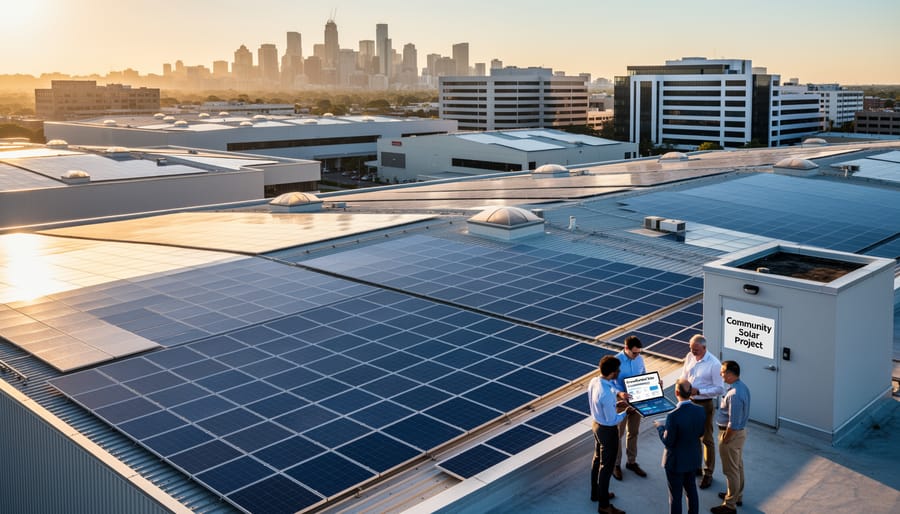
Crowdfunding presents compelling financial advantages for commercial solar adopters seeking to minimize capital constraints while maximizing deployment speed. Unlike traditional financing methods that require substantial upfront investment or lengthy loan approval processes, renewable energy crowdfunding platforms enable businesses to access distributed capital from multiple investors, significantly reducing the immediate financial burden on company balance sheets.
The primary benefit lies in preserved cash flow. Rather than allocating large capital reserves to solar infrastructure, businesses can leverage crowdfunded financing structures that allow for gradual repayment through power purchase agreements or lease arrangements. This approach maintains working capital availability for core operations, expansion initiatives, and unexpected business needs. Many commercial adopters report achieving electricity rate reductions of 15-30% compared to grid prices while avoiding the traditional financing costs associated with equipment loans or lease premiums.
Risk distribution represents another strategic advantage. Crowdfunding platforms inherently spread investment risk across numerous participants, creating a more stable financing ecosystem. For businesses, this translates to reduced exposure if project parameters change or if energy consumption patterns shift over the installation lifecycle. The shared investment model also accelerates project timelines, as capital aggregation occurs faster than conventional lending processes, enabling businesses to begin realizing energy savings months earlier than traditional approaches allow.
Furthermore, adopting crowdfunded solar installations aligns with broader ESG investment criteria that increasingly influence corporate valuation and stakeholder perception. Companies demonstrating commitment to sustainable energy solutions often experience enhanced reputation benefits and improved access to sustainability-focused capital markets. The connection between renewable energy adoption and financial performance extends to opportunities in carbon credits and solar ROI, further strengthening the business case for crowdfunding as a viable solar financing mechanism.
Real-world applications demonstrate that businesses utilizing crowdfunding platforms typically achieve full system deployment within 6-9 months from initial commitment, compared to 12-18 months through traditional financing channels, accelerating both environmental impact and financial returns.
Critical Considerations Before Pursuing Crowdfunded Solar
Before committing to crowdfunded solar financing, business decision-makers must conduct comprehensive due diligence across several critical dimensions to ensure project viability and regulatory compliance.
Regulatory compliance represents the foremost consideration. Crowdfunding platforms operate under specific securities regulations that vary by jurisdiction. Businesses must verify that platforms hold appropriate licenses and that investment offerings comply with local financial regulations. In the European Union, this includes adherence to the European Crowdfunding Service Providers Regulation, which establishes harmonized rules across member states. Failure to work with compliant platforms can expose businesses to legal liability and jeopardize project completion.
Ownership structures require careful examination. Different crowdfunding models create distinct relationships between businesses, investors, and solar assets. Equity-based models grant investors partial ownership stakes, potentially affecting future business decisions and exit strategies. Debt-based arrangements create repayment obligations that must align with projected energy savings and cash flow. Revenue-sharing agreements tie investor returns to actual solar production, transferring certain performance risks. Understanding these structures ensures alignment with long-term business objectives.
Platform reliability serves as a critical success factor. Businesses should evaluate platforms based on track record, completed project history, default rates, and financial stability. Platforms with established operational histories, transparent reporting practices, and robust investor communication demonstrate greater reliability. Examining case studies of projects similar in size and scope provides valuable insight into platform capabilities and potential challenges.
Ongoing obligations extend beyond initial funding. Businesses must understand reporting requirements to investors, performance monitoring expectations, and communication protocols throughout the project lifecycle. Some arrangements require regular financial disclosures or energy production updates, demanding administrative resources and ongoing transparency.
Investor expectations shape project parameters and must be thoroughly understood before engagement. Crowdfunded projects typically promise specific return profiles, which depend on accurate energy production forecasts, stable electricity rates, and consistent system performance. Businesses must ensure their projections are conservative and achievable to maintain investor confidence and avoid disputes.
Assessing project viability requires independent technical evaluation beyond platform-provided assessments. Engaging solar consultants to review system design, production estimates, equipment specifications, and installation plans provides objective verification. This independent analysis helps identify potential risks that might affect both project performance and investor satisfaction, ultimately protecting business interests while ensuring successful project outcomes.
Integration with Professional Solar Installation Services
Securing crowdfunding capital represents only the first phase of a successful solar deployment. To maximize return on investment and ensure long-term system performance, businesses must partner with accredited professional solar installation services regardless of their funding source. This strategic approach bridges alternative financing with technical expertise, creating a comprehensive solution that delivers both capital access and installation quality.
Professional solar providers bring essential value that crowdfunding alone cannot supply. Accredited installers conduct detailed site assessments, engineering reviews, and load calculations that optimize system design for specific facility requirements. They navigate permitting processes, utility interconnection protocols, and compliance requirements that vary across jurisdictions. Most importantly, certified installers provide warranties and performance guarantees that protect your investment beyond the initial installation phase.
When structuring a crowdfunding campaign, proactively engage qualified solar contractors to develop accurate project specifications and cost estimates. This partnership strengthens investor confidence by demonstrating professional oversight and realistic financial projections. Reputable installers can provide technical documentation, equipment specifications, and performance modeling that enhance campaign credibility and attract informed investors.
Post-installation monitoring and maintenance prove equally critical. Professional solar providers offer ongoing system monitoring services that track energy production, identify performance anomalies, and optimize output over the system’s 25-30 year lifespan. These services typically include remote diagnostics, preventive maintenance schedules, and rapid response protocols for system issues. A manufacturing facility in Barcelona successfully combined crowdfunding proceeds with a professional installer’s monitoring package, achieving 99.2 percent uptime and identifying optimization opportunities that increased annual production by eight percent. This comprehensive approach ensures that crowdfunded solar projects deliver the projected returns that attracted investors initially, while maintaining system integrity through professional oversight and technical expertise.

Renewable energy crowdfunding represents a fundamental shift in how businesses can access commercial solar installations. By distributing investment across multiple stakeholders, this financing model removes the traditional barriers that have prevented many organizations from pursuing sustainable energy solutions. The evidence from successful deployments across Europe demonstrates that crowdfunding platforms enable businesses of all sizes to implement solar projects that deliver measurable environmental impact alongside substantial long-term cost savings.
The democratization of solar financing means that upfront capital requirements no longer dictate your energy strategy. Whether you manage a single facility or oversee multiple commercial properties, crowdfunding options provide flexible pathways to reduce operational expenses while advancing corporate sustainability objectives. The case studies examined throughout this article illustrate how diverse organizations have leveraged these platforms to achieve energy independence without compromising financial stability.
For decision-makers evaluating their energy portfolio, the integration of crowdfunding mechanisms warrants serious consideration. Begin by conducting a comprehensive assessment of your facilities’ solar potential, including roof space analysis, energy consumption patterns, and available incentives. Simultaneously, research established crowdfunding platforms that align with your project scale and financial requirements. Compare platform terms, review investor structures, and examine the track record of completed projects in your sector.
The convergence of accessible financing and proven solar technology creates an unprecedented opportunity for businesses committed to sustainable operations. Taking action now positions your organization to capture both immediate operational benefits and long-term competitive advantages in an increasingly carbon-conscious marketplace.