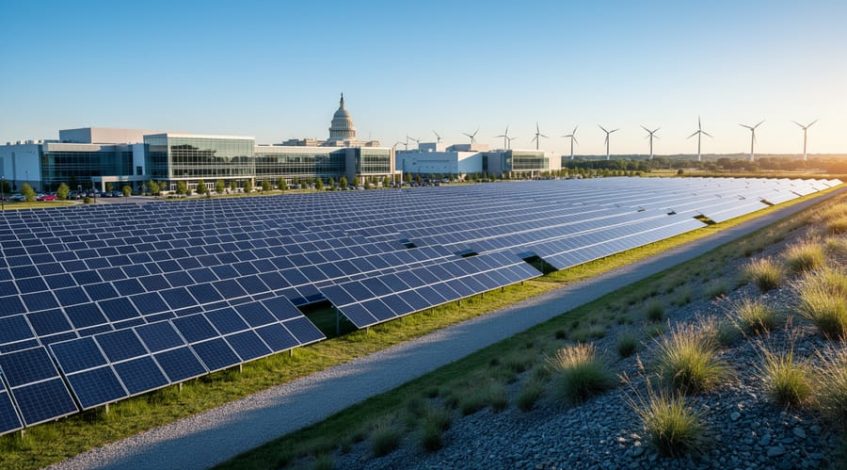
Solar power has emerged as a transformative force in the global energy landscape, yet its environmental impact extends far beyond the commonly understood carbon reduction narrative. For business leaders and government officials navigating today’s complex policy environment, understanding the complete environmental profile of solar energy is essential for making informed investment and regulatory decisions.
The environmental equation of solar power encompasses significant benefits alongside nuanced challenges. On the positive side, utility-scale solar installations eliminate approximately 900 pounds of carbon dioxide per megawatt-hour compared to coal-fired generation, while producing zero direct emissions during operation. Manufacturing facilities report air quality improvements within 50-mile radiuses of major solar deployments, translating to measurable public health benefits and reduced healthcare costs.
However, comprehensive environmental assessment must account for the full lifecycle impact. Solar panel manufacturing requires energy-intensive processes and materials extraction, including silicon, silver, and rare earth elements. Water consumption during production and panel cleaning, land use requirements averaging 5-10 acres per megawatt for utility installations, and end-of-life recycling challenges represent considerations that policy frameworks increasingly address through updated regulations and industry standards.
The intersection of environmental impact and policy creates direct financial implications for business adopters. Current federal Investment Tax Credits and state-level renewable portfolio standards enhance project economics while advancing environmental objectives. Understanding this policy-environment-business relationship enables stakeholders to optimize solar investments for both financial returns and environmental stewardship, positioning organizations competitively in an economy increasingly defined by sustainability metrics and regulatory compliance requirements.
The Environmental Case for Solar: Beyond Carbon Reduction
Quantifying Carbon Displacement in Commercial Applications
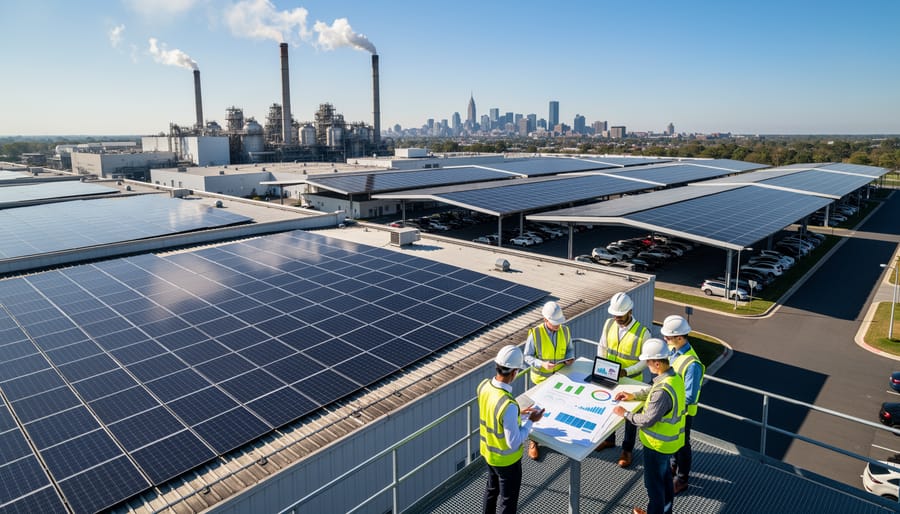
Commercial solar installations deliver quantifiable carbon displacement that extends far beyond theoretical projections. Recent data from large-scale deployments demonstrates that a typical 500-kilowatt commercial solar array prevents approximately 600 metric tons of CO2 emissions annually, equivalent to removing 130 passenger vehicles from roads for one year.
A manufacturing facility in Queensland installed a 750-kilowatt rooftop system in 2018, displacing 4,200 metric tons of carbon dioxide over its five-year operational period. This displacement equals the carbon sequestration capacity of 4,900 acres of forest annually. The system’s environmental payback period—the time required to offset emissions from manufacturing and installation—was achieved within 2.3 years, with an additional 23 years of net-positive environmental impact expected.
Similarly, a retail distribution center in New South Wales implemented a 1.2-megawatt solar installation that reduced grid dependency by 68 percent. Over three years, this facility documented emissions reductions of 2,880 metric tons while maintaining operational efficiency. The solar technology breakthroughs enabling higher conversion efficiency have amplified these environmental benefits, with newer installations achieving 15-20 percent greater carbon displacement compared to systems installed just five years ago.
These measurable outcomes provide facility managers and business leaders with concrete environmental impact data that supports sustainability reporting requirements and demonstrates corporate environmental responsibility through verifiable metrics rather than aspirational commitments.
Resource Efficiency Compared to Conventional Energy
Commercial-scale solar installations demonstrate substantial resource efficiency advantages over conventional power generation. Solar photovoltaic systems require virtually no water for electricity production, contrasting sharply with thermal power plants that consume approximately 20,000 to 60,000 gallons per megawatt-hour for cooling processes. This distinction proves particularly valuable in water-stressed regions where facilities face increasing operational constraints.
Land use comparisons reveal nuanced efficiency metrics. While solar arrays require more surface area per megawatt than traditional plants, dual-use applications increasingly maximize land value. Agricultural operations now integrate solar installations through agrivoltaics, maintaining crop production while generating electricity. A 2022 analysis of commercial solar facilities in the Southwest demonstrated that properly designed installations can preserve 80 percent of land for grazing or specialized crop cultivation.
Resource extraction requirements favor solar systems significantly over fossil fuel operations. Coal and natural gas facilities demand continuous fuel extraction, processing, and transportation infrastructure throughout their operational lifetime. Solar installations require one-time manufacturing inputs, primarily silicon, aluminum, and glass, with established recycling protocols recovering up to 95 percent of materials at end-of-life. Commercial operators report that modern solar panels offset their manufacturing resource consumption within 1.5 to 2 years of operation, delivering net resource savings across their 25-plus year lifespan.
Environmental Policies Driving Solar Industry Growth
Carbon Pricing and Emissions Trading Systems
Carbon pricing mechanisms create direct financial incentives that significantly enhance solar energy’s competitive position in the marketplace. Cap-and-trade systems, implemented across California, the European Union, and eleven northeastern U.S. states through the Regional Greenhouse Gas Initiative, establish declining emissions limits while allowing companies to trade carbon allowances. Organizations exceeding their allocated emissions must purchase additional permits, making high-emission operations increasingly expensive. This market dynamic shifts the total cost of ownership calculation in solar’s favor.
Carbon taxes function more directly by imposing fixed fees per ton of carbon dioxide emitted. Canada’s federal carbon pricing system, starting at $40 per ton in 2021 and escalating to $170 by 2030, demonstrates this approach’s economic impact. Manufacturing facilities and commercial operations face substantial ongoing costs for grid electricity derived from fossil fuels, while solar installations eliminate these recurring carbon-related expenses entirely.
The European Union’s Emissions Trading System, covering approximately 40 percent of the bloc’s greenhouse gas emissions, has generated carbon prices exceeding €80 per ton. At these levels, businesses investing in solar photovoltaic systems achieve accelerated payback periods, often reducing return-on-investment timelines by 2-3 years compared to markets without carbon pricing. Major corporations including Microsoft, Amazon, and Walmart cite carbon pricing exposure as a primary driver behind their substantial solar procurement commitments, recognizing that renewable energy investments provide protection against escalating carbon costs while simultaneously reducing environmental impact.
Renewable Energy Mandates and Targets
Government renewable energy mandates and corporate sustainability requirements are creating unprecedented demand for commercial solar installations. Many jurisdictions have established binding renewable energy targets, with some requiring 50% or higher renewable energy generation by 2030. These legislative frameworks effectively guarantee market demand while reducing investment risk for businesses considering solar adoption.
Corporate renewable energy procurement mandates, particularly for large facilities and industrial operations, compel organizations to meet specific sustainability thresholds. Fortune 500 companies increasingly face shareholder pressure and regulatory requirements to reduce carbon footprints, making solar installations not merely optional but strategically essential. This shift has contributed to solar’s business transformation from alternative energy source to mainstream infrastructure investment.
Government incentive programs complement these mandates, offering accelerated depreciation, tax credits, and renewable energy certificates. These mechanisms create favorable financial conditions while ensuring compliance with environmental targets. For facility managers and business owners, understanding applicable mandates provides clarity on timeline requirements and potential penalties for non-compliance.
Real-world applications demonstrate effectiveness: California’s renewable portfolio standard has driven substantial commercial solar growth, while European Union directives have accelerated corporate sustainability commitments. These policy frameworks establish predictable regulatory environments, enabling informed long-term energy planning and investment strategies.
Green Building Standards and Environmental Certifications
Green building certification programs have emerged as powerful drivers of solar adoption in commercial and government sectors. Leadership in Energy and Environmental Design (LEED) and Building Research Establishment Environmental Assessment Method (BREEAM) award substantial points for renewable energy integration, making solar installations strategically valuable for organizations pursuing certification. LEED version 4, for instance, allocates up to 18 points under the Energy and Atmosphere category for renewable energy generation, directly influencing project feasibility decisions.
The financial implications extend beyond environmental benefits. A 2022 analysis of LEED-certified buildings showed an average 20% premium in property value compared to non-certified equivalents, with solar installations contributing significantly to achieving higher certification tiers. Government facilities seeking LEED Gold or Platinum status routinely incorporate solar arrays to meet renewable energy thresholds while demonstrating fiscal responsibility.
BREEAM’s international framework similarly incentivizes solar adoption through its energy performance requirements, particularly influential in European and Asian markets. Organizations pursuing Green Star, Living Building Challenge, or ENERGY STAR certification find solar integration essential for meeting stringent energy efficiency benchmarks, creating a comprehensive ecosystem where environmental standards directly translate into increased solar deployment across commercial real estate portfolios.
Addressing the Environmental Considerations of Solar Infrastructure
Manufacturing and Supply Chain Environmental Standards
The solar manufacturing industry operates under increasingly stringent environmental regulations designed to minimize the ecological footprint of production processes. In the European Union, the Restriction of Hazardous Substances (RoHS) directive limits toxic materials in solar panel manufacturing, while the Waste Electrical and Electronic Equipment (WEEE) directive mandates responsible end-of-life panel recycling. Similarly, the United States enforces Environmental Protection Agency standards governing emissions and waste management at manufacturing facilities.
Leading manufacturers are adopting sustainable supply chain practices that extend beyond regulatory compliance. These include sourcing conflict-free minerals, implementing closed-loop water systems, and transitioning to renewable energy for factory operations. For example, several major panel manufacturers now operate carbon-neutral facilities, demonstrating that sustainable production methods can coexist with commercial viability.
Material sourcing policies have evolved significantly, with industry certifications like the Solar Stewardship Initiative establishing benchmarks for responsible manufacturing. These standards address labor practices, resource extraction impacts, and supply chain transparency. For business decision-makers, understanding these regulations provides assurance that solar investments align with corporate sustainability goals while meeting increasingly rigorous environmental, social, and governance criteria expected by stakeholders and investors.
End-of-Life Management and Circular Economy Policies
The solar industry is experiencing a significant shift toward comprehensive end-of-life management frameworks as early installations from the 2000s approach decommissioning. The European Union’s Waste Electrical and Electronic Equipment Directive now mandates that solar panel manufacturers take responsibility for collecting and recycling their products, with recovery targets of 85% by weight and recycling targets of 80%. Similar extended producer responsibility policies are emerging in California, Washington, and other U.S. states, creating financial accountability throughout the product lifecycle.
These regulatory developments are driving innovation in recycling technology. Current processes can recover approximately 95% of glass, 85% of silicon, and nearly all aluminum and copper from decommissioned panels. Companies like First Solar have established closed-loop recycling systems that recover semiconductor materials for use in new panels, demonstrating the technical feasibility of circular economy models. The value of recovered materials—estimated at $450 million globally by 2030—is transforming waste management from a cost center into a potential revenue stream.
For commercial solar investors, these policies create planning requirements but also risk mitigation opportunities. Many jurisdictions now require decommissioning bonds or financial assurance mechanisms, typically 3-7% of total project costs. However, forward-thinking organizations are partnering with manufacturers offering take-back programs and guaranteed recycling services, reducing long-term liability exposure.
Industry associations are developing best practice standards for site restoration, with successful implementations showing land can return to agricultural or ecological use within 6-12 months of panel removal. This demonstrates solar energy’s advantage over conventional power generation, where site remediation can take decades and cost significantly more.

Financial Incentives Tied to Environmental Performance
Environmental Tax Credits and Accelerated Depreciation
Businesses investing in solar power can leverage substantial financial incentives tied directly to environmental performance metrics. The federal Investment Tax Credit (ITC) currently offers a 30% credit on solar installation costs through 2032, with projects meeting domestic content requirements eligible for additional 10% bonuses. The Modified Accelerated Cost Recovery System (MACRS) allows commercial solar installations to be depreciated over five years, significantly improving cash flow and reducing tax liability in early project years.
Environmental bonus credits reward facilities that demonstrate measurable emission reductions and operate in low-income or energy community zones. These adders can increase total project credits by 20-30%, directly enhancing return on investment. Commercial installations achieving LEED certification or meeting specific carbon reduction thresholds may qualify for state-level production-based incentives, generating ongoing revenue streams beyond energy savings.
For facility managers evaluating solar investments, combining accelerated depreciation with environmental tax credits typically yields 3-7 year payback periods, with internal rates of return exceeding 15% in optimal conditions. Documentation of environmental impact metrics strengthens eligibility for these incentives while supporting corporate sustainability reporting requirements and stakeholder communications.
Green Financing and Preferential Loan Programs
Financial institutions increasingly recognize solar energy’s environmental benefits by offering specialized lending products that reduce project costs. Green bonds have emerged as a primary funding mechanism, allowing organizations to raise capital specifically for environmental projects while demonstrating corporate sustainability commitments. These bonds typically offer competitive rates and attract environmentally conscious investors seeking measurable impact.
Banks and development finance institutions now provide preferential lending rates for solar installations meeting strict environmental standards. Projects demonstrating reduced carbon emissions, minimal land disruption, and responsible supply chain practices often qualify for interest rate reductions of 0.5-2 percentage points below standard commercial rates. These savings significantly improve project economics and accelerate return on investment timelines.
Government-backed loan guarantee programs further reduce borrowing costs by mitigating lender risk. The Environmental Finance Corporation’s recent analysis shows that combining green bonds with preferential rates can reduce total financing costs by 15-25 percent compared to conventional loans. For commercial installations exceeding 500kW, this translates to savings of $50,000-$200,000 over typical 15-year loan terms.
Facility managers should explore these innovative financing options when planning solar deployments, as environmental certification requirements align naturally with best practices in site selection and installation methodology.
Real-World Impact: Case Studies in Policy-Driven Solar Adoption
Policy-driven solar adoption has transformed how organizations approach renewable energy investments, with measurable environmental and business outcomes emerging across multiple sectors. These real-world examples demonstrate the effectiveness of environmental policies in accelerating commercial solar deployment.
Amazon’s Australian fulfillment centers provide a compelling case study in policy-responsive solar adoption. Following the introduction of Australia’s Large-scale Renewable Energy Target and state-based environmental regulations, Amazon installed 22-megawatt solar arrays across its Sydney and Melbourne facilities in 2020. The installations reduce carbon emissions by approximately 36,000 metric tons annually while delivering estimated energy cost savings of 25-30 percent. The company’s decision was directly influenced by renewable energy certificate requirements and carbon reduction mandates, demonstrating how regulatory frameworks can align environmental objectives with operational efficiency. These commercial solar innovations incorporated advanced monitoring systems and battery storage, setting new benchmarks for industrial-scale implementations.
The South Australian Government’s Adelaide Desalination Plant represents successful policy integration in critical infrastructure. Responding to the state’s renewable energy target of 100 percent by 2030, the facility installed a 3.1-megawatt solar system in 2019, supplemented by renewable energy purchases. This configuration ensures the plant operates carbon-neutral while processing 100 gigaliters of water annually. The project avoided approximately 3,500 tons of CO2 emissions yearly and reduced operational costs by 18 percent, proving that environmental compliance and fiscal responsibility can coexist in public sector applications.
Coca-Cola Europacific Partners’ Queensland bottling facility illustrates industrial sector adaptation to environmental policies. The 1.2-megawatt rooftop solar installation, completed in 2021, was motivated by corporate sustainability commitments and state-level emissions reduction policies. The system powers 30 percent of facility operations, eliminates 1,800 tons of annual carbon emissions, and achieved payback within seven years. The installation included heat recovery systems that further improved environmental performance, showcasing how policy incentives can drive comprehensive efficiency upgrades beyond basic solar deployment.
These cases collectively demonstrate that well-designed environmental policies create predictable investment conditions, enabling organizations to pursue solar installations that deliver quantifiable environmental benefits alongside positive financial returns.
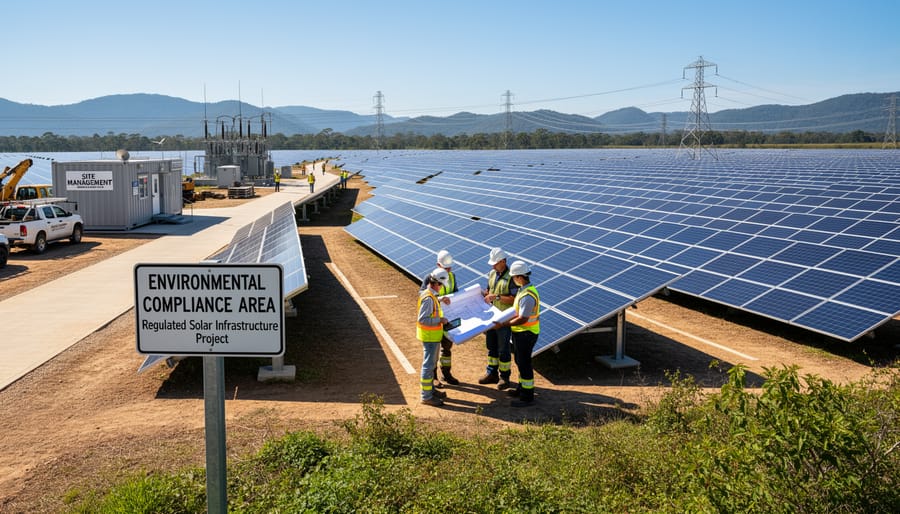
Environmental policies have created a powerful virtuous cycle in the solar industry, simultaneously accelerating adoption while establishing crucial environmental safeguards throughout the entire lifecycle of solar installations. This regulatory framework addresses both the immediate benefits of renewable energy deployment and the longer-term environmental considerations of manufacturing, installation, and decommissioning processes.
As we look ahead, emerging environmental regulations will increasingly shape commercial solar investment decisions. The growing emphasis on supply chain transparency, carbon accounting standards, and circular economy principles means businesses must consider not just the operational benefits of solar systems, but also the environmental credentials of their equipment suppliers and installation partners. Recent policy developments in extended producer responsibility and end-of-life management requirements are already influencing procurement strategies, with forward-thinking organizations prioritizing suppliers who demonstrate comprehensive environmental stewardship.
The integration of environmental, social, and governance criteria into corporate decision-making further reinforces this trend. Businesses that proactively align their energy strategies with evolving environmental regulations position themselves advantageously, avoiding compliance risks while capturing incentives designed to reward environmental leadership.
For organizations evaluating energy strategies, the imperative is clear: conduct a thorough assessment of how current and anticipated environmental policies impact your operations. Consider not only immediate incentives and compliance requirements, but also longer-term policy trajectories. Engage with experienced solar professionals who understand the intersection of environmental policy and commercial energy systems. By taking action now, businesses can develop resilient energy strategies that deliver financial returns while meeting increasingly stringent environmental standards, ensuring competitiveness in a policy landscape that increasingly rewards sustainable practices.