
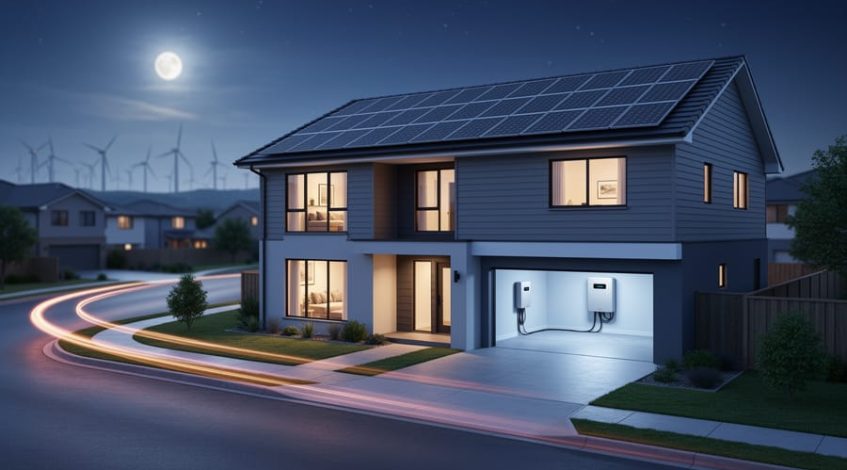
Artificial intelligence systems consume between 0.3 to 2 kilowatt-hours per query for advanced models, raising legitimate concerns about their energy footprint in commercial and industrial applications. However, this perspective misses the complete picture: AI-powered smart energy management systems typically reduce overall facility energy consumption by 15-30%, far exceeding the energy cost of running the AI itself.
The equation shifts dramatically when examining real-world implementations. A mid-sized commercial facility running AI optimization software uses approximately 50-100 kilowatt-hours monthly for the AI system while achieving savings of 5,000-15,000 kilowatt-hours through predictive load management, automated HVAC adjustments, and optimized equipment scheduling. This creates a net energy reduction ratio of 50:1 to 150:1, transforming AI from an energy concern into a compelling efficiency solution.
For organizations evaluating solar installations or seeking to maximize existing renewable energy assets, AI becomes particularly valuable. These systems analyze weather patterns, grid pricing, battery storage capacity, and consumption forecasts in real-time, ensuring every kilowatt generated delivers maximum value. Recent deployments across commercial properties demonstrate payback periods of 18-24 months purely from energy savings, with additional benefits including reduced equipment maintenance costs and extended asset lifecycles.
Understanding both the energy investment required for AI and its multiplier effect on facility-wide efficiency enables informed decision-making about implementation timing, system sizing, and expected returns.
The Reality Behind AI Energy Consumption Concerns
Edge Computing: AI That Lives in Your Home
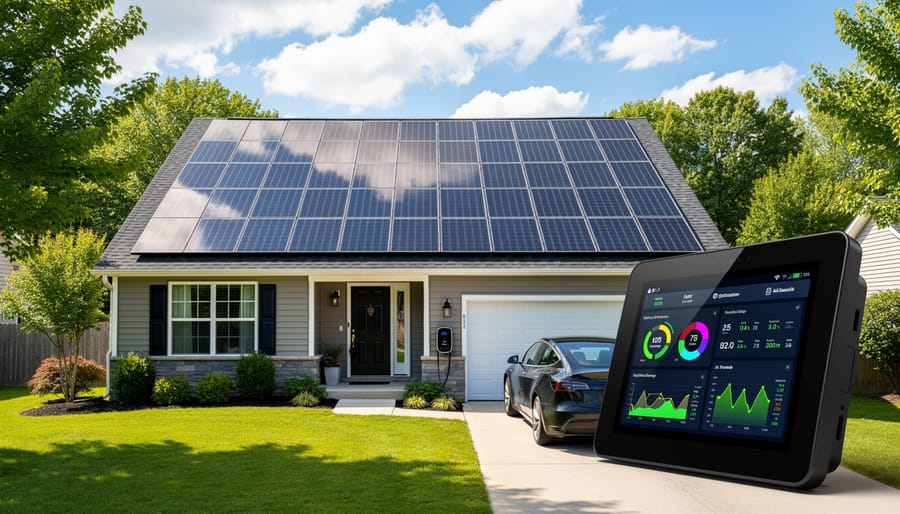
Modern residential AI energy management systems leverage edge computing to deliver sophisticated optimization without the energy overhead traditionally associated with artificial intelligence. Edge computing processes data locally on devices installed within your facility rather than transmitting information to remote data centers, fundamentally changing the energy equation for AI-powered solutions.
Traditional cloud-based AI systems require constant data transmission and rely on massive server farms that consume substantial electricity. Edge computing eliminates this dependency by running AI algorithms directly on local processors. For residential and commercial solar installations, this means AI optimization occurs on compact hardware units that typically consume between 5-15 watts—comparable to a standard LED light bulb.
The energy efficiency advantage becomes particularly significant when measured against the energy savings these systems deliver. A residential edge AI system managing solar panels, battery storage, and load distribution typically consumes less than 130 kilowatt-hours annually while optimizing systems that generate and manage 10,000-30,000 kilowatt-hours. This creates a remarkable 75:1 to 230:1 return on energy investment.
Real-world implementation demonstrates this efficiency. A commercial facility in Arizona reduced its grid dependency by 68% using edge-based AI that consumed only 0.04% of the energy it helped optimize. The system processed weather forecasts, occupancy patterns, and equipment schedules locally, adjusting solar production and storage allocation in real-time without cloud connectivity.
This localized processing approach also enhances system reliability and data security—critical considerations for business owners managing sensitive operational information while pursuing aggressive sustainability targets.
The Energy ROI of Smart Optimization
The financial case for AI-powered energy management becomes compelling when examining actual consumption data. Current generation AI optimization systems typically consume between 0.3% and 0.8% of the total energy savings they generate. For a commercial facility saving 100,000 kWh annually through AI optimization, the system itself draws only 300 to 800 kWh—a remarkably efficient ratio that delivers immediate return on investment.
Real-world deployments demonstrate these economics clearly. A 250,000 square-foot manufacturing plant in California integrated AI management with their solar array, achieving 23% reduction in grid dependency. The AI system’s annual consumption measured 2,400 kWh while facilitating savings of 340,000 kWh—representing 0.7% overhead. At commercial electricity rates, this translated to $51,000 in annual savings against $360 in AI system operating costs.
Similar results appear across diverse applications. A municipal building network in Texas reported that their AI platform consumed $180 monthly in electricity while generating $28,000 monthly in combined energy savings and demand charge reductions. The technology pays for its operational costs within the first week of each billing cycle, with remaining savings flowing directly to the bottom line. These metrics establish AI energy management as one of the highest-ROI infrastructure investments available to facility managers today.
How AI-Powered Energy Optimization Actually Works
Pattern Recognition and Predictive Analytics
Modern AI systems excel at identifying complex patterns in energy consumption data, enabling unprecedented optimization of residential and commercial energy usage. These systems continuously analyze multiple data streams—household consumption patterns, local weather forecasts, grid pricing fluctuations, and seasonal trends—to make intelligent decisions about energy distribution and storage.
Machine learning algorithms process historical energy data to understand when buildings require the most power, accounting for factors like occupancy schedules, appliance usage cycles, and climate control needs. By correlating this information with weather predictions, AI anticipates heating and cooling demands hours or days in advance, optimizing HVAC systems and smart appliances for maximum efficiency.
Grid pricing integration represents a significant financial advantage. AI monitors time-of-use rates and automatically shifts energy-intensive operations to off-peak hours when electricity costs less. For facilities with battery storage, the system determines optimal charging and discharging schedules, purchasing power during low-rate periods and drawing from batteries during peak pricing windows.
A notable case study involves a commercial facility in California that implemented AI-driven energy management alongside solar panels. The system learned to pre-cool the building during morning hours using excess solar generation, reducing afternoon peak demand by 34 percent and cutting annual energy costs by $47,000. The AI continuously refined its predictions, adapting to changing occupancy patterns and weather anomalies, delivering compound efficiency gains over time.
Real-Time Load Balancing
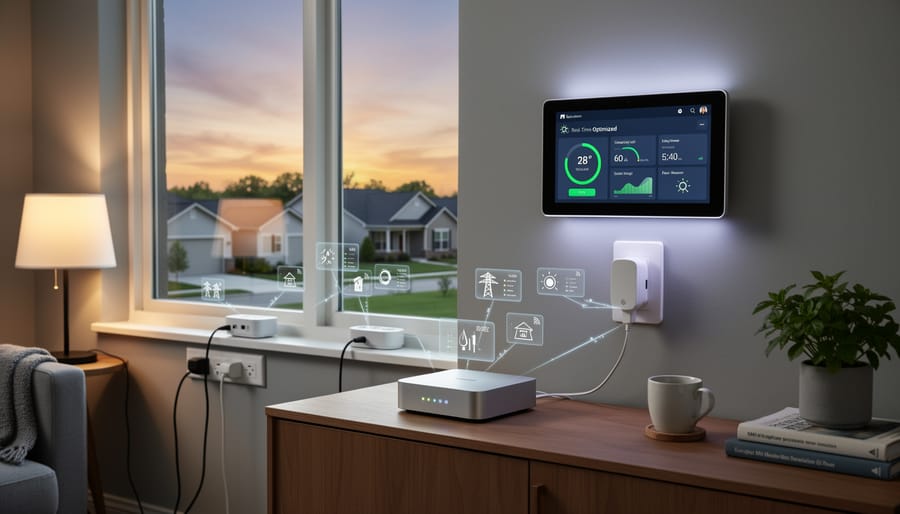
AI-powered energy management systems execute real-time load balancing by continuously analyzing multiple data streams and making instantaneous decisions about energy sourcing. These systems monitor solar panel production levels, battery state of charge, current electricity rates, and facility demand patterns to determine the most cost-effective energy source at any given moment.
The process operates on millisecond timeframes, far faster than human decision-making. When solar panels generate excess energy during peak production hours, the AI directs surplus power to battery storage while simultaneously meeting immediate facility needs. During periods of high grid electricity prices, typically late afternoon and early evening, the system automatically prioritizes battery discharge and any available solar power, minimizing expensive grid purchases.
This grid-interactive technology becomes particularly valuable during demand response events when utilities offer financial incentives for reduced consumption. The AI can instantly shift operations to stored energy, capturing these revenue opportunities without manual intervention.
Advanced systems also incorporate weather forecasting data to anticipate solar production changes. If cloud coverage is predicted, the AI may preserve battery reserves or schedule energy-intensive operations during current solar availability windows. This predictive capability ensures facilities maintain optimal performance while achieving maximum cost savings, with many commercial installations reporting 30-40% reductions in energy expenses through intelligent load balancing alone.
Solar Energy and AI: The Perfect Partnership
Maximizing Solar Self-Consumption Rates
AI-powered energy management systems deliver substantial grid independence by intelligently aligning energy-intensive operations with peak solar production windows. Through continuous monitoring of both solar generation patterns and facility energy demands, these systems automatically schedule high-consumption activities—such as HVAC pre-conditioning, water heating, battery charging, and equipment operations—during hours of maximum solar output, typically between 10 AM and 3 PM.
Leading commercial facilities implementing AI-driven solar optimization have documented grid dependency reductions of 40-60%, with some industrial operations achieving even higher self-consumption rates. A California-based manufacturing facility reduced daytime grid purchases by 52% within the first year by shifting production schedules and running energy-intensive machinery during solar peak hours.
The technology employs predictive algorithms that analyze historical weather data, seasonal patterns, and real-time cloud coverage to forecast solar production with remarkable accuracy. This enables proactive load scheduling rather than reactive adjustments. For instance, AI systems can initiate thermal storage processes when solar generation exceeds immediate demand, effectively banking excess energy for later use.
The financial impact proves equally compelling. Businesses typically see 15-25% reductions in monthly energy costs while simultaneously extending solar panel ROI. This optimization transforms solar installations from supplementary power sources into primary energy providers, fundamentally reshaping facility energy economics and accelerating the transition toward energy independence.
Battery Storage Optimization
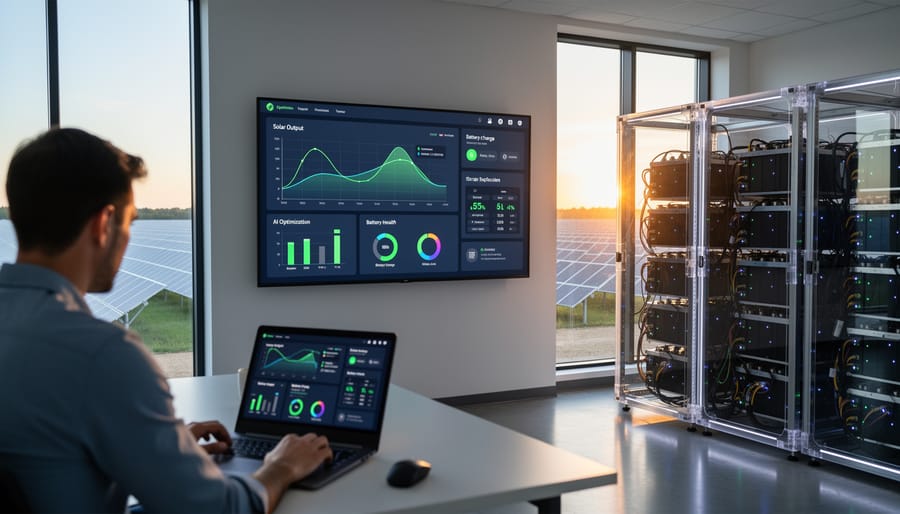
Artificial intelligence transforms how energy storage systems operate by continuously analyzing usage patterns, grid conditions, and weather forecasts to optimize charge and discharge cycles. Modern AI algorithms can predict energy demand with remarkable accuracy, ensuring batteries charge during periods of excess solar generation or low grid prices while discharging during peak demand times. This intelligent management significantly extends battery lifespan by preventing overcharging, deep discharging, and other stress factors that degrade storage capacity.
Battery storage optimization through AI delivers measurable financial returns. A commercial facility in Queensland implemented AI-powered battery management and achieved a 40% improvement in battery efficiency within the first year. The system learned the building’s energy consumption patterns and adjusted storage protocols accordingly, reducing peak demand charges by 35% while maintaining energy availability during critical hours.
AI systems also account for temperature fluctuations, seasonal variations, and equipment degradation to adjust operational parameters automatically. This proactive approach prevents costly premature battery replacement and maximizes return on investment. For businesses with multiple storage units, AI coordinates their operation as a unified system, optimizing capacity allocation and ensuring backup power availability when needed most.
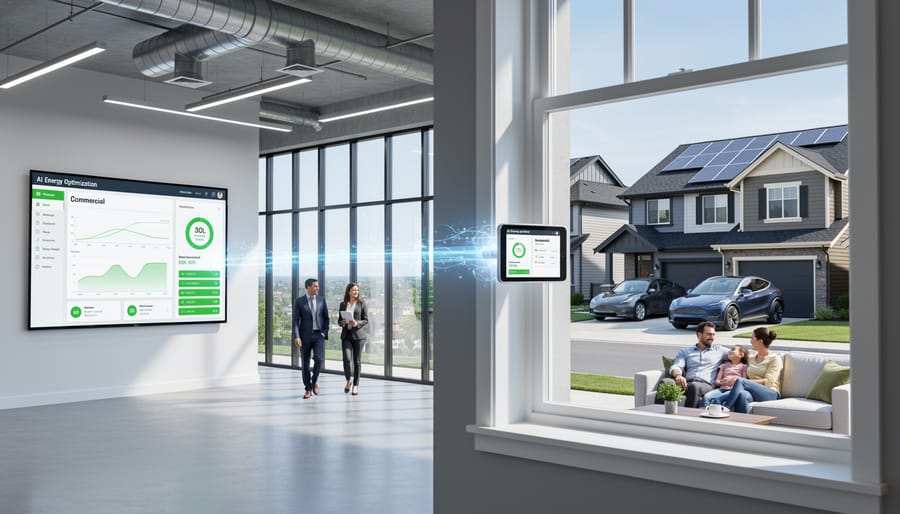
Real-World Performance: Case Studies from Commercial Applications
Manufacturing Facility Energy Reduction
A mid-sized automotive parts manufacturer in Michigan implemented an AI-driven energy management system alongside a 250kW solar array, achieving measurable results within the first year of operation. The facility, which operates two production shifts daily, previously spent approximately $42,000 monthly on electricity costs.
The AI system monitored 187 individual power consumption points throughout the facility, including CNC machines, HVAC systems, compressed air equipment, and lighting. By analyzing production schedules, weather patterns, and real-time energy prices, the system optimized equipment runtime and solar energy utilization. The AI algorithm identified that 34% of energy consumption occurred during non-production hours due to equipment left in standby mode and inefficient climate control scheduling.
After implementing AI recommendations and integrating solar generation forecasts into production planning, the facility reduced total energy costs by 28% within twelve months. Solar panels contributed 42% of daytime energy requirements during peak production hours, while AI optimization reduced overall consumption by 19%. The combined approach delivered annual savings of $141,120, resulting in a projected ROI of 4.2 years on the total system investment of $590,000, including both solar installation and AI infrastructure.
Government Building Smart Integration
A federal courthouse in Sacramento, California demonstrates the practical application of AI-driven energy management at the municipal level. The facility installed a 400kW solar array paired with 600kWh of battery storage, integrated with an AI platform that analyzes weather patterns, building occupancy schedules, and utility rate structures in real-time.
The system achieved grid independence during peak demand hours within six months of implementation. The AI algorithms learned the building’s energy consumption patterns and optimized battery discharge timing to coincide with the utility’s highest rate periods between 4 PM and 9 PM. During these hours, the facility operates entirely on stored solar energy, eliminating approximately $47,000 in annual peak demand charges.
The platform also coordinates HVAC operations with solar production forecasts, pre-cooling the building during high-generation periods and reducing compressor loads when clouds are anticipated. This predictive approach resulted in a 34 percent reduction in grid-supplied electricity compared to the previous year, while maintaining consistent indoor climate standards required for government operations. The facility now serves as a model for other municipal buildings evaluating similar energy independence strategies, with total project payback projected at 7.2 years including federal incentives.
Multi-Unit Residential Complex Success
A 240-unit residential complex in Denver implemented an AI-driven energy management system to optimize their 500kW shared solar array and building operations. The system monitors energy generation, storage capacity, and consumption patterns across all units in real-time, automatically adjusting HVAC systems, common area lighting, and electric vehicle charging schedules to maximize solar utilization.
Within the first year, the complex reduced grid dependency by 67 percent and decreased overall energy costs by $180,000 annually. The AI system learned resident behavior patterns and seasonal variations, proactively shifting non-essential energy loads to peak solar production hours. During winter months with reduced solar output, the system prioritized heating efficiency while managing the community’s battery storage to minimize demand charges.
The implementation cost of $95,000 for AI integration achieved payback in just seven months through energy savings and reduced peak demand charges. Residents experienced no lifestyle changes while benefiting from lower utility costs. The system’s predictive maintenance capabilities identified underperforming solar panels and equipment issues before they caused significant energy losses, adding an estimated $22,000 in avoided repair costs. This case demonstrates that AI energy management delivers measurable returns even in residential applications with shared renewable resources.
Implementing AI Energy Optimization in Your Facility
System Requirements and Compatibility
Modern AI energy optimization platforms require minimal technical infrastructure to deliver meaningful results. Most systems operate through cloud-based architectures, eliminating the need for expensive on-site hardware investments. A stable internet connection with minimum speeds of 10 Mbps and standard network security protocols form the foundation for reliable system performance.
Smart meter compatibility represents the primary hardware requirement. Digital meters with 15-minute or 30-minute interval data transmission capabilities provide the granular consumption data necessary for accurate AI analysis. Facilities using analog meters will need digital upgrades, though utility companies increasingly provide these at no cost as part of modernization initiatives. The AI platforms integrate seamlessly with most major smart meter brands through standardized communication protocols.
For facilities with existing solar installations, AI optimization systems connect through inverter monitoring systems and energy management platforms. These smart energy tools communicate with solar equipment via API connections, requiring no physical modifications to current infrastructure. Battery storage systems integrate similarly, enabling comprehensive energy flow optimization across generation, storage, and consumption.
Most implementations require 2-4 weeks for initial setup and calibration. The AI systems learn facility-specific consumption patterns during this period, establishing baseline performance metrics. Ongoing system requirements include regular data synchronization and periodic software updates, typically managed automatically through the cloud platform with minimal administrative oversight needed from facility management teams.
Investment and Payback Timelines
Understanding the financial commitment and return timeline for AI-powered energy management systems helps decision-makers develop realistic implementation strategies. For small facilities under 50,000 square feet, initial investments typically range from $15,000 to $35,000, including AI software integration and necessary monitoring hardware. These installations generally achieve payback within 3 to 5 years through reduced energy consumption and optimized solar production.
Medium-sized facilities spanning 50,000 to 200,000 square feet should anticipate investments between $35,000 and $125,000. The payback period for these systems averages 4 to 6 years, with annual savings reaching $20,000 to $45,000 once fully operational. Large industrial complexes exceeding 200,000 square feet face higher upfront costs of $125,000 to $500,000, but benefit from accelerated returns due to scale efficiencies, typically recovering investments within 5 to 7 years.
These timelines account for current utility rates and available incentives. Federal tax credits, state rebates, and accelerated depreciation schedules can reduce effective costs by 30 to 50 percent. Real-world implementations demonstrate that facilities combining AI optimization with solar installations achieve break-even points 18 to 24 months faster than solar-only projects, while continuously generating savings throughout the system’s 20 to 25-year operational lifespan.
Future-Proofing Your Energy Infrastructure
The energy landscape is evolving rapidly, and organizations that integrate AI-powered energy management systems today are positioning themselves strategically for tomorrow’s regulatory environment and market conditions. Early adoption provides significant competitive advantages as governments worldwide implement stricter energy efficiency standards and carbon reduction mandates.
Advanced AI systems are now moving beyond simple optimization to predictive grid integration. These platforms can anticipate utility rate structures, participate in demand response programs, and even facilitate energy trading in emerging peer-to-peer markets. Organizations implementing these systems now gain operational experience that will prove invaluable as grid modernization accelerates and new revenue opportunities emerge from distributed energy resources.
Recent developments in federated learning and edge computing are reducing the computational overhead of AI energy management systems while improving their capabilities. These technological advances mean that AI solutions require progressively less energy to deliver greater optimization results, addressing concerns about the systems’ own power consumption while amplifying their net-positive impact on overall energy usage.
Consider the case of a California manufacturing facility that implemented AI-driven energy management in 2021. When the state introduced new industrial efficiency requirements in 2023, the facility was already compliant and actually qualified for incentive programs worth $47,000 annually. Their early adoption transformed a potential compliance burden into a profit center.
Furthermore, organizations with established AI energy systems can more easily integrate emerging technologies like advanced battery storage, vehicle-to-grid capabilities, and hydrogen fuel cells. The data infrastructure and machine learning models already in place adapt quickly to incorporate new energy assets, reducing implementation costs and accelerating time-to-value for future upgrades.
The regulatory trajectory is clear: energy efficiency requirements will only intensify. Organizations that deploy AI energy management systems now build institutional knowledge, establish baseline performance metrics, and create data foundations that position them to navigate future changes efficiently while capturing financial benefits unavailable to late adopters.
The evidence is compelling: AI-powered energy optimization systems deliver substantial net-positive energy outcomes that far outweigh their operational consumption. While these intelligent systems require modest energy to function—typically 50-100 watts for residential applications—they consistently reduce overall facility consumption by 15-30% through predictive algorithms, dynamic load balancing, and strategic battery management. When integrated with solar installations, AI optimization platforms can improve energy harvest efficiency by up to 40%, dramatically accelerating return on investment timelines from over a decade to as little as five years.
For facility managers and business owners evaluating their energy infrastructure, the mathematics are straightforward. An AI system consuming 876 kWh annually while saving 8,000-12,000 kWh represents a 10:1 to 14:1 return ratio—an exceptional performance metric by any standard. Real-world implementations across commercial facilities, manufacturing operations, and multi-tenant buildings have demonstrated consistent results, with organizations achieving energy independence within 3-7 years while simultaneously reducing their carbon footprint.
The path forward requires action. Facility managers should conduct comprehensive energy audits to establish baseline consumption patterns and identify optimization opportunities. Business owners must evaluate their current solar capacity against potential AI-enhanced performance gains. Government officials and industry leaders should recognize these systems as critical infrastructure for achieving sustainability targets. The technology exists today to transform energy consumption from a recurring expense into a strategically managed asset. The question is no longer whether AI optimization delivers value, but how quickly your organization will capture its benefits.