

Recognize that Jersey Central Power & Light’s community solar program represents a strategic opportunity to reduce operational energy costs by 10-15% without capital investment, facility modifications, or the complexities of on-site installation. Decision-makers can subscribe to a portion of a local solar farm’s output and receive credits directly on monthly utility bills—making renewable energy adoption accessible even for leased facilities, historic buildings, or properties with unsuitable rooftops.
Establish a foundational understanding by evaluating your organization’s current energy consumption patterns against JCPL’s community solar subscription tiers. Request 12-24 months of utility data to identify baseline usage, then calculate potential savings based on subscription sizes ranging from 25 kW to several hundred kilowatts. This analysis positions leaders to make informed decisions about appropriate commitment levels while maintaining budget predictability through fixed subscription rates that protect against future utility rate increases.
Develop internal stakeholder buy-in by framing community solar as infrastructure modernization rather than environmental initiative alone. Present the program’s dual value proposition: immediate cost reduction through bill credits and long-term financial stability through rate protection. Municipal officials have successfully leveraged this approach to gain approval from finance committees and governing boards by emphasizing measurable ROI metrics alongside sustainability objectives.
Implement educational frameworks within your organization by designating energy champions who can translate technical program details into departmental benefits. These champions bridge the gap between utility-scale renewable concepts and practical operational advantages, ensuring that procurement teams, CFOs, and facility managers understand subscription mechanics, billing integration, and performance monitoring protocols that drive successful program participation.
Understanding JCPL Community Solar: A Foundation for Leaders

What Makes Community Solar Different
The JCPL community solar model represents a fundamental shift in how organizations and individuals access renewable energy benefits. Unlike traditional rooftop solar installations that require significant capital investment, suitable roof space, and property ownership, community solar programs operate on a subscription basis that removes these common barriers to entry.
Through this shared solar approach, multiple subscribers receive credits on their electricity bills for their portion of energy generated by a centralized solar array. Business owners can participate without installing panels on their facilities, while municipalities can meet sustainability goals without upfront infrastructure costs. The subscription model typically requires no installation fees, no equipment maintenance responsibilities, and no long-term property commitments.
This accessibility extends benefits to renters, organizations with unsuitable roof conditions, and entities operating in historic districts where traditional installations face restrictions. Subscribers simply allocate a portion of the solar farm’s output to their account, receiving proportional bill credits as the facility generates power.
For decision-makers evaluating renewable energy options, this model offers immediate participation in clean energy generation with predictable monthly costs and straightforward return on investment calculations. The program eliminates technical complexity while delivering tangible financial benefits and verified environmental impact, making solar energy adoption practical for organizations across diverse sectors and operational scales.
JCPL’s Role in New Jersey’s Clean Energy Future
Jersey Central Power & Light serves approximately 1.1 million customers across central and northern New Jersey, operating within a regulatory framework established by the New Jersey Board of Public Utilities. As a FirstEnergy company, JCPL plays a pivotal role in advancing the state’s ambitious clean energy goals, including the target to reach 100% clean energy by 2050 and develop 7,500 megawatts of offshore wind capacity by 2035.
Under New Jersey’s community solar program guidelines, JCPL facilitates subscription-based solar participation for customers who cannot install on-site systems due to space constraints, building ownership limitations, or financial barriers. The utility’s service territory encompasses diverse communities ranging from densely populated urban centers to suburban business districts, creating substantial opportunity for commercial and institutional entities to participate in shared solar projects.
JCPL operates within a competitive solar market that includes the Solar Renewable Energy Certificate program and net metering policies, though community solar offers distinct advantages for organizations seeking predictable energy cost reductions without capital investment. Understanding JCPL’s position as both utility provider and program facilitator enables decision-makers to navigate available incentives effectively while aligning sustainability initiatives with operational budgets and organizational objectives.
Why Community Leaders Need Solar Energy Literacy

Economic Development and Cost Savings Opportunities
Community leaders and government officials who understand JCPL’s community solar program can unlock substantial economic development opportunities while simultaneously reducing operational expenses. Municipal facilities, including public buildings, schools, and water treatment plants, typically face significant energy costs that strain budgets. By subscribing to community solar projects, municipalities can realize immediate savings on electricity bills without capital expenditure or infrastructure modifications.
Beyond direct cost reduction, informed leadership positions communities to attract environmentally conscious businesses seeking locations with robust renewable energy infrastructure. Companies increasingly prioritize sustainability in their site selection criteria, and municipalities demonstrating commitment to clean energy programs gain competitive advantages in economic development initiatives.
Community solar projects also generate local employment through construction, maintenance, and administrative roles. A single solar farm can create dozens of jobs during development and sustained positions for ongoing operations. Furthermore, the tax revenue generated from these installations provides additional municipal income streams without burdening residents.
Forward-thinking officials can leverage this knowledge to negotiate group purchasing agreements, securing favorable subscription rates for multiple municipal accounts. Some jurisdictions have successfully coordinated community-wide participation, amplifying cost savings through collective bargaining power while demonstrating environmental leadership. This strategic approach transforms energy procurement from a routine expense into an economic development tool that delivers measurable financial returns and positions communities as sustainable business destinations.
Meeting Constituent Demands for Clean Energy Access
Public demand for renewable energy continues to intensify as constituents recognize the environmental and economic advantages of clean power. Community solar programs like JCPL’s address a critical gap by providing inclusive access to solar benefits for residents who cannot install traditional rooftop systems. This demographic includes apartment dwellers, renters without property ownership rights, and homeowners with unsuitable roof conditions due to shading, structural limitations, or orientation constraints.
Community solar removes traditional barriers to renewable energy participation. Low-income households benefit from reduced electricity costs without upfront capital investment, while renters gain access to clean energy despite lacking property control. Organizations serving diverse constituencies can leverage JCPL’s community solar program to demonstrate responsiveness to environmental concerns while delivering tangible economic benefits.
The model proves particularly valuable for municipalities and businesses seeking to meet sustainability commitments without infrastructure modifications. By subscribing to community solar capacity, stakeholders satisfy constituent expectations for environmental leadership while maintaining budget predictability through stable energy costs. This approach transforms renewable energy from an exclusive option into a broadly accessible community resource.
Navigating Policy and Planning Decisions
Solar literacy directly influences the quality and effectiveness of policy decisions at the municipal and organizational level. When zoning boards evaluate community solar proposals, members with comprehensive understanding of JCPL’s program requirements can streamline approval processes while ensuring compliance with technical and safety standards. Government officials developing comprehensive energy plans benefit from solar knowledge that enables accurate cost-benefit analysis and realistic implementation timelines. For instance, several New Jersey municipalities have accelerated their renewable energy transitions by establishing solar-literate planning committees that effectively assess site suitability, interconnection requirements, and long-term financial implications. Business leaders and facility managers serving on advisory boards can contribute valuable insights when they understand subscriber agreements, capacity allocations, and grid integration fundamentals. This knowledge base proves essential when negotiating project terms, establishing community partnerships, and aligning solar initiatives with broader sustainability goals. Organizations that invest in educating decision-makers report more efficient approval cycles and better-informed policy frameworks that support sustainable energy infrastructure development.
Essential Knowledge Components for Community Leaders
Financial Mechanisms and Subscription Models
Understanding the financial framework of JCPL community solar programs enables informed decision-making for organizations evaluating renewable energy options. Participants subscribe to a portion of a shared solar array, typically ranging from 25% to 100% of their electricity usage, without upfront capital investment.
The billing structure operates through a straightforward credit system. Each month, subscribers receive credits on their JCPL bill based on their share of solar energy production from the community array. These credits directly offset electricity costs at the retail rate. Subscribers then pay the community solar provider a separate subscription fee, typically priced 5-15% below the value of the credits received, creating immediate savings.
For example, a commercial facility with monthly electricity costs of $2,000 might receive $1,800 in solar credits while paying $1,620 in subscription fees, yielding $180 in monthly savings. Annual savings calculations must account for seasonal production variations and potential rate adjustments.
Businesses benefit from predictable energy costs over subscription periods, typically ranging from one to twenty years, providing budget stability for financial planning. Organizations without suitable roof space or capital for dedicated solar installations gain access to renewable energy advantages previously unavailable. The subscription model eliminates maintenance responsibilities, as the array operator manages all system upkeep and performance monitoring.
Municipal facilities and non-profit organizations can redirect these savings toward core operations while advancing sustainability objectives. The absence of credit requirements or property ownership prerequisites makes community solar accessible to renters and organizations with complex facility portfolios.

Technical Fundamentals Without the Complexity
Community solar projects typically range from 1 to 5 megawatts (MW) in capacity, with each megawatt capable of serving approximately 150 to 200 households annually. Understanding these fundamentals helps decision-makers evaluate program participation effectively.
Solar array capacity refers to the maximum power output under ideal conditions, measured in kilowatts (kW) or megawatts. Annual energy production, however, depends on several factors including geographic location, panel orientation, and local weather patterns. In New Jersey, community solar arrays typically produce 1,100 to 1,300 kilowatt-hours (kWh) per installed kilowatt annually.
System performance is measured through the capacity factor, which represents actual versus potential output. New Jersey solar installations generally achieve capacity factors between 14% and 18%, accounting for nighttime hours, seasonal variations, and weather conditions.
For JCPL community solar subscribers, these metrics translate directly to bill credits. A typical 5 kW subscription allocation generates approximately 6,000 to 6,500 kWh annually, offsetting a substantial portion of standard commercial electricity consumption. This predictable production allows facilities managers to forecast energy costs more accurately while supporting renewable energy adoption without capital investment in on-site infrastructure.
Regulatory Framework and Incentive Structures
New Jersey’s community solar pilot program operates under the Community Solar Energy Pilot Program Act, established to expand solar access to residents and businesses unable to install on-site systems. The Board of Public Utilities (BPU) oversees program implementation, setting capacity limits and subscription requirements that directly impact JCPL service territory participants.
Community solar subscribers in JCPL’s territory benefit from Solar Renewable Energy Certificate (SREC) markets, where project developers generate tradable certificates for every megawatt-hour produced. These credits create additional revenue streams that help reduce subscriber costs. Current SREC-II pricing mechanisms stabilize long-term project economics, making community solar investments more predictable for decision-makers evaluating participation.
Net metering policies allow community solar arrays to credit subscriber utility bills proportionally to their subscription share. JCPL applies these credits based on kilowatt-hour production, with subscribers typically seeing 10-15% savings on electricity costs. Understanding subscription allocation methods proves essential for facilities managers calculating potential returns.
The regulatory framework also includes consumer protection provisions, requiring transparent disclosure of subscription terms, cancellation policies, and credit calculations. Business owners should review these requirements when evaluating community solar opportunities, ensuring contracts align with operational needs and financial objectives. These regulatory safeguards create a stable foundation for informed participation decisions.
Building Effective Solar Literacy Programs for Leaders
Curriculum Development Best Practices
Developing effective curriculum for JCPL community solar programs requires a structured approach tailored to distinct stakeholder groups. Municipal officials need content focused on regulatory compliance, zoning considerations, and public benefit analysis. Business leaders require materials emphasizing return on investment, operational cost reductions, and sustainability reporting metrics. Nonprofit directors benefit from modules addressing grant opportunities, mission alignment, and community engagement strategies.
A comprehensive solar energy education framework should incorporate three core components: technical fundamentals explaining how community solar subscription models function within JCPL’s service territory, financial literacy covering cost-benefit analysis and contract terms, and implementation planning detailing enrollment processes and timeline expectations.
Case studies demonstrate this approach’s effectiveness. Morris County successfully trained municipal staff using tiered learning modules, resulting in five towns enrolling in community solar within six months. Similarly, a regional chamber of commerce developed industry-specific workshops for members, achieving 40 percent participation in JCPL’s program. These examples underscore the importance of customizing content delivery methods, whether through webinars, in-person workshops, or digital resource libraries, to accommodate varying learning preferences and organizational schedules while maintaining technical accuracy and practical applicability.
Partnership Opportunities with Solar Providers
Strategic partnerships between community organizations and commercial solar providers create powerful opportunities for delivering comprehensive solar literacy programs. These collaborations leverage the technical expertise of professional solar companies while utilizing the community reach and trust that local organizations have established.
Commercial solar providers bring essential resources to these partnerships, including experienced instructors who can explain JCPL’s community solar program mechanics, renewable energy credit systems, and long-term financial projections. These companies often provide training materials, case study presentations, and interactive workshop formats that translate complex solar concepts into actionable knowledge for municipal officials and business leaders.
Community organizations contribute venue space, participant recruitment, and local context that makes training sessions relevant to regional needs. A successful partnership model involves solar providers conducting quarterly workshops focused on specific aspects of community solar participation, from initial feasibility assessment through contract negotiation and performance monitoring.
One effective approach involves developing tiered educational programs: introductory sessions for broad community awareness, intermediate workshops for decision-makers evaluating participation, and advanced training for facility managers responsible for implementation. This structured framework ensures stakeholders receive appropriate information aligned with their roles. Solar providers may also offer site assessments or feasibility studies as part of these partnerships, demonstrating practical applications of concepts covered in training sessions and building confidence in community solar adoption decisions.
Measuring Program Effectiveness
Effective program evaluation requires establishing clear, measurable objectives aligned with decision-making outcomes. Track participant understanding through pre- and post-program assessments that gauge comprehension of JCPL community solar mechanics, cost structures, and implementation requirements. Monitor application rates by measuring how many participants initiate feasibility studies, request proposals, or enroll their organizations within six months of completing the training.
Evaluate knowledge retention through follow-up surveys at 30, 60, and 90-day intervals, focusing on participants’ ability to explain program benefits to stakeholders and navigate enrollment processes. Document real-world implementation by tracking the number of organizations that successfully join JCPL community solar programs and quantify their aggregate energy savings and cost reductions.
Assessment should include qualitative feedback gathering through structured interviews with program graduates, examining barriers encountered during decision-making processes and identifying curriculum improvements. Calculate return on educational investment by comparing program costs against the total renewable energy capacity adopted by participating organizations.
Establish benchmark metrics such as participant satisfaction scores, knowledge assessment pass rates above 80 percent, and target conversion rates of at least 25 percent of trained leaders advancing to enrollment discussions. Regular reporting to stakeholders demonstrates program value and justifies continued investment in solar literacy initiatives.
Real-World Applications: Leaders Making an Impact
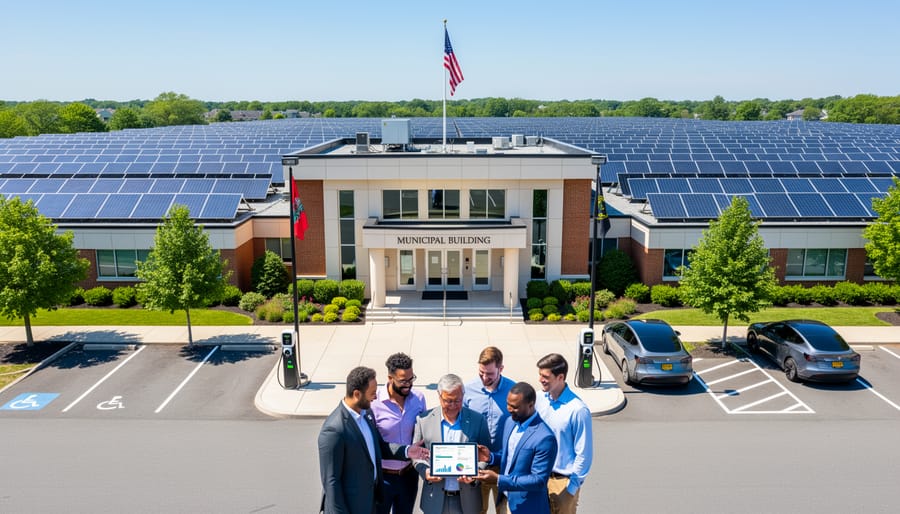
Municipal Government Success Stories
Several New Jersey municipalities have achieved measurable results through strategic participation in JCPL community solar programs. The Township of Millburn reduced municipal energy costs by 18% annually after enrolling three government facilities in local community solar projects. Their finance director reported immediate budget relief, allowing reallocation of approximately $47,000 toward infrastructure improvements while supporting clean energy development.
In Ocean County, the City of Toms River enrolled their wastewater treatment facility and municipal complex, achieving a combined 22% reduction in electricity expenses. This participation aligned with their sustainability goals while generating $63,000 in annual savings. Their facilities manager emphasized that the straightforward enrollment process required minimal staff time and no upfront capital investment.
The Borough of Princeton implemented a comprehensive approach by educating department heads about community solar economics before enrolling multiple facilities. This educational initiative ensured informed decision-making across all municipal operations. Their coordinated participation resulted in $89,000 in first-year savings and established a framework for future sustainability projects.
These municipalities demonstrate that informed participation in community solar programs delivers quantifiable financial benefits while advancing environmental objectives. Their success stems from understanding program mechanics, evaluating facility energy profiles, and making data-driven enrollment decisions that align with both fiscal responsibility and sustainability commitments.
Business and Institutional Leadership
Forward-thinking business leaders and facility managers are leveraging community solar literacy to drive both environmental stewardship and operational efficiency. By understanding JCPL’s community solar framework, organizations of all sizes have successfully reduced electricity costs without capital expenditure or roof modifications.
A regional healthcare network utilized community solar education to allocate 40% of their energy consumption to solar credits, achieving a 12% reduction in annual electricity expenses across multiple facilities. This strategic approach allowed them to redirect savings toward patient care improvements while meeting corporate sustainability benchmarks.
Manufacturing facilities have similarly benefited from comprehensive solar literacy programs. One mid-sized production facility in the JCPL service territory educated their executive team on community solar economics, resulting in a subscription model that offset 60% of their energy costs. The finance director reported that understanding the program’s fixed-rate structure enabled more accurate long-term budget forecasting.
Municipal governments have also employed solar literacy to achieve sustainability mandates. A township facilities department educated staff on community solar benefits, subsequently enrolling government buildings in the program. This decision reduced municipal energy costs by 15% annually while demonstrating environmental leadership to constituents.
These organizations share a common approach: they invested time in understanding program mechanics, analyzed their energy consumption patterns, and made informed decisions based on quantifiable financial and environmental returns. The knowledge gained through solar literacy transformed community solar from an abstract concept into a practical business solution.
Overcoming Common Barriers to Solar Literacy
Time Constraints and Information Overload
Busy decision-makers need streamlined access to JCPL community solar information without sacrificing comprehension. Effective education programs address this challenge by implementing modular learning approaches that break complex concepts into digestible segments. Consider offering 15-minute briefing sessions that focus on single topics such as enrollment mechanics, cost structures, or environmental impact metrics rather than overwhelming participants with comprehensive presentations.
Digital resources should prioritize scannable formats including executive summaries, infographics, and comparison charts that communicate key data points at a glance. Municipal energy committees in New Jersey have successfully adopted “decision-ready” documentation that presents critical information—projected savings, implementation timelines, and participation requirements—on single-page documents that busy officials can review between meetings.
Quarterly email updates with standardized templates help maintain engagement without demanding excessive time investment. These communications should highlight program updates, deadline reminders, and success metrics using bullet points and visual data representations. Recording brief video explanations allows leaders to access information on-demand, accommodating varied schedules while ensuring consistent messaging. This approach recognizes that sustainable participation in community solar programs depends on respecting the time constraints inherent to leadership positions while delivering actionable intelligence that supports informed decision-making.
Bridging the Technical Knowledge Gap
Effective solar literacy programs recognize that decision-makers possess varying levels of technical knowledge. The key lies in creating layered educational materials that provide essential information while offering pathways to deeper understanding. Start with fundamental concepts like how community solar differs from rooftop installations, explaining that subscribers receive credits on their utility bills for their portion of solar generation without requiring equipment on their property. Build upon this foundation by introducing capacity measurements, subscription models, and the relationship between kilowatt-hours generated and bill credits.
Visual aids prove invaluable in conveying technical information. Diagrams illustrating energy flow from solar arrays through JCPL’s distribution network to subscriber accounts help clarify abstract concepts. Financial models should present real-world scenarios demonstrating return on investment timelines and cost comparisons with traditional utility rates.
Create decision-making frameworks that organize technical details into actionable categories: eligibility requirements, subscription sizing calculations, contract terms, and performance monitoring. This approach allows leaders to grasp essential elements without becoming overwhelmed by specifications. Consider establishing peer learning groups where participants can discuss practical applications and share experiences, transforming complex information into accessible knowledge through collective problem-solving and real-world context.
The landscape of renewable energy continues to evolve rapidly, making solar energy literacy not just an advantage but a necessity for effective community leadership. For leaders considering JCPL community solar programs, the investment in renewable energy education directly translates to better fiscal outcomes, stronger stakeholder engagement, and more resilient community infrastructure planning.
Informed decision-making about community solar programs requires understanding not only the technical aspects of solar generation but also the financial mechanisms, regulatory frameworks, and long-term environmental implications. Leaders who develop this knowledge base position their organizations and communities to capitalize on immediate cost savings while building pathways toward sustainable energy independence. The evidence from municipalities and businesses already participating in community solar demonstrates measurable returns: reduced energy costs, enhanced corporate social responsibility profiles, and improved budget predictability.
The strategic imperative is clear. Community leaders who prioritize their renewable energy education today will navigate tomorrow’s energy challenges with greater confidence and competence. Whether you oversee a municipal budget, manage commercial facilities, or guide organizational strategy, dedicating resources to understanding JCPL community solar programs represents sound stewardship.
Take the next step in your renewable energy journey. Engage with educational resources, attend industry briefings, and connect with peers who have successfully implemented community solar initiatives. Your commitment to solar literacy will directly impact your community’s economic resilience and environmental legacy. The time to invest in this knowledge is now, positioning your leadership to make informed, strategic decisions that benefit stakeholders for decades to come.