
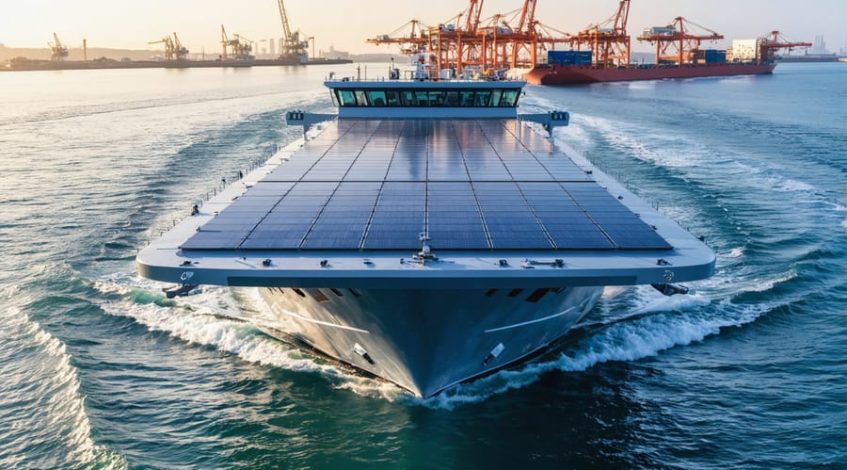
Integrate photovoltaic systems into vessel design during new-build specifications or retrofit planning, prioritizing lightweight, marine-grade panels with proven salt-fog resistance and impact durability ratings above IP67. Maritime solar installations now deliver 15-30% fuel cost reductions on commercial vessels operating coastal routes, with payback periods averaging 3-5 years depending on operational profiles and energy consumption patterns.
Deploy hybrid propulsion architectures combining solar arrays with battery storage and conventional engines, enabling zero-emission port operations while maintaining range capabilities. Fleet operators implementing ocean-based solar integration report annual savings exceeding $50,000 per vessel on fuel expenses alone, alongside substantial emissions reductions that enhance regulatory compliance and corporate sustainability credentials.
Calculate vessel-specific solar potential using surface area analysis, route optimization data, and regional irradiance patterns—critical factors determining system sizing and expected performance. Real-world installations on ferries, cargo ships, and offshore support vessels demonstrate that properly engineered marine solar systems maintain 85-90% efficiency throughout 25-year operational lifespans despite harsh maritime conditions.
The maritime transport sector stands at an inflection point where solar technology maturity, declining installation costs, and stricter environmental regulations converge to make photovoltaic integration financially compelling. Forward-thinking shipowners and operators now recognize marine solar not as experimental technology, but as proven infrastructure delivering measurable returns while future-proofing fleets against carbon pricing mechanisms and evolving international maritime emissions standards.
The Business Case for Solar Integration in Maritime Operations
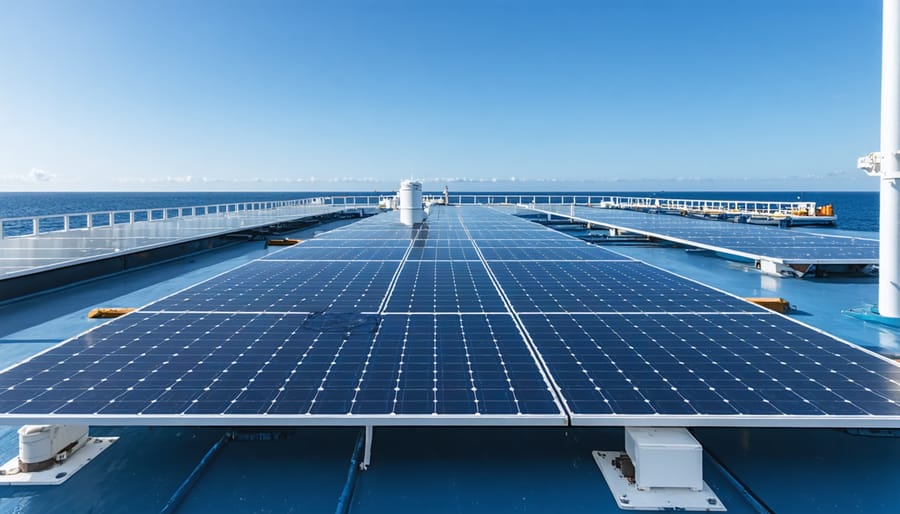
Rising Fuel Costs and Regulatory Pressures
The maritime industry faces unprecedented financial pressure from escalating fuel costs and stringent environmental regulations. Bunker fuel prices have fluctuated dramatically, with average costs rising over 40% between 2020 and 2023, directly impacting operational margins for shipping companies and fleet operators. These volatile fuel expenses, combined with geopolitical instability affecting global energy markets, have created an urgent need for alternative power solutions aboard commercial and recreational vessels.
The International Maritime Organization’s ambitious 2050 decarbonization targets mandate a 50% reduction in greenhouse gas emissions compared to 2008 levels, with interim goals requiring immediate action. Vessel operators must now factor in substantial compliance costs, including emissions monitoring systems, carbon offset programs, and potential carbon taxation schemes being implemented across major shipping routes. The European Union’s Emissions Trading System extension to maritime transport exemplifies this trend, adding significant operational expenses for non-compliant vessels.
Environmental compliance extends beyond carbon emissions. Sulfur cap regulations under MARPOL Annex VI have already forced costly fuel transitions or scrubber installations, with many operators spending millions on retrofitting existing fleets. The cumulative financial burden of these regulatory requirements—estimated at 15-25% of annual operational costs for conventional vessels—is driving maritime businesses toward renewable energy integration. Solar power systems offer a practical pathway to reduce both fuel consumption and compliance costs while future-proofing vessels against increasingly stringent environmental standards. Forward-thinking fleet managers recognize that early adoption of marine solar technology positions their operations competitively in an evolving regulatory landscape.
ROI Projections for Solar-Equipped Vessels
Return on investment for solar-equipped vessels varies significantly based on vessel type, operational profile, and energy requirements. Current market analysis demonstrates compelling financial outcomes across multiple maritime segments.
Commercial fishing vessels operating 200-250 days annually typically achieve payback periods of 4-6 years through solar integration. These vessels realize fuel savings of 15-25% by powering refrigeration systems, navigation equipment, and auxiliary loads through photovoltaic arrays. A 12-meter fishing trawler equipped with a 5kW solar system can reduce annual diesel consumption by approximately 3,000-4,500 liters, translating to $4,500-6,750 in annual savings at current fuel prices.
Ferry operators report even more favorable returns, with payback periods ranging from 3-5 years. Short-haul passenger ferries running consistent daily schedules achieve fuel reductions of 20-30% when solar systems power hotel loads including lighting, HVAC, and onboard services. One Mediterranean ferry operator documented $85,000 in annual fuel savings after installing a 50kW solar array, achieving full ROI within 4.2 years.
Offshore support vessels present the strongest business case, with fuel savings reaching 25-35% due to extended periods of reduced speed operations where solar can meet substantial portions of power demand. These vessels typically recover their solar investment within 3-4 years while simultaneously reducing maintenance costs associated with auxiliary generator runtime by 40-50%.
Long-term benefits extend beyond fuel savings. Solar-equipped vessels experience reduced engine wear, lower maintenance expenses, and enhanced operational flexibility in emissions-controlled zones. Similar economic principles driving commercial fleet solar adoption in land-based transport apply to maritime applications, with the added advantage of consistent solar exposure during daylight operations.
Twenty-year lifecycle analyses show total cost savings of 40-60% compared to conventional diesel-only configurations when factoring in fuel costs, maintenance reductions, and carbon credit opportunities.
Marine Solar Technology: Systems and Applications
Specialized Marine Solar Panel Design
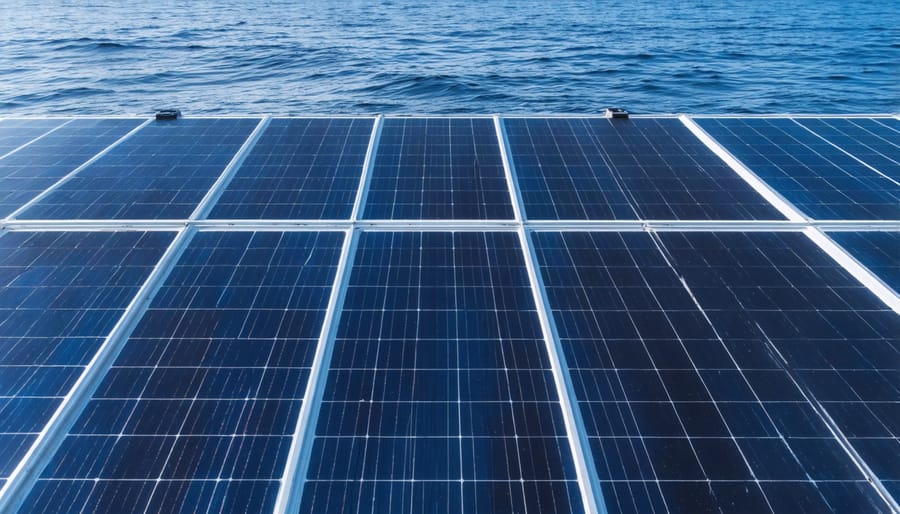
Marine solar panels require significantly more robust engineering than their land-based counterparts to withstand the harsh ocean environment. Manufacturers employ specialized corrosion-resistant materials, including marine-grade aluminum frames and stainless steel mounting hardware, to prevent degradation from constant saltwater exposure. Panel encapsulation utilizes enhanced UV-resistant polymers and tempered glass that can endure decades of intense sun and moisture.
Fleet operators can choose between flexible and rigid panel configurations depending on vessel design and available mounting surfaces. Flexible panels integrate seamlessly onto curved surfaces such as deck areas and cabin roofs, weighing up to 70% less than traditional panels while maintaining respectable efficiency ratings of 18-22%. Rigid crystalline panels offer superior longevity and efficiency rates exceeding 22%, making them ideal for flat deck installations where space optimization is critical.
Salt spray protection represents a paramount consideration in marine applications. Advanced anti-corrosive coatings and sealed junction boxes prevent moisture ingress that could compromise electrical connections. Leading manufacturers now offer IP67-rated panels specifically engineered for maritime use, with certifications demonstrating resistance to 1,000 hours of continuous salt spray testing.
Durability requirements extend beyond corrosion resistance to include impact resistance from wave action, thermal cycling from -40°C to +85°C, and sustained wind loads. Commercial vessels operating in North Atlantic routes have documented panel performance exceeding 20 years with minimal degradation, validating the return on investment for organizations prioritizing long-term sustainability initiatives.
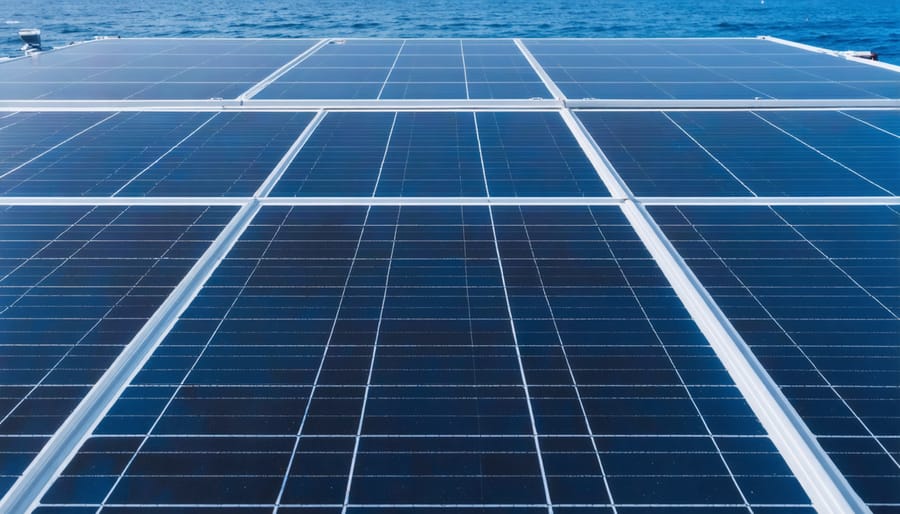
Integration Points Across Vessel Types
Solar integration strategies vary significantly across vessel categories, requiring tailored approaches that balance energy generation with operational requirements. Understanding these installation methodologies enables fleet operators to maximize return on investment while maintaining vessel functionality.
**Cargo Ships and Container Vessels** present substantial deck surface area, making them ideal candidates for large-scale solar deployments. Deck mounting systems typically utilize robust aluminum frames designed to withstand heavy seas and loading operations. Fleet operators report successful installations generating 100-400 kW depending on vessel size, with photovoltaic panels positioned to avoid interference with cargo handling equipment. Modern installations incorporate modular designs allowing temporary removal during specialized loading operations.
**Tankers** require enhanced safety considerations due to cargo volatility. Solar arrays are typically integrated into superstructure areas including bridge wings, accommodation blocks, and forward decks. These installations prioritize fire-resistant materials and maintain required hazardous area classifications. A North Sea tanker operator documented 15% auxiliary power reduction following a 200 kW superstructure installation completed in 2023.
**Ferries** benefit from consistent routes and predictable energy demands, enabling optimized solar configurations. Roof-mounted systems on passenger areas generate 50-150 kW while providing additional benefits including reduced air conditioning loads. A Mediterranean ferry operator achieved 18-month payback following installation across their fleet.
**Specialized Vessels** including research ships and offshore support vessels increasingly integrate flexible thin-film panels conforming to curved surfaces, maximizing generation capacity where rigid panels prove impractical. Space optimization strategies include utilizing previously unused vertical surfaces and retractable shade structures serving dual purposes.
Hybrid Power System Architecture
Marine solar installations achieve maximum efficiency through sophisticated hybrid power architectures that integrate seamlessly with traditional vessel systems. Modern configurations combine photovoltaic arrays with existing diesel generators, creating redundant power sources that reduce fuel consumption by 20-30% in typical applications. Advanced battery storage systems buffer energy fluctuations, storing excess solar generation during peak sunlight hours for use during nighttime operations or high-demand periods.
Intelligent energy management platforms serve as the system’s command center, automatically directing power flow between solar panels, batteries, and generators based on real-time demand and weather conditions. These platforms utilize regional ocean models to predict solar availability and optimize charging cycles, extending battery lifespan while minimizing generator runtime. Leading maritime operators report 40-60% reductions in diesel consumption through properly configured hybrid systems, with payback periods typically ranging from 3-5 years depending on vessel operation profiles and fuel costs.
Real-World Performance: Case Studies from Commercial Fleets
Container Shipping Solar Deployment
Maersk Line, the world’s largest container shipping company, launched a comprehensive solar deployment program in 2019 that demonstrates the commercial viability of photovoltaic systems on large cargo vessels. The initiative began with retrofitting 12 Triple-E class vessels, each receiving approximately 1,000 square meters of solar panels across available deck spaces.
The installation generates an average of 400 kW peak power per vessel, contributing approximately 850 MWh annually to onboard electrical systems. This renewable capacity delivers a measurable 3-5% reduction in auxiliary fuel consumption across the fleet, translating to annual savings of $150,000-$200,000 per vessel at current fuel prices. Beyond direct fuel savings, the program reduces generator runtime by 15-20% during port operations, extending maintenance intervals and lowering operational costs.
Operational insights from the three-year implementation reveal several critical success factors. Marine-grade photovoltaic modules with enhanced corrosion resistance proved essential in saltwater environments, while flexible mounting systems accommodated thermal expansion without structural stress. The company integrated solar output with existing power management systems rather than requiring wholesale electrical redesigns, significantly reducing installation complexity and cost.
Performance monitoring indicates consistent year-round operation across global shipping routes, with capacity factors ranging from 14% in northern latitudes to 22% in equatorial regions. The payback period averages 6-8 years, competitive with shore-based commercial installations when accounting for avoided fuel costs and emissions compliance benefits. Following initial success, Maersk expanded the program to 30 additional vessels, establishing solar integration as standard practice for new builds and major retrofits.
Ferry and Passenger Vessel Applications
Ferry operations represent one of the most commercially viable applications for marine solar energy, with vessels operating predictable routes and maintaining consistent schedules that maximize solar system utilization. Unlike long-haul shipping, ferries benefit from frequent port access for grid charging integration and typically operate during daylight hours when solar generation peaks, creating optimal conditions for return on investment.
Solar panels on passenger vessels primarily serve auxiliary power systems, reducing diesel generator runtime for hotel loads including HVAC, lighting, galley equipment, and entertainment systems. This application delivers immediate fuel savings while decreasing maintenance requirements and extending generator lifespan. A 150-passenger catamaran ferry operating Sydney Harbour routes demonstrated 35% reduction in auxiliary fuel consumption after installing a 45kW solar array, with payback achieved within 4.2 years through combined fuel savings and reduced maintenance costs.
The solar transportation economics for ferries improve substantially on routes under two hours, where battery storage systems can supplement solar generation during peak demand periods. Norwegian ferry operator Norled’s MF Ampere, the world’s first fully electric car ferry, utilizes rooftop solar panels to extend range and reduce charging infrastructure costs, serving as a benchmark for hybrid-electric ferry development worldwide.
Shorter routes enable right-sizing of solar installations based on actual vessel energy profiles rather than worst-case scenarios. This precision sizing optimizes capital expenditure while maintaining operational reliability. Additionally, passenger vessels benefit from marketing advantages associated with visible sustainability initiatives, often justifying accelerated implementation timelines. Fleet operators should prioritize solar integration on vessels with high auxiliary loads, consistent scheduling, and routes offering regular charging access to maximize financial returns while advancing decarbonization objectives.
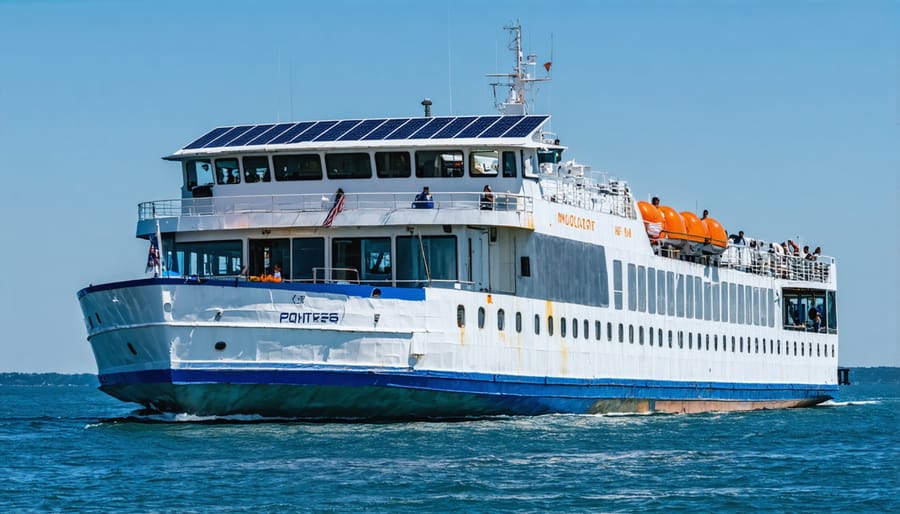
Overcoming Implementation Challenges
Space Constraints and Structural Considerations
Integrating solar arrays onto vessels requires careful evaluation of available deck space and structural capacity. Modern lightweight solar panels, weighing approximately 10-12 kg per square meter, minimize structural modifications while maximizing energy generation potential. Fleet operators must conduct thorough load distribution analyses to ensure panels complement rather than compromise vessel stability, particularly on smaller craft where center of gravity considerations are critical.
Innovative mounting solutions address space limitations through flexible panels that conform to curved surfaces, retractable systems for multipurpose deck areas, and vertical installations on superstructures. A European ferry operator successfully installed 200 square meters of solar capacity using modular, low-profile arrays that maintained full deck functionality while reducing fuel consumption by 15%. Weight-optimized mounting hardware and marine-grade aluminum frames ensure durability without excessive structural burden.
Professional marine surveyors should assess load-bearing capacity, stress points, and stability margins before installation. Advanced design software enables precise modeling of weight distribution impacts, ensuring compliance with maritime classification society requirements. Strategic placement of solar arrays can actually improve vessel balance when properly engineered, positioning panels to offset existing top-side equipment. This systematic approach transforms potential constraints into optimized solutions that enhance both operational efficiency and energy independence.
Installation Logistics and Downtime Management
Successful marine solar integration requires meticulous planning to minimize operational disruption and financial impact. Leading vessel operators strategically align solar installations with mandatory dry-dock periods, regulatory surveys, or scheduled maintenance cycles, effectively eliminating additional downtime. This approach transforms what could be a 14-21 day retrofit into a value-added component of existing maintenance schedules.
Modular installation methodologies enable phased implementations, allowing vessels to maintain partial operations during retrofit periods. Pre-fabricated mounting systems and plug-and-play electrical components reduce on-site installation time by up to 60% compared to custom fabrication approaches. Experienced marine solar integrators conduct comprehensive pre-installation surveys and prepare detailed installation protocols, ensuring crews can execute installations with precision and minimal delays.
For operational vessels requiring immediate deployment, mobile installation teams can perform work during port calls or cargo operations, utilizing flexible scheduling that accommodates commercial priorities. Port-side installations typically require 3-7 days for standard configurations, while larger commercial vessels benefit from shipyard facilities offering crane access and specialized equipment. Coordination with classification societies and port authorities during planning phases prevents regulatory delays and ensures seamless project execution, ultimately protecting revenue streams while advancing sustainability objectives.
Maintenance and Monitoring at Sea
Maritime solar installations require specialized maintenance protocols to ensure optimal performance in challenging oceanic conditions. Remote monitoring systems have become essential for fleet operators, providing real-time data on panel efficiency, battery status, and power generation across multiple vessels simultaneously. These platforms utilize satellite connectivity to track performance metrics and identify potential issues before they escalate into costly failures.
Salt accumulation presents the primary environmental challenge for marine solar arrays. Leading maritime operators implement automated cleaning systems that activate periodically, or schedule manual cleaning during routine port stops every 30-45 days. Research from commercial shipping applications demonstrates that regular salt removal maintains panel efficiency at 90-95% of rated capacity, directly impacting fuel savings calculations.
Predictive maintenance approaches leverage historical performance data to anticipate component degradation. Advanced monitoring systems analyze voltage irregularities, temperature fluctuations, and output variations to schedule proactive repairs during planned maintenance windows. This strategy reduces unexpected downtime by approximately 40% compared to reactive maintenance models, preserving the return on investment that attracted operators to marine solar technology initially.
Financial Mechanisms and Support Programs
Green Shipping Incentives and Grants
The European Union has established substantial funding mechanisms to accelerate maritime decarbonization through the European Green Deal and the Innovation Fund, which allocates billions in grants for clean technology adoption. The IMO’s GreenVoyage-2050 project supports developing nations in implementing energy-efficient technologies, including solar installations on commercial vessels. Maritime operators can access capital through the EU’s Connecting Europe Facility (CEF), which prioritizes projects demonstrating measurable emission reductions.
Several European nations offer dedicated maritime solar incentives. Norway’s NOx Fund provides direct subsidies covering up to 80% of emission-reducing equipment costs, while Denmark’s Green Ship of the Future program co-finances renewable energy integration projects. The EU Emissions Trading System (ETS), recently extended to maritime transport, creates financial incentives for vessel owners who reduce their carbon footprint through solar adoption.
International financial institutions, including the World Bank’s Climate Investment Funds and the Asian Development Bank’s Clean Energy Program, provide concessional financing for maritime solar projects. Fleet operators implementing comprehensive solar systems have successfully secured combined funding packages exceeding 50% of total installation costs, significantly improving project ROI and shortening payback periods to under three years.
Commercial Financing Structures
Maritime solar projects require flexible financial approaches that account for vessel operational patterns and regulatory requirements. **Leasing arrangements** allow shipowners to adopt solar technology without significant upfront capital expenditure, with monthly payments structured around predictable fuel savings. This model proves particularly attractive for fleet operators managing multiple vessels simultaneously.
**Energy-as-a-Service (EaaS) models** shift the investment burden to specialized providers who install, maintain, and optimize solar systems while charging based on actual energy production. Container shipping companies have successfully implemented EaaS agreements, reducing operational risk while achieving 15-20% fuel cost reductions on equipped vessels.
**Traditional capital financing** remains viable for established operators with strong balance sheets, offering full ownership benefits and accelerated depreciation advantages. Maritime development banks increasingly support solar retrofits through specialized loan products with terms extending 10-15 years, aligning repayment schedules with equipment lifespans. Hybrid financing structures combining grants, tax incentives, and commercial loans have enabled ferry operators to achieve project payback periods under five years, demonstrating financial viability across various maritime segments.
Future Trajectory: Scaling Solar in Maritime Transport
Next-Generation Marine Solar Technologies
The maritime sector is witnessing remarkable advances in solar technologies engineered specifically for oceanic conditions. Modern marine-grade photovoltaic panels now achieve conversion efficiencies exceeding 24%, representing a 40% improvement over earlier maritime installations. These high-efficiency modules incorporate monocrystalline PERC cells with anti-reflective coatings optimized for varying light angles encountered at sea.
Material innovation has produced lightweight, flexible solar solutions that reduce vessel weight while maintaining durability in harsh saltwater environments. Recent deployments feature panels weighing 50% less than traditional rigid alternatives, utilizing advanced polymer substrates resistant to corrosion and UV degradation.
Integrated power management systems represent another significant breakthrough, combining maximum power point tracking (MPPT) controllers with intelligent battery storage and hybrid propulsion interfaces. A 2023 pilot program with a Scandinavian shipping company demonstrated 30% fuel savings on short-haul routes using these integrated systems. The technology automatically optimizes power distribution between propulsion, auxiliary systems, and storage based on real-time demand and weather conditions.
These innovations deliver measurable ROI improvements, with installation costs declining 35% since 2020 while performance reliability extends operational lifespans to 25+ years in marine applications.
Industry Adoption Trends and Market Outlook
The marine solar energy sector is experiencing robust expansion, with market analysts projecting compound annual growth rates of 12-15% through 2030. This acceleration reflects mounting pressure to reduce maritime emissions and improve operational economics across vessel categories.
Commercial ferry operators currently lead adoption, with solar installations becoming increasingly standard on new hybrid-electric vessels. Cargo ships are following suit, particularly in coastal and short-sea shipping routes where battery-solar combinations prove most viable. Luxury yacht manufacturers now offer solar integration as a premium feature, while fishing fleets increasingly recognize fuel cost savings that offset initial investment within 3-5 years.
Major shipbuilders are incorporating solar-ready designs into new construction specifications, with solar panels transitioning from retrofit afterthoughts to integrated systems. This shift mirrors broader transportation energy integration trends across maritime and terrestrial sectors.
Industry experts anticipate that by 2028, solar capability will become standard equipment on most passenger vessels and specialized craft operating in regulated emission zones. The path forward depends on continued improvements in panel efficiency, energy storage capacity, and favorable regulatory frameworks that incentivize clean maritime technology adoption. Early adopters are positioning themselves advantageously for tightening environmental regulations while achieving measurable operational cost reductions today.
Marine solar integration represents a strategic convergence of economic efficiency and environmental responsibility for maritime operators. With documented fuel savings of 5-20%, rapid ROI timeframes of 3-5 years, and significant emissions reductions, the business case is compelling. Real-world deployments across commercial vessels, fishing fleets, and passenger ferries have validated the technology’s reliability and performance under demanding maritime conditions.
For operators considering solar adoption, the path forward begins with a thorough vessel energy audit to identify optimal system sizing and configuration. Partnering with experienced marine solar specialists ensures proper equipment selection, regulatory compliance, and integration with existing power systems. Starting with pilot installations on select vessels allows for performance validation before fleet-wide deployment.
The maritime industry’s transition toward sustainable operations is accelerating, driven by regulatory requirements and stakeholder expectations. Solar technology provides an immediately actionable solution that delivers measurable financial returns while advancing decarbonization goals. Maritime operators who embrace this technology position themselves competitively for an increasingly sustainability-focused market. EU Solar’s expertise in marine applications supports operators through every phase of implementation, from initial assessment through ongoing performance optimization, ensuring successful solar integration tailored to specific operational requirements.