
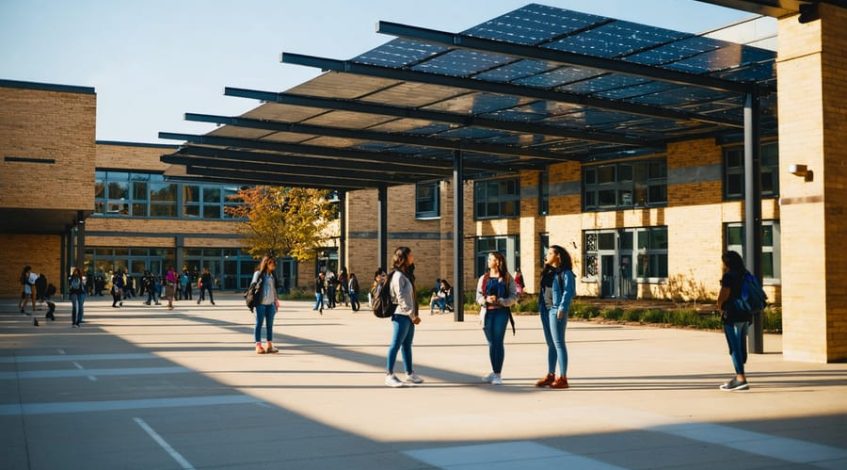
Solar energy delivers measurable returns that extend far beyond utility bill reduction. Educational institutions and creative organizations now leverage photovoltaic systems to redirect operational budgets toward mission-critical programs, transform infrastructure into interactive learning laboratories, and demonstrate environmental leadership that resonates with students, donors, and communities.
The financial case strengthens annually as installation costs decline and energy rates rise. Schools across North America report 50-75% reductions in electricity expenses within the first year, freeing substantial capital for classroom technology, arts programming, and facility improvements. These savings compound over system lifespans exceeding 25 years, creating predictable energy costs that simplify long-term budget planning.
Beyond economics, solar installations serve dual purposes: they generate clean power while functioning as tangible teaching tools. Students engage directly with renewable energy systems through monitoring software, curriculum integration, and hands-on maintenance experiences. Creative institutions similarly benefit from reliable, sustainable power that supports energy-intensive equipment—from kiln operations to digital media labs—without grid dependency concerns.
The following seven advantages examine how solar energy addresses specific operational challenges facing educational and creative facilities. Each benefit connects to real implementation scenarios, demonstrating practical applications that align with institutional values, operational requirements, and fiscal responsibility. These aren’t theoretical possibilities—they’re documented outcomes from organizations that have already made the transition to solar power.
Advantage 1: Living Laboratory for STEM Education
On-site solar installations deliver substantial educational value by transforming facilities into interactive learning environments. Modern solar monitoring systems provide real-time data streams that educators can integrate directly into STEM curricula, offering students hands-on experience with renewable energy technology while demonstrating practical applications of classroom concepts.
Solar monitoring platforms track energy production down to individual panel performance, weather conditions, system efficiency metrics, and financial returns. This continuous data flow creates opportunities for meaningful solar energy activities across multiple disciplines. Mathematics students can analyze production curves, calculate efficiency ratios, and project long-term savings based on actual facility data. Physics classes examine the photovoltaic effect in action, measuring how variables like temperature, angle of incidence, and cloud cover affect electrical output. Environmental science programs utilize the system to quantify carbon offset, compare renewable versus conventional energy sources, and assess the facility’s environmental footprint reduction.
The ROI analysis component provides particularly valuable lessons in financial literacy and business decision-making. Students can access real utility bills, track payback periods, and evaluate the economic impact of energy independence using their institution’s actual investment data. This practical application bridges theoretical learning with real-world financial planning, preparing students for data-driven decision-making in their future careers.
Several educational institutions have successfully integrated their solar installations into curriculum. A technical college in Queensland incorporated their 100kW system into engineering coursework, enabling students to monitor performance metrics and troubleshoot efficiency variations. Their students developed projects analyzing seasonal production patterns and optimizing system configurations based on historical data.
These living laboratories extend beyond scheduled classroom time. Display screens in common areas showcase real-time generation data, creating daily touchpoints that reinforce environmental awareness and energy consciousness across the entire facility population. This visibility transforms abstract concepts about renewable energy into tangible, observable outcomes that students, staff, and visitors can witness firsthand.

Advantage 2: Reduced Operating Costs Fund Educational Programs
Solar energy installations create substantial financial flexibility for educational institutions by dramatically reducing monthly utility expenses. These savings translate directly into additional funding for core educational priorities that might otherwise face budget constraints. Schools and universities implementing educational solar panels typically redirect their energy cost savings toward classroom resources, instructional materials, technology infrastructure, and program expansion.
The financial impact extends across multiple operational areas. Reduced electricity costs free up capital for textbook purchases, laboratory equipment, computer systems, and specialized learning tools. Creative programs benefit particularly from this budget reallocation, as funding becomes available for art supplies, musical instruments, performance spaces, and maker labs. Extracurricular activities, often vulnerable to budget cuts, gain renewed support when energy savings offset program costs.
A compelling example comes from Kingscliff Public School in New South Wales, which installed a 30kW solar system in 2018. The institution reduced annual electricity costs by approximately $8,500, redirecting these savings toward STEM program enhancements and digital learning resources. Within three years, the school expanded its technology offerings, purchased new science equipment, and funded additional after-school programs without increasing overall budget allocations.
The return on investment for educational solar installations typically ranges from 3-7 years, after which the savings become pure operational surplus. For a medium-sized educational facility spending $40,000 annually on electricity, solar implementation achieving 60-70% cost reduction creates $24,000-$28,000 in annual savings. Over a 25-year system lifespan, this represents over $600,000 in redirected funding—resources that directly enhance educational quality and program diversity while maintaining fiscal responsibility.
Advantage 3: Hands-On Career Pathway Development
The transition to solar energy extends beyond environmental benefits and cost savings—it creates robust pathways for workforce development and technical skill acquisition. Educational institutions and businesses partnering with solar companies can establish comprehensive training programs that address the growing demand for qualified professionals in renewable energy sectors.
Solar installation projects provide ideal platforms for hands-on learning experiences that combine theoretical knowledge with practical application. Technical colleges and universities increasingly collaborate with solar energy companies to develop certification programs aligned with industry standards, including North American Board of Certified Energy Practitioners (NABCEP) credentials. These partnerships enable students and career-changers to gain real-world experience through supervised installations, system maintenance, and performance monitoring activities.
Vocational training initiatives centered around solar technology encompass multiple specializations, from electrical engineering and system design to project management and regulatory compliance. Facilities implementing solar arrays can serve as living laboratories where trainees develop competencies in photovoltaic system installation, inverter configuration, energy storage integration, and grid interconnection protocols. This solar job training approach creates measurable value for both participants and host organizations.
The Australian renewable energy sector continues expanding, with solar installation and maintenance positions projected to grow substantially over the coming decade. Organizations investing in solar infrastructure position themselves as contributors to workforce development while simultaneously creating pipelines for qualified technical personnel. Many facilities establish internship programs that convert to permanent positions, addressing their own operational needs while supporting regional economic development.
Forward-thinking institutions recognize that hosting solar training programs enhances their reputation as community partners while potentially reducing installation and maintenance costs through collaborative arrangements. These workforce development initiatives demonstrate tangible commitment to sustainability while building the technical capacity necessary for Australia’s energy transition.

Advantage 4: Power for Remote and Outdoor Learning Spaces
Solar energy fundamentally transforms what’s possible beyond traditional facility walls, enabling educational institutions and creative organizations to extend their reach into previously inaccessible locations. For organizations committed to expanding learning opportunities and creative expression, solar technology provides the energy independence necessary to operate effectively in remote settings without costly grid infrastructure.
**Field Research and Outdoor Classrooms**
Universities and research institutions increasingly deploy solar-powered field stations for environmental studies, archaeology, and biological research. These installations typically combine solar panels with battery storage systems to power essential equipment including computers, refrigeration for samples, communication devices, and lighting. A marine biology program at the University of California operates solar-powered research stations on remote coastal sites, eliminating the need for diesel generators that previously cost $15,000 annually in fuel and maintenance while producing disruptive noise during sensitive wildlife observations.
**Mobile Learning Laboratories**
Educational organizations are equipping mobile labs and field trip vehicles with integrated solar systems, creating self-sufficient learning environments. These units support everything from STEM demonstrations to art workshops in underserved communities without reliable electricity access. The return on investment becomes evident when considering expansion capabilities—each solar-equipped mobile unit enables programming in 3-5 additional locations monthly without ongoing energy infrastructure costs.
**Performance and Installation Spaces**
Arts organizations utilize solar technology to power temporary performance venues, outdoor exhibitions, and large-scale installations in locations where grid connections prove impractical or prohibitively expensive. This flexibility allows creative programming to reach broader audiences while maintaining professional-quality lighting, sound, and multimedia capabilities.
Solar technology’s modular nature means systems scale appropriately for specific applications—from small photovoltaic panels powering individual outdoor teaching stations to comprehensive arrays supporting multi-building research campuses. This adaptability positions forward-thinking institutions to implement innovative educational models that physical infrastructure previously constrained.

Advantage 5: Environmental Stewardship Demonstration
Solar installations represent more than infrastructure upgrades—they serve as visible declarations of institutional commitment to environmental responsibility. For educational facilities and community organizations, these systems demonstrate leadership in sustainability, creating powerful ripple effects that extend far beyond energy production.
When students, staff, and visitors observe solar arrays on campus buildings or parking structures, they witness tangible evidence of climate action rather than merely hearing about it in presentations. This alignment between stated values and operational decisions reinforces credibility and inspires behavioral change. Research consistently shows that institutions practicing environmental stewardship influence stakeholder attitudes more effectively than those relying solely on curriculum-based education.
The impact of solar energy in schools extends into daily institutional culture. Faculty members incorporate real-world sustainability examples into lessons across disciplines, from science and mathematics to economics and social studies. Students develop environmental consciousness through regular exposure to renewable energy infrastructure, fostering habits and perspectives they carry into their careers and communities.
For facility managers and administrators, solar installations provide concrete metrics to showcase environmental progress to stakeholders, accreditation bodies, and funding organizations. Many institutions report that visible solar commitments strengthen their competitive positioning, attracting environmentally conscious families, students, and partners who prioritize sustainability values.
Community perception also shifts meaningfully. Local residents and businesses view solar-equipped institutions as forward-thinking leaders, creating opportunities for partnerships and collaborative initiatives. This reputational enhancement proves particularly valuable when seeking community support for future projects or initiatives.
The demonstration effect cannot be understated—when respected institutions invest in solar infrastructure, they normalize renewable energy adoption and encourage similar decisions throughout their communities, multiplying environmental benefits far beyond their direct energy savings.

Advantage 6: Enhanced Community Engagement and Public Relations
Solar installations represent more than infrastructure investments—they serve as powerful platforms for community engagement and institutional visibility. Organizations that implement solar energy systems create meaningful opportunities to strengthen stakeholder relationships while demonstrating commitment to environmental stewardship and fiscal responsibility.
Educational institutions and public facilities regularly transform their solar installations into interactive learning environments. These systems become focal points for structured tours, open houses, and public demonstrations that showcase renewable energy technology in action. Schools leverage their arrays to host workshops on energy efficiency, environmental science, and sustainable technology, positioning themselves as innovation leaders within their communities.
Community solar projects particularly excel at fostering stakeholder engagement. Organizations report increased parent participation, stronger donor relationships, and enhanced partnerships with local businesses following solar installations. These projects generate positive media coverage and social media engagement, amplifying organizational messaging without additional marketing expenditure.
The public relations benefits extend to transparency around operational efficiency. Real-time monitoring systems allow organizations to display energy production data publicly, demonstrating measurable environmental impact through reduced carbon emissions and energy consumption metrics. This transparency resonates strongly with stakeholders increasingly focused on sustainability outcomes.
Organizations also gain competitive advantage in recruitment and retention. Prospective students, faculty, employees, and partners actively seek institutions aligned with their environmental values. Visible commitment to renewable energy differentiates forward-thinking organizations from peers, supporting enrollment goals and talent acquisition strategies.
For government facilities and public institutions, solar installations demonstrate prudent use of taxpayer resources while advancing community sustainability goals. This combination of fiscal responsibility and environmental leadership strengthens public trust and stakeholder confidence, creating lasting reputational benefits that extend well beyond immediate energy savings.
Advantage 7: Long-Term Energy Security for Institutional Planning
One of solar energy’s most valuable yet often overlooked advantages for institutional planning is the exceptional predictability it provides for long-term financial forecasting. Unlike traditional utility expenses that fluctuate with market volatility and regulatory changes, solar energy systems deliver stable, calculable costs that extend decades into the future.
Educational and creative institutions operate on multi-year strategic plans that require reliable budget projections. Solar installations effectively lock in energy costs for 25 to 30 years—the typical warranty period for quality photovoltaic systems. This financial certainty allows administrators to allocate resources with confidence, knowing that a significant operational expense remains protected from the utility rate increases that have averaged 2-3% annually over the past decade.
Consider the University of California system, which has implemented solar across multiple campuses. Their analysis projects over $1 billion in avoided utility costs over 25 years, enabling more predictable allocation of funds toward core educational priorities rather than escalating energy bills.
For institutions managing tight budgets, this protection becomes particularly valuable. A mid-sized community college consuming $500,000 in annual electricity could face costs exceeding $850,000 in 20 years at conservative utility inflation rates. A properly sized solar installation eliminates this uncertainty, with maintenance costs representing only 1-2% of initial investment annually.
Beyond financial predictability, solar systems enhance institutional resilience. Facilities incorporating battery storage gain operational continuity during grid disruptions, ensuring that critical programs—from laboratory research to theater productions—maintain uninterrupted access to power. This energy independence strengthens institutional stability and demonstrates responsible stewardship of resources to stakeholders, supporting fundraising efforts and community confidence.
The extended lifespan of solar technology means today’s installation decisions positively impact institutional operations for generations, making solar adoption a strategic investment in long-term organizational health.
The seven advantages outlined demonstrate that solar energy represents far more than an operational upgrade for educational and creative institutions—it is a strategic investment with compounding returns. From substantial cost savings that free up resources for core programming, to enhanced learning opportunities that prepare students for a sustainable future, solar installations deliver measurable value across multiple dimensions. The environmental benefits align with institutional missions, while energy independence provides stability in an era of grid uncertainty. Improved facility infrastructure, combined with strengthened community reputation, positions forward-thinking institutions as leaders in their sectors.
For facility managers and institutional leaders, the imperative is clear: solar energy offers a unique convergence of fiscal responsibility and mission alignment. Unlike conventional infrastructure investments that serve singular purposes, solar installations simultaneously reduce operational expenses, advance educational objectives, and demonstrate organizational values. The scalability and flexibility of modern solar solutions mean that institutions of virtually any size can participate in this transformation.
The next step requires moving beyond general interest to concrete action. We strongly encourage decision-makers to commission comprehensive solar feasibility assessments that evaluate site-specific potential, financial modeling, and integration with existing operations. These assessments reveal opportunities that extend well beyond simple kilowatt-hour calculations, encompassing curriculum development possibilities, grant eligibility, community partnership potential, and long-term resilience planning. The institutions that act decisively today will reap compounding benefits for decades while positioning themselves at the forefront of the sustainable energy transition that increasingly defines institutional excellence.