

Commercial buildings waste approximately 30% of their HVAC energy consumption due to outdated systems and inefficient operation. Modern energy-efficient HVAC technologies, particularly when integrated with renewable energy sources, can reduce this waste by up to 50% while simultaneously cutting operational costs and carbon emissions. Facility managers and business owners now have unprecedented opportunities to transform their largest operational expense into a strategic advantage.
Upgrade to variable refrigerant flow (VRF) systems that adjust cooling output based on real-time demand rather than running at constant capacity. These systems deliver 25-40% energy savings compared to traditional units and integrate seamlessly with building management systems for optimized performance monitoring.
Implement smart building controls with AI-driven predictive maintenance that identifies inefficiencies before they escalate into costly breakdowns. Advanced sensors and analytics platforms reduce energy consumption by 15-20% through automated adjustments to occupancy patterns, weather conditions, and usage schedules.
Integrate solar-powered HVAC systems to offset peak demand charges and reduce grid dependency. Commercial solar installations specifically sized for HVAC loads typically achieve ROI within 3-5 years while providing energy cost certainty for decades.
Conduct comprehensive energy audits to identify duct leakage, improper refrigerant levels, and equipment sizing mismatches that collectively account for 20-35% efficiency losses in existing systems. Professional assessments reveal quick-win improvements that often pay for themselves within 12-18 months through reduced utility bills.
The Energy Crisis in Commercial HVAC Systems
Peak Demand and Cost Implications
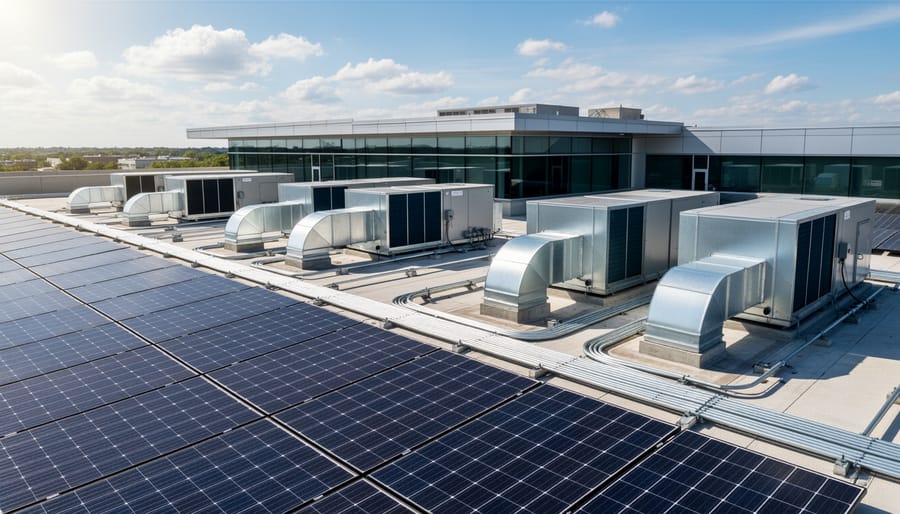
Commercial HVAC systems typically experience their highest energy demand during daytime hours when cooling loads peak due to occupancy, equipment operation, and solar heat gain through building envelopes. This demand pattern creates a natural alignment with peak solar energy production hours, making solar integration particularly effective for commercial facilities.
Understanding demand charges is essential for evaluating solar HVAC economics. Most commercial electricity tariffs include demand charges based on the highest 15 or 30-minute power consumption interval during a billing period. These charges can represent 30-70% of total electricity costs. Since HVAC systems often drive peak demand, offsetting this consumption with solar generation delivers substantial savings.
Time-of-use rates further enhance the value proposition. Peak electricity rates typically apply during afternoon hours when HVAC loads are highest and grid stress is greatest. Solar systems naturally generate maximum output during these expensive periods, providing premium-value energy precisely when costs are highest. A 100-kilowatt solar installation can reduce demand charges by $15,000-$30,000 annually while simultaneously lowering energy consumption charges.
For facilities operating weekday business hours, this synergy is optimal. Weekend generation can often feed back to the grid through net metering arrangements, creating additional revenue streams. Sophisticated energy management systems can coordinate HVAC operation with solar production patterns, pre-cooling buildings during high-generation periods and reducing compressor loads when solar output declines, maximizing both operational efficiency and cost savings.
Environmental and Regulatory Pressures
Commercial buildings face mounting pressure to reduce their environmental footprint as governments worldwide implement stricter carbon reduction mandates and building efficiency standards. The European Union’s Energy Performance of Buildings Directive and similar regulations in other jurisdictions now require significant improvements in energy efficiency, with many regions targeting net-zero emissions by 2050. These regulatory frameworks impose specific performance benchmarks that facility managers must meet to avoid penalties and maintain building certifications.
Energy-efficient HVAC systems integrated with solar power provide a practical pathway to compliance. By generating clean electricity on-site to power heating and cooling operations, facilities can dramatically reduce their Scope 2 emissions while meeting renewable energy portfolio standards. This approach addresses multiple regulatory requirements simultaneously, from energy efficiency ratios to carbon reporting obligations. Buildings that proactively adopt solar-HVAC integration often achieve LEED certification upgrades and qualify for green building incentives, creating competitive advantages in markets where sustainability credentials influence tenant decisions and property valuations. The combination of regulatory compliance and operational savings positions these systems as essential infrastructure investments rather than optional upgrades.
How Solar Energy Transforms HVAC Performance
Direct Solar-HVAC Integration
Photovoltaic systems offer a strategic advantage for commercial HVAC operations by generating maximum power precisely when cooling demands peak. This alignment between solar production and air conditioning loads during mid-day hours creates an efficient pairing that reduces grid dependency and operational costs.
Direct solar-HVAC integration involves connecting photovoltaic arrays to power conditioning equipment and HVAC systems through specialized inverters. During peak sunlight hours, solar panels generate DC electricity that inverters convert to AC power, directly supplying the building’s cooling systems. This configuration enables facilities to offset their highest energy consumption periods with on-site renewable generation, significantly reducing demand charges that typically represent a substantial portion of commercial electricity bills.
System sizing requires careful analysis of both cooling loads and available roof or ground space. A comprehensive energy audit should establish baseline HVAC consumption patterns throughout the year, particularly during peak summer months. Typical commercial buildings can offset 40-70% of cooling-related electricity through appropriately sized solar arrays. For example, a 50,000 square foot office building consuming 200 kW during peak cooling might install a 100-150 kW solar system to cover a significant portion of daytime HVAC demand.
Equipment compatibility considerations include inverter selection, voltage matching, and integration with existing electrical infrastructure. Modern variable refrigerant flow systems and rooftop units readily accept solar-generated power, though consultation with qualified electrical engineers ensures seamless integration. Battery storage systems can extend solar HVAC operation beyond daylight hours, though this addition requires additional capital investment and careful cost-benefit analysis.

Hybrid Systems with Energy Storage
Integrating solar photovoltaic systems with battery energy storage creates a powerful solution for commercial HVAC operations. These hybrid systems address the fundamental challenge of solar intermittency by storing excess daytime generation for use during peak demand periods and after-hours operation. For facilities requiring continuous climate control, this capability ensures uninterrupted comfort while maximizing renewable energy utilization.
Solar-plus-storage configurations excel at load shifting, allowing businesses to store solar energy when electricity rates are lowest and discharge batteries during expensive peak periods. This strategy can reduce demand charges by 30-50%, delivering substantial cost savings for facilities with high HVAC loads. Advanced battery management systems automatically optimize charging and discharging cycles based on time-of-use rates, weather forecasts, and building occupancy patterns.
The reliability benefits extend beyond cost optimization. Battery systems provide backup power during grid outages, maintaining critical HVAC functions for temperature-sensitive operations like data centers, healthcare facilities, and food storage warehouses. Modern lithium-ion batteries typically offer 4-8 hours of backup capacity, with scalable configurations available for extended runtime requirements.
Implementation considerations include proper system sizing to match HVAC load profiles, inverter selection for seamless grid interaction, and integration with building management systems for automated control. Battery degradation over time requires factoring replacement costs into long-term financial models, though improving technology and declining prices continue to enhance return on investment. When designed correctly, hybrid systems typically achieve payback periods of 5-8 years while providing enhanced energy security and operational flexibility.
Smart Controls and Energy Management
Modern intelligent control systems represent a transformative approach to maximizing solar energy integration with commercial HVAC operations. These advanced platforms utilize real-time weather forecasting, occupancy sensors, and machine learning algorithms to predict cooling demands and align energy consumption with peak solar production hours. Predictive cooling strategies pre-condition buildings during periods of maximum solar generation, effectively storing thermal energy and reducing grid dependence during afternoon peak hours.
Demand response capabilities enable facilities to automatically adjust HVAC settings based on solar output fluctuations and utility pricing signals. When solar production exceeds building requirements, smart controllers can increase cooling capacity or pre-cool thermal mass, banking energy for later use. Conversely, during low solar periods, systems can operate in energy-conservation mode without compromising occupant comfort.
A manufacturing facility in California demonstrated this technology’s potential by implementing predictive controls that reduced grid consumption by 38 percent while maintaining consistent temperature regulation. The system learned occupancy patterns and adjusted ventilation rates accordingly, optimizing solar energy utilization throughout daily operations. These intelligent platforms typically deliver return on investment within two to four years through reduced energy costs and enhanced system longevity, making them essential components of comprehensive solar-integrated HVAC solutions.
Energy-Efficient HVAC Technologies That Maximize Solar Benefits
Variable Refrigerant Flow (VRF) Systems
Variable Refrigerant Flow systems represent a sophisticated approach to commercial climate control, delivering exceptional energy efficiency through precise capacity modulation. Unlike traditional HVAC systems that operate at full capacity and cycle on and off, VRF technology adjusts refrigerant flow to match real-time thermal loads across multiple zones simultaneously. This capability produces energy savings of 30-50% compared to conventional systems, particularly during part-load conditions when buildings operate below peak capacity—which represents 80% of annual operating hours for most commercial facilities.
The technology’s efficiency profile aligns exceptionally well with solar power integration. VRF systems draw maximum power during daylight hours when cooling demands peak, corresponding perfectly with solar generation patterns. This synchronization reduces grid dependency and maximizes solar energy utilization. Advanced inverter-driven compressors enable VRF systems to maintain efficiency ratings above 20 SEER even at partial loads, while heat recovery capabilities allow simultaneous heating and cooling in different zones without additional energy consumption.
For facility managers evaluating long-term operational costs, VRF systems paired with solar installations typically achieve payback periods of 5-8 years through combined utility savings and available incentives, making them financially attractive for forward-thinking organizations committed to sustainability goals.
Solar Thermal Cooling and Absorption Chillers
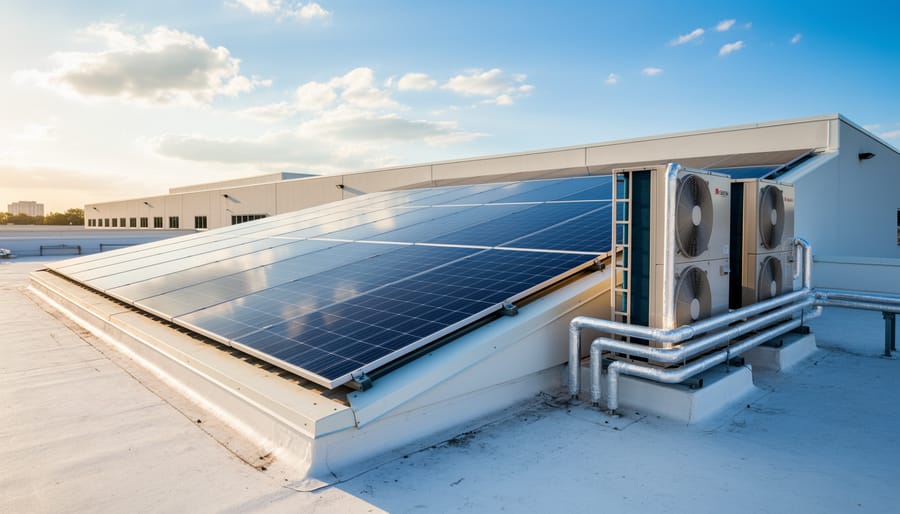
Solar thermal cooling represents an innovative approach where concentrated solar heat powers absorption chillers instead of traditional electric compressors. These systems use thermally-driven cycles with refrigerants like lithium bromide or ammonia-water solutions, making them particularly effective for facilities with substantial daytime cooling loads that align with peak solar availability.
Absorption chillers can achieve cooling capacities ranging from 50 to several thousand tons, with coefficients of performance between 0.6 and 1.2. The technology proves most cost-effective in regions with high cooling demands and strong solar radiation, such as the southwestern United States and southern Europe. Hotels, hospitals, and manufacturing facilities have documented 40-60% reductions in cooling-related electricity consumption after implementation.
A notable application involves a California distribution center that installed a 300-ton solar thermal absorption system. The facility reduced annual cooling costs by approximately $85,000 while eliminating 450 metric tons of carbon emissions. The system paired evacuated tube collectors with thermal storage tanks, providing cooling even during cloud cover and extending operational hours beyond daylight.
Initial investment remains higher than conventional systems, typically requiring seven to twelve years for payback. However, federal tax incentives, accelerated depreciation, and utility rebates can reduce this timeframe significantly while delivering long-term operational savings and enhanced sustainability credentials.
High-Efficiency Heat Pumps and Geothermal Integration
Electric heat pump technology represents a significant advancement in commercial HVAC efficiency, particularly when integrated with solar power systems. These systems transfer heat rather than generate it through combustion, achieving efficiency ratios of 300-400% compared to traditional heating methods. When paired with photovoltaic arrays, heat pumps can operate with minimal grid dependency, substantially reducing operational costs.
Ground-source heat pumps leverage stable underground temperatures to provide consistent heating and cooling year-round. By circulating fluid through buried pipe loops, these systems maintain efficiency even during extreme weather conditions. Commercial installations typically see 30-60% energy savings compared to conventional systems, with payback periods of 5-10 years depending on building size and local utility rates.
Air-source heat pumps offer lower installation costs while delivering comparable performance in moderate climates. Modern cold-climate models now function effectively in temperatures as low as -15°F, expanding their viability across diverse geographic regions. A manufacturing facility in Colorado recently reduced HVAC energy consumption by 42% after installing solar-powered air-source heat pumps, demonstrating measurable returns within seven years. The combination of reduced electricity demand and solar generation creates substantial long-term value for commercial property owners.
Real-World Performance: Case Studies and ROI Analysis
Office Building Transformation
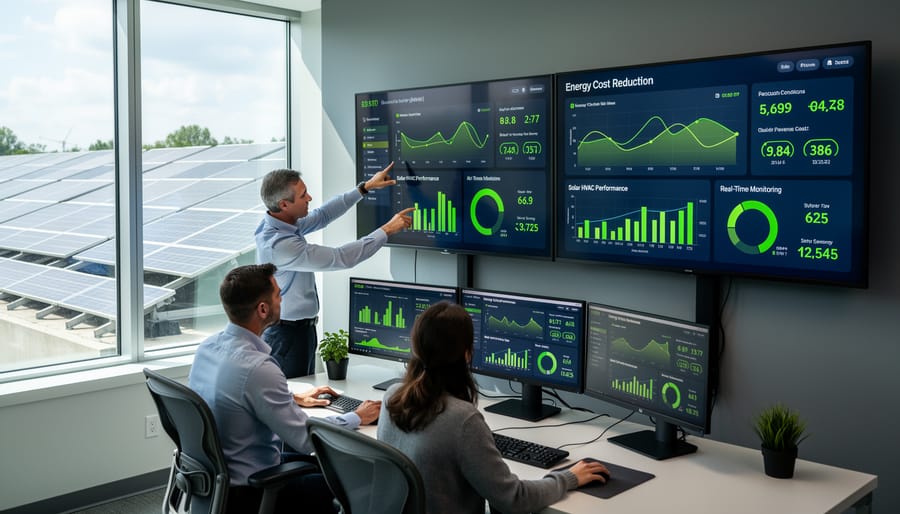
A 45,000-square-foot office complex in Stuttgart demonstrates the substantial financial benefits of integrating solar power with modern HVAC systems. The building’s facility management team implemented a comprehensive energy efficiency upgrade that reduced HVAC-related energy costs by 60% within the first operational year.
The project began with a detailed energy audit identifying that the existing HVAC system consumed approximately 180,000 kWh annually, representing 42% of total building energy usage. The solution combined a 120-kW rooftop solar photovoltaic array with a high-efficiency variable refrigerant flow (VRF) HVAC system and an intelligent building management system for optimal load balancing.
Implementation occurred in three phases over eight months. Phase one involved installing the solar array and upgrading electrical infrastructure, completed in twelve weeks. Phase two replaced the outdated HVAC equipment with energy-efficient units featuring advanced heat recovery capabilities, requiring ten weeks. The final phase integrated smart controls and commissioned the complete system over six weeks.
Total project investment reached €285,000, with solar installation accounting for €165,000 and HVAC upgrades comprising €120,000. Annual energy savings totaled €52,000, combining reduced grid electricity consumption and lower demand charges. The calculated payback period stands at 5.5 years, after which the building benefits from ongoing operational savings estimated at €50,000 annually for the system’s 25-year lifespan.
Beyond direct cost reduction, the facility achieved LEED Gold certification, enhanced tenant satisfaction through improved climate control, and significantly reduced its carbon footprint by 78 metric tons annually.
Industrial Facility Application
A leading automotive parts manufacturer in regional Queensland implemented a 500kW solar-powered HVAC system to manage climate control across 15,000 square meters of production floor space. The facility required consistent temperature regulation between 18-22°C for precision manufacturing processes, with conventional systems consuming approximately 35% of total energy costs.
The integrated solar solution incorporates thermal storage capabilities and grid connectivity to ensure uninterrupted operation during peak production hours. This hybrid approach delivers energy reliability while reducing HVAC operating costs by 68% annually. Advanced monitoring systems track performance metrics in real-time, enabling predictive maintenance and optimized energy distribution.
The facility achieved payback within 4.2 years through combined energy savings and government incentives. Beyond financial returns, the installation reduced carbon emissions by 420 tonnes annually while maintaining the precise environmental conditions critical for quality control. Temperature stability improved by 15%, resulting in fewer production defects and enhanced product consistency.
This application demonstrates how solar-powered HVAC systems can meet demanding industrial requirements while delivering substantial operational savings. The manufacturer now allocates recovered costs toward additional automation upgrades, creating a sustainable cycle of technological advancement and improved efficiency.
Government Institution Success
The San Diego County Administration Building achieved a 47% reduction in HVAC energy consumption after implementing a solar-powered system, demonstrating how public facilities can meet ambitious sustainability mandates while delivering measurable cost savings. Facing strict state energy efficiency requirements and aging equipment nearing replacement, facility managers opted for a comprehensive solar HVAC integration rather than conventional system upgrades.
The 180,000-square-foot facility installed a 350kW rooftop solar array paired with variable refrigerant flow HVAC technology and smart building controls. This configuration allows the system to draw power directly from solar panels during peak cooling hours, effectively eliminating demand charges that previously represented 40% of the building’s energy costs. Energy storage batteries provide additional capacity during evening hours and cloudy conditions.
Within 18 months, the facility documented annual operating cost reductions exceeding $120,000 while cutting carbon emissions by 285 metric tons. The project qualified for federal tax incentives and state renewable energy grants, reducing the payback period to 6.2 years. Beyond financial performance, the installation fulfilled the county’s zero-emission building commitment and established a replicable model for other government facilities throughout the region.
Financial Considerations and Investment Returns
Upfront Costs vs. Long-Term Savings
While energy-efficient HVAC systems require higher initial capital outlay compared to conventional units, comprehensive financial analysis reveals compelling long-term value. Premium variable refrigerant flow systems or geothermal installations typically cost 20-40% more upfront than standard equipment, yet these investments often achieve payback within 3-7 years through reduced energy consumption.
Financial incentives significantly improve project economics. The available tax credits and rebates through federal and state programs can offset 15-30% of total system costs. Commercial buildings qualify for accelerated depreciation under Section 179, allowing businesses to deduct the full purchase price during the tax year. Energy efficiency certificates and utility company rebates provide additional cost recovery mechanisms.
A Sydney manufacturing facility demonstrated these economics by replacing aging rooftop units with high-efficiency models integrated with solar power. Despite $280,000 in installation costs, the project received $65,000 in combined incentives and generated $48,000 in annual energy savings, creating a net positive cash flow by year six while reducing carbon emissions by 42%. These financial dynamics make energy-efficient HVAC systems increasingly attractive investments for forward-thinking organizations.
Calculating Your Payback Period
Determining your payback period requires analyzing four key variables: your facility’s size and energy consumption, local utility rates, anticipated solar energy production, and efficiency gains from new HVAC systems. Start by calculating your baseline energy costs—review 12-24 months of utility bills to establish current HVAC expenditures, typically 40-50% of total commercial building energy use.
Next, quantify potential savings from high-efficiency HVAC equipment. Modern variable refrigerant flow systems and high-SEER units can reduce consumption by 30-40% compared to older equipment. When paired with solar, these improvements compound significantly. Factor in your solar system’s expected output based on your location’s peak sun hours and roof orientation. Most commercial installations generate 1,200-1,500 kWh per installed kilowatt annually.
Apply current incentives including federal Investment Tax Credits (26% for commercial solar), state rebates, and accelerated depreciation. A 50,000-square-foot facility investing $200,000 in HVAC upgrades and $300,000 in solar typically achieves payback within 5-8 years. Real-world application: A California distribution center reduced HVAC costs by $42,000 annually through this combined approach, reaching full payback in 6.2 years while increasing property value and operational resilience.
Implementation Strategy for Your Facility
Energy Audit and System Assessment
A comprehensive energy audit serves as the foundation for optimizing HVAC efficiency in commercial buildings. This assessment should evaluate current system performance, identifying energy consumption patterns, operational inefficiencies, and opportunities for improvement. Professional auditors analyze equipment age, maintenance records, ductwork integrity, and control system functionality while measuring temperature distribution and air quality metrics throughout the facility.
The assessment should simultaneously evaluate solar energy potential by examining roof conditions, orientation, available surface area, and shading factors. Advanced monitoring equipment can measure baseline HVAC energy consumption, establishing clear metrics for future performance comparison. Thermal imaging cameras detect insulation deficiencies and air leaks that compromise system efficiency, while data loggers track real-time energy usage patterns.
Engaging certified energy auditors or HVAC specialists ensures accurate analysis and actionable recommendations. These professionals utilize sophisticated diagnostic tools and industry benchmarks to identify cost-effective upgrades, quantify potential energy savings, and develop prioritized implementation plans. A thorough assessment typically includes a detailed report documenting current performance, improvement opportunities, estimated costs, and projected return on investment, providing the critical data needed for informed decision-making about HVAC modernization and solar integration strategies.
Selecting Qualified Installation Partners
Selecting the right installation partner is critical to maximizing the performance and longevity of your energy-efficient HVAC system. Prioritize contractors who hold relevant certifications such as NATE (North American Technician Excellence) for HVAC professionals and NABCEP (North American Board of Certified Energy Practitioners) for solar installers. When integrating solar energy with HVAC systems, seek partners with demonstrated experience in hybrid projects, as this requires specialized knowledge of electrical load management and system synchronization.
Request detailed references from similar commercial installations and verify their track record with successful commissioning reports. The ideal partner should offer comprehensive post-installation support, including performance monitoring systems that provide real-time data on energy production and HVAC efficiency. This ongoing oversight enables quick identification of performance issues and ensures your system operates at optimal capacity.
Evaluate potential partners based on their warranty offerings, maintenance service agreements, and response times for technical support. A qualified contractor should conduct thorough site assessments, provide transparent cost breakdowns, and deliver realistic performance projections based on your building’s specific requirements. Their expertise in navigating local permitting, utility interconnection agreements, and available incentive programs will streamline implementation and maximize your return on investment.
Investing in energy-efficient HVAC systems powered by solar energy delivers measurable advantages for commercial operations. Beyond the immediate reduction in utility expenses, businesses position themselves as environmental leaders while securing long-term operational stability against fluctuating energy costs. The data consistently demonstrates that organizations implementing these systems achieve 30-50% decreases in HVAC-related energy consumption, with payback periods typically ranging from 5-8 years depending on system configuration and local incentives.
The competitive landscape increasingly favors organizations that demonstrate environmental responsibility. Early adopters gain reputational benefits, regulatory compliance advantages, and tangible cost savings that directly impact profitability. We encourage facility managers and business owners to conduct comprehensive energy assessments to identify optimization opportunities specific to their operations.
EU Solar specializes in commercial solar solutions tailored to HVAC integration requirements. Our team provides end-to-end support, from initial system design and financial modeling through installation, monitoring, and ongoing maintenance. We help organizations navigate incentive programs, utility interconnection requirements, and performance optimization strategies. Contact our commercial solutions team to evaluate how solar-powered HVAC systems can transform your facility’s energy profile while strengthening your bottom line and sustainability credentials.