

Modern cities move 1.4 billion people daily through transportation networks that consume 23% of global energy-related CO2 emissions. Intelligent Transportation Systems (ITS)—the digital infrastructure managing traffic signals, highway sensors, transit operations, and communication networks—represent a $40 billion annual investment worldwide, yet most installations remain tethered to conventional grid power with its rising costs and vulnerability to outages.
Solar-powered ITS infrastructure transforms this equation. Transportation authorities across North America and Europe now deploy photovoltaic systems that eliminate monthly utility bills for roadside equipment, reduce installation costs by 40% in remote locations, and ensure uninterrupted operation during grid failures. A single solar-equipped traffic management system can generate $15,000 in annual savings while supporting carbon neutrality commitments that increasingly influence government funding decisions.
The business case extends beyond operational savings. Federal infrastructure programs allocate substantial incentives for sustainable transportation technology, with solar integration often qualifying for both renewable energy tax credits and smart city development grants. Municipal transport departments report payback periods of 4-6 years on solar ITS investments, while equipment lifespan extends 25+ years with minimal maintenance requirements.
This convergence of fiscal responsibility and environmental stewardship positions solar-powered intelligent transportation as essential infrastructure modernization. Real-world deployments demonstrate measurable returns: reduced energy expenditure, enhanced system reliability, simplified installation in challenging locations, and alignment with regulatory sustainability mandates. For facility managers and government officials evaluating transportation infrastructure upgrades, solar integration delivers quantifiable value that strengthens both budget proposals and long-term operational resilience.
What Are Intelligent Transportation Systems and Why They Need Sustainable Power

The Energy Challenge Facing Modern Transport Infrastructure
Modern intelligent transportation systems represent a significant and growing energy demand for municipalities and transport authorities. A typical urban ITS network, including traffic signals, surveillance cameras, digital signage, and sensor arrays, can consume between 3,000 to 8,000 kilowatt-hours per intersection annually. For cities managing hundreds or thousands of intersection points, this translates to substantial operational expenditures that strain already limited infrastructure budgets.
Traffic signal systems alone account for approximately 2 billion kilowatt-hours of electricity consumption annually across the United States, generating operational costs exceeding $200 million per year. Variable message signs consume between 2,500 and 4,500 watts each when operational, while CCTV surveillance systems add another 50 to 300 watts per camera location. These continuous power requirements create predictable yet substantial recurring expenses for transport departments.
Beyond direct energy costs, ITS infrastructure faces critical grid reliability challenges. Power outages during severe weather events or grid failures can compromise traffic management capabilities precisely when they are most needed for public safety and emergency response. Many jurisdictions currently rely on diesel backup generators, which introduce additional operational costs, maintenance requirements, and environmental concerns.
The cumulative financial impact extends beyond electricity bills. Grid connection fees, demand charges during peak periods, and infrastructure upgrades to support expanded ITS deployments add layers of complexity to total cost of ownership calculations. These challenges have prompted forward-thinking transport authorities to explore alternative energy solutions that can reduce operational expenses while enhancing system resilience and sustainability.
Core Applications of Solar-Powered Intelligent Transport Infrastructure
Solar-Powered Traffic Management Systems
Solar-powered traffic management systems represent a practical convergence of renewable energy and intelligent transportation infrastructure, offering municipalities and transport authorities significant operational advantages. These systems eliminate dependence on grid electricity, reduce installation costs by avoiding trenching for power lines, and provide continuous operation even during grid outages.
Smart traffic signals equipped with solar panels typically require 50-150 watts of power, supported by battery storage systems ranging from 100-200 amp-hours. Modern LED signal heads consume approximately 10-15 watts compared to legacy incandescent bulbs, making solar integration highly viable. A standard configuration includes a 100-watt solar panel, charge controller, and gel cell batteries designed for 3-5 days of autonomy during low-sunlight periods.
Adaptive lighting systems use solar power combined with sensors and microprocessors to adjust illumination levels based on traffic flow and ambient conditions. These installations demonstrate energy savings of 40-60 percent compared to conventional street lighting while maintaining safety standards. Variable message signs, which require 200-400 watts depending on size and brightness, benefit from larger solar arrays paired with MPPT charge controllers for optimal efficiency.
Traffic monitoring cameras present unique power requirements, typically consuming 20-50 watts continuously for basic functionality and 100-200 watts when transmitting data wirelessly. Solar-powered camera systems incorporate cellular or wireless communication modules, eliminating the need for both power and data infrastructure in remote locations.
System integration allows centralized management through cloud-based platforms, enabling real-time monitoring of battery health, solar production, and equipment status. This proactive approach reduces maintenance costs and ensures consistent system performance, delivering measurable return on investment within 5-7 years for most implementations.
Electric Vehicle Charging Infrastructure
Solar-integrated electric vehicle charging infrastructure represents a strategic investment for transport authorities and facility managers seeking grid independence and operational cost reduction. By installing photovoltaic arrays at public transport depots, parking facilities, and highway rest stops, organizations can generate clean energy precisely where charging demand occurs, eliminating transmission losses and reducing peak demand charges.
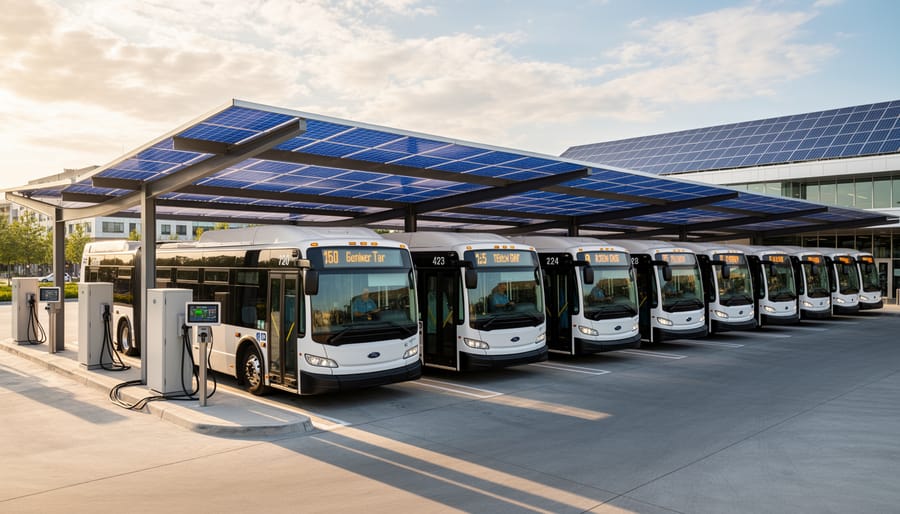
Public transport depots benefit significantly from solar canopies that shelter buses while generating power for overnight charging cycles. This approach aligns energy production with operational patterns, particularly when combined with battery storage systems that capture excess solar generation for evening use. Highway rest stops equipped with solar charging infrastructure provide travelers with reliable service while reducing facility operating costs by 40-60% compared to grid-only solutions.
Parking facilities represent ideal candidates for solar integration, with expansive canopy structures generating substantial power throughout business hours when commuter vehicles require charging. These installations protect vehicles from weather while maximizing revenue-generating capacity per square meter of property.
Demand management capabilities emerge as a critical advantage, with intelligent systems directing solar generation to balance grid consumption during peak pricing periods. Organizations implementing comprehensive solutions—similar to solar-powered public transit and commercial fleet solar solutions—typically achieve payback periods of 5-7 years while establishing energy resilience that protects against grid disruptions and price volatility.
Connected Vehicle-to-Infrastructure (V2I) Communication Networks
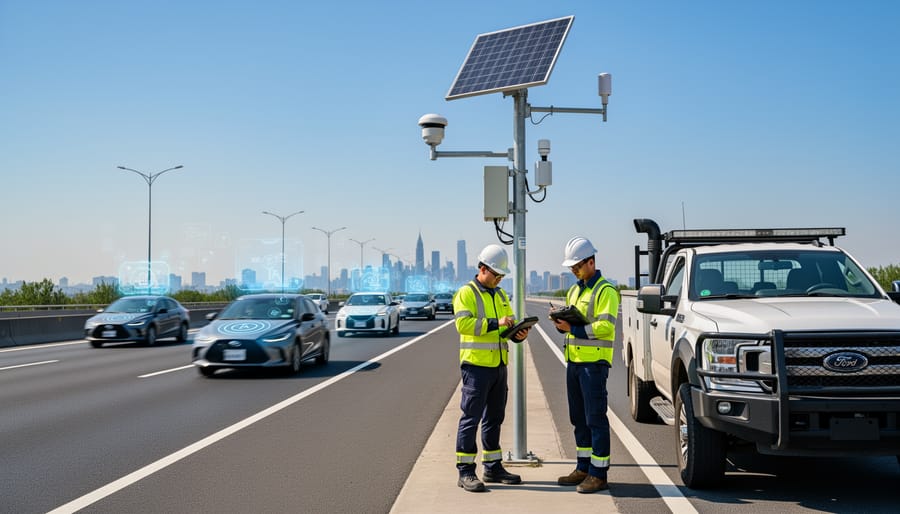
Vehicle-to-Infrastructure (V2I) communication networks form the backbone of modern intelligent transportation systems, enabling seamless data exchange between vehicles and roadside infrastructure. Solar-powered roadside units (RSUs) provide an economically viable solution for deploying these networks, particularly in locations where grid connectivity is limited or cost-prohibitive.
These systems typically consist of solar-powered communication hubs equipped with dedicated short-range communications (DSRC) or cellular V2X technology, enabling real-time transmission of traffic conditions, hazard warnings, and signal phase timing information. By eliminating dependence on grid power, solar RSUs can be strategically positioned at critical junctions, highway merge points, and high-risk corridors without the expense of trenching for electrical infrastructure.
Current deployments demonstrate significant operational advantages. The Colorado Department of Transportation operates over 200 solar-powered RSUs across rural mountain corridors, achieving 99.7% uptime while reducing installation costs by 40% compared to grid-connected alternatives. These units communicate with equipped vehicles to provide advance warnings about adverse weather, construction zones, and traffic incidents.
The return on investment becomes evident through reduced accident rates and improved traffic flow. A European Union study documented that V2I-enabled corridors experienced 23% fewer rear-end collisions and 15% improvements in average travel times during peak periods. For transportation authorities managing limited budgets, solar-powered V2I infrastructure delivers critical safety improvements while maintaining operational independence and predictable lifecycle costs.
Smart Parking and Access Control Systems
Solar-powered smart parking systems represent a high-return investment for facility managers seeking to optimize space utilization while reducing operational costs. These integrated solutions combine multiple technologies into cohesive platforms that guide drivers efficiently, automate entry and exit procedures, and process payments without relying on grid electricity.
Modern parking guidance systems use solar panels to power LED display signs, ultrasonic or camera-based sensors, and central processing units. These systems detect available spaces in real-time and direct drivers through digital signage, reducing search time by up to 43% according to implementation data from European commercial facilities. The elimination of circling vehicles decreases local emissions and improves the overall user experience.
License plate recognition cameras paired with automated barriers create seamless access control without manual intervention. Solar installations provide reliable power for these 24/7 operations, with battery storage ensuring functionality during low-light conditions. Payment kiosks integrated into these systems accept multiple payment methods while operating entirely off-grid, eliminating trenching costs and enabling flexible placement.
For business owners and government facilities, the return on investment typically occurs within 4-6 years through reduced labor costs, improved parking turnover, and elimination of electrical infrastructure expenses. These systems also provide valuable data analytics on utilization patterns, supporting evidence-based decisions for future capacity planning and rate optimization.
The Business Case: ROI and Cost-Benefit Analysis
Installation Costs Versus Long-Term Savings
Initial investment in solar-powered intelligent transportation systems typically ranges from $50,000 to $500,000 per installation, depending on system complexity and coverage area. A basic solar traffic management system for a small municipality might require $75,000-$150,000, while comprehensive regional deployments can exceed $2 million. These costs encompass solar infrastructure, ITS hardware, communications equipment, and integration with existing systems.
However, numerous financial incentives significantly reduce upfront costs. Federal programs through the Infrastructure Investment and Jobs Act allocate billions for sustainable transportation modernization. Many EU member states offer grants covering 30-50% of qualifying ITS projects. Additional funding sources include regional development banks, green infrastructure bonds, and carbon offset programs that monetize emission reductions.
Payback periods vary by application but generally range from 4-8 years. Solar-powered traffic signals demonstrate the shortest returns at 3-5 years through eliminated utility costs and reduced maintenance expenses. Variable message signs achieve payback within 5-7 years, while comprehensive corridor management systems require 6-9 years. These calculations account for energy savings, reduced grid dependency, lower operational costs, and avoided infrastructure upgrades.
Long-term financial benefits extend well beyond payback periods. Over a 25-year operational lifespan, solar ITS installations typically generate 300-400% return on investment through cumulative energy savings, reduced maintenance requirements, and enhanced system reliability. Organizations also benefit from predictable operating costs, immunity to utility rate increases, and improved budget forecasting. Environmental credits and sustainability reporting further enhance the value proposition for government entities pursuing decarbonization mandates.
Operational Advantages Beyond Energy Savings
Solar-powered intelligent transportation systems deliver substantial operational advantages that extend well beyond energy cost reduction. The infrastructure deployment model fundamentally differs from conventional grid-dependent systems, creating significant financial and operational benefits for transport authorities and facility managers.
Traditional ITS installations require extensive trenching to connect roadside equipment to electrical infrastructure, often costing $150-300 per linear meter in urban environments. Solar-powered systems eliminate these expenses entirely, reducing initial capital requirements by 30-40% in many applications. Remote locations such as rural highways and regional intersections particularly benefit from this independence, as grid connection costs can exceed equipment expenses when infrastructure extends beyond 500 meters from existing power sources.
Maintenance requirements decrease substantially with solar integration. Modern solar-powered ITS equipment operates with minimal intervention, typically requiring only annual inspections and routine panel cleaning. Battery management systems automatically regulate charging cycles, extending component lifespan to 7-10 years. This contrasts sharply with grid-connected systems that remain vulnerable to utility outages and require ongoing electrical infrastructure maintenance.
System reliability improves through redundancy inherent in distributed solar generation. Individual equipment failures affect only localized components rather than cascading through interconnected grid-dependent systems. Advanced battery storage ensures continuous operation during extended cloudy periods, with properly sized systems maintaining 5-7 days of autonomous operation.
Deployment flexibility represents perhaps the most significant operational advantage. Transport authorities can rapidly install solar-powered variable message signs, traffic monitoring stations, and emergency call boxes without coordinating utility connections or obtaining electrical permits. This agility proves invaluable during infrastructure emergencies or temporary installations for construction projects. The transport infrastructure solar integration approach enables scalable deployment that adapts to evolving transportation network requirements while maintaining full operational independence.
Real-World Implementation: Case Studies and Proven Results
Municipal Traffic Management System Retrofit
The City of Rotterdam’s 2022-2023 traffic management retrofit demonstrates the practical benefits of solar-powered intelligent transportation systems. Facing €180,000 in annual energy costs across 847 traffic signals and pedestrian crossings, municipal authorities initiated a phased transition to solar-integrated smart infrastructure.
The implementation began with a six-month pilot program converting 120 high-traffic intersections to solar-powered adaptive signals with integrated sensors and wireless communication capabilities. Initial investment totaled €2.4 million, including photovoltaic arrays, battery storage systems, LED signal replacements, and vehicle detection equipment. The pilot phase documented 73% reduction in grid electricity consumption and 41% improvement in traffic flow efficiency through real-time signal optimization.
Following successful pilot results, Rotterdam expanded the program city-wide over 18 months. Total project costs reached €14.8 million, with EU sustainability grants covering 35% of expenses. The solar arrays generate approximately 890 MWh annually, eliminating €127,000 in direct energy costs. Additional savings emerged from reduced maintenance requirements, with LED components lasting 5-7 years compared to 1-2 years for conventional bulbs.
Beyond financial metrics, the system achieved measurable operational improvements. Emergency vehicle response times decreased by 18% through priority signal sequencing, while pedestrian safety incidents dropped 24% at upgraded crossings equipped with enhanced detection and extended crossing times during peak hours. Rotterdam’s documented three-year payback period provides compelling evidence for similar municipalities evaluating intelligent transportation infrastructure investments.
Solar-Powered Bus Rapid Transit Infrastructure
Bus Rapid Transit systems represent a compelling application of integrated solar technology and intelligent transportation infrastructure. Modern BRT implementations demonstrate how renewable energy can power comprehensive transit operations while delivering measurable operational improvements and cost reductions.
A leading example is the deployment of solar-integrated BRT stations featuring photovoltaic canopies that generate electricity for station operations, real-time passenger information displays, LED lighting, and security systems. These installations typically incorporate 20-50 kW solar arrays per major station, achieving grid independence during daylight hours and reducing annual energy costs by 60-75 percent. The solar canopies serve dual purposes, providing weather protection for passengers while generating clean power.
Real-time passenger information systems powered by solar energy display accurate arrival predictions, route updates, and service alerts without increasing station operational costs. These displays integrate with central traffic management systems, utilizing GPS tracking and predictive algorithms to provide passengers with reliable journey planning information. The result is improved passenger satisfaction and increased ridership, with some systems reporting 15-20 percent growth following intelligent system implementation.
Electric bus charging facilities at terminal stations represent another critical component of solar-powered urban infrastructure. Solar carports and ground-mounted arrays provide supplementary charging capacity, reducing demand charges and stabilizing operational costs. Transportation authorities report payback periods of 5-8 years on solar investments, with annual savings exceeding $50,000 per major station. These systems demonstrate that renewable energy integration enhances service reliability while supporting long-term financial sustainability.
Technical Considerations for Optimal System Design
Sizing Solar Systems for Continuous ITS Operation
Proper sizing of solar systems for ITS applications requires comprehensive load calculations that account for all power-consuming components including traffic signals, sensors, cameras, communication equipment, and control systems. A thorough energy audit should document peak and average consumption patterns across different seasons and operational scenarios.
Battery storage capacity represents a critical design consideration, typically sized to provide 3-5 days of autonomous operation during periods of insufficient solar generation. This ensures continuous functionality during extended cloudy weather or winter months with reduced daylight hours. Advanced lithium-ion battery systems offer superior depth of discharge and longevity compared to traditional lead-acid alternatives, though they require higher initial investment.
Redundancy planning should incorporate backup power sources and parallel system configurations to eliminate single points of failure. Many installations combine solar arrays with grid connections or backup generators, creating hybrid systems that maximize renewable energy use while guaranteeing uninterrupted operation.
System oversizing by 15-25 percent above calculated requirements provides safety margins for equipment degradation over time and unexpected demand increases. Professional energy consultants can model site-specific solar irradiance data, seasonal variations, and equipment specifications to optimize system design. Geographic location significantly impacts sizing requirements, with northern latitudes requiring larger arrays and storage capacity to compensate for reduced winter solar availability.
Integration with Existing Infrastructure and Grid Connectivity
Successful deployment of solar-powered intelligent transportation systems requires careful integration with existing infrastructure and grid connectivity solutions. Hybrid approaches offer the most reliable operational framework, combining solar generation with grid backup to ensure uninterrupted system performance during periods of low sunlight or unexpected demand surges. This dual-source configuration provides transport authorities with the flexibility to maximize renewable energy usage while maintaining guaranteed uptime for critical traffic management functions.
Modern monitoring systems play an essential role in optimizing performance and identifying potential issues before they impact operations. Advanced platforms provide real-time data on energy production, consumption patterns, battery status, and system efficiency, enabling proactive maintenance and informed decision-making. These monitoring solutions typically integrate seamlessly with existing transport management platforms through standardized communication protocols and APIs, allowing facility managers to oversee both traffic operations and energy systems from unified control centers.
Grid interconnection options vary based on local regulations and utility requirements, but net metering arrangements can generate additional cost savings by feeding excess solar production back to the grid during peak generation periods. Working with experienced installation partners ensures compliance with grid codes, proper safety protocols, and optimal system configuration that aligns with both operational requirements and financial objectives, ultimately delivering measurable return on investment for transportation infrastructure modernization initiatives.

Future Trends: Where Solar-Powered ITS Is Heading
The convergence of solar technology with intelligent transportation systems is accelerating rapidly, driven by advances in artificial intelligence, Internet of Things connectivity, and autonomous vehicle development. Industry projections indicate that solar-powered ITS infrastructure will become standard in smart city deployments by 2030, with integration extending far beyond traditional traffic management.
Autonomous vehicle infrastructure represents a significant opportunity for solar-powered systems. Self-driving vehicles require continuous communication with roadside units for navigation, hazard detection, and traffic coordination. Solar-powered 5G nodes and vehicle-to-infrastructure (V2I) communication hubs eliminate the need for grid connectivity along highways and rural routes, reducing installation costs by 40-60% compared to traditional powered infrastructure. Several pilot programs in Australia and Europe are already testing solar-powered autonomous vehicle corridors.
AI-driven traffic optimization is transforming how cities manage congestion and emissions. Machine learning algorithms analyze real-time data from solar-powered sensors and cameras to predict traffic patterns, adjust signal timing dynamically, and recommend route alternatives. These systems reduce fuel consumption by 15-20% in urban environments while improving traffic flow by 25-30%. The integration with solar power ensures continuous operation during grid disruptions, maintaining critical transportation functions.
Smart city integration will expand solar-powered ITS beyond roads into comprehensive sustainable transportation solutions. Future systems will coordinate electric vehicle charging networks, public transit schedules, pedestrian infrastructure, and micro-mobility options through unified solar-powered platforms. Energy storage advances will enable these systems to function as distributed power resources, feeding excess solar generation back into municipal grids during peak production periods. This bidirectional energy flow creates additional revenue streams and enhances grid resilience, delivering measurable return on investment within 5-7 years for most implementations.
The integration of solar power with intelligent transportation systems represents a compelling investment opportunity that delivers both immediate financial returns and long-term strategic advantages. Organizations that adopt solar-powered ITS infrastructure position themselves to benefit from reduced operational costs while simultaneously advancing sustainability objectives that increasingly influence public perception and regulatory compliance.
The evidence from implemented projects across Europe demonstrates that solar integration with ITS is not merely an environmental initiative but a sound business decision. Energy cost reductions of 40-60% create substantial savings that accumulate year after year, while declining solar technology costs and improving efficiency metrics continue to strengthen the financial case. The reliability improvements and grid independence offered by solar solutions add further value, particularly for critical transportation infrastructure that demands continuous operation.
Beyond immediate cost benefits, solar-powered ITS infrastructure provides future-proof resilience against rising energy costs and evolving environmental regulations. As governments worldwide intensify emissions reduction targets and carbon pricing mechanisms, early adopters gain competitive advantages through established sustainable infrastructure that meets emerging requirements without costly retrofitting.
We encourage transport authorities, facility managers, and infrastructure planners to conduct comprehensive energy audits of their current ITS deployments. Assess your traffic management systems, surveillance networks, and communication infrastructure to identify opportunities for solar integration. Consider both new installations and retrofit applications for existing systems. The combination of proven technology, favorable economics, and strategic positioning makes solar-powered intelligent transportation systems an essential component of modern infrastructure modernization strategies.