
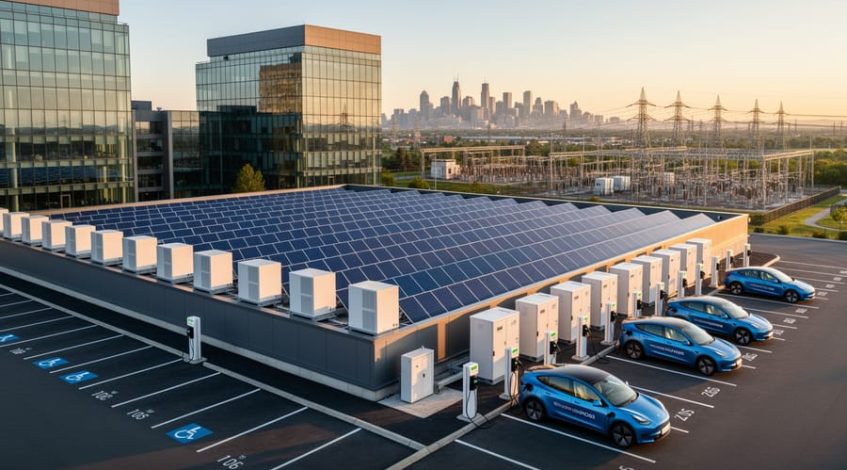
The energy landscape is undergoing a fundamental transformation, and virtual grid (v-grid) systems stand at the forefront of this revolution. As solar installations proliferate across commercial facilities and government properties, traditional grid infrastructure faces unprecedented challenges in managing bidirectional power flows, voltage fluctuations, and demand spikes. V-grid technology addresses these complexities by creating intelligent, software-defined energy networks that optimize solar generation, storage, and consumption in real-time.
Unlike conventional grid systems that operate on rigid, centralized models, v-grids employ advanced algorithms and IoT sensors to create flexible, distributed energy networks. These systems aggregate multiple energy assets—rooftop solar arrays, battery storage units, EV charging stations, and building loads—into a single, coordinated platform. The result is a dynamic energy ecosystem that responds instantly to price signals, grid conditions, and regulatory requirements while maximizing return on solar investments.
For business decision-makers evaluating energy infrastructure upgrades, v-grids represent more than technological innovation. They offer measurable financial benefits: reduced demand charges through peak shaving, enhanced energy independence, and compliance with increasingly complex solar interconnection regulations. Facility managers gain unprecedented visibility into energy flows and consumption patterns, enabling data-driven optimization strategies that can reduce energy costs by 20-40 percent.
The regulatory environment is evolving rapidly to accommodate these distributed energy resources. Net metering policies, interconnection standards, and grid service compensation mechanisms now directly impact v-grid implementation strategies. Understanding this intersection between technology capability and regulatory framework is essential for organizations seeking to deploy solar assets that deliver sustained value while maintaining full compliance with dynamic energy regulations.
What Are V-Grid Energy Systems?
The Technology Behind Virtual Grid Architecture
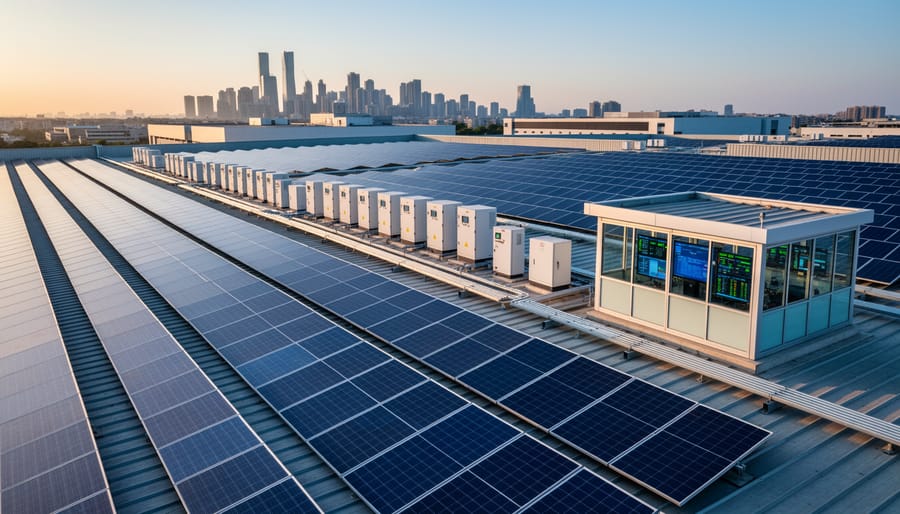
Virtual grid architecture operates through an integrated ecosystem of advanced hardware and software components working in concert to optimize energy distribution and consumption. At the foundation, smart inverters serve as the intelligent interface between distributed energy resources and the broader grid, converting DC power from solar panels while dynamically managing voltage, frequency, and power quality in real-time.
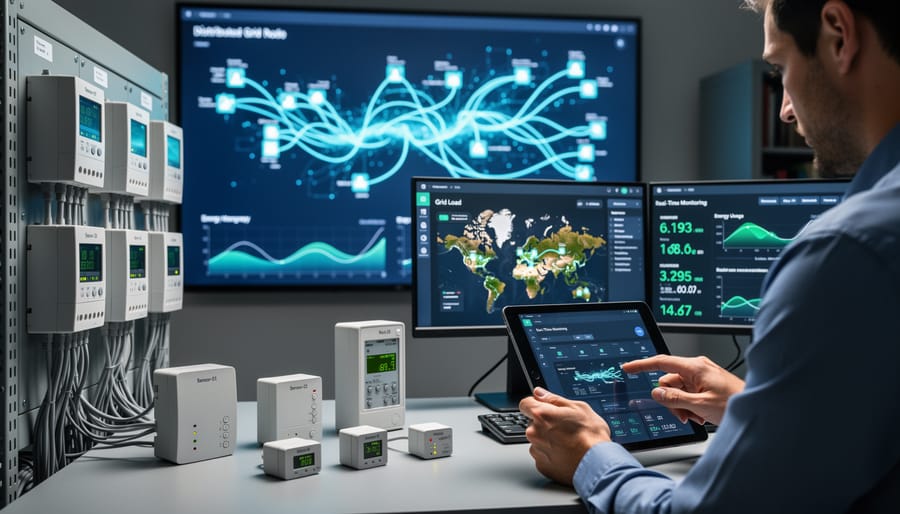
Internet of Things (IoT) sensors form the nervous system of v-grid infrastructure, continuously monitoring energy generation, storage levels, consumption patterns, and grid conditions. These sensors collect granular data across thousands of touchpoints, enabling unprecedented visibility into system performance and potential optimization opportunities.
The control center of any v-grid system lies in its AI-driven management platform. These sophisticated software solutions process massive datasets to forecast energy demand, predict generation patterns based on weather analytics, and execute automated decisions for load balancing and energy dispatch. Machine learning algorithms continuously improve system efficiency by identifying patterns and anomalies that human operators might overlook.
Advanced metering infrastructure provides bidirectional communication capabilities, allowing facilities to participate actively in demand response programs and peer-to-peer energy trading. When integrated with blockchain-enabled energy management, these systems create transparent, secure transaction records for energy exchanges.
Cloud-based analytics dashboards give facility managers actionable insights through intuitive interfaces, displaying real-time performance metrics, cost savings, and carbon reduction achievements. This technological convergence transforms traditional passive energy consumers into active participants in a resilient, decentralized energy ecosystem.
How V-Grids Integrate with Existing Solar Installations
V-grid technology offers remarkable flexibility for both existing and new solar installations. For facilities with current photovoltaic systems, retrofitting typically involves installing intelligent grid interface hardware and control software that connects between existing inverters and the electrical distribution system. This process generally requires minimal disruption to operations, often completed within a few days depending on system size. The existing solar panels, mounting infrastructure, and basic electrical components remain fully functional, making retrofit implementation a cost-effective upgrade path. Compatibility assessments examine inverter specifications, monitoring systems, and electrical panel configurations to ensure seamless integration.
New installations benefit from optimized design, allowing architects and engineers to integrate v-grid capabilities from the ground up. This approach enables better placement of control systems, enhanced monitoring infrastructure, and streamlined compliance with dynamic grid regulations. Installation costs for v-grid components typically represent 8-15% of total system investment but can significantly improve ROI through enhanced grid service revenue opportunities and demand charge management. Many manufacturers now offer v-grid-ready solar equipment, simplifying procurement and reducing installation complexity. Facility managers should work with certified installers experienced in grid-interactive systems to ensure proper configuration and regulatory compliance.
Dynamic Solar Energy Grid Management Regulations: The New Compliance Landscape
Key Regulatory Requirements for Commercial Solar Operators
Commercial solar operators implementing v-grid energy systems must navigate several critical regulatory requirements designed to maintain power network reliability and security. These obligations have evolved significantly alongside traditional EU grid management regulations, establishing clear frameworks for distributed energy resource participation.
Grid stability contributions form a primary compliance area. Operators must demonstrate capability to provide ancillary services including frequency regulation and voltage support. Modern v-grid systems typically incorporate advanced inverters that can rapidly adjust power output in response to grid conditions, maintaining system stability during demand fluctuations. Documentation proving these technical capabilities is required during licensing processes across most jurisdictions.
Demand response participation represents another essential obligation. Commercial operators must register with regional system operators and maintain communication infrastructure enabling real-time control signals. This includes implementing automated systems that can curtail generation or discharge storage within specified timeframes, typically ranging from 30 seconds to 10 minutes depending on service type. A manufacturing facility in Germany successfully demonstrated compliance by integrating a 2MW solar array with battery storage, achieving 98% response accuracy during peak demand events.
Reporting standards require comprehensive data submission on generation patterns, grid interactions, and system performance. Monthly reports must detail energy production, export volumes, response to dispatch signals, and any technical faults or outages. Many jurisdictions now mandate real-time data sharing through standardized protocols, enabling grid operators to optimize network management.
Equipment certification requirements ensure v-grid components meet safety and interoperability standards. This includes third-party testing of inverters, control systems, and metering infrastructure before commissioning.
Timeline and Implementation Deadlines
Implementation of v-grid energy systems requires careful attention to evolving regulatory timelines. Currently, many jurisdictions have established phased compliance schedules extending through 2028, with initial registration requirements taking effect as early as Q2 2024. Facility managers should prioritize conducting preliminary energy audits within the next 90 days to assess infrastructure readiness and identify potential integration challenges.
The typical deployment timeline spans 12-18 months from planning to full operation. Phase one involves regulatory approval and permitting processes, which generally require 3-4 months. Phase two encompasses procurement and installation, averaging 6-8 months for commercial-scale projects. The final phase focuses on testing, commissioning, and grid interconnection, typically completed within 2-3 months.
Business owners planning v-grid adoption should note that several states offer enhanced incentives for projects completed before December 2025, with rebate values decreasing incrementally thereafter. Early movers can capitalize on current feed-in tariff rates while securing priority access to technical support resources from utility providers. Additionally, companies initiating projects before mid-2024 may qualify for expedited permitting processes designed to encourage rapid clean energy deployment.
Business Benefits of V-Grid Energy Systems
Revenue Generation Through Grid Services
V-grid energy systems transform facilities from passive energy consumers into active revenue generators by leveraging excess capacity to provide valuable grid services. Through frequency regulation services, businesses can deploy their battery storage systems to help utilities maintain grid stability by automatically adjusting power output in response to frequency fluctuations. Grid operators compensate participants for this capacity availability, typically generating returns of $15-40 per kilowatt-year depending on regional market conditions.
Demand response programs offer another lucrative revenue stream, allowing facilities to reduce consumption during peak periods in exchange for financial incentives. V-grid systems automate this process, seamlessly shifting to stored solar energy or reducing non-critical loads when utilities issue demand response events. Commercial facilities participating in these programs commonly offset 20-35% of their annual energy costs through program payments and avoided peak demand charges.
Virtual power plant participation represents the most sophisticated revenue opportunity, aggregating multiple distributed energy resources to function as a single dispatchable power plant. Regional examples demonstrate significant potential: a California industrial park comprising twelve facilities generates approximately $180,000 annually through coordinated virtual power plant operations, while a Massachusetts commercial district recovers its energy storage investment 40% faster through grid service revenues.
These revenue streams create compelling financial models beyond traditional energy cost savings. Forward-thinking organizations recognize that strategic v-grid deployment transforms energy infrastructure from a cost center into a profit-generating asset, particularly as grid service markets expand nationwide and compensation structures become increasingly favorable for commercial participants.
Reduced Energy Costs and Enhanced ROI
V-grid energy systems deliver substantial financial advantages through sophisticated load management capabilities that directly impact operational expenses. By intelligently distributing energy consumption and storing excess solar generation, these systems reduce reliance on grid electricity during peak pricing periods when rates can increase by 200-300%. Peak shaving functionality automatically draws from stored battery reserves during high-demand intervals, effectively flattening energy cost curves and eliminating expensive demand charges that can represent 30-50% of commercial electricity bills.
The financial performance improvement extends beyond simple utility cost reduction. Businesses implementing v-grid technology typically achieve payback periods of 4-7 years, with some commercial installations reporting annual savings exceeding $50,000. The system’s predictive algorithms continuously optimize energy flow based on consumption patterns, weather forecasts, and time-of-use rates, ensuring maximum utilization of self-generated solar power. This intelligent approach to optimizing solar ROI transforms solar installations from passive generation assets into active revenue-enhancing infrastructure. Additionally, v-grids provide revenue opportunities through participation in demand response programs and virtual power plant networks, creating additional income streams that further accelerate return on investment while supporting grid stability.
Operational Resilience and Energy Security
V-grid energy systems deliver critical operational advantages by functioning as autonomous microgrids capable of island mode operation during utility disruptions. When grid outages occur, these systems seamlessly transition to battery storage and on-site generation, maintaining power to essential operations without interruption. This capability proves particularly valuable for facilities requiring continuous uptime, such as manufacturing plants, data centers, and healthcare facilities.
The reduced grid dependency inherent in v-grid architecture translates directly to enhanced business continuity. Organizations can maintain productivity during peak demand periods or utility brownouts, avoiding costly downtime that typically ranges from $5,000 to over $100,000 per hour in industrial settings. Real-world implementations demonstrate this value proposition: a distribution center in California maintained full operations during recent Public Safety Power Shutoffs, avoiding an estimated $2.3 million in lost revenue and spoilage.
Beyond emergency backup, v-grid systems provide predictable energy availability for mission-critical processes. The intelligent energy management platforms monitor storage levels and generation capacity in real-time, automatically prioritizing essential loads and optimizing discharge schedules to maximize operational resilience while maintaining cost efficiency throughout both normal operations and grid disturbances.
Real-World Applications Across Industries
Manufacturing Facilities: Managing High-Demand Operations
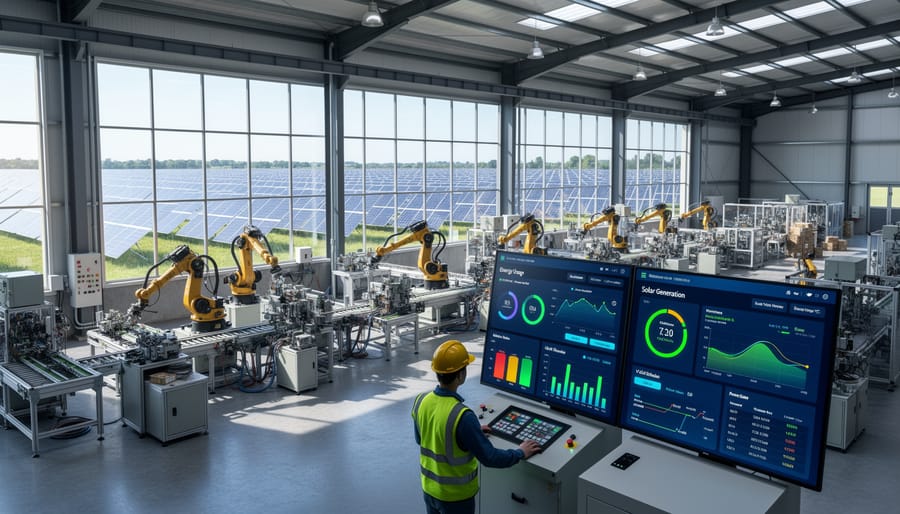
A leading automotive parts manufacturer in Michigan implemented v-grid technology to address the challenge of reconciling energy-intensive metal stamping operations with their 2.5 MW rooftop solar installation. The facility’s production peaks occurred during early morning and late afternoon shifts, while solar generation maximized during midday—creating a significant timing mismatch.
The v-grid system deployed advanced load forecasting algorithms that analyze production schedules 48 hours in advance, automatically adjusting battery storage dispatch and coordinating with the local utility during peak demand periods. During a typical production day, the system stores excess solar energy generated between 10 AM and 2 PM, then releases this stored capacity during the 6-8 AM and 4-6 PM manufacturing peaks.
Results after 18 months of operation demonstrated compelling returns: the facility reduced grid purchases by 64 percent and achieved demand charge savings of approximately $185,000 annually. The system’s intelligent load management also enabled the company to participate in demand response programs, generating an additional $42,000 in annual incentive payments.
Most significantly, the v-grid platform provided real-time visibility into energy consumption patterns across production lines, allowing facility managers to identify inefficient equipment and optimize shift schedules. This operational intelligence contributed to a complete system payback period of just 4.2 years, well ahead of initial projections.
Government Institutions: Meeting Sustainability Mandates
Public sector organizations face increasing pressure to meet ambitious renewable energy targets while demonstrating fiscal responsibility to taxpayers. V-grid energy systems offer government facilities a proven pathway to achieve both objectives simultaneously.
A representative case involves a municipal campus in Colorado that implemented a 2.5 MW v-grid system across multiple administrative buildings, public works facilities, and community centers. The distributed architecture allowed the municipality to maximize existing roof space and underutilized land parcels while maintaining grid reliability during peak demand periods.
The results demonstrate the technology’s effectiveness for public sector applications. The system generates approximately 3,800 MWh annually, covering 68 percent of the campus’s electrical consumption and reducing annual energy costs by $420,000. This reduction directly translates to taxpayer savings while advancing the city’s commitment to carbon neutrality by 2035.
Beyond financial metrics, the installation simplified compliance reporting. The v-grid’s integrated monitoring platform provides real-time data on renewable energy generation, consumption patterns, and grid interactions—essential documentation for state and federal sustainability mandates. This automated reporting capability reduces administrative burden and ensures accurate tracking toward renewable portfolio standards.
The project achieved a seven-year payback period through a combination of utility incentives, federal tax credits, and operational savings, establishing a replicable model for other government entities pursuing energy independence and environmental stewardship.
Commercial Real Estate: Tenant Energy Management
Multi-tenant commercial buildings face unique challenges in energy distribution and cost allocation, making v-grid energy systems particularly valuable for property managers and building owners. These advanced systems enable precise energy monitoring and equitable billing across multiple tenants with varying consumption patterns and operational schedules.
V-grid technology transforms traditional building energy infrastructure by installing individual metering capabilities at each tenant space while maintaining centralized solar generation or energy storage. This configuration allows property managers to accurately track energy usage down to the suite level, eliminating disputes over energy costs and ensuring each tenant pays only for their actual consumption. The system automatically calculates each tenant’s share of common area energy usage, streamlining the reconciliation process.
For mixed-use properties housing retail, office, and restaurant tenants with dramatically different energy profiles, v-grid systems provide transparent accountability. A recent implementation in a 45,000-square-foot commercial plaza reduced energy billing disputes by 94% while improving overall building efficiency by 23%. The granular data enables property managers to identify optimization opportunities and incentivize energy-conscious behavior among tenants.
This technology also simplifies tenant turnover, as individual meters eliminate the need for complex energy usage estimations during lease transitions, protecting both landlords and incoming tenants from billing inaccuracies.
Implementation Considerations for Your Organization
Assessing Your Facility’s V-Grid Readiness
Before implementing a V-Grid energy system, conduct a comprehensive readiness assessment across three critical dimensions. Begin with technical factors: evaluate your facility’s current energy consumption patterns, available roof or ground space for solar panel installation, existing electrical infrastructure capacity, and grid interconnection requirements. Document your peak demand periods and analyze whether your operations align with solar generation curves to maximize system utilization.
From an operational perspective, assess your organization’s ability to manage distributed energy resources. Consider whether you have qualified personnel to monitor system performance, coordinate with utility providers, and respond to dynamic pricing signals. Review your facility’s maintenance capabilities and determine if additional training or third-party support will be necessary. Examine your current energy contracts and identify any barriers to transitioning to a V-Grid configuration.
Financial readiness requires analyzing upfront capital requirements, available incentives, and projected return on investment. Calculate your current energy costs, evaluate financing options including power purchase agreements, and model scenarios under various regulatory frameworks. Many facilities discover implementation becomes viable when combining federal tax credits with state-level incentives and utility rebate programs. A thorough pre-implementation assessment positions your organization to capitalize on V-Grid benefits while mitigating potential challenges during deployment.

Working with Qualified Installation Partners
Selecting the right installation partner is critical for successful v-grid energy system deployment. Prioritize providers with demonstrated expertise in both traditional solar installations and advanced grid-interactive technologies. Look for accreditations from recognized bodies such as the Clean Energy Council and manufacturer-specific certifications for v-grid compatible inverters and battery systems.
Qualified partners should demonstrate comprehensive knowledge of current regulatory frameworks and emerging standards governing virtual power plants and grid services. They must navigate complex interconnection requirements while maximizing access to government solar incentives and network participation programs.
Essential capabilities include system design optimization for both self-consumption and grid participation, experience with utility coordination, and proven track records in commercial-scale deployments. Request case studies from similar facilities in your industry sector.
Ongoing support capabilities distinguish superior providers. Ensure your partner offers remote monitoring, performance optimization services, and software updates as v-grid protocols evolve. Clarify warranty coverage for both hardware and system performance, including guarantees for revenue generation from grid services. A qualified partner should provide detailed financial modeling that accurately projects returns from energy savings and grid participation income over the system’s lifecycle.
Planning for System Monitoring and Maintenance
Successful v-grid implementation requires a comprehensive monitoring and maintenance strategy to ensure optimal performance and long-term reliability. Industry leaders should establish regular inspection schedules, including quarterly performance assessments of battery storage systems, inverters, and grid connection points. Real-time monitoring platforms enable facility managers to track energy production, consumption patterns, and system efficiency metrics, allowing for proactive issue resolution before minor problems escalate into costly repairs. Leading organizations have documented 15-20% performance improvements through predictive maintenance protocols that combine automated alerts with scheduled professional servicing. Annual thermal imaging inspections and electrical testing help identify potential failures, while firmware updates ensure compliance with evolving grid regulations. Developing relationships with certified service providers guarantees swift response times and maintains warranty coverage, ultimately protecting your energy infrastructure investment and maximizing return on investment over the system’s 25-30 year operational lifespan.
V-grid energy systems represent a fundamental shift in how commercial enterprises approach solar energy management within increasingly dynamic regulatory environments. As grid modernization accelerates and policies evolve to support distributed energy resources, organizations that adopt intelligent grid integration technologies position themselves at the forefront of operational efficiency and regulatory compliance.
The competitive advantages of early adoption extend beyond immediate cost savings. Facilities equipped with v-grid capabilities demonstrate enhanced resilience during grid disruptions, improved demand response participation, and superior alignment with emerging carbon reduction mandates. These systems provide the infrastructure necessary to capitalize on evolving incentive programs while maintaining flexibility as regulations continue to mature across different jurisdictions.
For decision-makers evaluating their organization’s readiness, the critical question is not whether to integrate intelligent solar management, but when. The convergence of declining solar costs, advancing storage technologies, and increasingly sophisticated grid intelligence creates an unprecedented opportunity for commercial entities to transform their energy profile. Organizations that delay risk facing both higher integration costs and reduced access to transitional incentives designed to encourage early adoption.
Looking forward, the integration of solar technology, grid intelligence, and business sustainability goals will define competitive positioning across industries. V-grid energy systems serve as the enabling infrastructure for this convergence, allowing organizations to meet regulatory requirements while achieving measurable progress toward environmental, social, and governance objectives. The time to assess your facility’s capabilities and develop a strategic implementation roadmap is now, ensuring your organization remains positioned to thrive in an increasingly dynamic energy landscape.