
Establish comprehensive hazard identification protocols before system commissioning by conducting thorough risk assessments that account for thermal runaway scenarios, arc flash potential, DC voltage exposure, and structural load calculations. Document every identified risk with assigned severity ratings and mitigation timelines, creating a baseline safety profile that informs all subsequent operational decisions.
Integrate fire detection and suppression systems specifically designed for lithium-ion battery chemistry, deploying thermal sensors every 15-20 feet within energy storage areas and ensuring automatic suppression activation occurs within 10 seconds of detection. Standard commercial fire systems often prove inadequate for electrical fires common in solar-storage facilities, where traditional water-based methods can exacerbate hazards.
Implement tiered access control protocols that restrict entry to qualified personnel only, maintaining detailed training records and competency certifications for anyone working near energized equipment. A manufacturing facility in California reduced safety incidents by 73% within 18 months after instituting role-based access limitations combined with quarterly safety audits, demonstrating measurable returns on structured safety investments.
Develop emergency response procedures that address simultaneous system failures, including coordinated shutdown sequences for both solar arrays and battery storage units. Your emergency action plan must account for first responder unfamiliarity with these hybrid systems, providing clear visual indicators of isolation points and residual energy risks. Recent data shows facilities with integrated safety management systems experience 60% fewer insurance claims and qualify for premium reductions averaging 15-25%, offsetting implementation costs within three years while protecting personnel and assets. Regular third-party safety audits verify compliance with NFPA 855, UL 9540A, and local authority requirements, ensuring your system meets evolving regulatory standards.
Understanding Integrated Safety Management Systems in Solar-Storage Contexts
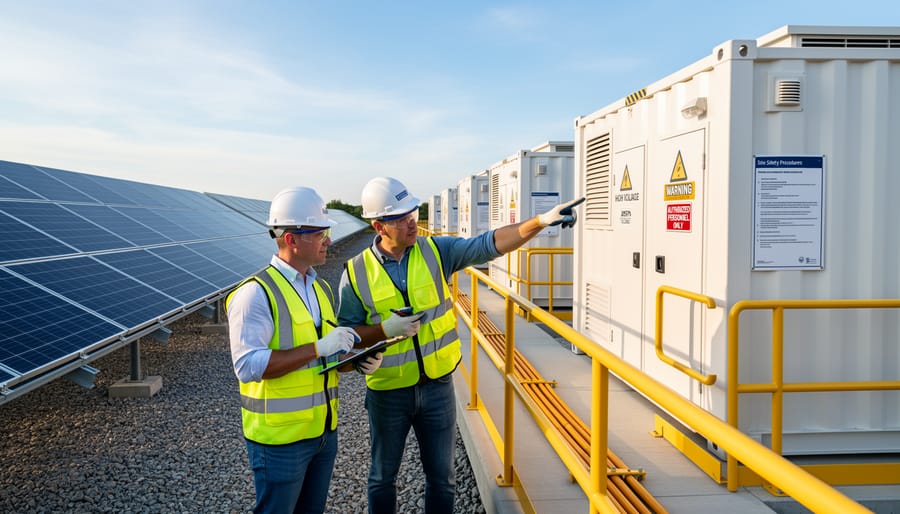
Core Components of an Integrated Approach
An effective integrated safety management system for solar-storage facilities comprises five interconnected components that work together to mitigate risks and ensure operational continuity.
Hazard identification forms the foundation, requiring systematic evaluation of potential threats unique to solar energy storage systems. This includes electrical hazards from high-voltage DC systems, thermal runaway risks in battery installations, arc flash dangers, and environmental factors such as extreme weather exposure. Regular site assessments using documented checklists ensure no potential risk goes unnoticed.
Risk assessment follows, quantifying the likelihood and severity of identified hazards. This data-driven process prioritizes safety investments based on actual risk levels rather than assumptions, delivering measurable return on investment through targeted resource allocation.
Operational controls translate risk assessments into practical safeguards. These include physical barriers, automated shutdown systems, proper spacing between equipment, ventilation requirements, and strict maintenance protocols. Access restrictions and competency-based training programs ensure only qualified personnel interact with critical systems.
Emergency response protocols establish clear procedures for incident management, including evacuation routes, fire suppression activation, first responder coordination, and business continuity measures. Regular drills validate these protocols and identify improvement opportunities.
Continuous monitoring systems provide real-time surveillance of critical parameters including temperature, voltage fluctuations, smoke detection, and battery management system alerts. Advanced monitoring platforms enable predictive maintenance, preventing incidents before they occur while documenting compliance for regulatory requirements.
Regulatory and Standards Framework
Implementing an effective integrated safety management system for solar-storage installations requires adherence to multiple regulatory frameworks and industry standards. The National Fire Protection Association (NFPA) provides foundational guidelines through NFPA 1, the Fire Code, and NFPA 855, which specifically addresses energy storage system safety requirements including minimum separation distances, ventilation specifications, and fire suppression protocols. These standards establish baseline safety parameters that facility managers must incorporate into their operational procedures.
The International Fire Code (IFC) complements NFPA standards by providing jurisdiction-specific requirements for installation, maintenance, and emergency response planning. Compliance with IFC provisions ensures that solar-storage systems meet local safety expectations and pass inspection requirements. Facility managers should work closely with authorities having jurisdiction to understand regional variations in code interpretation and enforcement.
UL certifications represent critical third-party validation for equipment safety and performance. UL 9540, the Standard for Energy Storage Systems, evaluates complete system safety under various operating conditions, while UL 1973 certifies individual battery components. These certifications provide assurance that equipment meets rigorous testing standards and reduces liability exposure for facility owners.
Beyond fire safety codes, installations must comply with electrical standards such as the National Electrical Code (NEC) Article 706 for energy storage systems and OSHA workplace safety regulations. Environmental regulations may also apply depending on battery chemistry and disposal requirements. Successful compliance requires ongoing monitoring of standard updates, as organizations like NFPA regularly revise requirements based on emerging research and incident data. Engaging qualified safety consultants during the design phase helps ensure comprehensive regulatory alignment while optimizing system performance and investment protection.
Critical Fire Risks in Solar-Storage Integration
Battery Storage Fire Hazards
Modern battery storage systems present unique fire hazards that demand specialized safety protocols. Lithium-ion batteries, the predominant technology in solar installations, pose specific risks that differ fundamentally from conventional electrical fires.
Thermal runaway represents the most critical concern. This self-accelerating chemical reaction occurs when a battery cell’s temperature rises uncontrollably, triggering neighboring cells in a cascading effect. A single compromised cell can propagate failure throughout an entire battery module within minutes. Temperature monitoring systems must detect early warning signs, as thermal runaway can initiate from manufacturing defects, physical damage, electrical abuse, or improper charging protocols.
Off-gassing compounds the fire hazard significantly. During thermal events, lithium-ion batteries release toxic and flammable gases including hydrogen fluoride, carbon monoxide, and volatile organic compounds. These emissions create explosion risks in enclosed spaces and present serious respiratory hazards to first responders. Ventilation systems must account for rapid gas accumulation, while detection equipment needs capability to identify these specific chemical signatures.
Chemical fire characteristics of battery incidents differ substantially from standard electrical fires. Lithium-ion fires burn at extremely high temperatures, often exceeding 1,000 degrees Celsius, and prove difficult to extinguish with conventional methods. Water application, while sometimes necessary for cooling, can react violently with lithium compounds. These fires may reignite hours or days after apparent suppression, requiring extended monitoring periods.
Real-world incidents underscore these risks. A 2019 Arizona facility experienced a battery explosion that injured four firefighters, highlighting the need for proper safety protocols and specialized training for emergency response teams.
Solar PV System Fire Vulnerabilities
Solar photovoltaic systems, while essential for sustainable energy generation, introduce specific fire vulnerabilities that facility managers must address within a comprehensive safety framework. Understanding these risks enables organizations to implement targeted mitigation strategies that protect both personnel and infrastructure investments.
DC arc faults represent one of the most significant fire hazards in solar installations. Unlike AC systems, DC circuits cannot self-extinguish when an arc occurs, allowing sustained electrical discharge that can reach temperatures exceeding 5,000 degrees Fahrenheit. These faults typically originate from compromised wire insulation, loose connections, or equipment failures, and can ignite surrounding materials rapidly. Modern arc fault detection devices provide critical protection, though proper installation remains essential for system effectiveness.
Module degradation poses an evolving risk throughout a system’s operational lifetime. Environmental exposure causes gradual deterioration of junction boxes, backsheet materials, and cell encapsulation. A 2019 analysis of commercial installations revealed that approximately 15 percent of fire incidents stemmed from module-level component failures, with degraded electrical connections being the primary contributor. Regular thermal imaging inspections can identify hot spots indicating developing problems before they escalate to critical failures.
Improper installation practices account for substantial fire risk exposure. Common issues include inadequate wire management, incorrect torque specifications on electrical connections, and insufficient clearances from combustible materials. When installers deviate from manufacturer specifications or apply residential-grade practices to commercial projects, the likelihood of connection failures increases significantly. Establishing rigorous quality assurance protocols during installation, including third-party verification for large-scale deployments, substantially reduces these vulnerabilities while supporting insurance and compliance requirements. Comprehensive documentation of installation standards also facilitates maintenance planning and long-term system reliability.
Building Your Integrated Safety Framework
Design Phase Safety Integration
Integrating safety protocols during the design phase establishes the foundation for long-term system reliability and risk mitigation. Proper system design considerations address critical safety elements before installation begins, significantly reducing retrofitting costs and operational disruptions.
Adequate spacing between battery storage units and other equipment prevents thermal incidents from cascading. Industry standards typically require minimum clearances of 3 feet between battery racks and 10 feet from electrical panels, though specific requirements vary based on battery chemistry and capacity. Ventilation systems must accommodate hydrogen off-gassing from certain battery types while maintaining appropriate temperature ranges for optimal performance and safety.
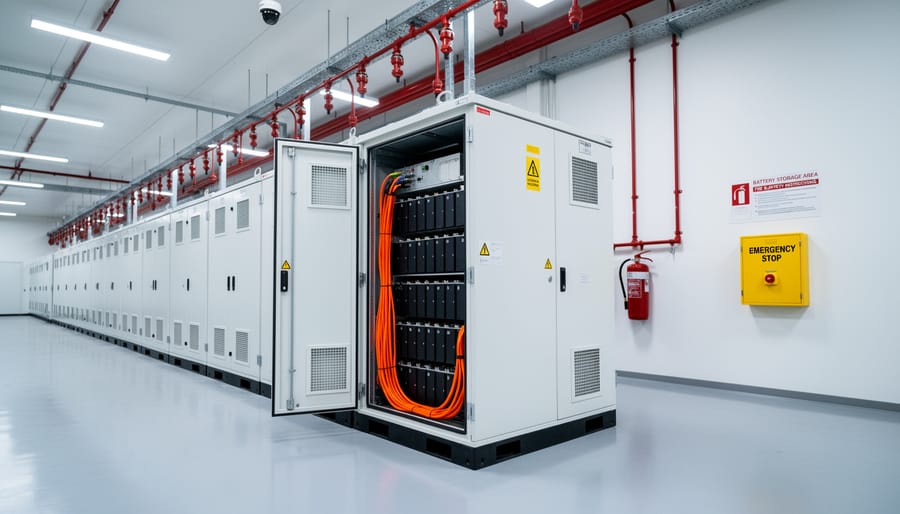
Fire-rated enclosures provide essential containment during thermal events. Two-hour fire-rated barriers between battery storage rooms and occupied spaces meet most commercial building codes, while four-hour ratings may be required for high-capacity installations exceeding 600 kWh. These enclosures should include proper cable penetrations with approved fire-stopping materials.
Detection systems form the early warning network, with smoke detectors, thermal sensors, and gas monitors providing multi-layered protection. Advanced installations incorporate thermal imaging cameras that identify temperature anomalies before they escalate.
Suppression equipment selection depends on system size and location. Clean agent systems like FM-200 or Novec 1230 protect sensitive electronics without water damage, while water mist systems offer cost-effective solutions for larger facilities. Integration with building management systems enables coordinated emergency responses, automatically shutting down affected circuits and notifying first responders when incidents occur.
Installation and Commissioning Protocols
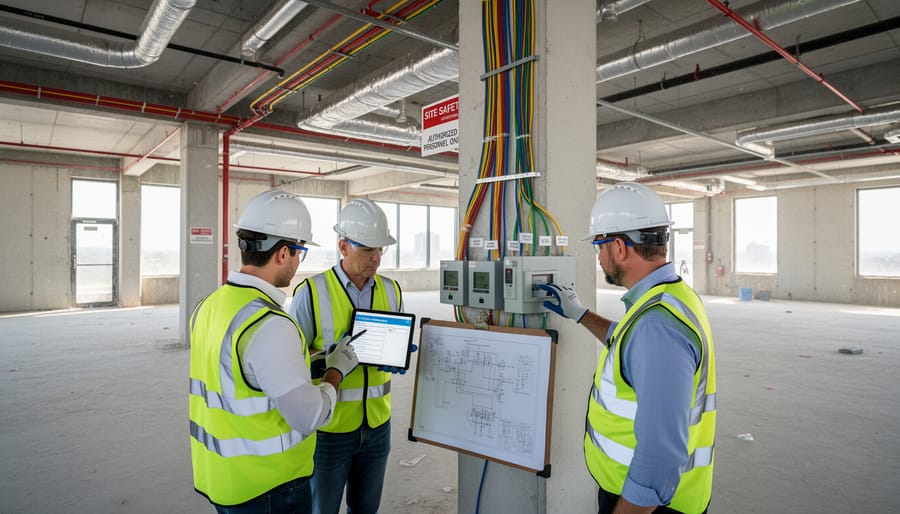
Effective safety management during installation and commissioning establishes the foundation for long-term operational integrity. Successful projects implement comprehensive contractor qualification processes that verify technical competency, safety training credentials, and track records with similar solar-storage installations. These requirements should extend beyond general construction safety to include specialized certifications for high-voltage electrical work, battery system handling, and arc flash protection.
Pre-construction safety protocols begin with detailed job hazard analyses that identify site-specific risks and establish mitigation measures. Daily toolbox talks reinforce safety procedures, while dedicated safety officers conduct ongoing compliance monitoring throughout the installation phase. Inspection checkpoints at critical milestones verify proper installation techniques, equipment grounding, fire suppression system placement, and emergency access pathways.
System validation testing represents the final safety verification before energization. This comprehensive process includes insulation resistance testing, ground fault protection verification, thermal imaging to detect anomalies, and functional testing of all safety interlocks and shutdown systems. Documentation of all test results creates an essential baseline for future maintenance and troubleshooting.
A case study from a commercial solar-storage facility in California demonstrated that investing 8 percent of construction budgets in enhanced safety protocols reduced insurance premiums by 15 percent while preventing costly work stoppages. This approach transforms safety from a compliance obligation into a measurable return on investment that protects both personnel and project timelines.
Operational Safety Management
Effective operational safety management transforms theoretical policies into daily practices that protect personnel, equipment, and facility operations. A comprehensive monitoring system forms the foundation, utilizing both automated sensors and regular manual inspections to track critical parameters including temperature fluctuations, voltage irregularities, and structural integrity indicators. Modern solar-storage facilities increasingly deploy IoT-enabled monitoring platforms that provide real-time alerts, enabling proactive intervention before minor issues escalate into safety incidents.
Maintenance protocols must address the unique requirements of integrated systems. Battery storage units require quarterly inspections of thermal management systems, electrical connections, and ventilation equipment, while solar arrays demand semi-annual checks for panel degradation, inverter functionality, and mounting structure stability. Documented maintenance schedules ensure consistent execution and create valuable historical data for predictive maintenance strategies.
Personnel training represents a critical investment in operational safety. All staff members working near solar-storage systems should complete role-specific certification programs covering electrical safety, fire suppression procedures, and emergency response protocols. Annual refresher courses maintain proficiency and incorporate lessons learned from industry incidents.
Incident response procedures establish clear action protocols for various scenarios, from minor equipment malfunctions to major fire events. These procedures should designate specific roles, outline communication chains, and identify external resources such as specialized fire departments. Regular drills validate response plans and build team confidence, while post-incident reviews drive continuous improvement in safety management practices.
Technology and Monitoring Solutions for Proactive Safety
Real-Time Monitoring and Alert Systems
Advanced real-time monitoring systems form the operational backbone of integrated safety management for solar-storage facilities. These technologies continuously track critical parameters including battery cell temperatures, voltage fluctuations, current loads, hydrogen gas concentrations, and thermal runaway indicators. Modern monitoring platforms utilize IoT sensors and cloud-based analytics to detect anomalies before they escalate into safety incidents.
Automated alert systems immediately notify facility managers and emergency responders when parameters exceed predetermined thresholds. For example, a 2-degree Celsius temperature increase in battery modules can trigger progressive alerts, enabling intervention before thermal events occur. Similarly, smoke detectors and gas sensors provide early warning of potential fire hazards.
Integration with building management systems allows coordinated responses, such as automatic ventilation activation or emergency shutdown protocols. Leading facilities report 40-60% faster incident response times through these automated systems compared to manual monitoring approaches.
The data collected also supports predictive maintenance strategies, identifying equipment degradation patterns that could compromise safety. This proactive approach reduces unplanned downtime by up to 35% while maintaining optimal safety margins. For compliance-focused organizations, continuous monitoring generates auditable records demonstrating adherence to safety standards and regulatory requirements.
Predictive Maintenance and Safety Analytics
Modern integrated safety management systems leverage predictive maintenance analytics to identify potential hazards before they escalate into critical incidents. By continuously monitoring operational data from solar panels, battery storage units, and inverters, artificial intelligence algorithms can detect anomalous patterns that indicate developing safety risks such as thermal irregularities, electrical faults, or component degradation.
These systems analyze historical performance data alongside real-time sensor inputs to establish baseline operating parameters. When deviations occur, automated alerts enable facility managers to schedule preventive interventions, reducing unplanned downtime and mitigating fire risks. For instance, battery storage systems benefit significantly from thermal monitoring that predicts potential thermal runaway events hours or days in advance.
The business case for predictive analytics is compelling. Facilities implementing these technologies report up to 40 percent reduction in safety incidents and 30 percent lower maintenance costs compared to traditional reactive approaches. Data-driven insights also optimize inspection schedules, directing resources toward equipment most likely to require attention while extending service intervals for components operating within normal parameters.
For commercial solar-storage installations, this proactive approach enhances both safety compliance and return on investment by preventing costly emergency repairs and system failures.
Real-World Application: Commercial Solar-Storage Safety Success
A mid-sized distribution warehouse in Southern California provides a compelling example of integrated safety management system implementation for commercial solar-storage installations. The 250,000-square-foot facility installed a 1.2 MW rooftop solar array paired with a 500 kWh lithium-ion battery storage system in 2021, requiring comprehensive safety protocols to protect personnel, inventory, and operations.
The facility initially faced several challenges. Legacy fire suppression systems were incompatible with lithium-ion battery chemistry, staff lacked training in electrical and battery safety protocols, and local fire departments expressed concerns about emergency response procedures. Additionally, the company’s existing insurance policy contained exclusions that would have increased premiums by 18 percent without adequate safety measures.
Working with safety consultants, the facility implemented a multi-layered integrated safety management system. Key solutions included installing thermal monitoring sensors with real-time alerts, upgrading fire suppression to include water mist systems specifically designed for battery fires, and establishing clear access pathways with posted emergency shutdown procedures. The company developed comprehensive training programs covering electrical hazards, thermal runaway recognition, and emergency response protocols. Quarterly drills were conducted with local fire departments to familiarize first responders with system locations and shutdown procedures.
The facility also implemented digital monitoring systems providing 24/7 oversight of temperature, voltage anomalies, and smoke detection with automatic notifications to both facility management and emergency services. Clear signage, lockout-tagout procedures, and restricted access zones completed the safety framework.
The measurable outcomes proved significant. Over three years of operation, the facility experienced zero safety incidents related to the solar-storage system. Insurance carriers recognized the comprehensive safety approach, resulting in premium reductions of 12 percent rather than the initially projected increase. Employee confidence improved markedly, with safety survey scores increasing from 6.2 to 8.9 out of 10. The systematic approach also expedited permit approvals for a planned expansion, demonstrating how proactive safety management delivers both risk mitigation and business value.
ROI and Business Benefits of Integrated Safety Management
Implementing a comprehensive integrated safety management system delivers measurable financial returns and operational advantages that extend well beyond regulatory compliance. Organizations that prioritize safety integration consistently outperform competitors in cost management and operational efficiency.
Insurance providers recognize the reduced risk profile of facilities with documented, integrated safety protocols. Businesses implementing robust safety management systems typically experience insurance premium reductions ranging from 10-30%, depending on coverage types and facility complexity. These savings compound annually, contributing significantly to long-term operational budgets. Additionally, facilities with proven safety records face fewer claim denials and maintain more favorable underwriting terms during policy renewals.
Operational continuity represents another substantial benefit area. Integrated safety systems minimize unplanned downtime through proactive hazard identification and preventive maintenance protocols. For solar-storage facilities, where revenue depends on continuous energy generation and delivery, each hour of avoided downtime translates directly to preserved income. Industry data indicates that facilities with integrated safety management experience 40-60% fewer emergency shutdowns compared to those with fragmented safety approaches.
Asset protection extends equipment lifespan and preserves capital investments. Properly maintained safety systems prevent catastrophic failures that could destroy expensive battery storage units, inverters, or solar arrays. A single thermal runaway event in an unprotected battery system can result in millions in equipment losses and remediation costs. The preventive nature of integrated safety management protects these capital investments while maintaining system performance specifications.
Regulatory compliance becomes streamlined when safety protocols are systematically integrated. Facilities avoid costly fines, operational restrictions, and legal liabilities associated with code violations. This proactive stance also positions organizations favorably for future regulatory changes, as integrated systems adapt more readily to evolving requirements.
Stakeholder confidence and market positioning improve measurably with demonstrated safety commitment. Tenants, investors, and community partners increasingly demand transparency regarding safety practices. Facilities with certified integrated safety management systems command premium lease rates, attract quality tenants more efficiently, and maintain stronger relationships with local authorities. This enhanced reputation creates competitive advantages in crowded markets while supporting long-term business development objectives.
Integrated safety management systems represent far more than regulatory checkboxes or insurance requirements—they constitute the operational foundation upon which successful solar-storage projects are built. Organizations that treat safety as a fundamental design criterion rather than an afterthought consistently achieve superior performance outcomes, including reduced downtime, lower insurance premiums, enhanced asset longevity, and protection of brand reputation.
The financial case for comprehensive safety integration is compelling. A recent analysis of commercial solar-storage installations demonstrated that facilities implementing integrated safety protocols from the planning phase experienced 40% fewer operational disruptions and 60% lower incident-related costs over five-year periods compared to those retrofitting safety measures post-construction. These savings compound significantly over the 20-25 year operational life of typical installations, fundamentally altering project economics.
For decision-makers evaluating solar-storage investments, the question should not be whether to implement robust safety management, but rather how quickly comprehensive systems can be integrated into project plans. The complexity of modern energy storage technology, coupled with evolving regulatory frameworks and escalating consequences of system failures, makes professional safety system design essential from the earliest conceptual stages.
As you advance your solar-storage initiatives, prioritize engagement with qualified safety engineering professionals who understand the unique intersection of photovoltaic generation and battery storage systems. Their expertise in hazard analysis, system integration, and compliance navigation will prove invaluable in protecting your investment, your people, and your organization’s future in the clean energy economy.