
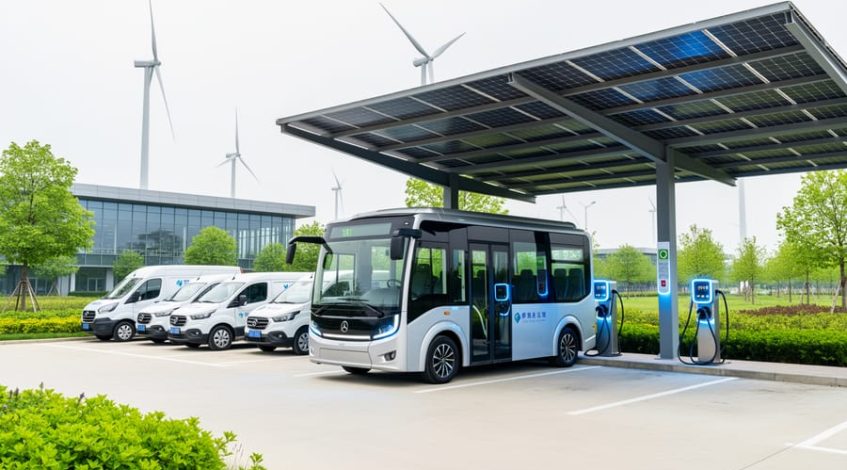
Green energy transport refers to vehicle fleets and transit systems powered directly by renewable energy sources such as solar panels, wind turbines, or battery storage charged from clean electricity. For facility managers and fleet operators, it represents the convergence of two major operational investments: transportation infrastructure and energy systems. Rather than treating vehicles as isolated assets that depend on external fossil fuel supply chains, green energy transport integrates mobility with on-site renewable generation, creating a self-contained ecosystem that reduces both carbon emissions and long-term operating costs.
The business case has strengthened considerably as battery technology improves and renewable energy costs continue their downward trajectory. Organizations that adopt green energy transport gain predictable energy expenses, insulation from diesel and gasoline price swings, and measurable progress toward sustainability commitments that increasingly influence stakeholder decisions and regulatory compliance.
This approach matters most for organizations with centralized operations: manufacturing facilities with delivery fleets, municipalities managing public transit, corporate campuses with shuttle services, and distribution centers running predictable daily routes. These scenarios allow for strategic placement of charging infrastructure powered by on-site solar arrays or dedicated wind capacity, creating what amounts to a private fuel network with fixed marginal costs approaching zero after capital recovery.
Understanding how these systems function, what configurations work for different operational profiles, and how the financial performance compares to traditional fuel-dependent fleets provides the foundation for evaluating whether green energy transport aligns with your organization’s operational requirements and financial objectives. The following sections break down the technical architecture, system variations, sector-specific applications, and cost considerations that inform implementation decisions.
What Green Energy Transport Means for Modern Infrastructure
Green energy transport represents a fundamental shift in how we power movement. At its core, it means using electricity generated from renewable sources, primarily solar and wind, to fuel vehicles and the infrastructure that supports them. Instead of diesel lorries, petrol vans, and fossil-fuel-powered buses, organizations power their fleets with clean electricity, often generated on-site through rooftop solar arrays or nearby wind installations.
This integration extends beyond simply swapping combustion engines for electric motors. Green energy transport connects three distinct systems: renewable power generation, energy storage and management, and transportation operations. A logistics company might install solar panels on its warehouse roof, store excess electricity in battery systems, and use that power to charge its delivery fleet overnight. The energy never touches the traditional grid, and no fossil fuels enter the equation.
- Green Energy Transport
- The use of renewable electricity sources to power vehicles, charging stations, and related transit infrastructure, eliminating reliance on petroleum-based fuels.
- Energy Ecosystem
- An integrated system where power generation, storage, distribution, and consumption work together, often combining solar installations, batteries, and electric vehicle charging within a single facility.
- V2G (Vehicle-to-Grid)
- Technology allowing electric vehicles to return stored electricity to the building or grid during peak demand, turning fleet batteries into distributed energy resources.
- Charging Infrastructure
- The physical equipment and electrical systems, including chargers, transformers, and management software, required to deliver power to electric vehicles efficiently and safely.
The contrast with conventional transport is stark. Traditional fleets depend on fuel deliveries, subject to price volatility and supply disruption. Each tank of diesel produces direct emissions at the tailpipe. Green energy transport reverses this model: the fuel source sits on your roof or adjacent land, immune to global oil markets. Energy costs become predictable. Emissions shift from hundreds of individual vehicles to zero at the point of use.
For businesses, this means operational control. You generate the power, manage its distribution, and determine charging schedules based on fleet requirements rather than petrol station availability. The infrastructure becomes an asset that produces energy rather than a cost centre consuming it.
How Green Energy Transport Systems Work
Energy Generation and Capture
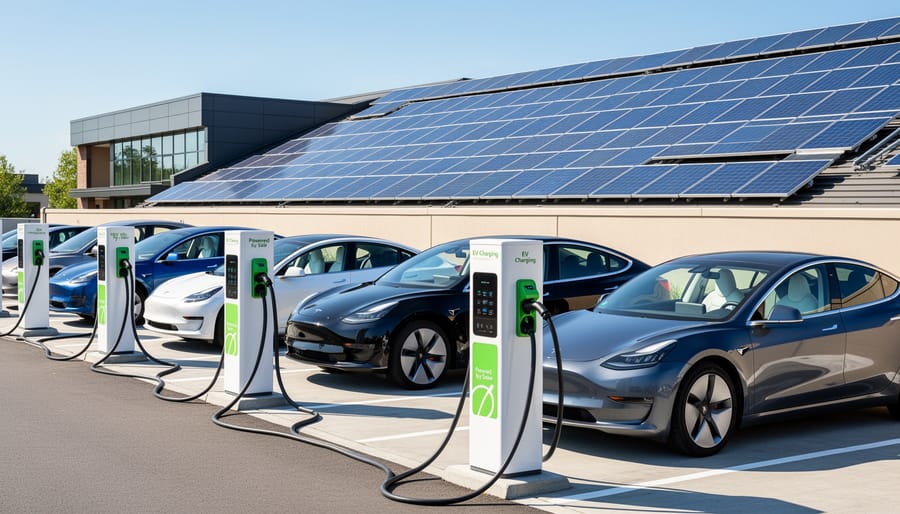
Solar photovoltaic arrays mounted on depot roofs, carports, or adjacent land capture sunlight and convert it directly into electricity that powers charging infrastructure. Commercial installations typically range from 100 kW to several megawatts depending on fleet size and charging demand. The DC electricity generated flows through inverters that convert it to AC power compatible with standard charging equipment and grid connections.
Wind turbines complement solar generation in locations with suitable wind resources, providing power during evening hours when solar output drops but charging demand remains. Some facilities integrate both sources to smooth out daily and seasonal generation patterns. The combined output feeds into the site’s electrical distribution system, where smart charging optimization systems direct power to vehicles based on grid conditions, electricity rates, and operational schedules.
Peak generation typically occurs midday when solar irradiance is strongest. Facilities match this output to daytime charging windows or route excess generation to battery storage for later use. System sizing depends on total fleet energy consumption, available installation area, and whether the organization targets partial offset or complete energy independence for transport operations.
Storage and Grid Integration
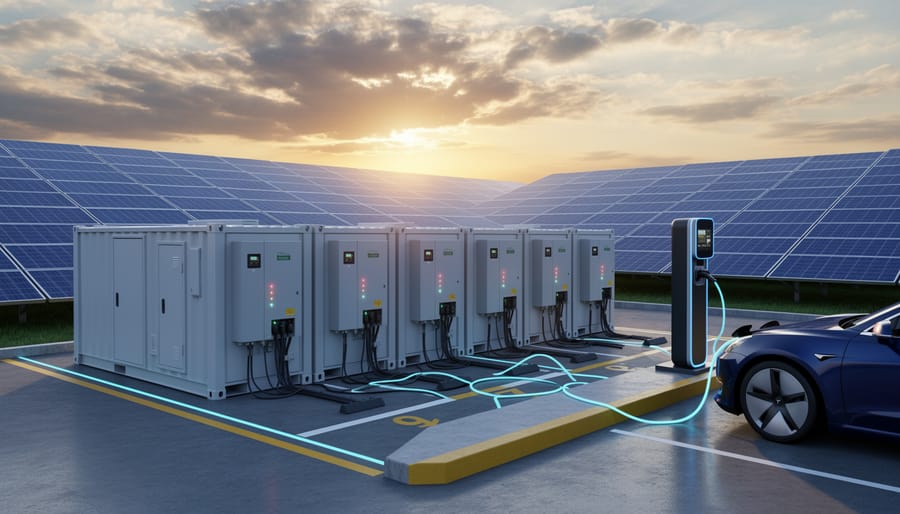
Battery storage systems serve as the critical buffer between variable renewable generation and the steady power demands of transport infrastructure. When solar arrays or wind farms produce excess energy during peak generation periods, lithium-ion or flow battery systems capture and store that electricity for later use. This stored energy then powers charging stations during evening hours, overnight fleet charging cycles, or periods of high demand when direct renewable generation falls short.
Grid-connected energy storage allows facilities to operate in multiple modes depending on energy availability and cost signals. During periods of strong solar production, batteries charge while simultaneously supplying charging infrastructure. When renewable output drops, stored energy maintains operations without drawing from the utility grid. Advanced systems can also participate in demand response programs, selling stored energy back to the grid during peak pricing periods to generate additional revenue.
The integration layer relies on energy management software that monitors generation, storage state-of-charge, charging demand forecasts, and utility rate structures in real time. These systems automatically route power along the most cost-effective path, whether that means using solar directly, drawing from batteries, or supplementing with grid power during rate valleys. This intelligent orchestration transforms intermittent renewable sources into reliable, 24-hour transport energy supply.
Distribution to Transport Infrastructure
Once energy leaves storage systems, sophisticated energy management platforms route it to wherever transport infrastructure needs it most. These systems continuously monitor demand across charging stations, depot facilities, and vehicle parking areas, directing power flow based on real-time usage patterns and grid conditions.
Smart load balancing prevents any single charging point from overwhelming the electrical supply while ensuring vehicles charge when they need to. The system prioritizes critical fleet vehicles during business hours and shifts heavy charging loads to off-peak periods when solar generation exceeds immediate demand or grid electricity costs less.
Modern energy management platforms track each charging session, vehicle battery state, and scheduled departure time, automatically allocating available renewable power to meet operational requirements without manual intervention.
Components of a Green Energy Transport Ecosystem
A functioning green energy transport ecosystem relies on several interconnected components working together to generate, store, and deliver clean energy to vehicles and transit infrastructure. Understanding these elements helps organizations assess what’s required for implementation and how each piece contributes to overall system performance.
Solar PV Installations and Renewable Generation
The foundation starts with energy generation, typically solar photovoltaic arrays mounted on facility rooftops, carports, or ground-mount systems. These installations convert sunlight into electricity that powers charging equipment and other transport operations. For businesses with substantial land or roof area, solar provides the most accessible renewable source, generating power during peak daylight hours when many fleet vehicles return for charging. Wind turbines or connections to off-site renewable energy sources can supplement solar where appropriate.
Energy Storage Systems
Battery storage bridges the gap between renewable generation and charging demand. Commercial-scale lithium-ion battery banks store excess solar production during the day, then discharge that energy during evening hours or cloudy periods when vehicles need charging but solar output is low. Storage capacity typically ranges from several hundred kilowatt-hours for small fleets to multi-megawatt systems for large transit operations. This component ensures charging availability regardless of weather conditions.
Charging Infrastructure
Level 2 chargers (typically 7-19 kW) and DC fast chargers (50-350 kW) form the physical interface between the energy system and vehicles. Installation requirements include proper electrical connections, network connectivity for smart charging features, and physical mounting at depot locations or public-facing stations. The charging infrastructure must be sized to match fleet composition and operational schedules.
Essential Supporting Components
- Energy management systems that optimize charging schedules based on solar production, electricity rates, and vehicle departure times
- Smart inverters converting DC solar output to AC power and managing bidirectional energy flow
- Grid connection infrastructure including transformers, switchgear, and utility interconnection equipment
- Fleet management software tracking vehicle state of charge, location, and energy consumption
- Monitoring and analytics platforms providing real-time visibility into system performance and energy flows
- Weather forecasting integration to predict solar generation and adjust charging strategies
These monitoring and control systems tie everything together, using data from all components to make intelligent decisions about when to charge vehicles, when to draw from storage versus the grid, and how to maximize renewable energy utilization. The software layer prevents grid overloads, reduces demand charges, and ensures vehicles are charged according to operational priorities.
For most commercial applications, the ecosystem also includes standard electrical infrastructure, service panels, conduit, metering equipment, sized to handle the combined loads of building operations and transport charging. Proper integration requires coordination between solar contractors, electricians, charging equipment vendors, and software providers to create a unified system rather than disconnected pieces.
Commercial and Industrial Applications
Electric Fleet Charging Solutions
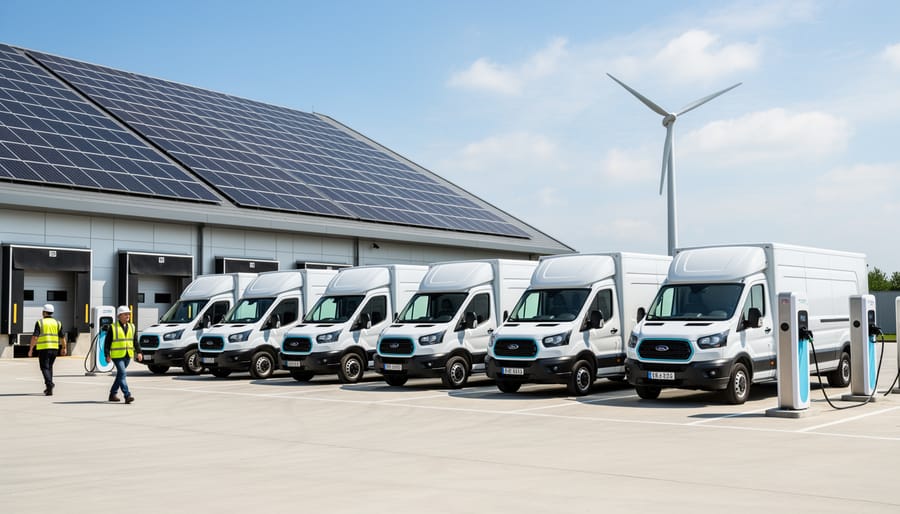
Businesses are increasingly pairing onsite solar installations with dedicated EV charging infrastructure to power their vehicle fleets. A typical setup involves solar arrays on warehouse roofs or parking canopies feeding energy directly to Level 2 or DC fast chargers installed at fleet parking locations. During daylight hours, vehicles charge from solar generation; at night or during high-demand periods, the system draws from battery storage or the grid.
Fleet managers configure charging schedules to align with solar production patterns. Delivery vans return to depots mid-day for opportunity charging when solar output peaks, while overnight fleets charge during off-peak grid rates. Smart charging systems automatically prioritize solar-generated electricity, switching to stored or grid power only when necessary.
The economics favor businesses with predictable routes and centralized parking. A 500kW solar installation can support 20-30 commercial vans, eliminating fuel costs that typically run £800-1,200 per vehicle annually. Companies with large depot facilities, logistics operators, utility service fleets, local government vehicle pools, see the strongest returns. The combination of solar generation and overnight grid charging provides flexibility while maximizing renewable energy utilization and reducing total transport operating costs.
Public and Private Transit Infrastructure
Transit authorities and institutions are implementing green energy transport to power their daily operations while cutting fuel costs and emissions. Bus depots install solar canopies over parking areas to charge electric buses overnight, ensuring fleets start each route with full batteries. The systems size energy storage to handle the concentrated charging load when buses return from service.
Rail systems integrate solar arrays at stations and along right-of-way corridors, feeding power directly into traction substations that supply electric trains. Light rail networks benefit particularly from this approach, as station rooftops and parking structures provide ready-made mounting surfaces for PV installations.
Universities, hospitals, and corporate campuses deploy solar-powered shuttle services, pairing rooftop or parking lot solar with dedicated charging infrastructure. These closed-loop systems work well because shuttle routes follow predictable schedules, making energy demand forecasting straightforward. Campus facilities can optimize solar production to align with charging windows between shuttle runs.
The common thread is matching renewable generation capacity to known transport demand patterns, then using battery storage to bridge timing gaps between peak solar production and peak charging needs.
Industrial and Warehouse Operations
Industrial facilities and warehouses represent prime opportunities for green energy transport integration, as their material handling operations consume substantial electricity while operating within confined, controllable environments. Electric forklifts, pallet jacks, reach trucks, and tuggers already dominate modern warehouse floors due to their zero indoor emissions and lower maintenance needs compared to propane or diesel alternatives. Pairing these vehicles with on-site solar installations creates a closed-loop energy system where rooftop arrays directly power charging infrastructure during daylight hours, with excess generation feeding building operations or stored for overnight charging cycles.
The business case strengthens considerably for facilities running multiple shifts. A 500,000-square-foot distribution center might operate 20-30 pieces of electric material handling equipment, collectively drawing 300-500 kWh daily. Solar arrays sized to cover this demand, typically 250-400 kW installations, can eliminate direct fuel costs while reducing grid dependency. Opportunity charging stations positioned throughout the facility allow equipment to top up during breaks, maximizing solar utilization during peak generation hours rather than concentrating all charging overnight when solar isn’t available.
The Business Case: ROI and Long-Term Savings
Evaluating green energy transport requires looking beyond sticker prices to total cost of ownership over the system’s operational life. While initial investments remain higher than conventional vehicle purchases, a commercial electric van typically costs €10,000-€15,000 more than its diesel equivalent, the economics shift dramatically when you factor in fuel elimination, reduced maintenance, and renewable energy integration.
Fuel represents the most immediate and substantial saving. Diesel fleets spend roughly €0.15-€0.25 per kilometre on fuel at 2026 rates. Electric vehicles powered by on-site solar reduce that to €0.02-€0.05 per kilometre, depending on electricity costs and solar utilization. For a 50-vehicle fleet covering 30,000 kilometres annually per vehicle, that difference translates to €180,000-€315,000 in avoided fuel costs each year.
Maintenance costs drop 40-60% with electric drivetrains. No oil changes, fewer brake replacements due to regenerative braking, simpler powertrains with fewer failure points, these factors compound over a vehicle’s working life. Fleet operators report maintenance savings of €800-€1,200 per vehicle annually compared to diesel equivalents.
When organizations integrate solar installations with transport electrification, payback periods typically range from 5-8 years for the combined system. Rooftop solar arrays sized to cover daytime charging demands generate electricity at a levelized cost of €0.04-€0.07 per kWh over 25 years, substantially below grid rates. This self-generated power extends the economic advantage beyond what grid-charged EVs achieve alone.
Available incentives accelerate returns. EU grants, national subsidies, and accelerated depreciation schemes can offset 20-40% of upfront costs in many member states. Enhanced capital allowances for zero-emission vehicles and renewable energy installations further improve cash flow in early years.
Total cost of ownership analysis consistently favours integrated green energy transport systems for organizations with predictable routing, dedicated parking facilities, and existing roof space suitable for solar deployment.
Integration with Commercial Solar Installations
Combining commercial solar installations with transport electrification requires careful load analysis and system design to serve both building operations and vehicle charging demands. Facilities planning this integration should start with detailed energy profiling: measure existing building consumption patterns alongside projected charging loads, factoring in when fleet vehicles return to base and how charging schedules align with solar production hours.
Sizing the solar array demands more than simple capacity addition. A business consuming 500 kWh daily for building operations might add 300 kWh in charging requirements for a dozen delivery vans. However, optimal system sizing considers temporal overlap. If vehicles charge primarily during overnight hours when panels produce nothing, the installation needs substantial battery storage to shift daytime solar generation to evening charging windows. Conversely, fleets that charge during business hours can utilize solar energy directly, reducing storage requirements and improving project economics.
Ground-mount systems offer distinct advantages for transport integration. They provide easier expansion capacity as fleet size grows, allow optimal panel orientation regardless of building architecture, and can position charging infrastructure adjacently for shorter electrical runs and reduced installation costs. Rooftop systems work well when daytime charging predominates and available roof area exceeds combined building and transport needs.
Smart energy management systems prove essential for facilities serving dual loads. These platforms prioritize critical building functions, direct excess solar production to vehicle charging, manage battery charge and discharge cycles, and pull grid power strategically during rate valleys. Advanced systems learn usage patterns and adjust automatically, shifting non-time-sensitive charging to periods of peak solar availability.
The electrical infrastructure must handle combined peak demand. If building load peaks at 200 kW and charging adds another 150 kW, the main service, inverters, and distribution panels require appropriate capacity, even if peaks rarely coincide.
Real-World Implementation Examples
Several organizations have successfully integrated green energy transport systems, demonstrating measurable financial and environmental returns across different sectors.
A large-scale logistics company in the Netherlands converted its Amsterdam distribution center to solar-powered fleet charging in 2024. The facility installed a 750 kW rooftop solar array paired with 500 kWh of battery storage to charge 85 electric delivery vans. Within eighteen months, the company reduced transport energy costs by 68% compared to diesel operations and eliminated approximately 420 tonnes of CO₂ emissions annually. The system paid for itself in under six years through combined fuel savings and government incentives.
Munich Airport implemented green energy transport for its ground operations fleet in 2023, installing 1.2 MW of solar capacity across terminal rooftops and parking structures. The system powers baggage tractors, passenger shuttles, and service vehicles throughout the airport complex. The airport reports annual energy savings of €180,000 and has eliminated 890 tonnes of carbon emissions from ground operations, contributing significantly to its carbon neutrality targets.
A manufacturing facility in northern France electrified its materials handling equipment by combining a 400 kW solar installation with strategic charging infrastructure. The company replaced 32 diesel-powered forklifts and pallet movers with electric equivalents charged predominantly through on-site solar generation. Beyond eliminating €95,000 in annual fuel costs, the facility achieved unexpected benefits: reduced maintenance expenses by 45% and improved indoor air quality by removing exhaust emissions from warehouse spaces.
The city of Bristol converted its public bus depot to solar-powered charging in 2025, installing solar canopies above parking bays to charge 40 electric buses overnight. The 850 kW system generates 65% of the depot’s charging requirements, with grid power supplementing during winter months. The transit authority projects total savings of £1.2 million over ten years while reducing fleet emissions by 75%.
Common Questions About Green Energy Transport
Decision-makers evaluating green energy transport systems typically face similar concerns about feasibility, performance, and integration. Understanding these common questions helps frame realistic expectations and proper planning for implementation.
Can solar systems generate enough power to reliably charge a commercial fleet?
Yes, when properly sized. A typical commercial solar array can generate sufficient daily energy for most fleet operations, though sizing depends on fleet size, daily mileage, and available roof or ground space. Systems often combine solar generation with grid connection to ensure continuous charging capability.
What happens during extended cloudy periods or winter months?
Green energy transport systems incorporate grid backup and battery storage to maintain operations during low solar production periods. The grid connection acts as a seamless backup, automatically supplying power when solar generation falls short, while still allowing you to maximize on-site renewable energy when available.
How long does it take to charge fleet vehicles with solar-powered infrastructure?
Charging times depend on charger type and vehicle battery size, not the energy source. Level 2 chargers typically fully charge light commercial vehicles in four to eight hours, making overnight charging at depots practical for most fleet operations.
Can we add green energy transport to existing facilities without major infrastructure changes?
Most facilities can integrate solar-powered charging infrastructure with minimal disruption. Existing electrical service, parking areas, and roof space typically accommodate the necessary equipment, though electrical panel upgrades may be required for larger installations.
Scalability concerns also rank high among facility managers. Green energy transport systems scale incrementally, allowing organizations to start with a pilot installation serving a portion of their fleet and expand as operational data validates the approach. This phased implementation reduces financial risk and allows refinement of charging schedules and energy management protocols before full deployment.
Maintenance requirements remain modest compared to traditional fuel infrastructure. Solar panels require occasional cleaning and annual inspections, while charging stations need periodic software updates and connector maintenance. Unlike fuel dispensing equipment, there are no underground tanks, no fuel quality monitoring, and no vapor recovery systems to service. Energy management software handles most optimization tasks automatically, requiring minimal staff intervention once configured properly.

The convergence of renewable energy generation and transportation infrastructure represents more than a sustainability milestone, it’s a proven strategy for reducing operational costs and securing long-term energy independence. Organizations that integrate solar installations with fleet electrification and charging infrastructure are building holistic energy ecosystems that deliver measurable returns while future-proofing their operations against volatile fuel markets.
Green energy transport systems have moved from experimental pilots to mainstream business infrastructure in 2026. Companies across logistics, manufacturing, public transit, and commercial operations are powering vehicles directly from on-site renewable generation, capturing both environmental and financial value. The technology works. The economics make sense. The integration challenges are manageable with proper planning and experienced partners.
For business leaders evaluating their organization’s energy future, the starting point is straightforward: calculate what you currently spend on transport fuel and vehicle maintenance, then model what portion of that demand could be met through solar-powered charging infrastructure. Many facilities already have suitable roof space or land area for PV installations that can serve dual purposes, powering both building operations and transport fleets.
The question isn’t whether green energy transport will become standard practice. It’s whether your organization will lead the transition or follow years later at higher costs. Assess your transport energy expenditure, examine your solar potential, and explore how integrated renewable systems can support your operational needs today.