
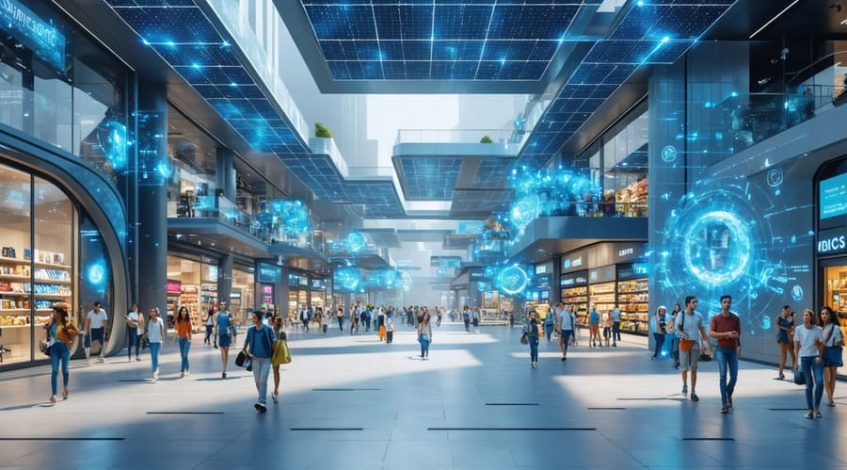
Digital retail solutions are revolutionizing how businesses engage with customers and optimize operations in today’s competitive marketplace. By integrating advanced technologies with traditional retail environments, companies that have reduced carbon emissions through solar power are now leveraging data analytics, artificial intelligence, and IoT devices to create seamless shopping experiences while reducing operational costs.
Modern retail facilities are experiencing a fundamental shift from conventional point-of-sale systems to comprehensive digital ecosystems that encompass inventory management, customer relationship management, and energy-efficient operations. These solutions not only streamline business processes but also provide valuable insights into consumer behavior, enabling retailers to make data-driven decisions that enhance profitability and sustainability.
As facility managers and property owners seek to future-proof their investments, digital retail solutions offer scalable, integrated platforms that combine energy management with advanced retail technologies. This convergence of sustainable practices and digital innovation is setting new standards for retail excellence, delivering measurable ROI through reduced operational costs, improved customer satisfaction, and enhanced competitive advantage in an increasingly digital marketplace.
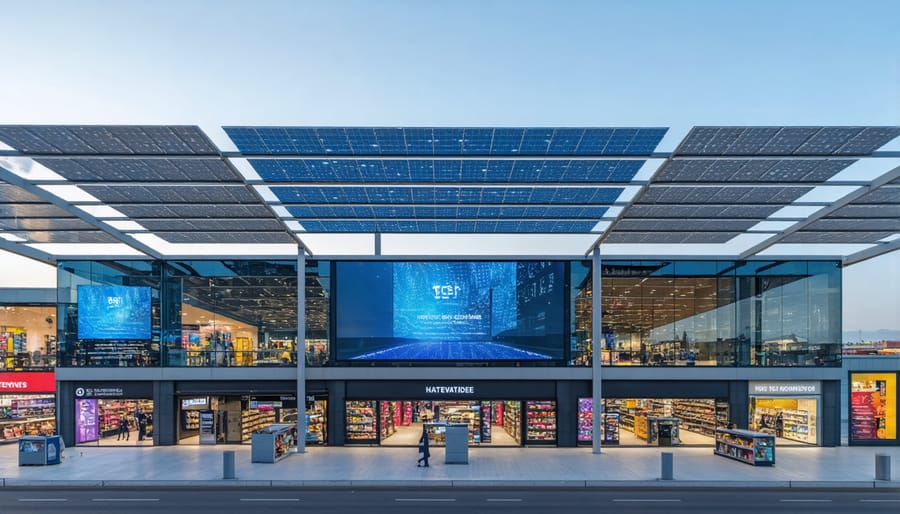
Digital Retail Technologies Powering Solar Shopping Centers
Smart Energy Management Systems
Modern retail spaces are increasingly adopting intelligent energy management systems that seamlessly integrate with solar installations to maximize efficiency and reduce operational costs. These digital solutions combine real-time monitoring, predictive analytics, and automated control systems to optimize energy consumption patterns across retail facilities.
Advanced IoT sensors and smart meters track energy usage throughout the building, from HVAC systems to lighting and refrigeration units. This data feeds into centralized management platforms that use artificial intelligence to identify peak consumption periods and automatically adjust energy distribution. Many retailers are participating in community solar initiatives to further enhance their sustainable energy strategies.
The integration of smart energy systems with solar installations typically delivers 20-30% reduction in energy costs. For example, major retail chain Target achieved significant savings by implementing AI-driven energy management across 1,800 stores, optimizing their solar energy utilization and reducing grid dependency.
Key features of these systems include:
– Dynamic load balancing between solar and grid power
– Automated demand response capabilities
– Real-time performance monitoring and reporting
– Predictive maintenance alerts
– Mobile-based remote management
These solutions also enable retailers to participate in demand response programs, generating additional revenue while supporting grid stability. The ROI for such systems typically ranges from 2-4 years, making them an attractive investment for forward-thinking retail businesses.
IoT-Enabled Retail Operations
IoT technology is revolutionizing retail operations by creating interconnected environments that enhance efficiency, reduce operational costs, and improve customer experience. Smart sensors and connected devices enable real-time monitoring of various retail parameters, from foot traffic patterns to inventory levels and energy consumption.
In modern retail environments, IoT devices facilitate automated inventory management through RFID tags and smart shelving systems. These solutions provide instant updates on stock levels, automatically trigger reorder requests, and help prevent stockouts. Smart cameras and motion sensors analyze customer movement patterns, enabling retailers to optimize store layouts and staffing levels based on peak activity periods.
Energy management represents a crucial application of IoT in retail spaces. Smart lighting systems automatically adjust brightness based on natural light availability and store occupancy, while intelligent HVAC systems optimize temperature control according to real-time conditions. These automated systems can reduce energy consumption by up to 30% compared to traditional setups.
Security and loss prevention benefit significantly from IoT integration. Connected surveillance systems, smart locks, and environmental monitors work together to protect assets and ensure safety. Advanced analytics platforms process data from these devices to identify potential security risks and maintenance issues before they become critical.
For customer engagement, IoT enables personalized shopping experiences through digital signage, mobile app integration, and location-based services. Beacon technology can send targeted promotions to customers’ smartphones as they move through the store, while smart mirrors and virtual try-on solutions enhance the fitting room experience.
Customer Experience in Solar-Powered Digital Retail
Interactive Shopping Experiences
Modern retail environments are leveraging solar-powered digital solutions to create immersive and engaging shopping experiences. Interactive digital displays, powered by sustainable solar energy, enable retailers to showcase products, provide real-time information, and interact with customers in innovative ways while maintaining environmental responsibility.
Smart mirrors and virtual try-on stations, operating on solar energy, allow customers to experiment with products virtually, reducing physical inventory needs while enhancing the shopping experience. These installations typically consume 40-60% less energy than traditional lighting and display systems, making them both environmentally and economically sustainable.
Digital wayfinding kiosks powered by solar arrays help customers navigate large retail spaces efficiently while providing personalized recommendations and promotions. Studies show that these interactive systems increase customer engagement by up to 47% and boost average transaction values by 15-20%.
Retailers are implementing solar-powered digital shelf labels that display dynamic pricing, product information, and real-time inventory status. These systems not only reduce paper waste but also enable instant price updates and promotion management across entire store networks. The integration of these solutions with existing store management systems creates a seamless operational environment while maintaining energy independence.
Customer feedback terminals and interactive product catalogs running on solar power provide valuable insights into shopping patterns and preferences. This data helps retailers optimize their inventory, improve store layouts, and create more targeted marketing campaigns. The implementation of these systems has shown to increase customer satisfaction scores by an average of 32%.
By combining sustainable energy with digital retail solutions, businesses are creating future-ready shopping environments that appeal to environmentally conscious consumers while driving operational efficiency and sales growth.
Sustainability Tracking and Display
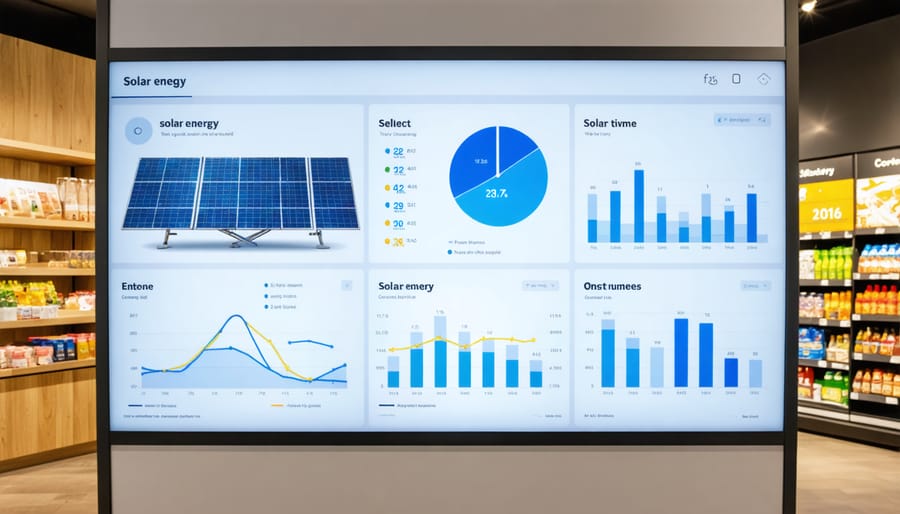
Modern retail environments are increasingly incorporating digital sustainability tracking systems that provide real-time visibility into their solar energy usage and environmental impact. These sophisticated displays serve dual purposes: educating customers about the facility’s green initiatives while providing valuable data insights for management.
Interactive digital dashboards, typically positioned in high-traffic areas, showcase live solar production metrics, carbon offset calculations, and equivalent environmental benefits in easily digestible formats. These displays can be integrated with existing digital signage systems and have proven particularly effective in shopping centers participating in local energy transformation programs.
The tracking systems typically feature:
– Real-time energy generation statistics
– Daily, monthly, and annual environmental impact metrics
– Comparative analysis against traditional energy usage
– Weather-based performance forecasting
– Community energy contribution indicators
Advanced implementations incorporate mobile applications that allow customers to track their shopping center’s sustainability efforts through their smartphones. This technology creates a connection between consumers and the facility’s environmental initiatives, often leading to increased customer loyalty and positive brand association.
For facility managers, these systems provide detailed analytics through backend dashboards, enabling precise monitoring of solar performance, maintenance requirements, and ROI tracking. The data collected helps optimize energy usage patterns and supports future expansion planning of solar installations.
Research indicates that retailers utilizing these sustainability displays report a 12% increase in customer engagement with their environmental initiatives and a 15% improvement in brand perception scores, demonstrating the tangible benefits of transparent environmental reporting in retail spaces.
Implementation and ROI
Integration Strategy
Implementing digital retail solutions alongside solar infrastructure requires a systematic approach to ensure seamless integration and optimal performance. Begin with a comprehensive site assessment to evaluate both existing digital systems and potential solar installation locations. This initial analysis should account for power requirements, network infrastructure, and physical space constraints.
Next, develop a phased implementation plan that prioritizes critical systems. Start with core infrastructure upgrades, including power management systems and network capabilities. Install smart meters and energy monitoring devices to establish baseline consumption patterns before solar integration.
The third step involves deploying solar equipment in conjunction with digital retail components. This includes installing PV panels, inverters, and energy storage systems while simultaneously implementing digital control systems. Ensure all components are compatible with your building management system (BMS) and can communicate effectively.
Integration of customer-facing technologies follows, incorporating digital signage, smart lighting, and IoT devices that leverage the solar power infrastructure. Implementation should include fail-safes and backup systems to maintain operations during maintenance or unexpected outages.
Data integration is crucial for success. Connect your energy management system with point-of-sale systems, inventory management, and customer analytics platforms. This creates a comprehensive dashboard for monitoring both energy performance and retail operations.
Finally, establish a continuous optimization protocol. Regular system audits, performance monitoring, and updates ensure the integrated solution remains efficient and adaptable to changing business needs. Train staff on system operation and maintenance procedures to maximize the return on investment and ensure long-term sustainability.
Remember to document all integration steps and maintain detailed records for future reference and system optimization. This approach ensures a robust foundation for future technological additions and expansions.
Cost-Benefit Analysis
The integration of digital retail solutions with solar energy systems presents a compelling financial case for modern businesses. Initial investment costs are typically offset within 3-5 years through significant energy cost savings and operational efficiencies. Studies show that retail facilities implementing comprehensive digital solutions alongside solar installations reduce their energy consumption by 25-40% annually.
Real-world data from major shopping centers demonstrates that smart lighting systems integrated with solar power can decrease lighting costs by up to 75%. Digital energy management systems optimize power consumption patterns, resulting in additional savings of 15-20% on overall energy expenses. Moreover, automated HVAC controls synchronized with occupancy patterns and solar generation can reduce climate control costs by 30%.
The financial benefits extend beyond direct energy savings. Digital retail solutions enhance customer experience through improved ambient conditions and interactive displays, leading to increased foot traffic and sales. Retailers report an average 12% increase in customer satisfaction scores after implementing these integrated systems.
Maintenance costs are also significantly reduced through predictive analytics and automated monitoring. These systems can detect potential issues before they become critical, reducing unexpected downtime by up to 60%. The combination of reduced operational costs and increased revenue streams typically results in a ROI of 15-20% annually.
Government incentives and tax benefits for sustainable retail solutions further improve the financial outlook, with many businesses qualifying for additional depreciation benefits and environmental credits.
Case Study: Success Story
The Westbrook Mall in Colorado Springs exemplifies the successful integration of digital retail solutions with solar power infrastructure. In 2021, the shopping center underwent a comprehensive digital transformation, installing a 500kW solar array combined with smart energy management systems and customer-facing digital amenities.
The mall implemented digital wayfinding kiosks powered by solar energy, mobile app integration for parking management, and AI-driven crowd monitoring systems. These solutions reduced energy consumption by 45% while enhancing the shopping experience for visitors. The solar installation powers 60% of the mall’s digital infrastructure, including LED displays, charging stations, and automated building management systems.
Key achievements include a 30% increase in foot traffic within six months of implementation, a 25% reduction in overall operational costs, and improved tenant satisfaction scores. The digital solution’s integration with solar power helped the mall achieve LEED Gold certification and positioned it as a pioneer in sustainable retail innovation.
The project’s ROI exceeded expectations, with the initial $2.8 million investment projected to be recovered within four years, two years ahead of schedule. The success has prompted neighboring retail centers to adopt similar integrated solutions, establishing Westbrook Mall as a model for modern, sustainable retail operations.
This case demonstrates how digital retail solutions, when powered by renewable energy, can deliver both environmental benefits and significant business value.
Digital retail solutions in solar-powered shopping centers represent a transformative approach to modern retail operations, combining sustainability with advanced technology. The integration of these solutions has demonstrated significant benefits, including reduced operational costs, enhanced customer engagement, and improved environmental performance. Shopping centers implementing these systems have reported energy savings of up to 40% while simultaneously increasing customer satisfaction through personalized experiences and seamless transactions.
Looking ahead, the future of digital retail solutions in solar-powered facilities appears increasingly promising. Industry forecasts suggest that by 2030, over 60% of retail centers will incorporate both renewable energy systems and advanced digital technologies. This trend is driven by falling solar technology costs, improving energy storage capabilities, and increasingly sophisticated retail management systems.
The convergence of digital retail solutions and solar power creates a sustainable ecosystem that benefits all stakeholders. Property owners enjoy reduced operational costs and increased property values, while retailers benefit from enhanced data analytics and improved inventory management. Customers experience superior shopping environments with smart parking, personalized recommendations, and efficient checkout processes, all powered by clean energy.
As technology continues to evolve, we can expect to see even greater integration between sustainable energy systems and digital retail solutions, leading to smarter, more efficient, and environmentally responsible shopping centers. This evolution will be crucial in meeting both consumer expectations and environmental regulations while maintaining competitive advantages in the retail sector.