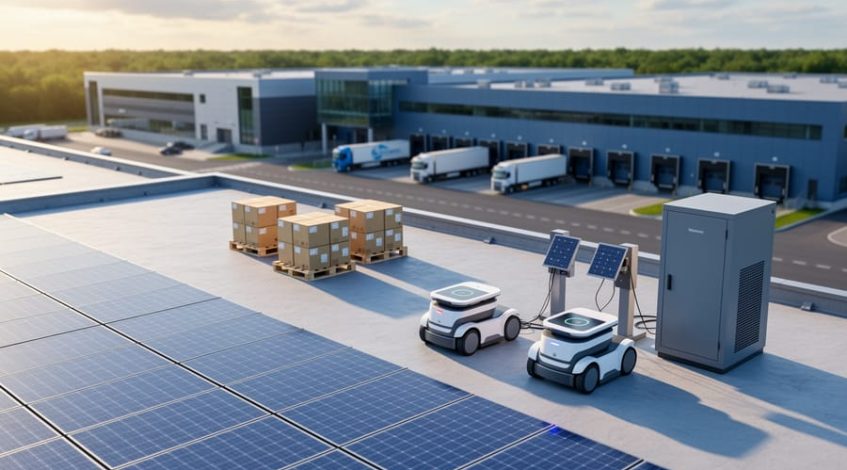
Energy robots represent the convergence of solar power generation and advanced automation, delivering measurable operational savings of 15-30% while reducing carbon footprints across manufacturing, warehousing, and agricultural facilities. These autonomous systems harness photovoltaic energy to power material handling, inspection protocols, and repetitive industrial tasks without grid dependence, creating self-sufficient operational ecosystems that lower electricity costs and enhance sustainability metrics.
Modern solar-powered robotic platforms operate independently during daylight hours, storing excess energy in integrated battery systems for continuous 24-hour functionality. Manufacturing facilities deploying these solutions report reduced peak demand charges, decreased maintenance labor costs, and improved workplace safety through automated hazardous task management. Distribution centers utilize solar-charged autonomous guided vehicles for inventory transport, eliminating diesel-powered forklifts and their associated fuel expenses while meeting corporate ESG commitments.
The financial case strengthens as installation costs decline and government incentives expand. Commercial solar installations paired with robotic automation systems typically achieve payback periods of 4-7 years, with equipment lifespans exceeding 20 years. Agricultural operations employ solar-powered robots for crop monitoring and precision irrigation, reducing water consumption by 40% while optimizing yield through data-driven field management.
Implementation requires strategic assessment of facility energy profiles, operational workflows, and available roof or ground space for photovoltaic arrays. Successful deployments integrate battery storage capacity calibrated to operational demand patterns, ensuring robots maintain productivity during low-light conditions. As battery technology advances and solar panel efficiency increases, energy robots transition from innovative pilot programs to essential infrastructure for organizations prioritizing operational resilience and environmental stewardship.
What Are Energy Robots in Industrial Settings?
The Convergence of Solar Technology and Robotics
The integration of solar technology with robotic systems represents a significant milestone in industrial automation, driven primarily by substantial improvements in energy capture and storage capabilities. Recent advances in photovoltaic efficiency have pushed conversion rates beyond 26% in commercial applications, while modern lithium-ion and emerging solid-state battery technologies now offer energy densities exceeding 250 Wh/kg. These developments have fundamentally transformed the feasibility of deploying autonomous solar-powered robots in demanding industrial environments.
The practical implications are considerable for facility managers seeking to reduce operational costs. Solar-powered robotic systems can now operate continuously in outdoor settings, with battery storage providing sufficient capacity for overnight or low-light operations. In warehouse facilities, solar panels integrated into building infrastructure power autonomous material handling robots, eliminating the downtime associated with battery swaps or charging stations. Manufacturing sites have successfully deployed solar-charged inspection robots that patrol large outdoor facilities, monitoring equipment and infrastructure without grid connectivity requirements.
The financial benefits extend beyond energy savings. Solar-powered robots reduce infrastructure costs by eliminating the need for extensive electrical wiring in large facilities. A distribution center in Queensland recently reported a 40% reduction in energy-related operational expenses after implementing solar-powered autonomous vehicles across their 50,000 square meter facility. This convergence of technologies delivers measurable returns while advancing corporate sustainability objectives.
Types of Solar-Powered Industrial Robots
Solar-powered industrial robots span several distinct categories, each designed to address specific operational challenges while maximizing energy independence and sustainability.
Mobile inspection robots represent a rapidly growing segment, particularly valuable for solar farm monitoring and facility security. These autonomous units patrol large installations, using onboard solar panels to maintain charge throughout extended missions. They conduct thermal imaging, identify equipment malfunctions, and monitor perimeter security without requiring charging infrastructure. Leading manufacturers report these systems can operate continuously for 12-16 hours daily in optimal sunlight conditions.
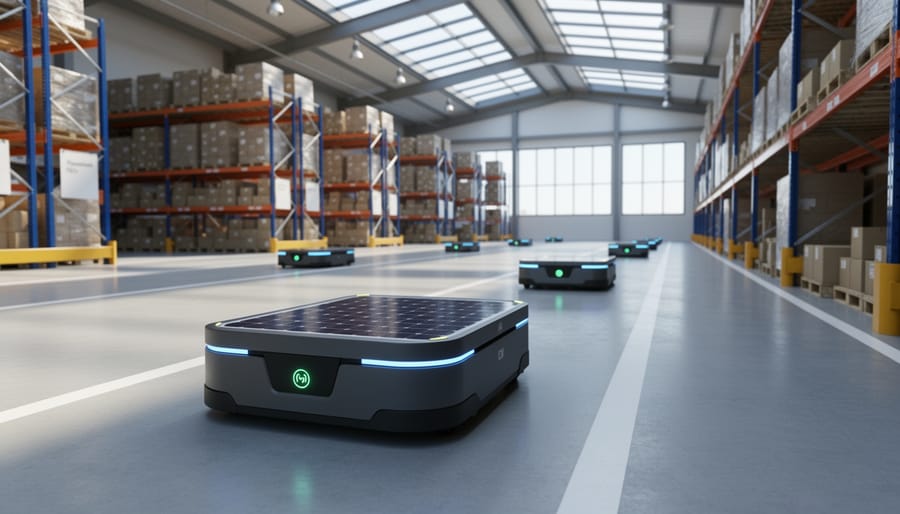
Warehouse automation systems increasingly incorporate solar energy to reduce grid dependence. Automated guided vehicles (AGVs) and autonomous mobile robots (AMRs) equipped with photovoltaic panels can supplement battery power during material transport and inventory management operations. While indoor lighting provides limited charging capacity, facilities with skylights or outdoor loading areas see measurable reductions in charging downtime. These systems prove particularly cost-effective in distribution centers with predictable sunlight exposure.
Outdoor maintenance robots handle demanding tasks like grounds keeping, agricultural monitoring, and infrastructure inspection. Lawn care robots maintain commercial properties autonomously, while agricultural variants monitor crop health and soil conditions across expansive operations. These platforms benefit most from solar integration, as their outdoor operation ensures consistent energy harvesting. Commercial implementations show 40-60% reductions in operational costs compared to traditional fuel-powered equipment.
Each category offers distinct advantages depending on facility requirements, available sunlight exposure, and operational schedules. Understanding these classifications helps decision-makers identify which solar-powered robotic solutions align best with their sustainability objectives and return on investment targets.
The Business Case for Solar-Powered Automation
Reduced Operational Costs
Solar-powered robotic systems deliver substantial operational cost reductions through measurable electricity savings and decreased reliance on grid power. Facilities implementing energy robots typically experience 40-60% reductions in energy consumption for automated processes, with some installations achieving complete energy autonomy during daylight operations. This translates to immediate bottom-line improvements while reducing industrial energy costs by thousands to millions of dollars annually, depending on scale.
The financial advantage extends beyond simple electricity bill reductions. Solar-powered robotic systems provide predictable energy costs over their 25-30 year operational lifetime, insulating businesses from volatile grid electricity rates that historically increase 3-5% annually. A warehouse deploying solar-powered autonomous inventory robots, for example, can lock in energy costs at installation, creating accurate long-term budget forecasts and improving financial planning precision.
Grid independence offers additional value through avoided demand charges, which can represent 30-70% of commercial electricity bills. Energy robots operating on dedicated solar microgrids eliminate peak demand spikes, delivering savings that compound over time. Manufacturing facilities report payback periods of 3-7 years, after which the systems generate pure cost savings.
Real-world data from Australian industrial installations demonstrates average annual savings of 150,000-500,000 dollars for medium-sized operations, with larger facilities achieving proportionally greater returns. These quantifiable benefits make solar-powered automation systems increasingly attractive investments for forward-thinking organizations prioritizing both sustainability and financial performance.
Energy Independence and Resilience
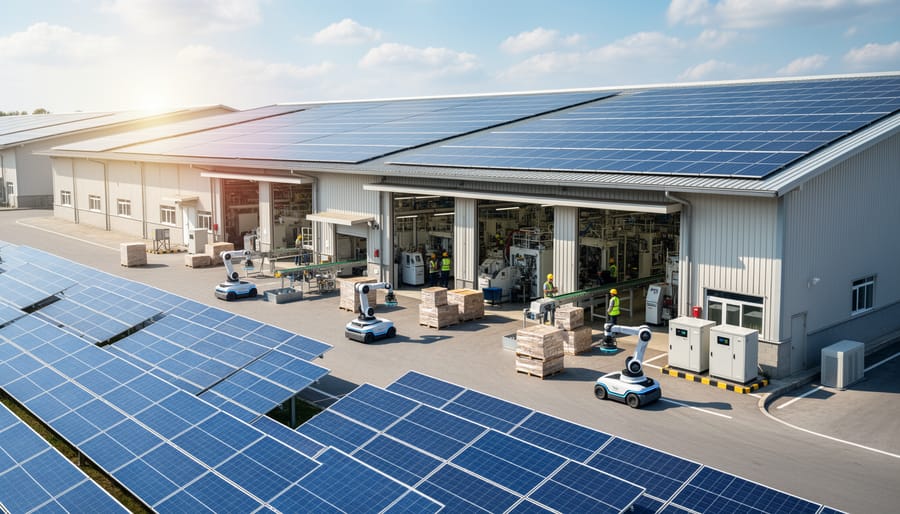
Solar-powered robotic systems deliver significant operational continuity advantages by functioning independently from traditional grid infrastructure. During power outages—whether caused by extreme weather events, grid maintenance, or infrastructure failures—facilities equipped with solar-powered automation maintain critical cleaning and maintenance operations that would otherwise halt production or compromise system efficiency.
The resilience benefits extend beyond emergency scenarios. Organizations utilizing solar-powered robots eliminate exposure to volatile electricity markets and fluctuating energy costs. A manufacturing facility in Bavaria demonstrated this advantage during the 2022 energy crisis, maintaining automated panel cleaning operations while grid-dependent competitors faced operational disruptions and unprecedented utility expenses. Their solar-powered robotic fleet continued operations seamlessly, protecting the facility’s 15-megawatt solar array performance and ensuring consistent energy generation throughout the crisis period.
When integrated with battery storage systems, these robotic platforms achieve 24-hour operational capability independent of grid availability. This configuration proves particularly valuable for critical infrastructure facilities, remote installations, and operations in regions with unreliable power supply. The investment in solar-powered automation creates a hedge against future energy market volatility while simultaneously reducing long-term operational expenses and carbon footprint—a strategic advantage that strengthens business resilience across multiple risk dimensions.
Sustainability and Corporate Responsibility Goals
Energy robots represent a strategic investment for organizations committed to environmental, social, and governance (ESG) excellence. These systems directly support corporate sustainability targets by reducing carbon emissions through optimized solar energy utilization and decreased reliance on grid power during peak demand periods. For companies facing increasing pressure from stakeholders and regulatory bodies, implementing automated energy management solutions provides quantifiable metrics for sustainability reporting, including precise measurements of carbon offset, energy savings, and renewable energy percentages.
The integration of solar-powered robotic systems helps organizations comply with evolving environmental regulations while positioning them as industry leaders in corporate responsibility. Manufacturing facilities using robotic panel cleaning systems, for example, have documented 15-20% improvements in energy generation efficiency, translating to measurable reductions in their overall carbon footprint. This performance data strengthens annual sustainability reports and demonstrates tangible progress toward net-zero commitments.
Beyond regulatory compliance, energy robots enhance brand reputation by showcasing technological innovation and environmental stewardship. Organizations that deploy these systems often experience positive recognition from customers, investors, and community stakeholders who increasingly prioritize partnerships with environmentally responsible businesses. This competitive advantage extends to improved employee recruitment and retention, as workforce surveys consistently show preference for employers demonstrating genuine commitment to sustainability initiatives through concrete technological investments.
Real-World Applications Across Industries
Manufacturing and Warehouse Operations
Solar-powered automated guided vehicles and material handling robots are revolutionizing warehouse and manufacturing efficiency while significantly reducing energy costs. These autonomous systems combine advanced robotics with renewable energy infrastructure, creating self-sustaining logistics operations that operate independently of grid power during daylight hours.
Modern solar-powered AGVs transport materials, finished goods, and inventory throughout facilities using onboard photovoltaic panels or facility-wide solar arrays that charge battery systems. Major automotive manufacturers have deployed fleets of these vehicles, achieving 40-60% reductions in material handling energy costs while maintaining 24/7 operational capacity through integrated battery storage. The systems navigate autonomously using sensors and software, eliminating manual forklift operations and reducing workplace accidents.
Material handling robots equipped with solar charging capabilities are transforming warehouse operations across food distribution, e-commerce fulfillment, and pharmaceutical facilities. These robots perform picking, packing, and sorting tasks with exceptional precision while drawing power from rooftop solar installations. A European logistics provider recently implemented 200 solar-charged robotic units, reducing annual energy expenses by €850,000 while processing 35% more orders daily.
Integration with solar-powered manufacturing operations creates comprehensive energy ecosystems where robotic systems, production equipment, and facility infrastructure share renewable power resources. This approach delivers rapid ROI, typically within 3-5 years, while supporting corporate sustainability commitments and qualifying for renewable energy incentives across multiple jurisdictions.
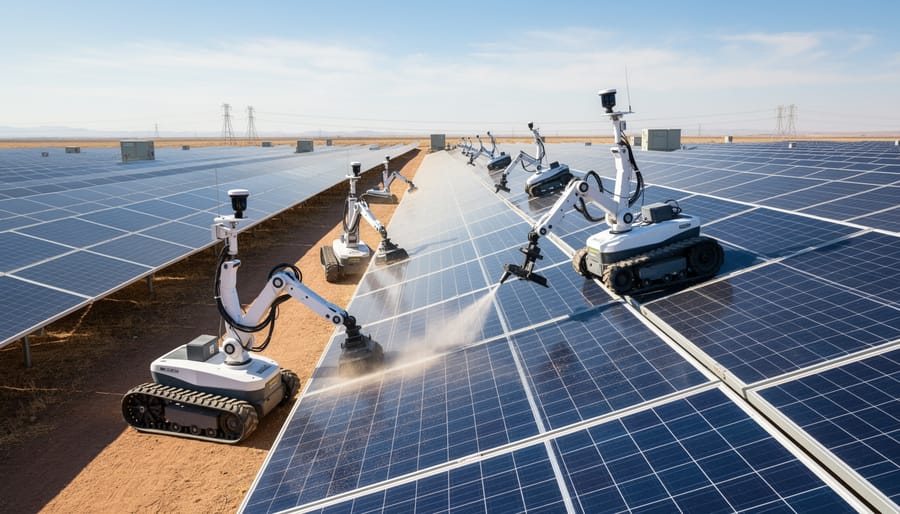
Solar Farm Maintenance and Inspection
A leading utility company in Nevada recently deployed a fleet of autonomous inspection robots across its 250-megawatt solar installation, demonstrating the operational advantages of robotic maintenance systems. These self-powered robots navigate between panel rows using GPS guidance, conducting thermal imaging scans to identify malfunctioning cells, measuring soiling accumulation, and detecting physical damage that reduces energy output.
The implementation yielded measurable results within the first operational year. The facility documented a 12% increase in overall energy production through early fault detection and a 35% reduction in maintenance labor costs compared to traditional manual inspections. The robots operate during off-peak hours, completing comprehensive site assessments in one-third the time previously required by human inspection teams.
Each unit draws power exclusively from integrated solar panels, eliminating fuel costs and enabling continuous operation in remote locations without grid infrastructure. The robots transmit real-time data to centralized monitoring systems, allowing maintenance teams to prioritize repairs based on performance impact rather than scheduled rotations.
For facility managers overseeing large-scale installations, this approach delivers quantifiable returns through enhanced uptime, reduced staffing requirements, and data-driven maintenance scheduling. The technology proves particularly valuable for installations in challenging terrain or extreme climates where human access presents safety concerns and operational inefficiencies.
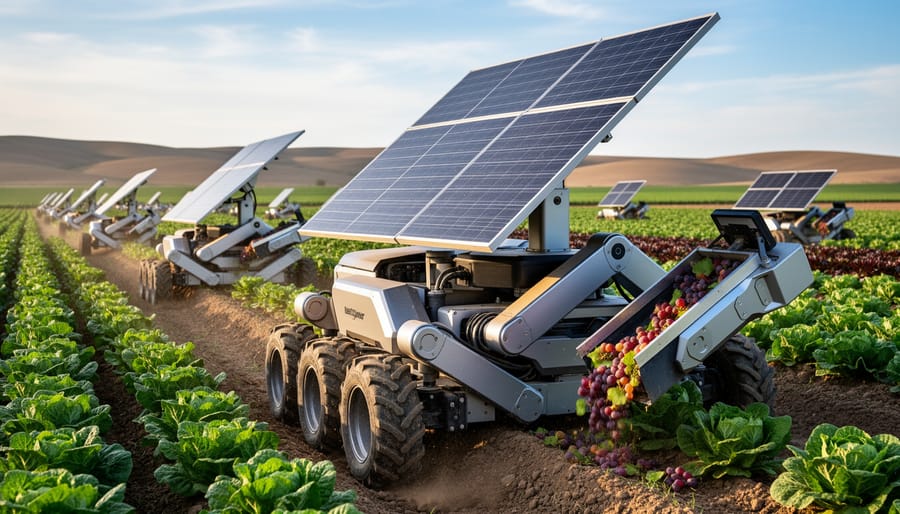
Agriculture and Food Processing
The agricultural sector has emerged as a significant adopter of solar-powered robotic technology, with systems designed to address labor shortages while reducing operational costs and environmental impact. Solar-powered harvesting robots represent a practical solution for large-scale farming operations, particularly in sun-rich regions where photovoltaic panels can generate sufficient energy throughout growing seasons.
Modern harvesting robots equipped with integrated solar panels can operate autonomously for 8-12 hours daily, identifying ripe produce through computer vision and executing precision harvesting without damaging crops. A notable implementation involves a California-based berry farm that deployed solar-powered harvesting units across 50 acres, achieving a 35% reduction in labor costs while increasing harvest efficiency by 20%. These systems typically achieve return on investment within 3-4 years through combined energy savings and productivity gains.
Automated irrigation systems powered by standalone solar installations demonstrate similar value propositions. These systems utilize sensors to monitor soil moisture, weather conditions, and crop requirements, automatically adjusting water distribution to optimize resource usage. A vineyard operation in Spain reduced water consumption by 40% and eliminated grid electricity costs for irrigation pumping after installing solar-powered automated systems, recovering the initial investment in under three years.
The scalability of these solutions makes them particularly attractive for mid-sized to large agricultural operations. As technology advances and component costs decline, solar-powered agricultural robotics continue demonstrating measurable improvements in operational efficiency, resource conservation, and bottom-line profitability for forward-thinking agribusiness managers.
Technical Considerations for Implementation
Power Requirements and System Sizing
Calculating appropriate solar capacity for energy robots requires careful analysis of operational requirements, duty cycles, and energy consumption patterns. A typical autonomous solar panel cleaning robot operating 8 hours daily may consume 2-5 kWh per day, requiring a dedicated solar array of 3-7 kW with proportional battery storage. For larger robotic systems managing large-scale solar installations, power demands can reach 15-20 kWh daily.
The sizing formula considers three critical factors: average daily energy consumption, peak power demand during operation, and backup autonomy requirements. For example, a monitoring robot with continuous operation needs 24-hour coverage, typically requiring battery storage capacity equivalent to 1.5-2 times daily consumption to account for cloudy conditions and seasonal variations.
Battery storage selection depends on application criticality. Lithium-ion systems offer 90-95% round-trip efficiency and compact footprints suitable for mobile robots, while flow batteries provide extended cycle life for stationary monitoring systems. Most commercial installations incorporate 24-48 hour backup capacity to ensure uninterrupted operation.
Real-world applications demonstrate these principles: a Queensland agricultural facility deployed solar-powered monitoring robots with 5 kW solar arrays and 20 kWh battery banks, achieving 98% system uptime. System sizing should include 20-25% capacity overhead to accommodate future expansion and account for panel degradation over time, ensuring long-term operational reliability and optimal return on investment.
Integration with Existing Infrastructure
Integrating solar-powered robotic systems into existing industrial infrastructure represents a strategic investment rather than a complete operational overhaul. Modern energy robots are designed with compatibility in mind, featuring standardized communication protocols such as OPC-UA and MQTT that enable seamless connection with legacy automation systems, programmable logic controllers, and existing supervisory control and data acquisition platforms.
Retrofitting typically begins with a comprehensive facility assessment to identify optimal deployment locations where solar exposure aligns with operational workflows. Many manufacturers offer modular robotic units that can be incrementally introduced alongside conventional equipment, minimizing disruption to ongoing production. This phased approach allows businesses to validate performance and ROI before scaling deployment.
Key integration considerations include existing power infrastructure compatibility, communication network capacity, and workforce training requirements. Solar-powered robots can often utilize current mounting structures, conveyor systems, and control interfaces with minimal modifications. A European automotive parts manufacturer successfully integrated solar-driven quality inspection robots into their 15-year-old assembly line within three months, achieving full operational capacity while reducing energy consumption by 34 percent. The modular nature of these systems ensures that businesses can adapt their automation strategies as technology evolves, protecting long-term investments while advancing sustainability objectives.
Monitoring and Maintenance Systems
Effective monitoring systems are essential for maximizing the performance and longevity of energy robots. Modern solar-powered robotic installations incorporate real-time analytics platforms that track energy production, consumption patterns, and operational efficiency metrics. These systems utilize IoT sensors and cloud-based dashboards to provide facility managers with 24/7 visibility into equipment performance, enabling proactive intervention before minor issues escalate into costly downtime.
Preventive maintenance protocols extend equipment lifespan by 30-40% compared to reactive approaches. Leading installations schedule automated diagnostics that assess battery health, solar panel output, motor function, and sensor accuracy. When performance deviates from established baselines, the system generates alerts for maintenance teams, ensuring rapid response times. Best practices include quarterly deep cleaning of solar arrays to maintain optimal energy capture and biannual inspections of mechanical components.
Performance optimization algorithms continuously adjust operational parameters based on weather conditions, energy availability, and workload demands. This adaptive approach ensures robots operate at peak efficiency while minimizing wear on components, delivering sustained ROI throughout the system’s 20-25 year operational lifecycle.
Overcoming Common Implementation Challenges
Initial Capital Investment
The upfront investment for energy robots typically ranges from $50,000 to $500,000 depending on system size, automation complexity, and specific applications. While these costs may appear substantial, several financing mechanisms can reduce initial financial barriers and accelerate implementation.
Power Purchase Agreements (PPAs) allow businesses to deploy solar-powered robotic systems with minimal upfront capital, paying only for the energy generated at predetermined rates. Alternatively, equipment leasing arrangements spread costs over 5-10 year periods while maintaining operational benefits from day one. Many jurisdictions offer tax incentives, including Investment Tax Credits (ITC) of up to 30% for solar installations and accelerated depreciation schedules through Modified Accelerated Cost Recovery Systems (MACRS).
Commercial energy efficiency grants and green technology subsidies provide additional funding support, particularly for manufacturing facilities and critical infrastructure projects. Strategic deployment begins with high-impact applications where energy robots deliver immediate measurable returns, such as solar panel cleaning operations that maintain peak system efficiency or automated energy monitoring systems that identify optimization opportunities.
A phased implementation approach allows organizations to validate performance metrics and ROI before scaling operations. Leading manufacturers report achieving payback periods of 3-5 years through combined energy savings, reduced labor costs, and increased system productivity. Financial modeling should account for both direct operational savings and indirect benefits including extended equipment lifespan and improved sustainability metrics.
Weather Dependency and Energy Storage
One of the primary concerns facility managers raise about solar-powered robotic systems is operational continuity during periods of reduced sunlight or nighttime operations. Modern energy robots address this challenge through sophisticated hybrid power architectures that combine solar generation with advanced battery storage systems.
Commercial-grade energy robots typically incorporate lithium-ion or lithium iron phosphate battery banks that store excess solar energy generated during peak production hours. These batteries ensure uninterrupted operation during cloudy conditions, overnight shifts, or indoor applications where direct sunlight access is limited. Battery capacities are engineered based on operational requirements, with most industrial robots maintaining 12-24 hours of autonomous operation without solar input.
Hybrid configurations represent the most reliable approach for mission-critical applications. These systems integrate solar panels as the primary power source while maintaining grid connectivity or backup generators for extended periods of insufficient sunlight. The intelligent power management systems automatically switch between sources, prioritizing solar energy when available and seamlessly transitioning to backup power as needed. This configuration delivers the cost savings of solar operation while eliminating any risk of operational downtime.
For organizations operating across multiple facilities or geographic regions, distributed energy storage solutions offer additional resilience. Several leading manufacturers now provide cloud-based monitoring platforms that predict energy availability based on weather forecasts, allowing facility managers to optimize robot deployment schedules and charging cycles. This predictive approach maximizes solar utilization while maintaining productivity targets, delivering average energy cost reductions of 60-75% compared to conventional grid-powered systems without compromising operational reliability.
Future Trends in Solar-Powered Industrial Automation
Advances in Energy Efficiency
The evolution of energy robots centers on significant improvements in power efficiency and intelligent energy management systems. Next-generation bifacial solar panels now achieve conversion rates exceeding 22%, allowing autonomous robots to operate longer on smaller panel arrays while maintaining peak performance throughout extended operational cycles.
AI-driven power management represents a transformative advancement in energy robot technology. Machine learning algorithms continuously analyze energy consumption patterns, weather forecasts, and operational demands to optimize battery charging schedules and power distribution. These systems predict energy requirements with 95% accuracy, ensuring robots complete critical tasks even during periods of limited sunlight.
Advanced lithium-ion and emerging solid-state battery technologies extend operational capacity by 40% compared to conventional systems. Combined with regenerative braking and kinetic energy recovery mechanisms, modern energy robots maximize every watt of harvested solar power.
Real-world implementation at a Queensland manufacturing facility demonstrated these advances, where updated energy robots reduced grid dependency by 68% while increasing productivity by 23%. The facility’s ROI improved significantly through decreased operational costs and enhanced system reliability.
Looking ahead, future solar energy trends indicate continued efficiency gains through perovskite solar cells and quantum dot technology, promising even greater autonomy and cost-effectiveness for commercial applications.
Scaling Opportunities for Industrial Facilities
The decreasing costs of solar technology and robotics are creating unprecedented opportunities for facilities of all sizes to adopt automated solar-powered systems. Industry analysts project that solar panel costs will continue declining by approximately 15-20% every time global installed capacity doubles, making these solutions increasingly viable for mid-sized operations and smaller manufacturing facilities that previously found such investments prohibitive.
Modular system designs now allow businesses to start with pilot programs and scale incrementally based on performance data and budget availability. A food processing facility in Spain, for instance, began with solar-powered automated cleaning robots for a single production line before expanding to four additional lines within eighteen months after documenting a 34% reduction in labor costs and improved sanitation compliance.
Emerging financing models, including energy-as-a-service and performance-based contracts, are removing traditional capital barriers. These arrangements enable facilities to implement solar automation with minimal upfront investment while immediately benefiting from operational savings. Additionally, standardized integration protocols are simplifying installation across different facility types, reducing implementation timelines from months to weeks. As battery storage technology advances and becomes more affordable, even facilities in regions with variable solar resources can achieve reliable 24/7 automated operations, expanding the geographic and sectoral reach of these transformative solutions.
The integration of energy robots into industrial operations represents a pivotal advancement in both sustainability and operational efficiency. These solar-powered automated systems deliver measurable returns through reduced energy costs, decreased labor expenses, and enhanced productivity while simultaneously advancing corporate environmental objectives. Organizations that have implemented energy robots report average energy cost reductions of 40-60% alongside significant improvements in operational consistency and safety metrics.
The financial case for energy robots extends beyond immediate cost savings. With declining solar panel prices and improved battery storage technologies, payback periods for these systems now typically range from 3-5 years, making them increasingly accessible to facilities of all sizes. When combined with available tax incentives and accelerated depreciation schedules, the return on investment becomes even more compelling for forward-thinking business leaders.
From a sustainability perspective, energy robots enable facilities to demonstrate tangible progress toward carbon neutrality goals while reducing reliance on grid electricity during peak demand periods. This dual benefit positions organizations as industry leaders in environmental stewardship while creating operational resilience against energy price volatility.
Now is the time to evaluate your facility’s potential for solar-powered automation. Begin by conducting an energy audit to identify high-consumption processes suitable for robotic automation. Assess your available roof space, ground area, and solar exposure to determine installation capacity. Most importantly, consult with experienced commercial solar installers who can design customized solutions that align with your specific operational requirements and financial objectives. The transformative potential of energy robots awaits those prepared to embrace this proven technology.