
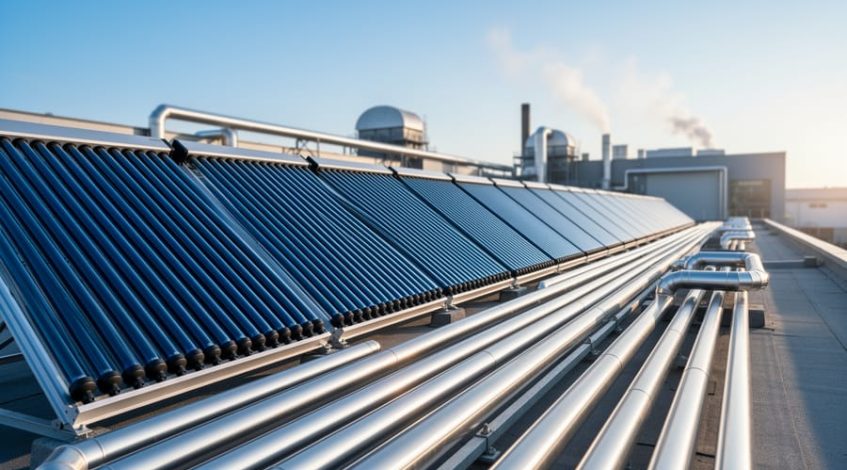
Manufacturing facilities waste billions annually on conventional heating systems when thermal solar technology can deliver process heat at 40-70% lower operating costs. Industrial operations requiring temperatures between 60°C and 400°C—from food processing and textile dyeing to chemical production and metal treatment—now have access to proven solar thermal systems that integrate directly into existing infrastructure without production disruptions.
The technology captures sunlight through concentrating collectors or evacuated tube arrays, converting it to thermal energy that feeds directly into steam generation, hot water systems, or heat transfer fluid loops. Unlike photovoltaic panels that generate electricity, these systems produce heat exactly where industrial processes need it most, eliminating conversion losses and matching the thermal demand profile of manufacturing operations.
Current installations across automotive parts manufacturing, pharmaceutical production, and food processing demonstrate 3-7 year payback periods with 25-year operational lifespans. These systems offset 30-50% of fossil fuel consumption in facilities with consistent daytime thermal loads, delivering immediate reductions in both energy expenses and carbon emissions without compromising production capacity or product quality.
The financial case strengthens with rising natural gas prices, available federal tax credits covering 30% of system costs, and accelerated depreciation schedules. Facility managers evaluating thermal solar technology need specific data on integration requirements, seasonal performance variation, and operational implications—information that determines whether this approach fits their manufacturing environment and delivers projected returns on capital investment.
What Is Solar Thermal Process Heat Technology?
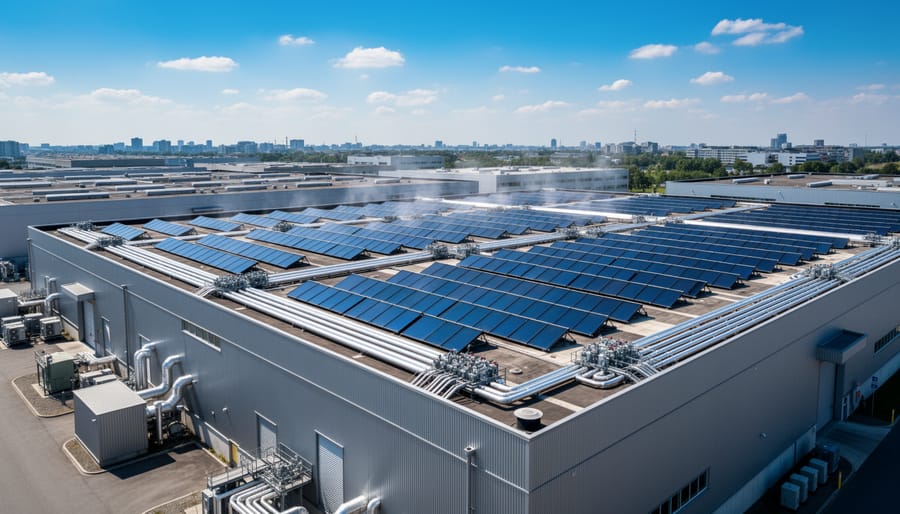
How Solar Thermal Systems Generate Industrial Heat
Solar thermal energy systems for industrial applications operate through three integrated components that work together to deliver consistent, high-temperature heat for manufacturing processes.
The foundation begins with solar collectors, which come in several configurations depending on temperature requirements. Parabolic trough collectors use curved mirrors to concentrate sunlight onto a receiver tube, achieving temperatures between 150°C and 400°C. Linear Fresnel reflectors offer a more cost-effective alternative for lower-temperature applications, while evacuated tube collectors provide excellent performance in various weather conditions. These collectors capture solar radiation with efficiency rates typically ranging from 50% to 70%.
Heat transfer fluids circulate through the collector system, absorbing thermal energy and transporting it to the point of use. Synthetic oils, water-glycol mixtures, or specialized thermal fluids are selected based on the required operating temperature and process specifications. The fluid circulates in a closed loop, maintaining system pressure and ensuring consistent heat delivery to production equipment.
Thermal storage systems provide operational flexibility by storing excess heat generated during peak sunlight hours. Molten salt tanks, pressurized water storage, or phase-change materials allow facilities to continue operations after sunset or during cloudy periods, significantly improving system capacity factors. This storage capability typically ranges from 4 to 16 hours, enabling manufacturers to achieve energy independence while maintaining production schedules. Advanced control systems monitor and optimize performance across all components, ensuring maximum efficiency and integration with existing industrial heating infrastructure.
Temperature Ranges and Manufacturing Applications
Solar thermal systems are categorized by their operating temperature ranges, each serving distinct industrial manufacturing needs. Low-temperature systems (50-100°C) effectively support food processing operations, including pasteurization, bottle washing, and product drying. These applications are ideal entry points for facilities new to solar integration, as they require minimal infrastructure modifications and deliver rapid payback periods.
Medium-temperature systems (100-250°C) power more energy-intensive processes such as textile dyeing, chemical processing, pharmaceutical production, and industrial cleaning. A textile manufacturer in California successfully integrated parabolic trough collectors to provide 180°C heat for fabric dyeing operations, reducing natural gas consumption by 42% annually while maintaining consistent temperature control.
High-temperature systems (250-400°C) serve demanding applications including metal treatment, concentrated chemical synthesis, and enhanced oil recovery. These installations typically utilize advanced concentrating solar technologies with tracking systems to achieve the required thermal output. A metals processing facility in Nevada implemented high-temperature solar collectors for pre-heating operations, cutting energy costs by 35% and significantly reducing carbon emissions. Understanding which temperature range aligns with your manufacturing processes is essential for selecting the appropriate solar thermal technology and maximizing return on investment.
Industries Benefiting from Solar Thermal Process Heat
Food and Beverage Processing
The food and beverage industry presents significant opportunities for thermal solar integration across multiple processing operations. Solar thermal systems effectively support pasteurization processes requiring temperatures between 145°F and 165°F, commonly used in dairy, juice, and liquid food production. These moderate temperature ranges align well with flat-plate and evacuated tube collectors, making implementation both technically feasible and economically viable.
Sterilization applications demand higher temperatures, typically 250°F to 280°F, achievable through concentrating solar collectors or parabolic trough systems. Several European food processing facilities have successfully deployed solar thermal systems for sterilizing equipment and containers, reducing natural gas consumption by 30-40% during peak solar hours.
Drying operations, essential for fruits, vegetables, grains, and pasta production, operate efficiently at 120°F to 200°F. A California nut processing facility integrated solar thermal technology into their drying process, achieving a 22-month payback period while reducing annual energy costs by approximately $180,000.
Solar cooking and blanching processes operate at similar temperature ranges, making them ideal candidates for renewable heat integration. These applications benefit from thermal storage systems that extend operating hours beyond direct sunlight availability, maximizing return on investment and ensuring consistent production schedules even during variable weather conditions.
Textile and Chemical Manufacturing
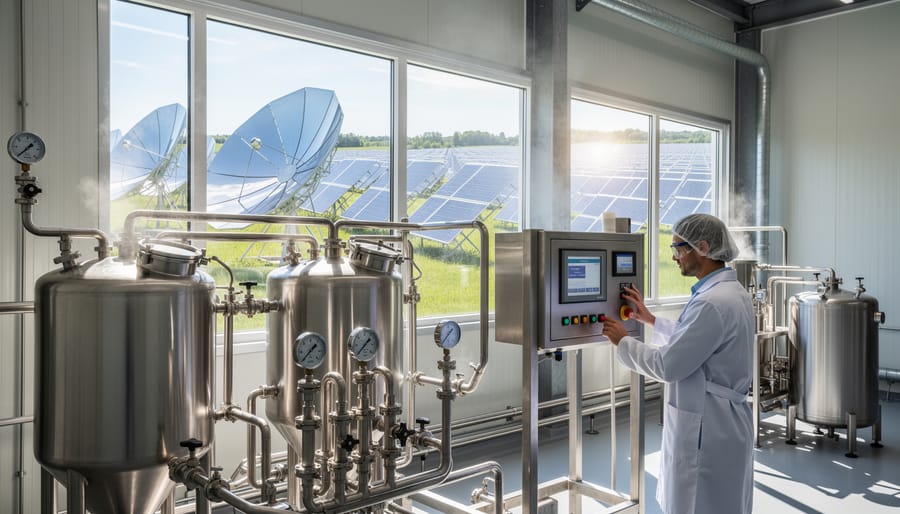
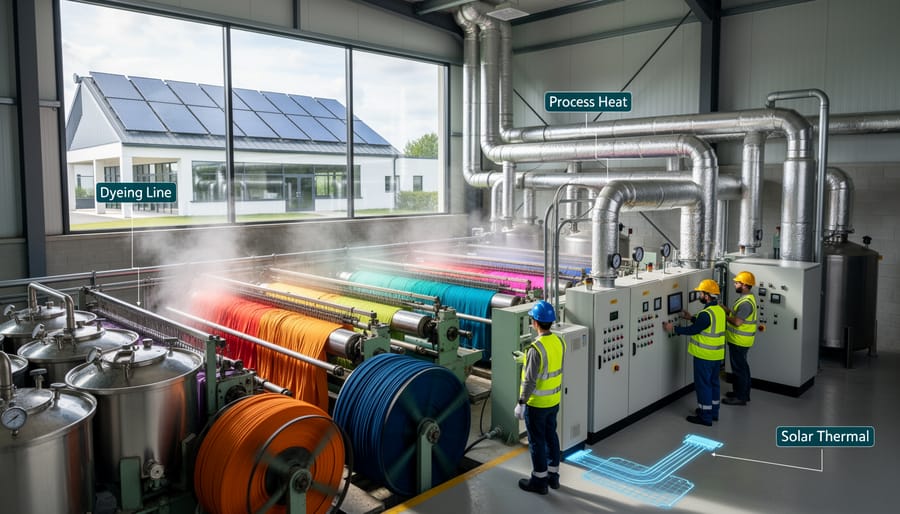
Textile and chemical manufacturing operations require substantial thermal energy for processes that demand precise, consistent temperatures. Solar thermal systems excel in meeting these requirements, particularly for dyeing and washing operations that typically operate between 60-90°C. In textile facilities, hot water and steam generated from solar collectors support fabric preparation, bleaching, mercerizing, and finishing processes. Chemical manufacturers utilize solar thermal energy for reactor heating, distillation, and evaporation processes where temperature stability directly impacts product quality and yield.
Product drying represents another significant application, with solar thermal systems providing reliable heat for drying fabrics, chemicals, and intermediate materials. A textile facility in Gujarat, India reduced natural gas consumption by 35% after installing parabolic trough collectors to support their dyeing operations, achieving a return on investment within four years. The predictable thermal output of properly designed solar systems ensures batch-to-batch consistency while reducing exposure to fossil fuel price volatility. Chemical plants benefit particularly from the ability to integrate solar thermal systems with existing heat distribution infrastructure, minimizing capital expenditure while maximizing operational savings. Modern control systems maintain precise temperature ranges even with variable solar input through hybrid configurations.
Other High-Potential Sectors
Beyond the traditional food and beverage sectors, thermal solar technology demonstrates significant potential across diverse manufacturing applications. The pharmaceutical industry increasingly leverages solar thermal systems for sterilization processes, particularly for equipment washing and sanitization cycles that require consistent temperatures between 80-95°C. These applications not only reduce energy costs but also align with stringent regulatory requirements for sustainable manufacturing practices.
In automotive manufacturing, parts cleaning and degreasing operations consume substantial energy for maintaining heated chemical baths and rinse water systems. Solar thermal installations can reliably supply heat for these processes, with several European automotive suppliers reporting 30-40% reductions in natural gas consumption after implementing hybrid solar thermal systems.
Metal treatment facilities utilize solar process heat for preheating operations before electroplating, anodizing, and powder coating. The controlled, consistent heat delivery from solar thermal collectors proves particularly valuable in maintaining precise temperature ranges critical for coating adhesion and finish quality.
The plastics processing sector applies solar thermal energy for preheating polymer materials, maintaining extrusion temperatures, and supporting thermoforming operations. While complete solar integration remains challenging for high-temperature plastics processing, supplemental solar heating for auxiliary processes delivers measurable energy savings with payback periods typically ranging from four to seven years depending on regional solar resources and energy prices.
The Financial Case: ROI and Cost Savings
Typical Payback Periods and Energy Cost Reductions
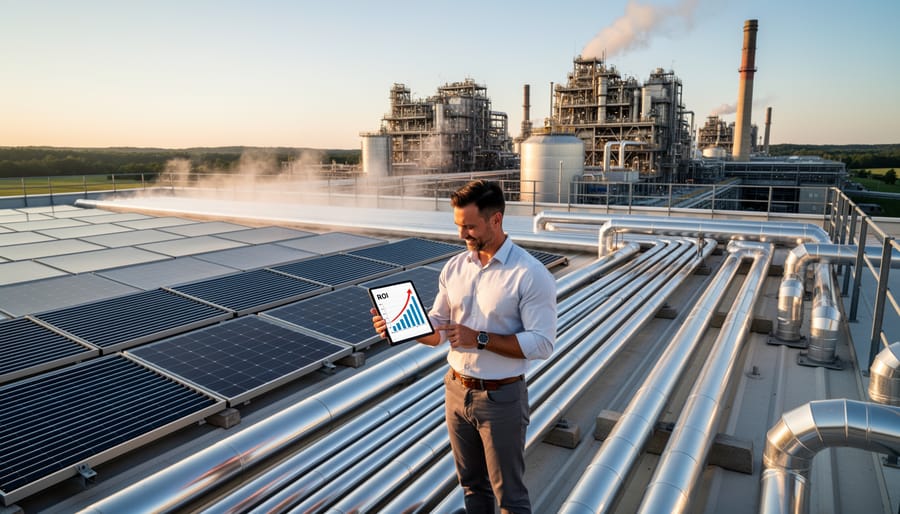
Investment returns on solar thermal systems vary based on facility size, energy consumption patterns, and regional factors, but industry data demonstrates consistent financial viability across diverse applications. Manufacturing facilities typically experience payback periods ranging from 4 to 8 years, with many operations achieving returns at the shorter end of this spectrum when utility rates are high or renewable energy incentives are available.
Energy cost reductions generally fall between 30% and 70% for process heating applications, depending on the percentage of thermal load offset by solar and the existing fuel source being replaced. Food processing plants replacing natural gas for cleaning and pasteurization operations commonly report savings of 40-50% on related energy expenses. Textile manufacturers utilizing solar thermal for dyeing processes have documented reductions approaching 60% in some installations, particularly in sun-rich regions.
Location significantly influences both payback periods and savings potential. Facilities in the southwestern United States or similar high-insolation regions often achieve 5-year payback periods, while northern installations may extend to 7-8 years. However, rising fossil fuel costs and strengthening carbon pricing mechanisms are compressing these timelines across all geographic markets.
Federal tax credits, accelerated depreciation schedules, and state-level renewable energy incentives can reduce payback periods by 1-3 years. When combined with avoided carbon compliance costs and enhanced corporate sustainability credentials, the total value proposition extends well beyond direct energy savings. Manufacturing operations should evaluate lifetime system costs against 20-25 year operational horizons, during which solar thermal systems provide increasingly competitive economics as conventional energy prices escalate.
Incentives and Financing Options
Industrial solar thermal projects benefit from multiple financial incentives designed to accelerate adoption and improve return on investment. Understanding these mechanisms is essential for facility managers evaluating project feasibility.
The Federal Investment Tax Credit (ITC) remains a cornerstone incentive, allowing businesses to deduct a significant percentage of solar thermal system costs from federal taxes. This credit applies to both equipment and installation expenses, substantially reducing upfront capital requirements. Additionally, the Modified Accelerated Cost Recovery System (MACRS) enables accelerated depreciation of solar thermal assets over five years, creating immediate tax advantages that improve cash flow during the critical early project phases.
State and local governments often supplement federal programs with grants, rebates, and performance-based incentives. Many jurisdictions offer property tax exemptions for renewable energy installations, while utility companies may provide interconnection incentives or capacity payments for systems that reduce peak demand.
Power Purchase Agreements (PPAs) present an attractive alternative for organizations seeking to avoid upfront costs entirely. Under PPA structures, third-party developers finance, install, and maintain solar thermal systems while customers purchase the generated thermal energy at predetermined rates, typically below conventional fuel costs. This arrangement transfers technical and financial risk while delivering immediate operational savings.
Several financing options including equipment leasing, green bonds, and specialized clean energy loans accommodate diverse organizational structures and financial strategies. Working with experienced solar thermal providers ensures access to current incentive programs and optimal financing structures tailored to specific industrial applications and regional opportunities.
System Design Considerations for Manufacturing Facilities
Evaluating Your Facility’s Solar Thermal Potential
Before implementing solar thermal technology, conducting a thorough site assessment ensures optimal system performance and return on investment. Several critical factors determine whether your facility is well-suited for this renewable energy solution.
Available space represents the primary consideration. Solar thermal collectors require adequate roof or ground area with unobstructed southern exposure in the Northern Hemisphere. A typical industrial installation needs approximately 2-4 square meters of collector area per kilowatt of thermal capacity. Flat roofs, sloped roofs with proper orientation, and adjacent ground parcels can all accommodate collector arrays.
Solar irradiation levels directly impact system efficiency and energy output. Facilities in regions receiving 4-6+ peak sun hours daily achieve the strongest performance metrics. However, even areas with moderate solar resources can justify installations when heat demand is substantial. Professional solar resource mapping tools provide precise data for your specific location.
Understanding your current heat demand profile is essential for proper system sizing. Document your facility’s thermal energy consumption patterns, including seasonal variations and daily load curves. Solar thermal systems perform optimally when aligned with consistent daytime heat requirements, such as industrial wash cycles, pasteurization processes, or space heating.
Process temperature requirements determine appropriate collector technology. Low-temperature applications below 80°C suit flat-plate collectors, while medium-temperature needs from 80-250°C require evacuated tube or parabolic trough systems. High-temperature processes above 250°C may necessitate concentrating solar thermal technologies.
Engaging qualified solar thermal consultants to perform detailed feasibility studies provides accurate projections of energy production, cost savings, and payback periods specific to your operational parameters.
Hybrid Systems and Backup Integration
Solar thermal systems deliver maximum value when designed as hybrid configurations that work seamlessly alongside conventional heating infrastructure. Rather than requiring complete replacement of existing boilers, thermal solar installations integrate as a preheating stage, reducing fossil fuel consumption while maintaining operational reliability.
In typical hybrid configurations, solar collectors preheat water or thermal fluid before it enters conventional boilers. When solar irradiance is sufficient, the system can meet 100% of process heat requirements. During periods of low sunlight or peak demand, existing boilers automatically supplement the supply, ensuring uninterrupted production. This dual-fuel approach eliminates concerns about process disruptions while progressively reducing energy costs.
The integration architecture typically employs intelligent control systems that prioritize solar energy when available and seamlessly transition to backup heating as needed. Temperature sensors and flow controls monitor both solar and conventional systems, optimizing the contribution from each source based on real-time conditions. Many facilities integrate energy storage systems such as insulated buffer tanks, extending solar availability beyond daylight hours and smoothing supply throughout production shifts.
A food processing facility in Queensland exemplifies this approach, installing solar thermal collectors alongside their existing natural gas boilers. The hybrid system now provides 65% of annual process heat requirements, with gas boilers serving solely as backup during extended cloudy periods or maintenance windows. This configuration achieved a 3.8-year payback while maintaining the operational security demanded by continuous production schedules.
Real-World Success: Solar Thermal in Action
Case Study: Food Processing Facility
A mid-sized dairy processing facility in California provides a compelling demonstration of solar thermal technology’s commercial viability. The plant required consistent hot water at 85°C for pasteurization, cleaning-in-place systems, and sanitization processes, consuming approximately 45,000 therms of natural gas annually.
The facility installed a 2,400 square meter evacuated tube collector system with integrated thermal storage capacity of 15,000 liters. The total project investment reached $485,000, including installation, controls, and grid interconnection. State incentives and federal tax credits reduced the net cost to $312,000.
Performance data from the first 18 months shows the system displaces 28,500 therms annually, representing 63% of the facility’s thermal energy demand. At current natural gas rates of $0.85 per therm, this generates annual savings of $24,225. Additional savings of $3,800 result from avoided carbon offset purchases under California’s cap-and-trade program.
The simple payback period calculates to 12.9 years, with an internal rate of return of 9.2% over the system’s 25-year lifespan. When factoring in projected energy cost escalation of 3.5% annually, the adjusted payback drops to 9.7 years. Maintenance costs average $2,400 annually, primarily for glycol replacement and automated system monitoring.
Case Study: Textile Manufacturing Plant
A leading textile manufacturer in North Carolina implemented a 12,000 square foot solar thermal array to support their fabric dyeing and finishing operations, which previously consumed 450,000 therms of natural gas annually. The facility required consistent temperatures between 140-180°F for dye baths and washing cycles, making it an ideal candidate for parabolic trough collectors.
The integration presented specific challenges. Existing steam boilers required modification to accept solar-preheated water, necessitating additional heat exchangers and control systems. The engineering team addressed spatial constraints by installing collectors on an unused portion of the property adjacent to the processing building, requiring 300 feet of insulated piping.
After eighteen months of operation, the system delivers measurable results. Solar thermal provides 38 percent of the facility’s process heat requirements during peak months, reducing natural gas consumption by 168,000 therms annually. This translates to $185,000 in annual energy cost savings and eliminates 890 metric tons of carbon emissions. The $1.2 million installation, combined with federal tax incentives and state grants, achieved a 5.8-year payback period.
Operations Manager David Chen reports that system reliability exceeded expectations, with automated controls seamlessly switching between solar and conventional heating. The installation also positioned the company favorably with major retail clients increasingly scrutinizing supplier sustainability practices.
Overcoming Common Implementation Challenges
While thermal solar technology offers substantial benefits for industrial applications, facility managers often encounter several practical challenges during implementation. Understanding and addressing these obstacles proactively ensures smoother project deployment and optimal system performance.
Space constraints represent one of the most frequently cited concerns. Solar collectors require adequate roof or ground space with proper southern exposure in the Northern Hemisphere. However, innovative solutions exist: rooftop installations can utilize otherwise unused areas, while ground-mounted systems can be positioned on marginal land unsuitable for other purposes. A food processing facility in California successfully integrated collectors on warehouse rooftops, generating 40% of their process heat requirements without impacting production floor space.
Intermittency challenges arise from the variable nature of solar radiation. This concern is typically mitigated through hybrid system designs that combine solar thermal with existing boilers or through thermal energy storage systems. These storage solutions, using phase-change materials or insulated water tanks, can maintain heat availability during cloudy periods or overnight operations. Many facilities operate solar thermal as a preheating system, reducing fossil fuel consumption while maintaining operational reliability.
Maintenance requirements often worry operations teams unfamiliar with solar technology. Modern systems are designed for minimal intervention, typically requiring only periodic collector cleaning, fluid checks, and standard pump maintenance. Most manufacturers report maintenance costs of 1-2% of initial investment annually, comparable to conventional heating systems.
Operational complexity concerns diminish with proper system integration. Advanced control systems automatically manage heat distribution between solar collectors, storage, and backup systems. Training existing maintenance staff on basic monitoring procedures typically requires just a few days, and many manufacturers offer long-term support contracts to ensure continuous optimal performance throughout the system’s 20-25 year lifespan.
Making the Transition: Next Steps for Your Facility
Conducting an Energy Audit and Feasibility Study
A professional energy audit serves as the foundation for informed decision-making when implementing solar thermal systems. Qualified assessors will analyze your facility’s thermal energy consumption patterns, examining production schedules, process temperatures, and seasonal demand fluctuations. This comprehensive evaluation typically includes infrared thermography to identify heat loss areas, detailed measurements of current fuel consumption, and temperature profiling of your manufacturing processes.
The feasibility study quantifies potential energy savings, calculates system sizing requirements, and projects realistic payback periods based on your specific operational parameters. Expect assessors to evaluate roof or ground space availability, structural load capacity, and integration points with existing heating infrastructure. Key data points collected include current energy costs per unit of production, annual thermal load in kilowatt-hours, required process temperatures, and available solar resources at your location.
This assessment provides the technical and financial justification needed to transition to solar thermal energy confidently, delivering actionable recommendations tailored to your manufacturing requirements.
Selecting the Right Solar Partner
Selecting a qualified solar thermal partner requires evaluating several critical factors that directly impact system performance and return on investment. Prioritize installers with demonstrated experience in industrial process heat applications, as residential or commercial building expertise does not necessarily translate to manufacturing environments. Request documentation of completed projects in your specific industry sector, including system capacities, integration complexities, and achieved performance metrics.
Industry certification through organizations like NABCEP (North American Board of Certified Energy Practitioners) signals technical competency and adherence to professional standards. Verify the installer’s engineering capabilities, particularly their ability to conduct thorough thermal audits and model system performance under your operational conditions.
Comprehensive ongoing support should include performance monitoring, preventive maintenance protocols, and troubleshooting assistance. Leading partners provide data analytics dashboards that track energy production, system efficiency, and financial returns. Clarify warranty terms covering both equipment and installation workmanship, typically spanning 10-25 years for major components. A strong partnership extends beyond installation to optimization services that ensure your system consistently delivers projected savings throughout its operational lifetime.
Solar thermal process heat represents a strategic investment that delivers measurable advantages across multiple operational dimensions. Industrial facilities implementing this technology consistently achieve substantial reductions in energy costs while advancing corporate sustainability objectives and strengthening competitive positioning in increasingly environmentally conscious markets. The financial benefits extend beyond immediate fuel savings to include predictable energy pricing, reduced regulatory exposure, and enhanced asset value.
Manufacturing leaders who have integrated solar thermal systems report improvements in operational resilience, particularly as energy price volatility continues to affect conventional fuel markets. The technology’s proven performance across diverse applications—from food processing to chemical manufacturing—demonstrates its versatility and reliability as an industrial energy solution.
Moving forward requires a systematic approach. Facility managers should initiate comprehensive energy audits to identify optimal integration points and quantify potential savings specific to their operations. Engaging with experienced solar thermal consultants and system providers ensures proper sizing, technology selection, and integration planning aligned with production requirements.
The convergence of declining system costs, available financial incentives, and rising conventional energy prices creates a compelling economic case for action. Organizations that evaluate solar thermal process heat today position themselves to capture long-term cost advantages while meeting stakeholder expectations for environmental responsibility. Begin your assessment now to determine how this technology can strengthen your facility’s operational and financial performance.