
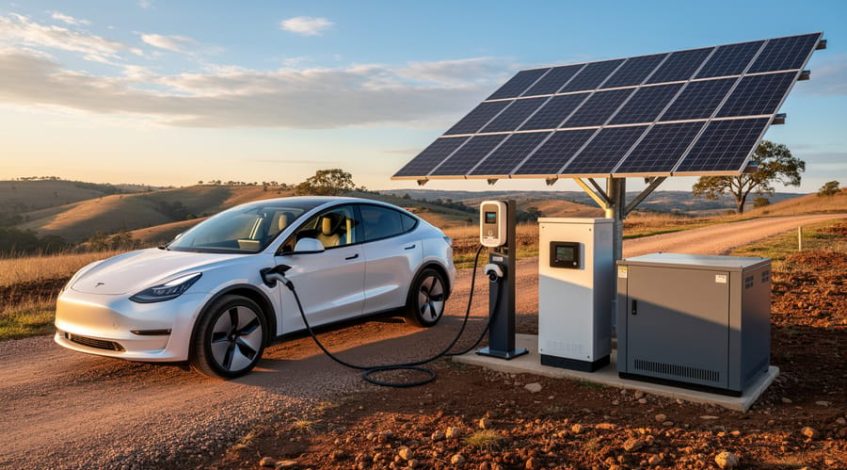
Rural communities and remote facilities face a persistent challenge: establishing reliable electric vehicle charging infrastructure without dependable grid access. Off-grid inverter/chargers solve this by converting stored DC battery power into AC electricity for EV charging while simultaneously managing solar panel input and battery storage—creating completely autonomous energy systems that operate independently of utility connections.
These integrated devices serve three critical functions simultaneously. First, they regulate incoming solar energy, converting variable DC voltage from photovoltaic arrays into optimized charging current for battery banks. Second, they transform stored battery power into clean AC electricity matching grid quality (typically 230V or 400V three-phase) for EV charging stations. Third, they manage power distribution intelligently, prioritizing charging demands while maintaining battery health and system longevity.
The technology has evolved significantly beyond basic off-grid applications. Modern systems incorporate sophisticated maximum power point tracking (MPPT) controllers that extract up to 30% more energy from solar arrays compared to conventional charge controllers. Advanced models feature programmable load management, allowing facility managers to prioritize critical charging sessions during peak demand or limited sunlight conditions. Battery communication protocols ensure compatibility with lithium-ion, lead-acid, and emerging solid-state storage technologies.
For solar-powered charging hubs in regional transport networks, these systems eliminate infrastructure expenses typically exceeding $50,000 per kilometer for grid extensions. Installation timelines compress from months to weeks, and operational costs remain predictable regardless of utility rate fluctuations. The investment equation becomes particularly compelling in locations where grid connection costs exceed the complete off-grid system expense—a threshold often reached beyond 500 meters from existing infrastructure.
The Rural Mobility Challenge: Why Grid-Connected Solutions Fall Short

Economic Realities of Grid Extension
Grid extension costs present a compelling economic argument for standalone solar solutions in rural applications. Traditional utility infrastructure averages $15,000 to $50,000 per kilometer in moderate terrain, with costs escalating dramatically in challenging topography or remote locations. For sites located just five kilometers from existing grid infrastructure, connection expenses can easily exceed $75,000 before accounting for ongoing utility fees and demand charges.
In contrast, a properly specified off-grid inverter/charger system with adequate solar array and battery storage typically requires a capital investment of $40,000 to $80,000 for commercial-scale installations. This creates a clear break-even point for sites beyond 2-3 kilometers from grid access. Municipal transportation authorities implementing rural EV charging hubs have documented ROI timelines of 4-7 years when factoring in avoided grid connection costs and reduced operational expenses.
Commercial facilities benefit from predictable energy costs insulated from utility rate increases, which have averaged 3.2 percent annually over the past decade. Government-funded rural development projects increasingly favor solar-integrated charging infrastructure, with federal and state incentive programs reducing effective system costs by 30-50 percent. This financial framework positions off-grid solutions as economically superior for distributed charging networks serving underserved communities.
Service Gaps Affecting Commercial Fleet Operations
Rural businesses face distinct infrastructure challenges that urban operations rarely encounter. In agricultural regions, commercial fleet operations require charging solutions for utility vehicles, refrigerated transport, and equipment far from grid connection points. Tourism operators managing safari vehicles, eco-lodges, and remote adventure services need dependable power where grid extension costs can exceed $50,000 per kilometer. Logistics companies servicing remote communities and mining sites operate delivery fleets that cannot rely on unpredictable grid availability.
These operations share a critical requirement: charging infrastructure that functions independently of grid constraints. Off-grid inverter/charger systems address this need by combining solar generation with battery storage and intelligent power management. For agricultural enterprises, this means charging electric utility vehicles overnight using stored solar energy. Tourism businesses maintain guest services while simultaneously powering electric transport fleets. Regional logistics providers establish reliable charging stations at strategic rural locations without waiting for grid infrastructure development. The return on investment becomes particularly compelling when comparing installation costs against grid connection fees and ongoing demand charges that rural utility providers typically impose on commercial accounts.
Off-Grid Inverter/Chargers Explained: The Core Technology
How Inverter/Chargers Manage Multiple Power Flows
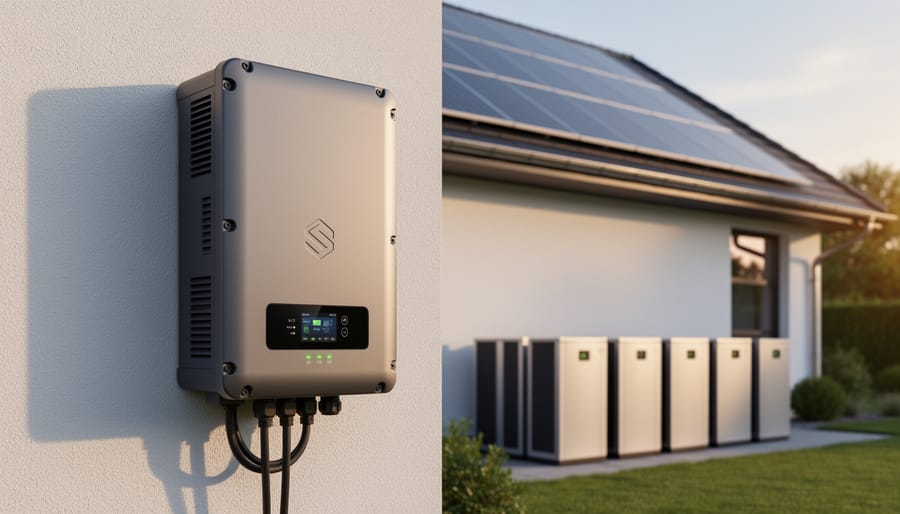
Off-grid inverter/chargers function as intelligent power management systems, orchestrating multiple energy flows to ensure consistent EV charging capability. These devices simultaneously monitor and regulate three critical pathways: incoming solar generation, battery state of charge, and real-time load demands from connected vehicles.
During peak sunlight hours, the system prioritizes direct solar-to-vehicle charging while simultaneously replenishing battery storage. Advanced algorithms calculate available solar capacity and intelligently allocate power based on predetermined priorities. If solar production exceeds both charging demand and battery capacity, the system automatically regulates input to prevent overcharging and equipment damage.
When solar generation diminishes or multiple vehicles require charging simultaneously, the inverter/charger seamlessly transitions to battery power without interrupting the charging session. This automatic switching occurs within milliseconds, ensuring uninterrupted service delivery. The system continuously balances these draws against available stored energy, preventing complete battery depletion that could compromise operational reliability.
In practical applications, a rural mobility hub in Kenya demonstrates this capability effectively. The facility’s 15kW inverter/charger manages charging for a fleet of electric motorcycles used for agricultural transport. During morning hours, solar input directly powers vehicle charging while topping off the 30kWh battery bank. Afternoon peak demand draws from both solar and stored energy, while evening charging relies entirely on battery reserves accumulated during the day. This coordinated power management delivers approximately 45 charging sessions daily without grid dependency, demonstrating the viability of inverter/chargers for sustained off-grid EV infrastructure operations.
Key Technical Specifications for Mobility Hubs
Selecting appropriate off-grid inverter/charger systems for rural mobility hubs requires careful consideration of several critical specifications. Power ratings typically range from 3kW to 15kW for individual charging points, with scalability to accommodate multiple vehicles simultaneously. For rural applications serving light commercial vehicles and personal EVs, systems in the 5-8kW range offer optimal balance between capacity and investment.
Efficiency metrics directly impact operational viability in off-grid environments. Modern hybrid inverter/chargers should demonstrate minimum 92-94% conversion efficiency during both charging and discharging cycles. This specification becomes particularly significant when solar generation is limited during seasonal variations or extended periods of cloud cover.
Surge capacity represents another essential consideration, as many EVs and e-mobility devices require brief power spikes during initial charging handshake protocols. Quality systems should handle surge loads of 200-300% of continuous rating for 5-10 seconds without disruption. This capability prevents charging failures and ensures reliable service delivery.
Battery compatibility requirements warrant thorough evaluation. Systems must support common battery chemistries including lithium iron phosphate (LiFePO4), which offers superior cycle life and safety characteristics for stationary installations. Voltage ranges should accommodate 24V, 48V, and increasingly popular 51.2V configurations, with scalable battery banks from 10kWh to 100kWh+ based on daily charging demand and backup requirements. Advanced battery management integration ensures optimal charging profiles, temperature monitoring, and cell balancing to maximize system longevity and return on investment.
Designing Solar-Integrated Charging Hubs: System Architecture
Sizing Your System for Current and Future Demand
Accurately sizing your off-grid inverter/charger system requires a methodical assessment of current requirements and anticipated growth. Begin by cataloging the vehicle types you intend to support, as each has distinct power demands. A typical electric car requires 7-11 kW for Level 2 charging, while electric buses or delivery trucks may need 25-50 kW or higher. Calculate your peak simultaneous charging load by determining how many vehicles will charge concurrently during your busiest operational periods.
Next, evaluate charging frequency patterns. A rural mobility hub serving daily commuters will have predictable morning and evening peaks, while facilities supporting commercial fleets may require rapid mid-day top-ups. Document the average battery capacity of your vehicle fleet and their typical state-of-charge upon arrival to estimate total daily energy throughput in kilowatt-hours.
Build in a capacity buffer of 25-30 percent above your calculated baseline to accommodate inefficiencies, seasonal variations in solar production, and unexpected demand spikes. For expansion planning, consider a modular system architecture that allows incremental capacity additions without replacing core components.
A practical example: A rural transport cooperative serving 15 electric vehicles with 60 kWh batteries, assuming 50 percent average depletion and staggered charging over eight hours, would require approximately 55-60 kW of inverter capacity with corresponding battery storage. Including expansion headroom, a 75 kW system provides operational flexibility while supporting future fleet growth. Engage with experienced system integrators who can validate your calculations against local solar insolation data and operational patterns specific to your geographic location.
Battery Storage Configuration for 24/7 Availability
Proper battery storage configuration is fundamental to maintaining consistent charging availability at off-grid mobility hubs. Battery bank sizing should account for at least 48-72 hours of autonomous operation to accommodate extended periods of low solar production. This requires calculating daily energy consumption, including inverter standby losses, and multiplying by the desired autonomy period, then dividing by the planned depth of discharge.
Lithium iron phosphate (LiFePO4) batteries have become the preferred chemistry for off-grid charging applications due to their 4,000-6,000 cycle lifespan at 80% depth of discharge, compared to sealed lead-acid batteries which typically deliver only 500-800 cycles at 50% depth of discharge. While lithium solutions carry higher upfront costs, the total cost of ownership over a 10-year period typically favors lithium by 30-40% when factoring replacement cycles and usable capacity.
Depth-of-discharge management directly impacts battery longevity and system reliability. Programming inverter-chargers to limit discharge to 80% for lithium batteries or 50% for lead-acid significantly extends service life. Advanced battery management systems should include temperature compensation, cell balancing, and low-voltage disconnect protection. For rural facilities, implementing a tiered discharge protocol that prioritizes essential loads during low-state-of-charge conditions ensures critical charging services remain available even during challenging weather patterns.
Hybrid Capabilities: Backup Generator Integration
Integrating backup generators with off-grid inverter/charger systems provides critical reliability during extended cloudy periods or unexpected demand surges at rural mobility hubs. Modern hybrid systems automatically activate generator support when battery reserves fall below predetermined thresholds, typically 20-30% capacity, ensuring uninterrupted EV charging operations.
Quality inverter/chargers feature intelligent load management that seamlessly coordinates between solar input, battery storage, and generator backup. This coordination optimizes fuel consumption by running generators at peak efficiency levels rather than constant idling. For facilities managing multiple charging points, this integration mirrors the resilience strategies employed in microgrid systems at commercial ports.
Implementation considerations include generator sizing—typically matching 80% of peak inverter capacity—and fuel storage logistics for remote locations. Australian case studies demonstrate that properly configured hybrid systems reduce generator runtime by 65-75% compared to generator-only solutions, delivering substantial fuel cost savings while maintaining operational reliability during seasonal weather variations or infrastructure maintenance periods.
Real-World Applications: Charging Hubs in Action

Agricultural Fleet Charging: Farm and Forestry Operations
A 450-acre organic farm in Vermont demonstrates the practical application of agricultural fleet electrification using solar-powered charging infrastructure. The operation transitioned four utility vehicles and two compact tractors to electric power, installing a 28kW solar array paired with 48kWh battery storage and a 15kW off-grid inverter/charger system.
The investment addressed two critical challenges: diesel fuel costs exceeding $42,000 annually and emissions regulations affecting equipment operation near certified organic fields. The facility manager selected a modular charging solution featuring three Level 2 charging stations powered entirely by the solar installation, with the inverter/charger managing power distribution based on equipment schedules and weather conditions.
Operational data from the first 18 months revealed a 67 percent reduction in fuel expenses and eliminated emissions concerns during field operations. The system’s intelligent charging protocols prioritized equipment needed for early morning operations, ensuring full charges by 5:00 AM daily. Battery storage capacity proved sufficient for three consecutive overcast days, a crucial consideration for time-sensitive agricultural activities.
A forestry operation in Oregon implemented a similar configuration, supporting electric chainsaws, all-terrain vehicles, and equipment charging at remote harvest sites. Their portable 8kW inverter/charger system reduces generator fuel consumption by 1,200 gallons annually while maintaining OSHA-compliant charging capabilities in wilderness areas.
Community Mobility Hubs: Municipal and Public Access
Municipal governments across Australia and internationally are deploying off-grid inverter/charger systems to establish community EV charging stations in underserved rural areas. These installations demonstrate how renewable energy infrastructure can address transportation equity while supporting regional economic development.
The Regional Victorian town of Maldon implemented a solar-powered charging hub using a 15kW off-grid inverter/charger system with 40kWh battery storage, serving approximately 150 monthly charging sessions for residents and visitors. The installation eliminated the $85,000 grid connection cost while providing reliable charging access to a community previously without EV infrastructure. Similar projects in rural New South Wales have integrated charging facilities with community centres, creating multi-purpose energy hubs that serve both transportation and emergency backup power needs.
Government-funded programs in Western Australia have established twelve remote charging stations along regional highways, each utilizing off-grid systems ranging from 10-25kW capacity. These installations support intercity travel while demonstrating positive impacts on public transportation economics and tourism development. Data from these pilot programs shows average installation costs of $45,000-$75,000 per station, with operational costs 60% lower than grid-connected alternatives. The success of these municipal projects provides validated templates for other jurisdictions evaluating rural EV infrastructure investments, proving that off-grid solutions deliver both technical reliability and fiscal sustainability for community-scale applications.
Tourism and Hospitality Applications
Rural tourism operators increasingly recognize off-grid inverter/charger systems as valuable amenities that enhance guest experience while advancing sustainability credentials. Eco-lodges in remote locations such as the Costa Rican rainforest and African safari camps have successfully implemented solar-powered charging infrastructure to provide modern conveniences without compromising their environmental positioning.
These systems deliver measurable business advantages. Tour operators offering multi-day expeditions now advertise reliable device charging capabilities, addressing a common guest concern in off-grid environments. Safari lodges in Tanzania report that guest satisfaction scores improved by 18% after installing solar charging stations, directly correlating with positive reviews mentioning the availability of power for cameras and communications equipment.
The technology serves dual purposes: meeting operational energy needs for lighting, refrigeration, and communications while providing guest-facing charging services. A boutique resort in rural New Zealand eliminated diesel generator costs of $3,200 monthly after transitioning to a 15kW off-grid system, simultaneously reducing noise pollution that previously affected guest experience.
For hospitality managers evaluating this investment, the return extends beyond direct cost savings. Marketing research indicates that 67% of eco-conscious travelers prioritize accommodations demonstrating verifiable sustainability practices, positioning off-grid charging infrastructure as both operational efficiency and competitive differentiation.
Financial Considerations: Investment and Return
Total Cost of Ownership Over System Lifespan
Understanding the total cost of ownership for off-grid inverter/charger systems requires examining three primary components: capital expenditure, ongoing maintenance, and operational savings over a typical 15-20 year lifespan.
Capital costs for a complete rural mobility hub system typically range from $25,000 to $75,000, depending on capacity requirements. This includes solar arrays, battery storage, inverter/charger units, and installation. A mid-sized facility supporting 4-6 simultaneous EV charging sessions generally requires an investment of approximately $45,000.
Maintenance expenses remain relatively modest, averaging $800-$1,500 annually. This covers battery monitoring, inverter inspections, solar panel cleaning, and component replacements. Battery bank replacement, occurring every 8-12 years depending on technology, represents the most significant periodic expense.
Operational savings prove substantial when compared to grid extension alternatives. Rural locations requiring 2-5 miles of grid connection face infrastructure costs exceeding $150,000, with ongoing utility fees adding $2,000-$4,000 annually. Off-grid systems eliminate these perpetual charges while providing energy independence.
A comparative analysis from a Wisconsin agricultural cooperative demonstrated payback within 7 years against grid extension costs, with total 15-year savings exceeding $85,000. Similar installations in remote government facilities have achieved 5-6 year payback periods when factoring avoided infrastructure investment and enhanced service reliability during grid outages.
Available Grants and Incentive Programs
Several funding mechanisms currently support the deployment of off-grid inverter/charger systems for rural mobility hubs across Europe. The European Union’s Connecting Europe Facility (CEF) allocates substantial resources to alternative fuel infrastructure in underserved regions, with specific provisions for renewable-powered charging stations. Projects demonstrating innovative grid-independent solutions may qualify for grants covering up to 30% of eligible costs.
National programs vary by member state but generally prioritize rural electrification and clean transport initiatives. Germany’s Federal Ministry for Economic Affairs and Climate Action offers support through its renewable energy grant scheme, while France’s ADVENIR program provides targeted funding for charging infrastructure in areas with limited grid connectivity. The UK’s Rural Community Energy Fund similarly supports feasibility studies and capital investments in off-grid renewable installations.
Additionally, the European Investment Bank provides favorable loan terms for sustainable infrastructure projects, particularly those combining energy storage with mobility solutions. Business owners should evaluate regional development funds administered by local authorities, as these often feature streamlined application processes and faster approval timelines. Many programs require demonstration of technical feasibility and long-term operational sustainability, making thorough project planning essential. Engaging experienced consultants familiar with funding requirements can significantly improve application success rates and optimize total project financing structures.
Implementation Considerations for Decision-Makers
Site Evaluation and Solar Resource Assessment
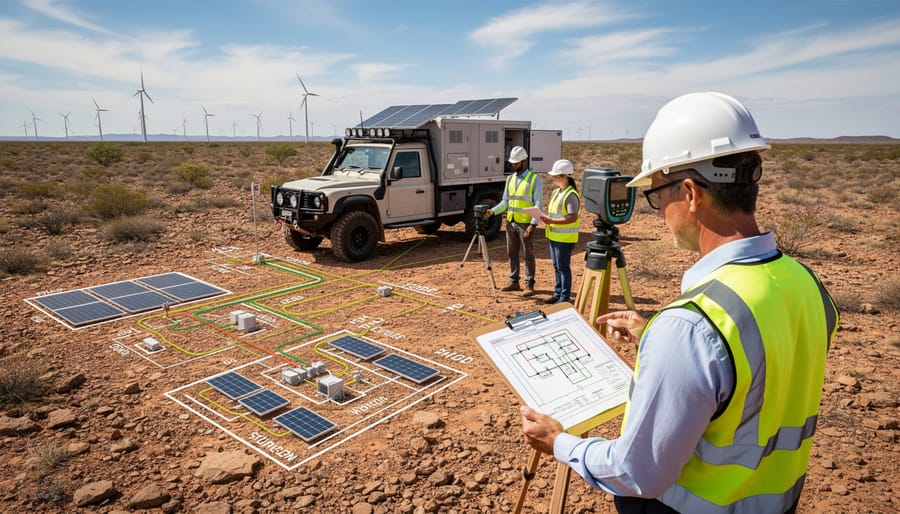
Successful off-grid mobility hub deployment begins with comprehensive site evaluation. Solar irradiance data should be collected for at least one year, with a minimum threshold of 4-5 peak sun hours daily for economically viable operation. Locations with annual solar irradiance below 1,500 kWh/m² typically require oversized arrays that may compromise project economics.
Land availability must accommodate solar arrays, equipment housing, and vehicle maneuvering space. A typical rural charging station serving 4-6 vehicles requires approximately 500-800 square feet of panel area, depending on regional solar conditions and expected usage patterns. Sites with southern exposure and minimal shading from trees or structures optimize energy generation.
Access patterns significantly impact system sizing. Facilities with predictable weekday traffic patterns can operate with smaller battery reserves than locations serving weekend recreational traffic. Historical data from similar rural facilities indicates that agricultural communities typically show 60-70% weekday concentration, while tourism-dependent areas may experience reverse patterns.
Environmental factors including extreme temperatures, dust exposure, and precipitation levels affect equipment selection and maintenance requirements. Coastal installations require corrosion-resistant components, while desert locations need enhanced cooling provisions. Professional site assessments identify these variables early, preventing costly retrofits and ensuring reliable long-term operation.
Working with Accredited Installation Partners
Partnering with certified solar installation professionals ensures your off-grid inverter/charger system meets safety standards and operates at optimal efficiency. Professional installers bring essential expertise in system sizing, component integration, and regulatory compliance specific to rural mobility hub applications.
During the commissioning phase, qualified technicians conduct comprehensive testing of all system components, including battery bank calibration, charge controller programming, and load management verification. This process typically includes establishing baseline performance metrics and configuring automated alerts for system anomalies. Installers should provide detailed documentation of system specifications, wiring diagrams, and maintenance schedules.
Establishing robust monitoring protocols from the outset allows facility managers to track energy production, consumption patterns, and equipment health remotely. Modern inverter/charger systems offer cloud-based monitoring platforms that provide real-time data on battery state of charge, solar generation efficiency, and power quality metrics. These insights enable predictive maintenance and help optimize charging schedules for electric vehicle fleets.
Request contractors with demonstrated experience in commercial off-grid installations and verify their certifications through recognized industry bodies. A comprehensive service agreement should include warranty coverage, emergency response protocols, and scheduled maintenance visits to protect your infrastructure investment and ensure continuous operation of your rural charging facility.
Off-grid inverter/charger systems represent a proven, mature technology that transforms the economics of rural EV charging infrastructure. Organizations previously constrained by prohibitive grid extension costs or unreliable utility service now have access to scalable, financially viable alternatives that deliver genuine energy independence while supporting sustainability objectives.
The strategic value extends beyond simple cost avoidance. Facilities implementing these systems gain operational resilience against grid disruptions, demonstrate environmental leadership to stakeholders, and position themselves advantageously as electrification accelerates across transportation sectors. The modular nature of contemporary inverter/charger platforms allows initial deployments to expand seamlessly as charging demand grows, protecting infrastructure investments while maintaining flexibility.
Financial analysis consistently demonstrates favorable returns, particularly when evaluating total cost of ownership over system lifespans of 20-25 years. The combination of declining component costs, available incentive programs, and elimination of ongoing utility expenses creates compelling economics for public agencies, private operators, and community organizations alike. Real-world installations across diverse climates and applications validate both technical reliability and business model sustainability.
Implementation success depends on proper system sizing, component selection, and integration with site-specific energy resources. Organizations considering off-grid charging infrastructure benefit significantly from professional assessment that evaluates solar potential, anticipated usage patterns, regulatory requirements, and long-term operational considerations.
For facility managers and decision-makers exploring rural charging solutions, a comprehensive system assessment provides clarity on technical feasibility, capital requirements, and projected returns specific to your application. Professional consultation ensures your investment delivers optimal performance while meeting both immediate operational needs and strategic organizational goals. Contact qualified renewable energy providers to evaluate how off-grid inverter/charger technology can transform your rural electrification challenges into competitive advantages.