
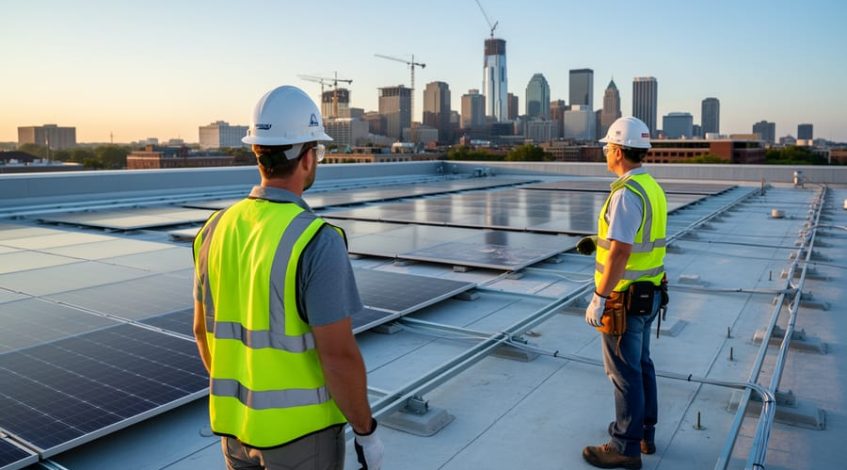
The 2025 building codes represent a fundamental shift in commercial construction requirements, with solar-ready provisions now mandatory in multiple jurisdictions across North America. Property owners and developers face immediate compliance deadlines that will directly impact project budgets, timelines, and long-term operational costs.
Review your local jurisdiction’s adopted building code version now—whether it’s the 2024 International Energy Conservation Code (IECC) or state-specific amendments—to determine if solar-ready requirements apply to your upcoming projects. These mandates typically require designated roof space, structural reinforcement, electrical conduit pathways, and reserved panel board capacity, even if solar installation isn’t immediate. Documentation requirements have also expanded, necessitating specific plan notations and as-built drawings that clearly identify solar-ready zones.
Evaluate whether voluntary solar installation now makes financial sense beyond mere code compliance. Current federal Investment Tax Credits, accelerated depreciation schedules, and utility incentive programs can reduce project costs by 40-60%, potentially delivering faster ROI than waiting until future mandates force installation under less favorable economic conditions.
Engage design teams familiar with solar-ready specifications early in the development process. Retrofitting buildings to accommodate solar infrastructure costs significantly more than integrating these provisions during initial construction. Engineering studies demonstrate that structural preparation during new construction adds approximately 1-3% to total building costs, while post-construction modifications can exceed 15-20% of equivalent solar system value.
The strategic advantage belongs to organizations treating 2025 codes as a catalyst for competitive positioning rather than merely a compliance burden.
What’s Changing in 2025 Building Codes
Federal Building Code Updates
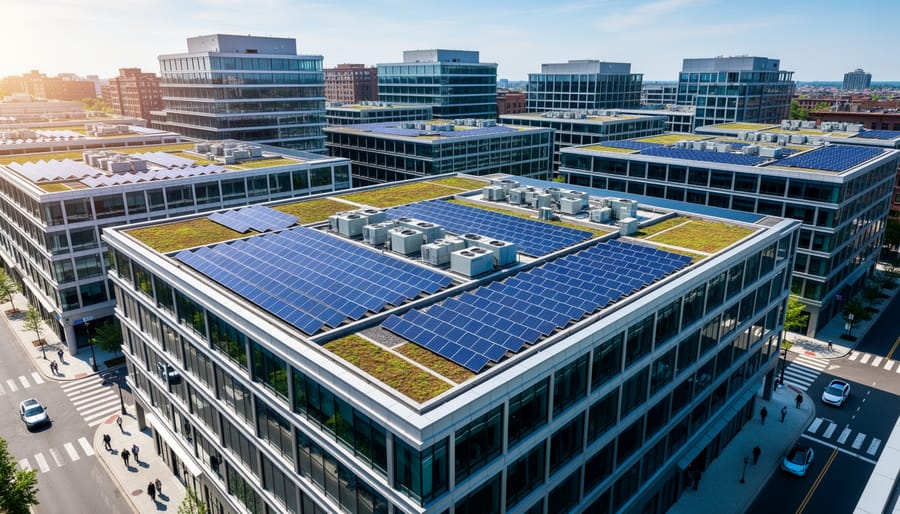
The International Energy Conservation Code (IECC) 2024 represents a significant evolution in solar panel regulations, with key provisions being adopted across jurisdictions throughout 2025. These updates establish comprehensive solar-ready requirements for new commercial and residential construction, positioning buildings for future renewable energy integration while maintaining cost-effectiveness during initial development.
The updated code mandates specific rooftop design considerations for buildings with suitable solar exposure. New construction must incorporate designated solar zones—unshaded roof areas that meet minimum size requirements based on building footprint. These zones must remain free from obstructions including HVAC equipment, vents, and architectural features that would compromise future photovoltaic installations.
Structural load considerations form a critical component of the 2025 requirements. Building designs must account for additional dead loads of 3-5 pounds per square foot in designated solar zones, ensuring roof structures can support panel installations without costly reinforcement. This forward-thinking approach prevents the significant retrofitting expenses many existing buildings face when adding solar capacity.
Electrical infrastructure mandates require buildings to include dedicated pathways from solar zones to electrical service panels. This includes conduit installations, panel capacity allocations, and appropriate wiring specifications. While buildings need not install actual solar systems immediately, the infrastructure preparation reduces future installation costs by 15-30 percent according to industry estimates.
These provisions create measurable value for property owners, whether planning immediate solar deployment or preserving future flexibility as energy costs and technology evolve.
State and Local Variations
Implementation of 2025 building codes varies significantly across jurisdictions, with several states adopting progressive solar-ready provisions that exceed federal baselines. California continues to lead with Title 24 requirements mandating photovoltaic systems on most new commercial buildings, while states like New York, Massachusetts, and Washington have introduced enhanced solar-ready infrastructure standards through their energy conservation codes.
Commercial-focused jurisdictions demonstrate diverse approaches to compliance requirements. Florida’s code amendments prioritize structural reinforcement for panel installation in hurricane-prone zones, whereas Colorado emphasizes electrical infrastructure capacity in warehouse and distribution centers. Texas has implemented tiered requirements based on building size, with facilities exceeding 50,000 square feet facing more stringent solar-ready specifications.
Several municipalities have established accelerated timelines, with jurisdictions like San Francisco and Seattle requiring immediate compliance rather than phased adoption. These variations create opportunities for forward-thinking facility managers to exceed minimum standards in anticipation of future regulatory tightening. Understanding your local jurisdiction’s specific implementation timeline and technical requirements enables strategic planning and potential cost savings through early adoption.
Solar-Ready vs. Solar-Installed: Understanding the Difference
Solar-Ready Infrastructure Requirements
The 2025 building codes establish specific technical requirements for solar-ready infrastructure that property owners must understand to ensure compliance. These specifications create a foundation for future solar installations while maintaining cost-effectiveness during initial construction.
Conduit pathways represent a primary requirement, mandating continuous runs from designated solar zones on rooftops to the main electrical service panel. These pathways must accommodate future wiring without requiring structural modifications. The International Residential Code specifies minimum conduit sizing based on building square footage, typically ranging from 1.5 to 2 inches in diameter for commercial applications.
Panel board capacity requirements ensure electrical systems can accommodate solar integration. Main service panels must include reserved space for a minimum 40-amp dual-pole circuit breaker, clearly labeled “For Future Solar Electric.” The panel’s total bus rating must support the additional load, often requiring upgrades from 200-amp to 225-amp service in existing structures undergoing major renovations.
Roof access provisions mandate pathways measuring at least 36 inches wide from roof edges to designated solar zones, enabling safe equipment installation and maintenance. Load-bearing calculations must demonstrate capacity for an additional 5 pounds per square foot to support photovoltaic arrays and mounting systems.
Documentation requirements include permanent labeling of all solar-ready components, submission of electrical service panel specifications, and as-built drawings showing conduit routing. Facility managers should maintain these records for future contractors, reducing installation costs by an estimated 15 to 25 percent when solar deployment occurs.
The Business Case for Going Solar-Installed
Installing solar during construction delivers quantifiable financial advantages compared to retrofitting systems later. Industry data demonstrates that integrating photovoltaic arrays during the build phase reduces installation costs by 15-25% through consolidated labor, streamlined permitting, and optimized structural integration. These savings stem from coordinating electrical infrastructure, roof penetrations, and equipment mounting during construction when trades are already mobilized on-site.
The return on investment timeline accelerates significantly with immediate energy offset. A 500kW commercial system installed during construction typically achieves payback within 4-6 years, compared to 6-8 years for retrofitted installations. Buildings begin generating energy credits from day one of operation, eliminating the ramp-up period where occupancy costs accumulate without offsetting production.
Labor efficiency represents another critical advantage. Coordinating solar installation with construction eliminates duplicate site mobilization, scaffolding, and roof access costs. Building teams can integrate conduit runs, inverter locations, and electrical panel upgrades seamlessly into the construction schedule. This integration reduces project timeline extensions and minimizes operational disruptions that plague retrofit projects.
The comprehensive commercial solar benefits extend beyond installation savings to include enhanced asset valuation and reduced operating expenses from the first month of occupancy.
Impact on Commercial Construction Projects
New Construction Requirements
The 2025 building codes introduce distinct requirements for new commercial construction that vary by building type and jurisdiction. Most notably, warehouse facilities exceeding 50,000 square feet in states like California, Colorado, and Massachusetts must incorporate solar-ready infrastructure during initial construction. This mandate includes structural reinforcement to support photovoltaic panel loads, typically requiring an additional 3-5 pounds per square foot capacity, and pre-installed conduit pathways from roof areas to designated electrical rooms.
Office buildings and retail centers face similar requirements, though thresholds differ. New office construction over 25,000 square feet must include solar-ready specifications in compliance jurisdictions, while retail facilities generally trigger requirements at 15,000 square feet. These mandates add approximately $0.75-$1.50 per square foot to initial construction costs, translating to $37,500-$75,000 for a 50,000 square foot facility.
Industrial buildings present unique considerations due to rooftop equipment loads and operational requirements. Code compliance typically requires dedicated roof zones for solar infrastructure, separate from HVAC and manufacturing equipment areas. Forward-thinking developers are discovering that addressing these requirements during initial design phases costs 40-60% less than retrofitting.
The financial impact extends beyond construction costs. A manufacturing facility in Denver implementing solar-ready requirements during 2024 construction invested an additional $85,000 upfront. However, when they activated solar installation eighteen months later, they avoided $340,000 in retrofit costs and began generating 450 kW of power, reducing annual energy expenses by $62,000. This real-world application demonstrates how compliance requirements create strategic opportunities rather than mere regulatory burdens for commercial property stakeholders.
Major Renovations and Retrofits
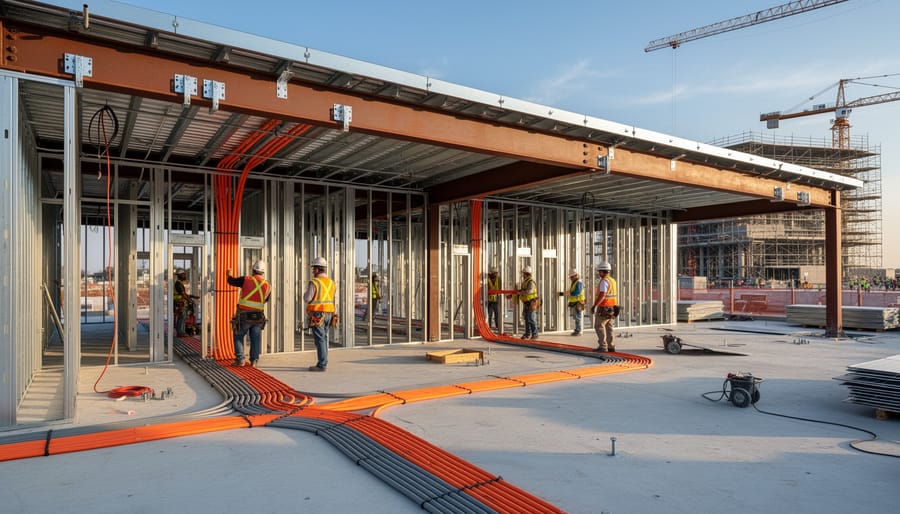
Understanding when renovations trigger solar-ready requirements is essential for strategic project planning and budget management. The 2025 building codes specify that substantial alterations to existing commercial buildings may activate compliance requirements, particularly when projects involve roof replacement, structural modifications, or major electrical system upgrades.
The threshold for triggering these requirements typically occurs when renovation costs exceed 50 percent of the building’s assessed value, though this varies by jurisdiction. Facility managers planning roof replacements should note that this common maintenance activity frequently activates solar-ready mandates, requiring conduit installation, structural load verification, and designated electrical space allocation even if immediate solar installation is not planned.
Real-world applications demonstrate the strategic advantage of proactive compliance. A 150,000-square-foot warehouse in California planned a routine roof replacement estimated at $450,000. By incorporating solar-ready infrastructure during the renovation at an additional cost of $35,000, the facility positioned itself for a future photovoltaic installation that will reduce energy costs by approximately $85,000 annually. The incremental investment proved significantly more cost-effective than retrofitting after roof completion.
Government officials and business owners should conduct pre-renovation assessments to determine whether planned improvements will trigger code requirements. This evaluation should include structural engineering analysis to confirm roof load capacity, electrical infrastructure review, and zoning compliance verification. Early identification allows for integrated project planning, avoiding costly post-construction modifications and maximizing potential energy savings. Working with qualified solar consultants during the design phase ensures compliance while optimizing long-term return on investment.
Cost Implications: Compliance Now vs. Retrofitting Later
Initial Investment Breakdown
Solar-ready infrastructure implementation during the construction phase represents a strategic investment that typically accounts for 1-3% of total building costs. For a standard commercial facility valued at $2 million, this translates to approximately $20,000-$60,000 in additional upfront expenses.
The breakdown includes several key components: electrical conduit runs from the roof to designated equipment areas averaging $8,000-$15,000, main service panel upgrades with additional capacity costing $5,000-$12,000, and structural roof assessments with reinforcement documentation ranging from $3,000-$8,000. Dedicated electrical room space allocation and wiring pathways add another $4,000-$10,000, while engineering design and permitting documentation typically requires $2,000-$5,000.
Real-world applications demonstrate significant cost advantages when compared to retrofitting existing structures. A 2024 case study involving a 45,000-square-foot warehouse in California showed that incorporating solar-ready infrastructure during initial construction cost $42,000, while similar retrofitting on a comparable building exceeded $120,000 due to structural modifications, additional labor, and operational disruptions.
These initial investments provide immediate compliance with 2025 code requirements while preserving future flexibility. Building owners gain the ability to deploy solar systems when financial conditions optimize, whether through improved technology costs, favorable incentive programs, or enhanced utility rate structures, without incurring substantial retrofit expenses.
Retrofit Cost Comparison
A commercial distribution center in Phoenix provides compelling insight into the financial impact of retrofit decisions. The 185,000-square-foot facility, constructed in 2019 without solar-ready infrastructure, recently required a solar installation to meet corporate sustainability targets and reduce operational costs.
The retrofit process revealed significant cost premiums across multiple categories. Structural engineering assessments added $47,000 to determine roof load capacity—an expense avoided when solar-ready provisions are incorporated during initial design. The facility required $125,000 in electrical infrastructure upgrades, including panel replacements and conduit installation through occupied spaces. These modifications necessitated temporary operational disruptions, resulting in an estimated $83,000 in productivity losses and logistics complications.
Labor costs escalated substantially due to retrofit complexity. Installing conduit pathways and electrical connections in an active facility required premium rates for after-hours work and specialized coordination. The total installation cost reached $892,000, representing a 410% increase compared to the $215,000 estimated cost had solar-ready infrastructure been included during original construction.
The comparison extends beyond immediate expenses. The retrofit timeline stretched to 11 months versus an estimated 4-month installation period with proper pre-wiring. Additionally, the facility incurred ongoing opportunity costs, foregoing approximately $34,000 in monthly energy savings during the extended timeline.
This case demonstrates how initial cost avoidance creates substantially higher long-term expenditures. Facility managers and developers evaluating 2025 building code compliance should recognize that solar-ready infrastructure represents strategic financial planning rather than discretionary spending.
Strategic Planning for Business Owners
Timeline Considerations
Engaging solar professionals early in the building design process is critical for compliance and cost optimization. For new construction projects subject to 2025 solar-ready mandates, initiate consultations with qualified solar installers during the preliminary design phase, ideally 6-9 months before breaking ground. This timing allows solar considerations to be integrated into structural, electrical, and roofing designs, avoiding costly modifications later.
Permit timelines vary by jurisdiction but typically require 4-8 weeks for solar installations. Commercial projects often face additional review periods for utility interconnection agreements, which can extend timelines by 30-60 days. Facility managers should account for these windows when coordinating construction schedules.
Effective coordination with general contractors requires clear communication about roof load requirements, conduit pathways, and electrical panel capacity. Establish a collaborative framework where solar contractors participate in regular project meetings alongside your general contractor, structural engineer, and architect. This integrated approach prevents conflicts between building systems and ensures solar infrastructure is properly incorporated from the foundation up.
For retrofit projects on existing buildings, engage solar professionals at least 90 days before planned installations to allow adequate time for structural assessments, energy audits, and permit processing. This proactive timeline prevents project delays and ensures seamless integration with your facility’s operational requirements.
Incentives and Financing Opportunities
The financial landscape in 2025 presents compelling opportunities for property owners who choose to install solar systems rather than simply meeting solar-ready requirements. Federal tax credits through the Investment Tax Credit (ITC) remain available at 30% for commercial solar installations, providing substantial upfront cost reduction. Additionally, accelerated depreciation through the Modified Accelerated Cost Recovery System (MACRS) allows businesses to recover solar investments more quickly, typically within five years.
Many states complement these federal programs with their own solar energy incentives, including performance-based incentives, sales tax exemptions, and property tax abatements. These combined benefits can reduce the effective cost of commercial solar installations by 40-50%, significantly improving return on investment timelines.
For businesses constructing new facilities, the timing is particularly advantageous. Installing solar during initial construction eliminates retrofit costs and allows immediate capitalization of all available incentives. This strategic approach transforms code compliance from a minimum requirement into a value-generating investment that reduces operating costs while enhancing property value and sustainability credentials.

Working with Solar Professionals During Design Phase
Engaging commercial solar professionals during the design phase represents a strategic advantage that extends well beyond simple code compliance. When architects, general contractors, and solar specialists collaborate from project inception, they identify cost-saving opportunities and design optimizations that become exponentially more expensive to implement later in the construction timeline.
Solar providers bring specialized expertise in electrical load analysis, structural engineering requirements, and utility interconnection protocols that most design teams encounter infrequently. This knowledge proves particularly valuable when navigating the 2025 building code revisions, which introduce updated wiring specifications, conduit pathways, and roof load requirements specific to photovoltaic installations. A commercial solar partner can specify exact electrical panel capacities, inverter locations, and dedicated circuit pathways that satisfy both current needs and future expansion possibilities.
Early collaboration also prevents costly redesigns. For instance, a recent mixed-use development in California reduced project costs by 18 percent when solar engineers participated in initial architectural reviews. They identified optimal roof orientations, specified structural reinforcements during the foundation phase rather than through expensive retrofits, and coordinated mechanical systems placement to maximize usable roof area for panels. The building ultimately achieved 40 percent greater solar capacity than initially projected.
Furthermore, experienced solar professionals understand regional utility requirements and incentive program timelines that influence project economics. They can structure systems to qualify for accelerated depreciation schedules, navigate local permitting nuances, and ensure designs meet both minimum code requirements and optimal performance standards. This comprehensive approach transforms solar-ready compliance from a regulatory checkbox into a strategic investment that delivers measurable returns while positioning facilities for long-term energy resilience and operational cost reduction.
The 2025 building code updates represent far more than a compliance checkbox for commercial property owners and facility managers. These code changes mark a pivotal shift in how we approach energy infrastructure, presenting a strategic opportunity to enhance property value, reduce long-term operational costs, and position your facilities ahead of the market curve.
Forward-thinking organizations that embrace proactive planning will gain significant competitive advantages. Properties equipped with solar-ready infrastructure become more attractive to environmentally conscious tenants, command premium valuations, and avoid the costly retrofitting expenses that late adopters will inevitably face. The financial case is compelling: early implementation allows you to capitalize on current incentive programs, lock in favorable financing terms, and begin realizing energy cost savings sooner.
Rather than viewing these code changes as regulatory burdens, successful facility managers and business owners recognize them as catalysts for strategic energy planning. By engaging qualified professionals now, conducting thorough site assessments, and developing phased implementation strategies, you can transform compliance requirements into measurable business advantages. The organizations that act decisively today will establish themselves as industry leaders in sustainability and operational efficiency, setting the standard for commercial property management in the evolving energy landscape.