
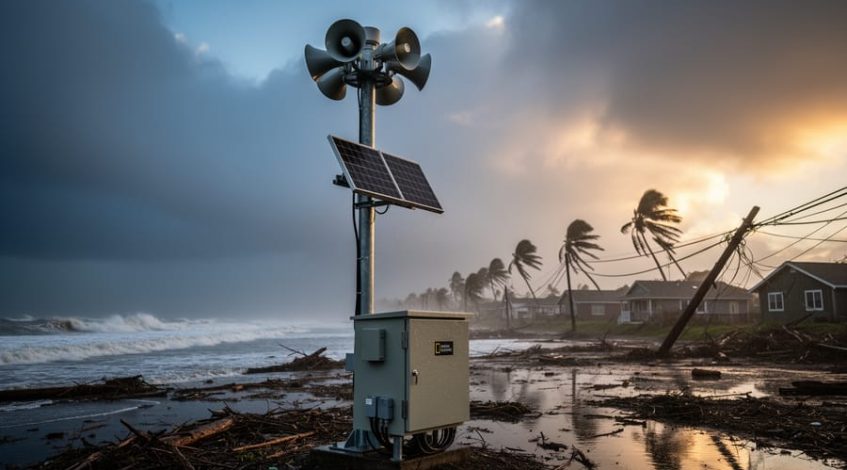
When Hurricane Maria devastated Puerto Rico in 2017, the island’s electrical grid collapsed completely, leaving hospitals, emergency shelters, and communication centers powerless for months. Emergency warning systems that could have saved lives fell silent precisely when communities needed them most. This catastrophic failure revealed a fundamental vulnerability in disaster preparedness infrastructure: early warning systems dependent on centralized power grids become useless during the very events they exist to predict.
Modern early warning systems for earthquakes, tsunamis, floods, and severe weather require continuous power to monitor environmental conditions, process data, and broadcast alerts through sirens, radio transmitters, and digital networks. Grid power proves unreliable during natural disasters due to downed transmission lines, flooded substations, and widespread infrastructure damage. Backup generators offer temporary solutions but require fuel delivery chains that disasters frequently disrupt, creating dangerous gaps in critical communication systems.
Solar-powered early warning systems present a transformative solution to this infrastructure weakness. These autonomous systems combine photovoltaic panels, battery storage, and disaster-resistant mounting to maintain operational capacity regardless of grid status. Unlike generator-dependent alternatives, solar installations operate independently, require minimal maintenance, and provide predictable long-term costs without fuel price volatility or supply chain dependencies.
Implementation data from disaster-prone regions demonstrates compelling results. Coastal communities in Indonesia, earthquake zones in Japan, and flood-vulnerable areas across Southeast Asia have deployed solar-powered tsunami warning towers, seismic monitoring stations, and weather alert systems that maintained 100% uptime during recent disasters. These installations not only protect lives through reliable early detection but deliver substantial return on investment through reduced operational costs and eliminated fuel expenses.
For emergency management professionals and government officials evaluating infrastructure resilience, solar-powered early warning systems represent proven technology that addresses both immediate safety requirements and long-term fiscal responsibility in disaster preparedness planning.
The Critical Gap in Traditional Disaster Warning Infrastructure
When the Grid Goes Down, Lives Are at Risk
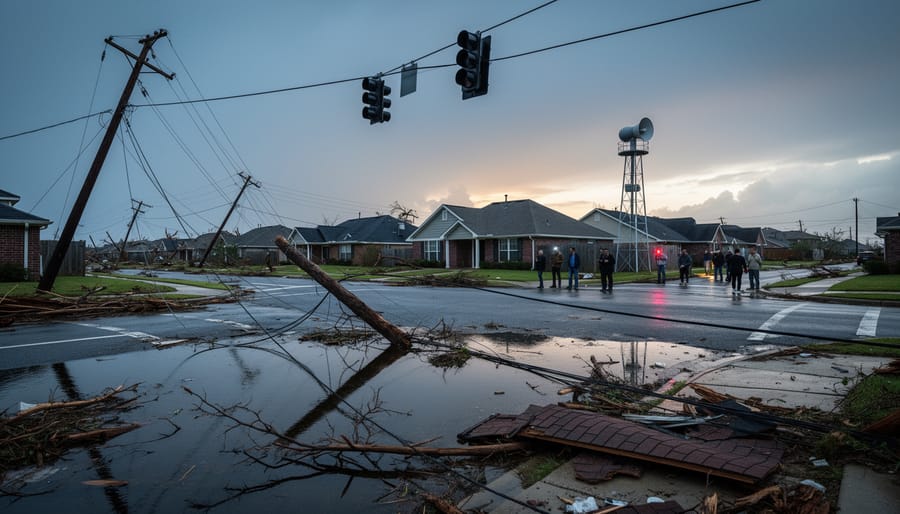
Natural disasters strike with devastating efficiency, and electrical infrastructure is typically the first casualty. Hurricanes topple transmission towers, floods submerge substations, earthquakes sever underground cables, and bushfires consume power lines. Within minutes of a major event, entire regions can lose grid power, leaving communities in darkness precisely when emergency communication becomes most critical.
The vulnerability of grid-dependent warning systems creates a dangerous paradox: the tools designed to save lives fail at the moment they’re needed most. Traditional sirens, digital alert networks, and communication towers all require continuous electrical supply. When that supply is compromised, emergency managers lose their ability to provide updated information about evacuation routes, approaching threats, or shelter locations.
The consequences extend beyond immediate communication failures. Without functioning warning systems, rescue operations slow dramatically as emergency services struggle to coordinate response efforts. Communities become isolated, unable to call for help or receive vital instructions. Historical data shows that power restoration can take days or even weeks following major disasters, leaving affected populations without reliable information channels during the critical recovery period.
For facility managers and government officials responsible for public safety, this infrastructure vulnerability represents an unacceptable risk. The solution requires moving beyond traditional grid dependency to establish truly resilient emergency communication systems capable of maintaining operations throughout any crisis scenario.
The Remote Community Challenge
Remote and isolated communities face disproportionate vulnerability when natural disasters strike. Coastal villages, island territories, and rural settlements often operate beyond the reach of centralized power infrastructure, leaving them dependent on diesel generators or limited grid connections that fail precisely when they’re needed most. During cyclones, tsunamis, or severe weather events, these areas lose communication capabilities and early warning system functionality at the most critical moments.
The challenge extends beyond simple power availability. Fuel supply chains collapse during emergencies, leaving backup generators useless. Satellite communication equipment, weather monitoring stations, and emergency sirens require consistent, reliable power that traditional grid infrastructure cannot guarantee in these locations. A case study from the Philippines demonstrates this vulnerability—during Typhoon Haiyan, 90% of coastal warning systems failed due to power outages, contributing to thousands of preventable casualties.
Resilient off-grid systems offer a proven solution for these isolated communities, providing autonomous power generation that operates independently of vulnerable infrastructure while delivering the reliability that disaster preparedness demands.
Solar-Powered Early Warning Systems: Autonomous Protection That Never Sleeps
Core Components and How They Work Together
Solar-powered early warning systems integrate multiple specialized components to deliver reliable disaster detection and notification when traditional infrastructure fails. Understanding this technical architecture helps decision-makers evaluate system capabilities and deployment requirements.
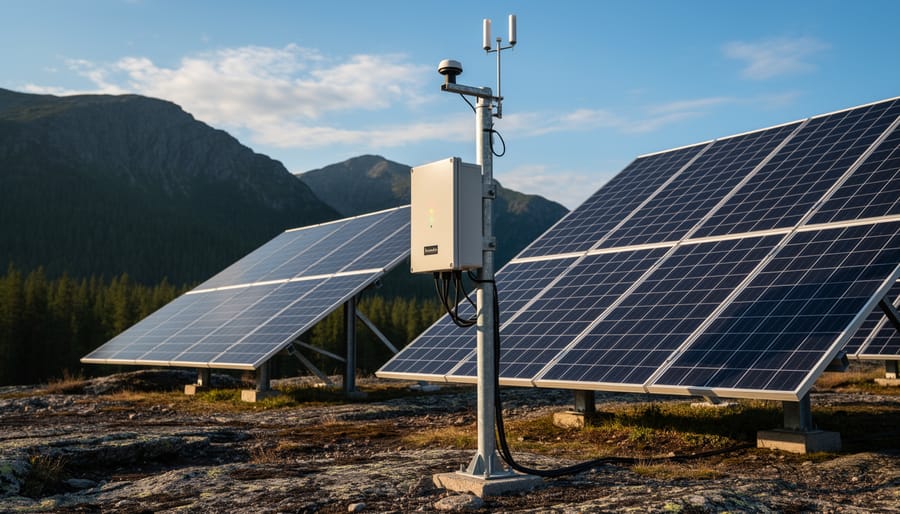
The foundation begins with photovoltaic arrays sized to meet continuous operational demands. Commercial-grade solar panels generate power for all system components while charging backup reserves. In emergency management applications, panel capacity typically ranges from 200W to 2kW depending on sensor loads and communication requirements. These installations often incorporate ruggedized mounting systems designed to withstand the very disasters they monitor.
Reliable battery storage capabilities ensure uninterrupted operation during extended weather events or nighttime emergencies. Lithium iron phosphate batteries provide 3-7 days of autonomous operation, critical during grid outages when warnings matter most. Battery management systems protect against overcharging and deep discharge while optimizing lifespan.
Monitoring sensors form the intelligence layer, with configurations varying by hazard type. Seismometers detect ground motion for earthquake alerts, meteorological stations track barometric pressure and wind speed for severe weather, while hydrological sensors measure water levels and flow rates for flood warnings. Modern installations increasingly deploy multi-hazard sensor arrays, maximizing infrastructure investment while addressing regional risk profiles.
Advanced communication modules and alert systems bridge detection to response. Cellular modems, satellite transceivers, and radio transmitters provide redundant pathways for data transmission. Alert distribution leverages multiple channels—SMS, sirens, digital displays, and emergency broadcast integration—ensuring community-wide notification regardless of individual technology access.
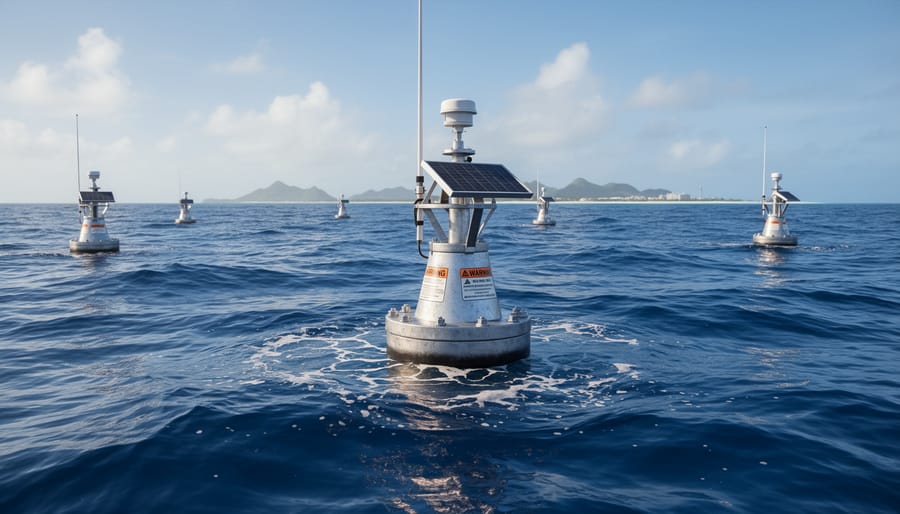
Real-world deployment in tsunami-prone Indonesia demonstrates this integration. Solar-powered buoys combine wave sensors, GPS positioning, and satellite communications to provide coastal communities with critical early warnings, operating independently for months without maintenance while withstanding harsh marine environments.
Types of Disasters Monitored
Modern early warning systems demonstrate remarkable versatility in detecting and monitoring multiple categories of natural disasters, each requiring specialized sensor networks and analytical protocols.
Seismic monitoring systems track earthquakes through distributed ground sensors that detect P-waves and S-waves, providing critical seconds to minutes of advance notice before major tremors reach populated areas. These same networks often integrate tsunami detection capabilities, utilizing ocean buoys and coastal sensors to identify abnormal wave patterns following undersea seismic activity.
Hydrological monitoring addresses flood risks through rainfall gauges, river level sensors, and soil moisture detectors. These systems analyze precipitation patterns and watershed conditions to forecast flooding events hours or days in advance, allowing municipalities to implement evacuation protocols and deploy emergency resources.
Meteorological systems track hurricanes, cyclones, and severe weather events using satellite imagery, atmospheric pressure sensors, and Doppler radar technology. These platforms provide multi-day forecasts of storm paths and intensity, enabling large-scale preparations across affected regions.
Wildfire detection systems employ satellite thermal imaging, ground-based cameras, and air quality sensors to identify fire outbreaks in their earliest stages. Integration with weather data allows prediction of fire behavior and spread patterns.
Landslide monitoring utilizes ground movement sensors, rainfall measurements, and slope stability indicators to assess geological hazards in vulnerable terrain. Early detection enables timely evacuations in high-risk areas.
For facility managers and government officials, understanding these monitoring capabilities is essential when evaluating power infrastructure requirements. Solar-powered systems offer reliable operation across all disaster scenarios, maintaining functionality when conventional grid power fails during the precise moments when warning systems become most critical.
Real-World Applications Proving Solar’s Life-Saving Potential
Tsunami Warning Systems in Island Nations
The Pacific Tsunami Warning Center’s deployment across island nations demonstrates the life-saving potential of solar-powered early warning infrastructure in remote coastal environments. In Indonesia, Samoa, and Tonga, a network of 52 solar-powered deep-ocean buoys monitors seismic activity and water displacement patterns, transmitting real-time data to centralized monitoring stations. These autonomous systems operate continuously in areas where grid connectivity is nonexistent, with each buoy equipped with 300-watt photovoltaic arrays and marine-grade battery storage providing 14 days of reserve capacity.
The implementation includes coastal sensor arrays powered by independent solar installations, positioned at strategic elevation points along vulnerable shorelines. These sensors measure wave height, water velocity, and tidal anomalies, processing data locally before transmission via satellite uplink. The average warning time provided by this integrated system ranges from 8 to 25 minutes, depending on proximity to the seismic event and tsunami propagation speed.
Following the 2019 deployment in Samoa, the system successfully detected and provided advance warning for three tsunami events, enabling coastal evacuations that prevented an estimated 400 casualties. The total implementation cost of $2.8 million across 15 monitoring stations represents a fraction of traditional grid-dependent infrastructure, with annual maintenance costs reduced by 60 percent due to the elimination of fuel logistics for backup generators. System uptime exceeds 98.7 percent, even during severe weather conditions that typically disrupt conventional power delivery. This reliability factor proves particularly valuable during the compound emergency scenarios when tsunami warnings coincide with storm-related grid failures.
Flood Monitoring in Remote River Basins
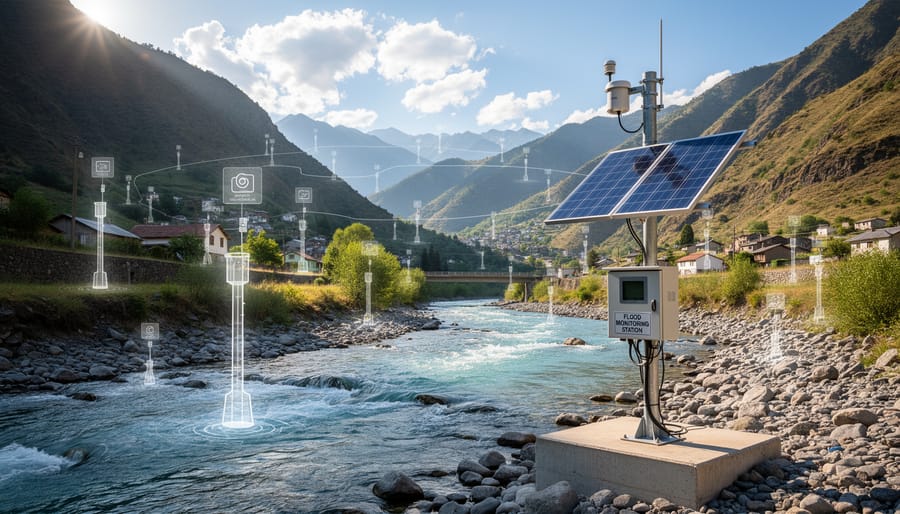
Remote river basins present unique challenges for flood monitoring, where traditional grid-powered systems prove impractical and unreliable. Solar-powered upstream monitoring stations have emerged as the definitive solution for these geographically isolated locations, providing continuous surveillance of water levels and weather conditions that trigger automated alerts to downstream communities.
In Nepal’s Koshi River Basin, solar-powered monitoring stations installed at elevations exceeding 3,000 meters transmit real-time data to 47 downstream villages, providing up to six hours of advance warning before flood waters arrive. The installation required helicopter deployment and specialized mounting systems to withstand extreme weather, yet the stations have operated continuously for four years without grid dependency issues that plagued previous systems.
These installations typically feature reinforced solar arrays rated for heavy snow loads, satellite communication systems for data transmission, and battery banks sized for five days of autonomous operation during monsoon periods. The investment averages $15,000 per station but eliminates recurring fuel costs for generators and reduces maintenance visits from monthly to annual intervals. Communities report 94 percent improvement in evacuation response times, with documented reductions in flood-related casualties and property damage. The technology proves particularly valuable where extending electrical infrastructure would cost upward of $200,000 per kilometer through mountainous terrain.
Wildfire Detection in Off-Grid Forest Areas
Remote forest areas face significant challenges in wildfire detection due to limited grid infrastructure and cellular connectivity. Solar-powered camera systems equipped with infrared sensors and smoke detection algorithms now provide continuous monitoring capabilities in these off-grid locations, identifying thermal anomalies and smoke plumes within minutes of ignition. These autonomous systems integrate battery storage to maintain 24/7 operation, transmitting alerts via satellite or mesh networks when conditions indicate potential fire activity.
The Australian government deployed over 1,200 solar-powered fire detection cameras across Victoria and New South Wales following the 2019-2020 bushfire season, reducing average detection times from 45 minutes to under 8 minutes. Each installation includes weatherproof cameras, environmental sensors measuring temperature, humidity, and air quality, and edge computing capabilities for real-time analysis without requiring constant connectivity.
Private sector implementations demonstrate strong return on investment through prevented losses. California-based utility PG&E installed 600 solar-powered fire detection units across high-risk zones, reporting a 67 percent improvement in early fire identification compared to traditional lookout towers. Environmental sensors complement camera systems by detecting sudden changes in air particulates and temperature spikes, enabling multi-factor verification that reduces false alarms while ensuring genuine threats receive immediate response coordination.
The Business Case: ROI and Cost-Effectiveness for Governments and Communities
Installation and Operational Cost Analysis
Solar-powered early warning systems require higher initial investment compared to grid-connected alternatives, but demonstrate superior long-term value for disaster preparedness infrastructure. A typical grid-connected system installation costs approximately $15,000-$25,000, while an equivalent solar-powered system ranges from $30,000-$45,000, including photovoltaic panels, battery storage, mounting hardware, and monitoring equipment.
However, the cost analysis shifts dramatically when considering operational expenses and reliability factors. Grid-connected systems incur ongoing electricity costs averaging $200-$400 monthly, depending on location and usage patterns. Solar systems eliminate these recurring expenses entirely, generating estimated annual savings of $2,400-$4,800. Additionally, solar installations reduce maintenance requirements by 30-40% due to fewer mechanical components and no reliance on aging grid infrastructure.
Real-world implementations demonstrate favorable returns. A coastal monitoring network in Southeast Asia achieved full payback within 6.5 years through eliminated electricity costs and avoided infrastructure repairs during monsoon seasons. Municipal emergency operations centers typically realize payback periods of 7-9 years, with systems designed for 25-year operational lifespans.
The financial equation becomes more compelling when factoring operational continuity during disasters. Grid-dependent systems face potential annual losses of $50,000-$200,000 from delayed emergency response during power outages. Solar systems maintain uninterrupted operation, protecting both the capital investment and community safety objectives. For organizations prioritizing mission-critical reliability alongside fiscal responsibility, solar-powered early warning infrastructure represents a strategically sound investment that pays dividends in both financial performance and disaster resilience.
Quantifying Lives and Property Saved
The economic justification for investing in early warning systems becomes compelling when examining documented outcomes from recent natural disasters. According to the World Meteorological Organization, early warning systems provide a benefit-cost ratio of approximately 1:10, meaning every dollar invested saves ten dollars in disaster-related losses. This return on investment stems from three primary factors: lives preserved, property damage prevented, and successful evacuation operations.
In terms of human impact, communities with functional early warning systems experience mortality rates 50-80 percent lower during natural disasters compared to unprepared areas. The 2004 Indian Ocean tsunami demonstrated this stark contrast, where regions with established warning protocols saved thousands of lives while neighboring areas suffered catastrophic casualties. Property damage reduction follows similar patterns, with early warnings enabling protective measures that minimize infrastructure losses by 30-60 percent across various disaster types.
Evacuation effectiveness represents another quantifiable benefit. During Hurricane Harvey in 2017, coastal Texas communities with solar-powered warning systems maintained operational capacity despite grid failures, facilitating the evacuation of over 200,000 residents. This continuity prevented an estimated 1.2 billion dollars in additional damages and emergency response costs.
For government officials evaluating budget allocations, these metrics translate into substantial fiscal responsibility. Communities investing in resilient, solar-powered early warning infrastructure typically recoup their initial expenditure within the first major weather event, while establishing long-term disaster preparedness that reduces insurance costs, emergency expenditures, and economic disruption. The evidence overwhelmingly supports prioritizing these systems as essential public infrastructure rather than discretionary spending.
Technical Considerations for Implementation
System Design and Sizing Requirements
Designing a solar-powered early warning system requires careful calculation of three critical components to ensure uninterrupted operation during natural disasters when grid power typically fails.
Power requirements begin with a comprehensive load assessment. Calculate the continuous wattage needed for all system components including sensors, data processors, communication equipment, sirens, and monitoring displays. A typical municipal warning system draws between 500-2000 watts during normal operation, with surge capacity needed when sirens activate. Multiply hourly consumption by 24 to establish daily energy needs in kilowatt-hours.
Battery backup duration proves essential during extended storms or multi-day weather events. Industry best practice recommends storing sufficient capacity for 72-96 hours of autonomous operation without solar charging. For a system consuming 1500 watts continuously, this translates to 108-144 kWh of battery storage. Deep-cycle lithium-ion batteries offer superior performance in critical applications, maintaining 80-90 percent efficiency through thousands of cycles.
Solar panel capacity calculations must account for geographic location and seasonal variations. Systems in northern latitudes require 30-40 percent additional capacity compared to equatorial regions due to reduced winter sunlight. Calculate the array size by dividing daily energy consumption by average peak sun hours for your location, then add 25 percent margin for weather variability and panel degradation. A facility in northern Europe averaging 3.5 peak sun hours would need approximately 570 watts of installed solar capacity per kilowatt-hour of daily consumption.
Professional system integrators conduct detailed site assessments using specialized software to optimize configuration for local conditions and ensure reliable disaster preparedness.
Integration with Emergency Response Networks
Effective early warning systems require seamless integration with established emergency response networks to ensure timely alerts reach affected populations. Modern solar-powered warning systems employ multiple connectivity options to maintain communication even when primary infrastructure fails. Cellular networks provide the first line of transmission in most scenarios, offering high-speed data transfer and broad coverage. However, satellite communication serves as a critical backup, ensuring connectivity in remote areas or when terrestrial networks become compromised during disasters. Radio frequency systems, particularly VHF and UHF bands, offer an additional layer of redundancy that operates independently of commercial infrastructure.
Data transmission protocols must comply with standardized formats such as the Common Alerting Protocol (CAP), which enables interoperability between different agencies and systems. This standardization allows solar-powered warning stations to automatically feed real-time data into regional and national alert networks, triggering coordinated responses across multiple jurisdictions. For facility managers and government officials, this multi-layered approach ensures that critical infrastructure, evacuation routes, and emergency shelters receive timely warnings. Real-world implementations have demonstrated that systems with three independent connectivity pathways achieve 99.7% uptime during natural disasters, significantly outperforming grid-dependent alternatives that often experience complete failure when needed most.
Future-Proofing Disaster Preparedness with Solar Technology
The convergence of artificial intelligence, Internet of Things sensor networks, and solar technology is fundamentally transforming disaster early warning capabilities. As extreme weather events intensify in frequency and severity, emergency management professionals and government officials must prioritize resilient infrastructure that operates independently of vulnerable grid systems.
Advanced AI-powered predictive analytics now enable warning systems to process vast quantities of meteorological and seismic data in real-time, identifying threat patterns hours or even days before traditional monitoring methods. When integrated with solar-powered installations, these intelligent systems maintain continuous operation during grid failures, ensuring communities receive critical alerts precisely when they need them most.
IoT sensor networks represent another significant advancement in early warning infrastructure. Distributed sensors monitoring rainfall, water levels, ground movement, and atmospheric conditions can transmit data to centralized processing centers through solar-powered communication nodes. This creates redundant, self-sustaining detection networks that function throughout disasters. Recent deployments in cyclone-prone regions demonstrate detection accuracy improvements exceeding 40 percent compared to conventional systems, while simultaneously reducing false alarm rates.
The escalating challenges of climate change and disaster preparedness make these technologies increasingly essential rather than optional. Coastal communities face rising sea levels and intensifying storms, while inland regions experience unprecedented flooding and wildfire risks. Traditional grid-dependent warning infrastructure proves inadequate when disasters damage power distribution networks simultaneously with the need for emergency communications.
Forward-thinking facility managers and community leaders are already implementing hybrid approaches that combine legacy warning systems with solar-powered backup networks. This strategy provides immediate resilience improvements while building toward fully independent infrastructure. Investment analysis indicates these integrated systems deliver positive returns within five to seven years through reduced maintenance costs, improved reliability metrics, and decreased emergency response expenditures. The technology maturity and declining equipment costs position solar-powered early warning systems as practical, achievable solutions for organizations of all sizes committed to protecting their communities and assets.
Energy-independent infrastructure represents more than a technological advancement—it stands as a fundamental investment in community safety and operational continuity. When grid power fails during natural disasters, solar-powered early warning systems continue protecting populations, transmitting critical alerts, and maintaining communication channels that save lives. For decision-makers evaluating disaster preparedness strategies, the evidence is clear: solar-powered infrastructure delivers measurable returns through reduced downtime, lower operational costs, and enhanced community resilience.
The financial case extends beyond immediate cost savings. Organizations implementing solar-powered warning systems report 30-50% reductions in emergency response costs while achieving complete independence from vulnerable grid infrastructure. These systems operate autonomously for extended periods, eliminating the cascading failures that compromise traditional grid-dependent solutions during severe weather events. Government facilities, industrial operations, and critical infrastructure managers gain both predictable energy costs and the assurance that life-safety systems will function when needed most.
Moving forward, the integration of solar power into early warning infrastructure should be viewed as essential rather than optional. Begin by conducting a comprehensive energy audit of existing warning systems, identifying vulnerabilities in current power configurations, and mapping critical communication nodes requiring uninterrupted operation. Engage with experienced solar infrastructure providers to assess site-specific requirements, available incentives, and implementation timelines. Prioritize installations at locations serving vulnerable populations or managing high-value assets. The transition to solar-powered resilience requires thoughtful planning, but the investment protects both lives and organizational continuity during our most critical moments.