

Commercial EV charging integrated with solar power represents one of the most significant opportunities for businesses to reduce operational costs while meeting sustainability goals. Organizations currently allocating substantial budgets to fleet electrification face a critical decision: whether to treat EV charging as an isolated expense or leverage it as part of a comprehensive energy strategy that delivers measurable returns.
The financial case is compelling. Businesses installing solar-powered EV charging infrastructure typically achieve payback periods of 4-7 years, with some operations seeing returns in under three years when factoring in reduced grid dependency, demand charge mitigation, and available incentives. A logistics company in Rotterdam recently reduced their fleet charging costs by 63% after implementing solar integration, while a municipal fleet in Belgium achieved complete energy independence for daytime charging operations within their first operational year.
Smart EV charging technology enables businesses to optimize power distribution between facility operations and vehicle charging based on real-time solar generation, grid pricing, and fleet schedules. This intelligence transforms what could be a significant electrical load into a flexible asset that absorbs excess solar production during peak generation hours and minimizes grid consumption during expensive peak periods.
The convergence of declining solar costs, advancing battery storage solutions, and increasingly sophisticated charge management systems has created ideal conditions for commercial adoption. Forward-thinking organizations are no longer questioning whether to integrate solar with EV charging, but rather how quickly they can deploy these systems to capture competitive advantages. The organizations that act now position themselves to control energy costs for decades while competitors remain vulnerable to grid rate escalation and regulatory pressure to decarbonize operations.
What Makes EV Charging ‘Smart’ in Commercial Solar Applications
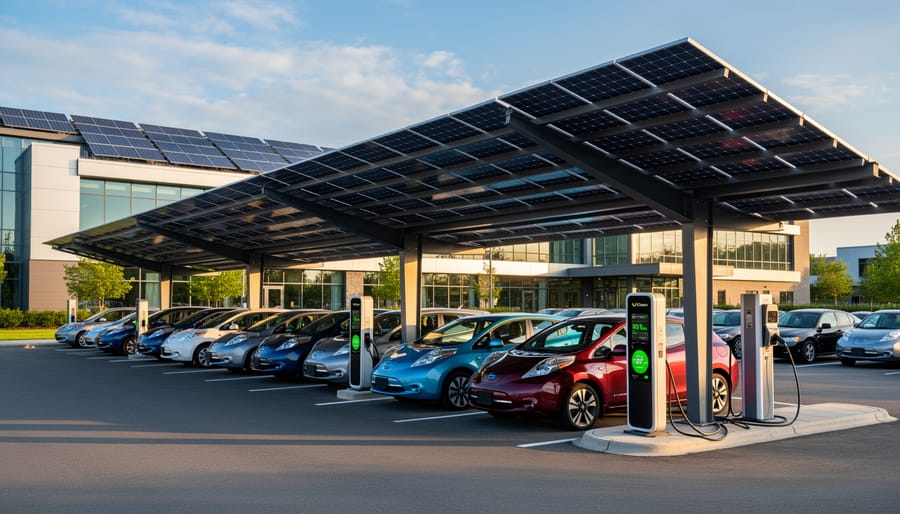
Key Intelligence Features That Maximize Solar Utilization
Modern smart charging systems leverage sophisticated algorithms and real-time data integration to maximize the utilization of solar-generated electricity for EV fleets. These intelligent features transform standard charging infrastructure into dynamic energy systems optimization platforms that deliver measurable cost savings and sustainability benefits.
Solar surplus charging represents the foundational capability, automatically directing excess photovoltaic production to EV batteries before exporting to the grid. The system continuously monitors solar generation against facility consumption, initiating charging sessions when production exceeds demand. This approach ensures maximum self-consumption rates, reducing grid dependency during peak tariff periods.
Time-of-use optimization adds another layer of intelligence by incorporating electricity pricing structures into charging decisions. The system analyzes utility rate schedules and automatically schedules charging during off-peak hours when grid electricity costs less, while prioritizing solar energy when available. For commercial operations, this dual optimization typically reduces charging costs by 40-60 percent compared to unmanaged charging.
Demand response capabilities enable participation in utility programs that provide financial incentives for load flexibility. Smart chargers can temporarily reduce or pause charging during grid stress events, generating revenue while supporting grid stability. Advanced systems automatically balance these curtailment requests against operational requirements to ensure fleet availability.
Predictive algorithms represent the most sophisticated feature, utilizing weather forecasting, historical production data, and fleet schedules to anticipate optimal charging windows. By forecasting tomorrow’s solar generation and vehicle departure times, the system creates charging schedules that maximize renewable energy utilization while guaranteeing vehicles are fully charged when needed. These algorithms continuously learn from operational patterns, improving accuracy and efficiency over time.
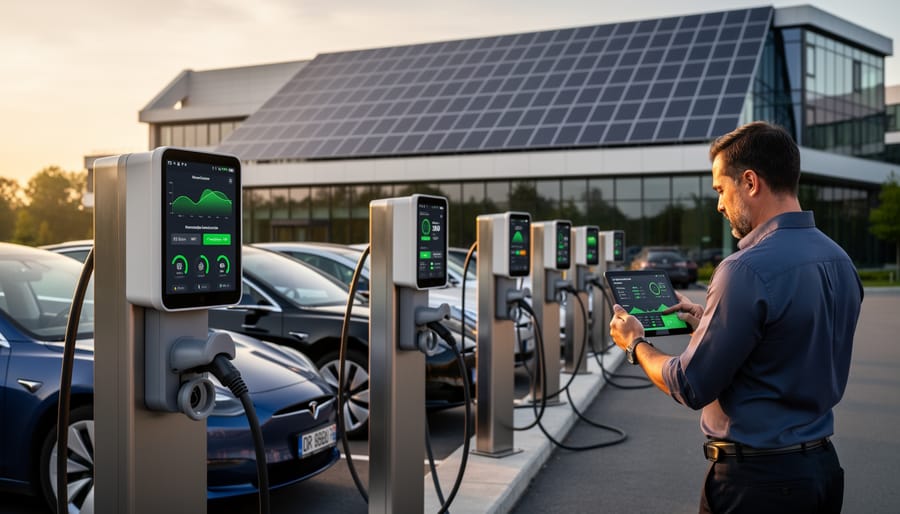
The Business Case: Cost Savings and ROI Analysis
Real-World Cost Reduction: A Commercial Fleet Case Study
GreenLogistics UK, a mid-sized delivery company operating a fleet of 45 electric vans across the Midlands, implemented solar-integrated smart charging at their 12,000-square-foot distribution center in 2022. The company partnered with an energy solutions provider to install a 150kW rooftop solar array combined with intelligent charging infrastructure designed to optimize energy consumption across their entire fleet.
Before implementation, GreenLogistics faced mounting electricity costs, with their EV charging expenses averaging £8,200 monthly during peak operational periods. The facility’s existing grid connection limited their ability to charge multiple vehicles simultaneously during cost-effective off-peak hours, creating operational bottlenecks and exposing them to expensive demand charges.
The solar-integrated smart charging system transformed their operations dramatically. The intelligent charging platform coordinated vehicle charging schedules based on solar generation forecasts, electricity tariff rates, and planned delivery routes. During daylight hours, the system prioritized charging vehicles using solar-generated electricity, while overnight charging was optimized to occur during the lowest tariff periods. Battery storage capacity of 200kWh provided additional flexibility, storing excess solar generation for evening charging sessions.
Within the first year, GreenLogistics achieved a 63 percent reduction in grid electricity purchases for vehicle charging, translating to monthly savings of £5,160. Their total project investment of £185,000 produced an anticipated payback period of 2.9 years, factoring in available government incentives and avoided grid infrastructure upgrade costs.
Beyond direct energy savings, the company experienced significant operational improvements. The smart charging system eliminated previous scheduling conflicts, ensuring vehicles were charged and ready for morning routes. Real-time monitoring capabilities provided fleet managers with unprecedented visibility into energy consumption patterns and vehicle readiness status.
The demand charge reduction proved particularly valuable, as intelligent load management prevented simultaneous high-power draws that previously triggered expensive utility penalties. This optimization alone contributed £1,400 in monthly savings, a benefit the company had not initially anticipated during project planning.
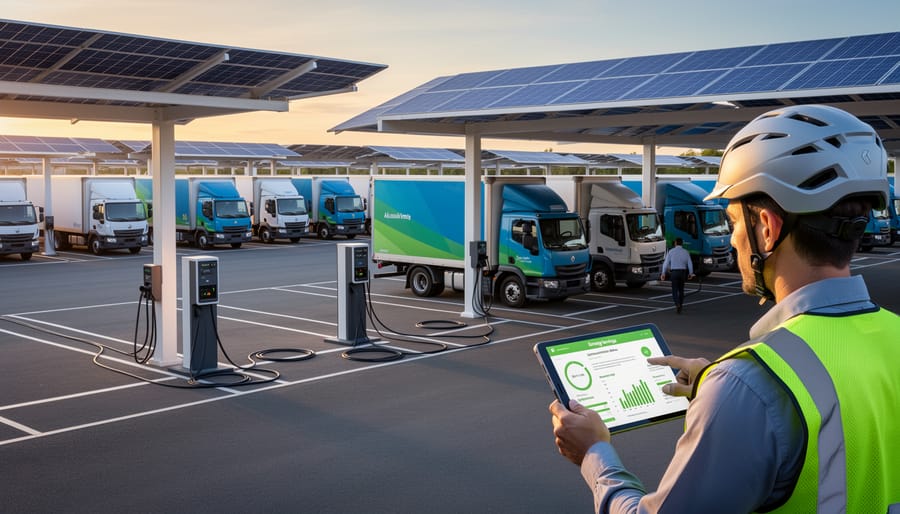
System Design Considerations for Optimal Performance
Sizing Your Solar Array for EV Charging Demands
Accurately sizing your solar array for EV charging demands requires a systematic approach that balances current needs with future scalability. Begin by conducting a comprehensive energy audit of your facility to establish baseline consumption patterns. Document your existing fleet size, average daily mileage per vehicle, and charging frequency. Most commercial EVs require 20-30 kWh per 100 miles traveled, providing a foundation for calculating daily energy requirements.
Analyze your charging patterns throughout the day and week to identify peak demand periods. This temporal analysis reveals whether your fleet charges primarily during business hours, overnight, or across mixed schedules. Facilities with daytime charging patterns benefit from direct solar-to-vehicle energy transfer, maximizing cost savings, while overnight charging operations require robust battery storage integration.
Calculate your minimum solar capacity by multiplying your daily EV charging demand by 1.25 to account for system inefficiencies and weather variability. For example, a fleet requiring 500 kWh daily for EV charging should target a 625 kWh minimum solar production capacity. Factor in your facility’s broader energy profile, including HVAC, lighting, and operational equipment, to determine whether a unified system or dedicated EV charging array better serves your needs.
Address seasonal variations by reviewing historical solar production data for your geographic location. Winter months typically yield 40-60 percent less solar output than summer peaks, necessitating either grid supplementation or oversized arrays to maintain year-round charging reliability.
Build growth capacity into your design by sizing arrays for 120-150 percent of current demand, accommodating fleet expansion and increasing electrification trends. This forward-thinking approach prevents costly retrofits and positions your operation for long-term sustainability. Real-world applications demonstrate that commercial facilities planning for five-year growth trajectories achieve superior return on investment compared to minimum-viable installations.
Battery Storage: When It Makes Financial Sense
Adding battery storage systems to solar-integrated EV charging infrastructure presents compelling financial advantages in specific scenarios, though the investment requires careful evaluation against operational needs.
The primary value proposition centers on demand charge reduction and time-of-use optimization. For facilities facing high demand charges—often representing 30-50% of commercial electricity bills—batteries can shave peak loads by storing solar energy and discharging during charging events. This strategic load management delivers ROI improvement of 15-25% compared to solar-only installations in high-demand-charge environments.
Battery storage proves particularly cost-effective when grid capacity constraints would otherwise require expensive utility infrastructure upgrades. A distribution center in Queensland avoided $180,000 in grid connection fees by implementing 200 kWh of storage alongside their solar array, with the battery system achieving payback within 4.5 years through combined infrastructure avoidance and energy arbitrage.
Time-of-use arbitrage creates another revenue stream, especially in regions with significant peak-to-off-peak pricing differentials. Facilities can charge batteries during low-cost periods and discharge during expensive peak windows, generating savings of $8,000-$15,000 annually per 100 kWh of capacity.
However, storage may not justify its premium in scenarios with minimal demand charges, flat-rate electricity pricing, or consistent daytime charging patterns that align well with solar generation. Conducting a comprehensive load analysis and financial modeling exercise before committing to battery integration ensures alignment between capital expenditure and measurable operational benefits.
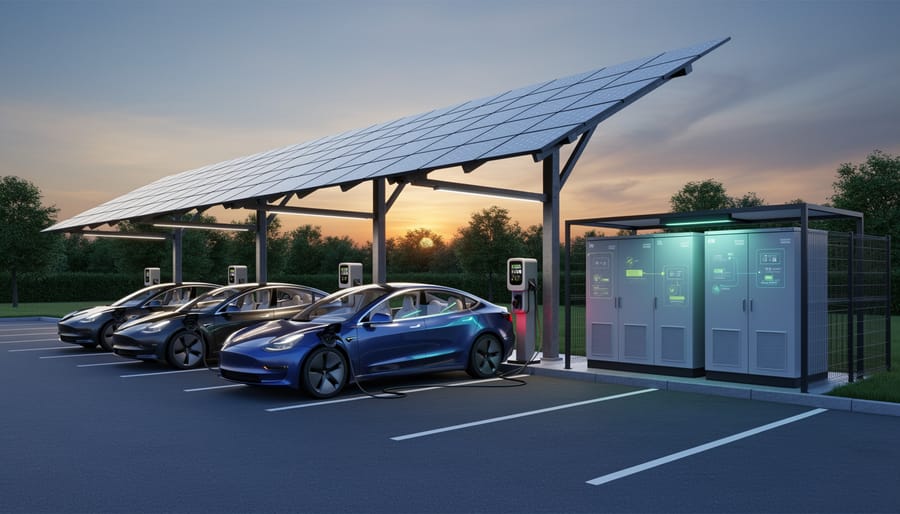
Grid Services and Revenue Opportunities
Smart EV charging systems integrated with solar installations unlock significant opportunities for participating in energy markets and generating additional revenue beyond simple operational cost savings. By strategically managing when and how electric vehicles charge, commercial facilities can transform their EV fleets into valuable grid assets while maximizing renewable energy utilization.
Demand response programs represent one of the most accessible revenue opportunities. These programs compensate businesses for reducing electricity consumption during peak demand periods. Smart charging systems automatically adjust EV charging schedules in response to grid signals, shifting power-intensive charging to off-peak hours or times of high solar production. Many utilities and grid operators offer substantial financial incentives for this flexibility, with commercial participants earning hundreds to thousands of dollars annually depending on fleet size and program structure.
Vehicle-to-grid technology enables bidirectional power flow, allowing EV batteries to discharge electricity back to the facility or grid during high-demand periods. When paired with solar arrays, this creates a dynamic energy storage ecosystem. Facilities can store excess solar generation in vehicle batteries during midday production peaks, then utilize that stored energy during evening demand peaks or sell it back to the grid at premium rates. This capability becomes particularly valuable in regions with time-of-use rates or capacity charge structures.
Frequency regulation services offer another revenue stream for larger commercial operations. Grid operators need rapid response resources to maintain power quality and system stability. Smart charging systems equipped with appropriate controls can respond within milliseconds to frequency signals, providing balancing services that command premium compensation rates in wholesale energy markets.
Real-world implementation demonstrates tangible results. A California logistics company with 50 electric delivery vehicles and a 500kW solar array generates approximately $45,000 annually through demand response participation and energy arbitrage, reducing their total energy costs by an additional 18 percent beyond direct solar savings. The system automatically optimizes charging schedules based on solar production forecasts, grid conditions, and delivery route requirements, ensuring operational needs remain uncompromised while maximizing financial returns.
Implementation Roadmap for Commercial Facilities
Incentives and Financing Options
Implementing charge smart EV infrastructure paired with commercial solar systems qualifies for substantial financial incentives that significantly improve project economics. At the federal level, the Investment Tax Credit (ITC) currently allows businesses to claim 30% of solar installation costs, while the Alternative Fuel Vehicle Refueling Property Credit provides up to $100,000 per charging station location. These credits directly reduce tax liability, accelerating payback periods and enhancing return on investment.
State-level programs vary considerably but often include additional rebates, expedited permitting, and property tax exemptions for renewable energy installations. Many jurisdictions offer specific incentives for solar-integrated EV charging infrastructure, recognizing its dual environmental benefits. California’s Self-Generation Incentive Program and New York’s Charge Ready NY program exemplify state initiatives that subsidize both equipment costs and installation expenses.
Utility companies increasingly provide demand response incentives and reduced rate structures for businesses that install smart charging systems capable of load shifting. Time-of-use rates combined with solar generation create optimal conditions for cost-effective EV charging operations.
For organizations concerned about capital requirements, multiple financing models eliminate upfront barriers. Power Purchase Agreements (PPAs) enable businesses to adopt solar-integrated charging infrastructure with zero initial investment, paying only for electricity generated at predictable rates below grid pricing. Energy-as-a-Service models bundle equipment, installation, maintenance, and monitoring into manageable operational expenses. Additionally, commercial Property Assessed Clean Energy (PACE) financing attaches loan repayment to property tax bills, offering extended terms that align with system lifespans. These structures transform capital expenditures into cash-flow positive investments from day one.
The integration of solar-powered smart EV charging infrastructure represents more than an operational upgrade—it constitutes a strategic positioning for the evolving commercial landscape. Organizations implementing these systems today are establishing competitive advantages that extend across multiple dimensions: operational cost reduction through renewable energy generation, enhanced sustainability credentials that resonate with stakeholders and customers, and future-proofed infrastructure aligned with regulatory trajectories across European markets.
The financial case remains compelling. Facilities achieving 60-70% solar offset ratios demonstrate payback periods of 4-6 years, while benefiting from decades of reduced operational expenses. These economics improve continuously as grid electricity costs rise and renewable technology costs decline. Beyond immediate returns, these installations insulate businesses from energy price volatility while generating measurable progress toward carbon neutrality commitments.
Real-world implementations across logistics operations, commercial fleets, and retail facilities validate both the technical reliability and business impact of integrated systems. Organizations report not only cost savings but also operational benefits including enhanced brand reputation, improved employee satisfaction, and increased customer engagement around sustainability initiatives.
The convergence of smart charging technology with solar generation is no longer experimental—it represents essential infrastructure for competitive commercial operations. The complexity of system design, regulatory compliance, and financial optimization demands professional expertise. A comprehensive site assessment conducted by experienced energy solution providers identifies optimal configurations specific to your operational requirements, energy consumption patterns, and financial objectives. Forward-thinking organizations are moving beyond evaluation to implementation, securing the operational and financial advantages that define market leadership in the sustainable economy.