
The solar industry faces a critical inflection point: as early installations reach end-of-life, businesses must decide whether panels become tomorrow’s waste or today’s competitive advantage. Circular solar arrays—systems designed with complete lifecycle management and manufacturer take-back commitments—are transforming this challenge into measurable financial and environmental returns.
Traditional solar procurement treats panels as disposable assets. When a 25-year warranty expires, facility managers confront disposal costs averaging $20-30 per panel, regulatory compliance burdens, and lost material value. Circular models reverse this equation. Manufacturers commit contractually to reclaim equipment, recovering up to 95% of materials while eliminating client-side decommissioning expenses.
For commercial decision-makers, the business case extends beyond waste diversion. Take-back programs reduce total cost of ownership by 8-12% through guaranteed residual value, streamlined upgrades to higher-efficiency technology, and insulation from evolving disposal regulations. Organizations like Microsoft and IKEA have integrated circular solar procurement into sustainability targets, demonstrating how lifecycle planning satisfies both ESG mandates and operational budgets.
The shift requires evaluating vendors differently. Rather than comparing only upfront costs and efficiency ratings, forward-thinking buyers now assess decommissioning guarantees, material recovery capabilities, and upgrade pathways. As landfill restrictions tighten and material scarcity intensifies, circular solar arrays represent not an environmental gesture, but sound asset management—protecting investments while building resilience into energy infrastructure.
What Makes a Solar Array ‘Circular’
The Circular Economy Framework Applied to Solar
Circular economy principles fundamentally reshape solar panel procurement by shifting from a traditional linear “buy-use-dispose” model to a closed-loop system that maximizes resource value throughout the product lifecycle. For solar installations, this framework operates on three foundational pillars: designing for longevity and recovery, maintaining materials in productive use, and regenerating natural systems.
Material selection forms the first critical application. Manufacturers increasingly specify recyclable aluminum frames, standardized glass compositions, and silicon cells with reduced rare earth dependencies. These choices enable efficient material recovery at end-of-life, with some facilities achieving up to 95% material reclamation rates. Forward-thinking procurement teams now prioritize panels certified for material traceability and recyclability.
Modular design represents the second implementation strategy. Contemporary solar arrays incorporate standardized mounting systems, quick-disconnect electrical components, and panel configurations that facilitate individual unit replacement without disturbing entire installations. This modularity extends system lifespan by enabling targeted upgrades and repairs, directly improving return on investment.
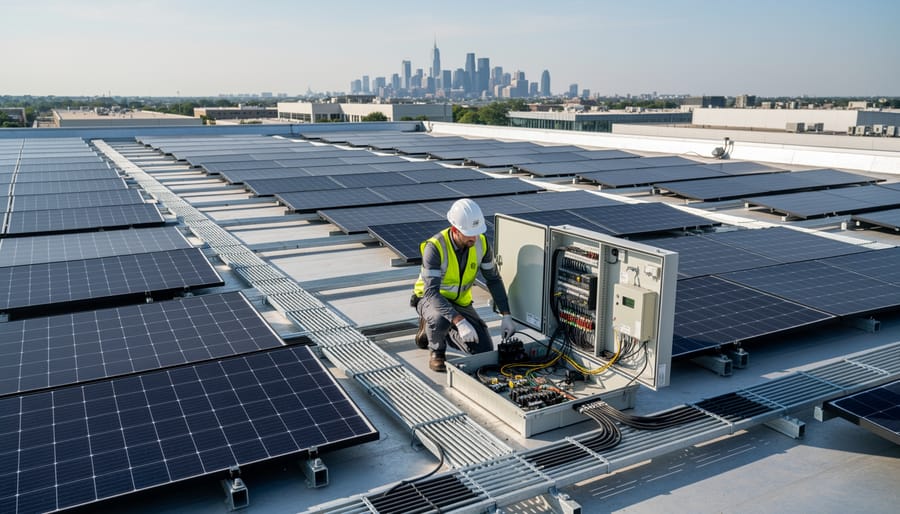
Integrated tracking systems provide the essential digital infrastructure for circular models. Advanced arrays now include embedded sensors monitoring performance degradation, enabling predictive maintenance and optimized retirement timing. These systems feed data to manufacturers and service providers, supporting take-back program logistics and refurbishment decisions.
Together, these elements create actionable pathways for organizations to participate in circular solar economies while maintaining operational efficiency and financial performance. The framework transforms solar investments from capital expenditures into strategic assets within a value-recovery ecosystem.
Key Components of Circular Solar Design
Circular solar design fundamentally reimagines how photovoltaic systems are manufactured, deployed, and eventually recovered. At the core of this approach are four critical components that enable true circularity.
Recyclable frames represent the first essential element. Rather than traditional aluminum frames bonded permanently to panels, circular designs utilize frames engineered for disassembly. These frames connect through mechanical fasteners rather than adhesives, allowing materials to be separated cleanly at end-of-life. This design choice increases material recovery rates from typical 40% to over 90%, significantly reducing waste and preserving valuable resources.
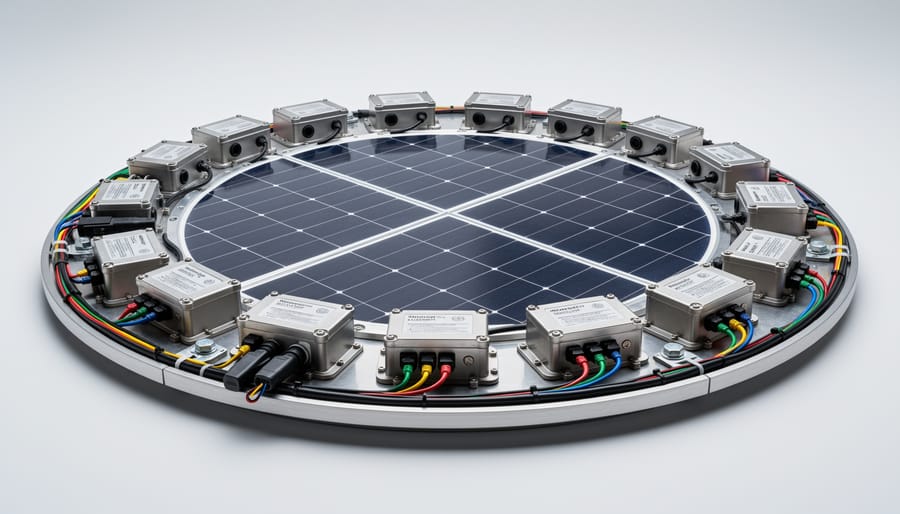
Separable junction boxes constitute the second component. Traditional junction boxes are permanently attached using industrial adhesives, making recovery of valuable copper and semiconductor materials difficult. Circular designs employ click-fit or bolt-on junction boxes that facility managers can remove without damaging the panel, streamlining both maintenance during operation and material recovery during decommissioning.
Standardized mounting systems form the third pillar. Universal mounting specifications ensure compatibility across manufacturers and product generations, extending system lifespan through component upgrades rather than complete replacement. This standardization reduces installation costs by 15-20% while simplifying future modifications.
Digital product passports complete the framework. These comprehensive records, often powered by tracking systems and advanced solar management technology, document material composition, manufacturing origin, maintenance history, and performance data. This transparency enables accurate valuation during take-back programs and ensures materials reach appropriate recycling streams, maximizing recovery value and environmental benefit.
Take-Back Business Models: How They Work for Commercial Installations
Extended Producer Responsibility Programs
Extended Producer Responsibility (EPR) regulations are rapidly reshaping the solar industry landscape, particularly in Europe where the European Union’s Waste Electrical and Electronic Equipment Directive now explicitly covers photovoltaic modules. These regulations mandate that manufacturers assume financial and operational responsibility for end-of-life management of their products, fundamentally shifting the burden from municipalities and property owners to producers. For solar buyers, this translates into significant long-term cost predictability and reduced liability exposure.
The EU framework requires producers to establish collection systems, meet recycling targets exceeding 85% by weight, and finance these operations through visible or hidden fees. Similar legislation is emerging in Japan, South Korea, and several U.S. states including California and Washington, creating a patchwork of compliance requirements that forward-thinking manufacturers are already addressing proactively.
Progressive solar manufacturers are moving beyond minimum compliance by integrating EPR principles into their business models from the outset. Industry leaders like Meyer Burger and Maxeon Solar have implemented comprehensive take-back programs that exceed regulatory requirements, offering buyers guaranteed end-of-life collection and certified recycling at no additional cost. These manufacturers view EPR not as a burden but as a competitive differentiator that demonstrates commitment to circular economy principles.
For procurement decision-makers, evaluating a manufacturer’s EPR readiness should become standard practice. Request documentation of existing take-back infrastructure, recycling partnerships with certified processors, and financial provisioning for future obligations. Companies with established EPR frameworks provide greater assurance that your solar investment won’t become a stranded liability decades from now, protecting both your budget and sustainability credentials.
Solar-as-a-Service and Performance Contracts
Energy-as-a-Service models represent a transformative approach to solar procurement that fundamentally shifts lifecycle responsibility from customers to providers. Under these arrangements, businesses access solar energy through subscription-based agreements while the service provider retains ownership of the equipment throughout its operational life and manages decommissioning.
This service-based structure creates clear financial advantages for commercial customers. Organizations avoid substantial upfront capital expenditure, converting solar adoption into a predictable operational expense. More significantly, end-of-life management becomes the provider’s responsibility, eliminating uncertainty around decommissioning costs and regulatory compliance for panel disposal.
Performance contracts further enhance this model by guaranteeing energy output levels. Providers maintain strong incentives to maximize system longevity and efficiency, as their revenue depends directly on performance. This alignment naturally promotes circular economy principles, as manufacturers and service companies benefit from designing products for extended lifecycles, easier maintenance, and efficient material recovery.
Commercial sector adoption demonstrates the model’s viability. Major retail chains have deployed solar-as-a-service arrangements across multiple locations, securing fixed energy rates without managing dozens of individual installations. Industrial facilities have similarly embraced performance contracts, achieving sustainability targets while maintaining balance sheet flexibility.
Healthcare organizations provide particularly compelling examples, where facility managers prioritize reliability and risk mitigation. Service agreements allow hospitals to pursue renewable energy goals without diverting capital from core operations or assuming technical risks associated with long-term equipment management.
The service provider assumes responsibility for technology obsolescence, regulatory changes affecting disposal requirements, and material recovery value optimization. This arrangement proves especially valuable as solar panel recycling regulations evolve, ensuring businesses remain compliant without dedicating internal resources to monitoring changing requirements.

The Business Case: ROI Beyond Energy Savings
Long-Term Cost Avoidance
Circular solar array programs deliver substantial financial protection through avoided costs over typical 25-30 year system lifecycles. Disposal fees for standard panels range from $20-30 per panel, translating to $40,000-60,000 for a 2,000-panel commercial installation. As regulatory frameworks tighten, these costs are projected to increase significantly. California’s proposed electronic waste regulations could triple disposal expenses by 2030, while European Union directives already impose extended producer responsibility requirements that transfer compliance burdens to system owners.
Take-back programs eliminate these liabilities entirely. A manufacturing facility in Arizona operating a 1.5 MW circular array avoided $127,000 in projected end-of-life disposal costs through their manufacturer partnership. The agreement included guaranteed panel retrieval, recycling management, and regulatory compliance documentation at no additional charge.
Panel replacement economics further demonstrate long-term value. Standard linear procurement models require complete system repurchase after 25-30 years, typically costing 60-70% of original installation expenses due to efficiency improvements offset by inflation. In contrast, circular programs often include technology refresh provisions at 30-40% below market rates, as manufacturers recover value from returned materials. One municipal government saved $890,000 on their second-generation deployment by leveraging circular pricing structures that credited previous panel returns.
Regulatory compliance represents another avoided expense category. Environmental reporting, hazardous material tracking, and decommissioning bonds can cost $15,000-25,000 annually for large installations. Circular partnerships typically assume these administrative responsibilities, delivering consistent savings throughout operational lifecycles while reducing organizational risk exposure.
Sustainability Credentials and Stakeholder Value
Circular solar arrays deliver measurable improvements to Environmental, Social, and Governance (ESG) metrics that increasingly influence investment decisions and market valuations. Organizations adopting take-back models demonstrate quantifiable reductions in waste generation and resource extraction, directly strengthening environmental performance scores tracked by major rating agencies. This documented lifecycle responsibility addresses growing investor scrutiny of supply chain sustainability and end-of-life planning.
For corporate sustainability leaders, circular procurement models provide concrete progress toward net-zero commitments and circular economy targets. Rather than simply purchasing renewable energy equipment, companies demonstrate systems-thinking by addressing the full product lifecycle. This comprehensive approach resonates particularly with institutional investors who recognize that incomplete sustainability strategies create long-term liability risks.
Brand reputation benefits extend beyond regulatory compliance. Consumer research consistently shows preference for companies with transparent environmental practices, while B2B customers increasingly require supplier sustainability documentation. Organizations implementing circular solar procurement gain competitive advantages in RFP processes and partnership negotiations where sustainability credentials serve as differentiators.
The stakeholder value proposition strengthens further as major corporations establish supplier sustainability requirements. Early adopters of circular models position themselves favorably within evolving procurement standards, while delayed action may eventually result in market access limitations as circular economy principles become baseline expectations rather than differentiators.
Real-World Implementation: Commercial Case Studies
Leading organizations across multiple sectors have already demonstrated the viability and benefits of circular solar array implementations, providing valuable insights for decision-makers evaluating these models.
Google’s Data Center Initiative represents one of the most comprehensive circular economy approaches in commercial solar deployment. The technology company partnered with SunPower to implement a take-back program across its California facilities, covering over 1.6 megawatts of installed capacity. Under this arrangement, SunPower retains ownership of the panels throughout their operational life and assumes responsibility for end-of-life management. Google achieved a 23 percent reduction in upfront capital expenditure while eliminating future decommissioning costs estimated at $180,000 per megawatt. The program faced initial challenges in contract structuring, particularly around performance guarantees and liability allocation during the recycling phase. The breakthrough came through establishing clear metrics for panel degradation and implementing quarterly performance reviews. The key lesson learned was the importance of selecting partners with demonstrated recycling infrastructure rather than relying on future capabilities.
IKEA’s European Distribution Centers provide a mid-market perspective on circular solar implementation. The Swedish retailer deployed 15 megawatts of solar capacity across six facilities through a partnership with Lightsource BP, which includes comprehensive take-back provisions. IKEA reduced its solar investment costs by 18 percent compared to traditional purchase models while securing guaranteed energy production levels. The arrangement includes provisions for panel upgrades at year ten, allowing IKEA to benefit from technology improvements without additional capital investment. Challenges emerged around insurance requirements and warranty transfers, resolved through innovative three-party agreements involving the installer, recycler, and facility owner. This case demonstrates that circular models scale effectively for organizations with multiple locations seeking standardized sustainability solutions.
The University of California system offers insights into public sector adoption. UC Davis implemented a 16-megawatt circular solar project where the developer maintains ownership and recycling responsibility throughout a 25-year power purchase agreement. The university achieved solar energy access without upfront costs while meeting its carbon neutrality goals. The institution reports 100 percent budget predictability for solar-derived electricity, a significant advantage for public entities operating under fixed appropriations. The primary challenge involved navigating procurement regulations designed for traditional ownership models, requiring policy adaptations at the state level. This case illustrates the regulatory considerations public institutions must address when pursuing circular solar arrangements.
Evaluating Circular Solar Options for Your Facility
Key Questions for Your Solar Provider
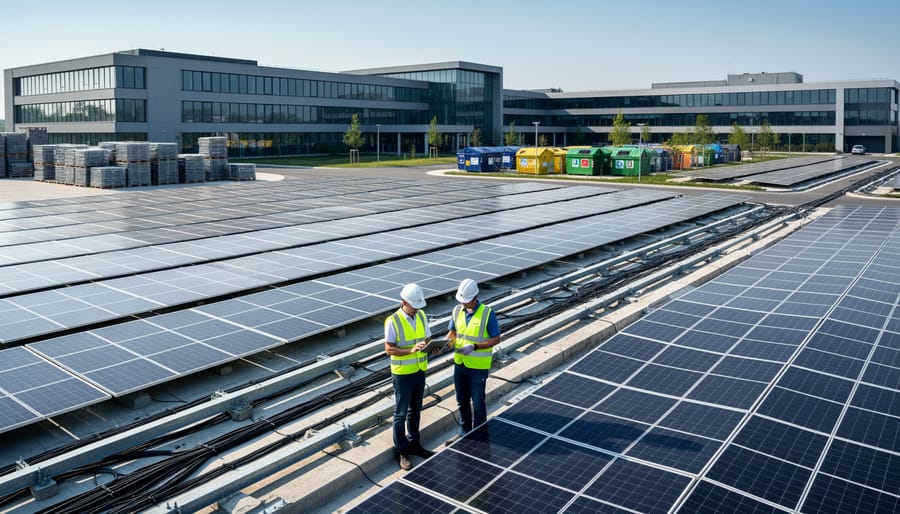
Before committing to a circular solar array installation, facility managers should conduct thorough due diligence on provider capabilities. When evaluating solar service contracts, ask these essential questions:
What is your end-of-life management strategy? Request detailed documentation of the provider’s decommissioning process, including timelines and responsibilities for system removal and disposal.
Do you offer take-back guarantees? Clarify whether panel retrieval is contractually binding, who bears transportation costs, and what happens if the company changes ownership or ceases operations.
What materials comprise your solar panels? Understanding the material composition helps assess recyclability and environmental impact. Request third-party certifications for material transparency.
Which recycling partners do you work with? Verify that providers maintain relationships with certified recycling facilities capable of recovering silicon, silver, aluminum, and other valuable materials at industry-leading rates.
How do you track and report recycling outcomes? Ask for metrics on actual recovery rates and material destinations, not just intentions.
What financial provisions exist for end-of-life costs? Ensure adequate escrow accounts or financial instruments guarantee future recycling obligations regardless of business conditions.
Can you provide case studies from existing clients? Real-world examples demonstrate proven circular economy performance beyond theoretical commitments.
Certifications and Standards to Consider
When evaluating circular solar array providers, several key certifications validate genuine commitment to circularity principles. The Cradle to Cradle Certified program represents the gold standard, assessing products across material health, recyclability, renewable energy use, water stewardship, and social fairness. Solar panels achieving Bronze level or higher demonstrate measurable progress toward closed-loop systems.
The SERI R2 (Sustainable Electronics Recycling International) and e-Stewards certifications ensure responsible electronics recycling practices, particularly important for end-of-life panel management. These standards verify that recyclers meet environmental and worker safety requirements while maximizing material recovery rates, which can exceed 95% for glass, aluminum, and copper components.
ISO 14001 environmental management certification indicates systematic approaches to reducing environmental impact throughout operations. Additionally, the European Union’s CE marking confirms compliance with waste electrical and electronic equipment directives, ensuring proper collection and recycling infrastructure.
Emerging frameworks like the Solar Stewardship Initiative and PV CYCLE certification specifically address photovoltaic lifecycle management. When reviewing vendor proposals, request documentation of these certifications alongside specific take-back program details. Verify that manufacturers provide transparent reporting on material recovery rates and recycling partnerships. Third-party verification from organizations like UL Environment or NSF International adds credibility to circularity claims, helping decision-makers distinguish substantive programs from greenwashing.
The Regulatory Landscape and Future Outlook
The regulatory environment surrounding solar panel waste management is undergoing significant transformation across Europe, with implications that will fundamentally reshape how businesses approach solar investments. The EU Waste Electrical and Electronic Equipment (WEEE) Directive already classifies solar panels as electronic waste, placing responsibility on producers and importers for end-of-life management. However, enforcement has historically been inconsistent, allowing some market participants to avoid their obligations.
This regulatory landscape is tightening considerably. The European Commission’s Circular Economy Action Plan explicitly targets solar photovoltaic systems as a priority waste stream, with member states implementing stricter compliance mechanisms. By 2025, enhanced collection targets and reporting requirements will make circular approaches increasingly difficult to avoid. Germany and France have already established robust enforcement frameworks, with substantial penalties for non-compliance reaching tens of thousands of euros per violation.
For business owners and facility managers, these changes represent both challenge and opportunity. Organizations that proactively adopt take-back models position themselves ahead of mandatory requirements while potentially avoiding rushed, costly compliance measures later. The financial implications extend beyond penalty avoidance. Companies demonstrating circular economy practices increasingly gain preferential treatment in public procurement processes, with several EU member states now incorporating lifecycle management criteria into tender evaluations.
The extended producer responsibility principle is expanding beyond manufacturers to encompass the entire value chain, including system owners and operators. This shift means that facility managers who previously viewed solar installations as simple capital assets must now consider end-of-life obligations as integral to project planning. Forward-thinking organizations are responding by incorporating take-back guarantees into procurement specifications, effectively transferring compliance risk to suppliers while securing predictable decommissioning costs.
Industry experts anticipate that by 2030, circular solar procurement will become the standard rather than the exception, driven by regulatory pressure, financial incentives, and stakeholder expectations. Organizations establishing circular practices today gain competitive advantages while building operational resilience for tomorrow’s regulatory environment.
Circular solar arrays represent more than an environmental commitment—they constitute a strategic business decision that delivers measurable financial returns while mitigating long-term risks. Organizations that integrate lifecycle management and take-back provisions into their solar procurement strategies position themselves ahead of evolving regulatory requirements and stakeholder expectations. Rather than viewing end-of-life planning as a compliance burden, forward-thinking decision-makers recognize it as a competitive differentiator that enhances operational efficiency, preserves capital value, and strengthens corporate sustainability credentials.
When planning new installations or expanding existing systems, proactively evaluate manufacturers and developers offering comprehensive take-back programs. Establish clear contractual provisions for decommissioning, material recovery, and environmental liability allocation. This approach transforms potential future liabilities into manageable processes with predictable costs. The organizations that embrace circular principles today will benefit from streamlined asset transitions, access to recovered material value, and enhanced reputation among customers, investors, and regulators. As the solar industry matures and installed capacity continues to grow exponentially, circular solar arrays will transition from innovative practice to industry standard—making early adoption a strategic imperative for sustained competitive advantage.