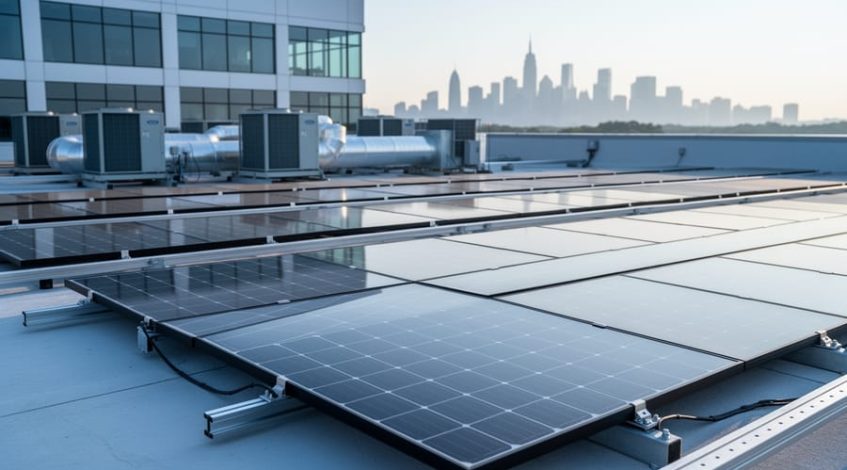
Advanced photovoltaics represent a fundamental shift in commercial solar technology, delivering efficiency rates exceeding 26% compared to conventional panels at 15-18%. These next-generation materials—including perovskite tandems, bifacial modules, and heterojunction cells—are transforming the economic calculus for businesses evaluating solar investments.
The technology has reached commercial viability. Major manufacturers now deploy advanced photovoltaic systems in utility-scale installations, industrial facilities, and commercial buildings worldwide. Manufacturing costs have declined 47% since 2019, making these systems competitive with traditional panels when factoring in their superior energy yield per square foot.
For decision-makers, advanced photovoltaics solve critical space constraints. A facility with limited roof area can generate 30-40% more power using the same footprint, accelerating payback periods and improving return on investment. Temperature coefficients have improved significantly, maintaining performance in extreme heat where conventional panels degrade rapidly.
Three material innovations drive this advancement. Tandem cell architectures stack multiple light-absorbing layers to capture broader solar spectrum. Passivated contact technologies reduce electron loss at cell interfaces. Advanced encapsulation materials extend operational lifespans beyond 30 years while maintaining warranty-backed performance guarantees.
The procurement decision centers on total cost of ownership rather than upfront price. When accounting for higher energy production, reduced maintenance requirements, and extended warranties, advanced photovoltaics typically achieve break-even within 18-24 months compared to conventional alternatives. This financial performance, combined with proven reliability in commercial deployments, positions these materials as the pragmatic choice for organizations planning long-term energy infrastructure investments.
What Makes Photovoltaic Materials ‘Advanced’
Beyond Traditional Silicon: The New Material Classes
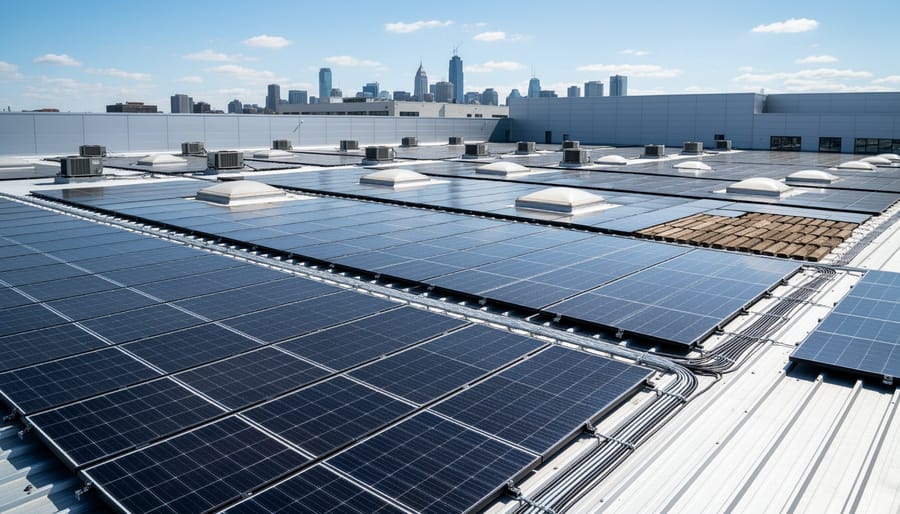
The solar industry is experiencing a significant shift beyond conventional silicon panels, with several emerging material classes demonstrating promising commercial potential. These innovations address key limitations of traditional photovoltaics while opening new application possibilities for diverse operational environments.
Perovskite solar cells have advanced rapidly from laboratory curiosities to commercially viable options, offering manufacturing flexibility and enhanced light absorption capabilities. These materials can be applied using cost-effective printing methods, potentially reducing production costs while delivering competitive efficiency ratings. Current commercial deployments focus on building-integrated applications where lightweight, flexible characteristics provide distinct advantages over rigid silicon panels.
Tandem cell configurations combine multiple light-absorbing layers to capture broader portions of the solar spectrum, achieving efficiency levels exceeding single-junction alternatives. Recent installations demonstrate how these systems maximize energy generation in space-constrained commercial facilities, delivering superior performance per square meter. This technology proves particularly valuable for urban installations where roof space commands premium value.
Organic photovoltaics present opportunities for specialized applications requiring transparency, flexibility, or custom form factors. While efficiency levels remain lower than silicon alternatives, these panels integrate seamlessly into architectural elements, vehicle surfaces, and consumer devices where traditional panels prove impractical.
Quantum dot technologies leverage nanocrystal engineering to optimize light absorption and conversion efficiency. Early commercial implementations show promise in concentrated solar applications and specialized industrial settings where enhanced spectral response delivers measurable performance improvements.
These material innovations share common attributes: reduced manufacturing complexity, lighter weight profiles, and application versatility that extends solar viability beyond conventional deployments.
Efficiency Gains That Impact Your Bottom Line
Recent efficiency improvements in advanced photovoltaic systems deliver measurable financial benefits for commercial installations. Modern high-efficiency panels convert 22-24% of available sunlight into electricity, compared to 15-17% for conventional systems, generating 30-40% more power from the same rooftop area.
For a typical 100kW commercial installation, this translates to an additional 10,000-15,000 kWh annually. At average commercial electricity rates of $0.25 per kWh, that represents $2,500-3,750 in extra savings each year. Over a 25-year system lifespan, higher efficiency delivers $62,500-93,750 in additional value.
These gains prove particularly valuable for space-constrained facilities. A manufacturing plant requiring 200kW capacity might need 800 square meters with conventional panels but only 650 square meters with advanced systems, reducing structural requirements and installation costs.
The improved performance also accelerates payback periods. Commercial installations using advanced photovoltaics typically achieve return on investment 18-24 months faster than standard systems, making renewable energy investments more attractive for budget-conscious decision-makers focused on near-term financial performance.
The Commercial Case for Advanced Photovoltaic Materials
Higher Power Density for Space-Constrained Facilities
Space constraints represent a critical challenge for commercial and industrial facilities seeking to maximize solar energy generation. Advanced photovoltaic materials directly address this limitation by delivering substantially higher power density compared to conventional silicon panels. Today’s high-efficiency modules routinely achieve 22-24% efficiency ratings, with some premium products reaching 26% or higher, translating to approximately 400-450 watts per square meter under optimal conditions.
For urban commercial properties with limited roof space, this efficiency advantage makes previously unviable solar projects economically feasible. A distribution center with 10,000 square feet of available roof area can now generate 30-40% more electricity using advanced materials versus standard panels installed just five years ago. This increased output directly improves project economics by reducing payback periods and enhancing return on investment.
Manufacturing facilities facing high daytime energy consumption particularly benefit from higher power density installations. A food processing plant in California replaced aging conventional panels with advanced heterojunction technology, increasing system output by 35% within the same footprint. The facility now meets 68% of its operational electricity needs during peak production hours, significantly reducing demand charges and improving overall energy cost predictability.
Industrial parks and multi-tenant commercial buildings also gain strategic advantages from space-efficient installations. By maximizing power generation per available square meter, facility managers can allocate remaining roof space for HVAC equipment, safety access, or future expansion while still achieving aggressive renewable energy targets. This flexibility proves essential for facilities pursuing LEED certification or corporate sustainability commitments without compromising operational requirements.
Performance in Real-World Conditions
Traditional solar panels experience significant efficiency losses under less-than-ideal conditions, but advanced photovoltaic materials demonstrate superior resilience in real-world operating environments. Understanding these performance characteristics is essential for accurate return-on-investment calculations and long-term operational planning.
Modern bifacial panels and multi-junction cells maintain substantially higher energy generation during overcast conditions and early morning or late afternoon hours when light intensity is reduced. Field studies show advanced materials can produce 15-25% more energy annually compared to conventional panels in regions with frequent cloud cover or shorter daylight periods during winter months.
Temperature tolerance represents another critical advantage. Standard silicon panels lose approximately 0.5% efficiency for every degree Celsius above 25°C. Advanced materials with improved thermal stability experience reduced degradation in hot climates, maintaining higher output during peak summer temperatures when cooling loads and electricity demand are greatest. This characteristic proves particularly valuable for facilities in southern regions or tropical climates where ambient temperatures regularly exceed 35°C.
Advanced coatings and encapsulation technologies also enhance durability in challenging weather conditions. These innovations resist moisture infiltration, reduce soiling from dust and debris, and withstand high winds and hail impact better than earlier generations. Commercial installations in coastal environments benefit from improved corrosion resistance, while facilities in industrial areas see better performance despite air quality challenges.
These real-world performance improvements translate directly to higher energy yields, improved system reliability, and more predictable financial returns over the 25-30 year operational lifespan of commercial solar installations.
Emerging Technologies Ready for Commercial Deployment
Perovskite-Silicon Tandem Cells: The Efficiency Breakthrough
Tandem cell technology represents a significant advancement in commercial solar efficiency by stacking two different photovoltaic materials to capture a broader spectrum of sunlight. Perovskite-silicon tandem cells combine the light-absorption properties of perovskite materials with the proven reliability of crystalline silicon, achieving conversion efficiencies exceeding 33 percent compared to conventional silicon panels that typically reach 22-24 percent.
This efficiency gain translates directly to improved return on investment for commercial installations. Facilities can generate more power from the same roof space, reducing the payback period and maximizing long-term energy savings. These advanced photovoltaic systems are particularly valuable for space-constrained applications where every square meter counts.
Real-world deployment is accelerating rapidly. Oxford PV’s commercial manufacturing facility in Germany began producing tandem modules in 2023, with major installations planned across European commercial buildings. In Australia, pilot projects at industrial facilities in Victoria demonstrate the technology’s performance under local conditions, showing 30-35 percent efficiency gains in field testing.
For business decision-makers, the investment case strengthens as manufacturing scales up. While current premium pricing ranges 15-20 percent above conventional panels, the higher energy output typically delivers comparable or better levelized cost of energy. Industry analysts project price parity within three to five years as production volumes increase, making tandem cells an increasingly attractive option for forward-thinking organizations planning major solar installations.
Bifacial and Transparent Solar Technologies
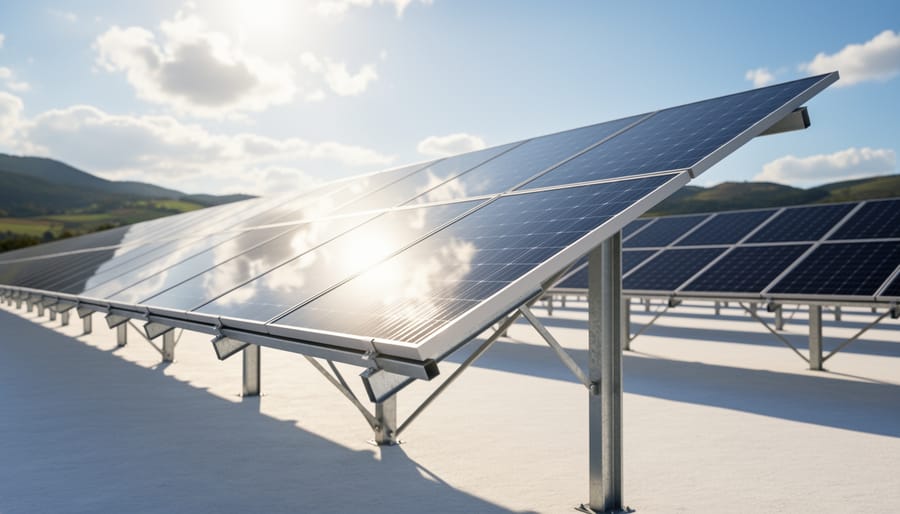
Bifacial solar modules represent a significant advancement in energy capture efficiency by generating electricity from both sides of the panel. These systems utilize albedo effect, collecting reflected light from surfaces beneath the installation, which can increase energy yield by 10-30% compared to traditional monofacial panels. This technology proves particularly valuable for commercial facilities with reflective roofing materials or ground-mounted arrays over light-colored surfaces.
Transparent photovoltaic materials are transforming building-integrated photovoltaic applications by converting windows, skylights, and building facades into power-generating surfaces. These semi-transparent cells allow visible light to pass through while capturing ultraviolet and infrared wavelengths for electricity generation. Major office buildings and commercial developments are now incorporating these materials into architectural designs, effectively turning entire building envelopes into revenue-generating assets.
For facility managers evaluating these technologies, bifacial installations work best in elevated mounting systems with optimal ground clearance, while transparent solutions integrate seamlessly into new construction or major renovation projects. Leading manufacturers now offer 25-year performance warranties on both technologies, with transparent panels achieving 5-8% efficiency rates that continue improving through materials innovation. These installation options expand solar deployment opportunities beyond traditional rooftop configurations, maximizing available space for energy generation.
Flexible and Lightweight Advanced Materials
Thin-film photovoltaic technologies represent a breakthrough for facilities facing structural constraints or specialized installation requirements. These advanced materials, typically 300 times thinner than conventional silicon panels, offer exceptional versatility while maintaining competitive energy output. Building-integrated photovoltaic applications particularly benefit from this technology, as the reduced weight enables installations on aging rooftops, curved surfaces, and even window facades without extensive structural reinforcement.
Modern thin-film solutions, including cadmium telluride and copper indium gallium selenide variants, deliver power-to-weight ratios that make them ideal for temporary structures, mobile applications, and historic buildings where load-bearing capacity is limited. Manufacturing advancements have improved efficiency ratings to 15-20 percent, closing the gap with traditional panels while offering lower upfront costs per watt installed. For facility managers evaluating retrofit projects or greenfield developments with architectural constraints, thin-film materials provide practical pathways to solar adoption that previously seemed cost-prohibitive or structurally unfeasible.
Real-World Applications Across Industries
Manufacturing and Industrial Facilities
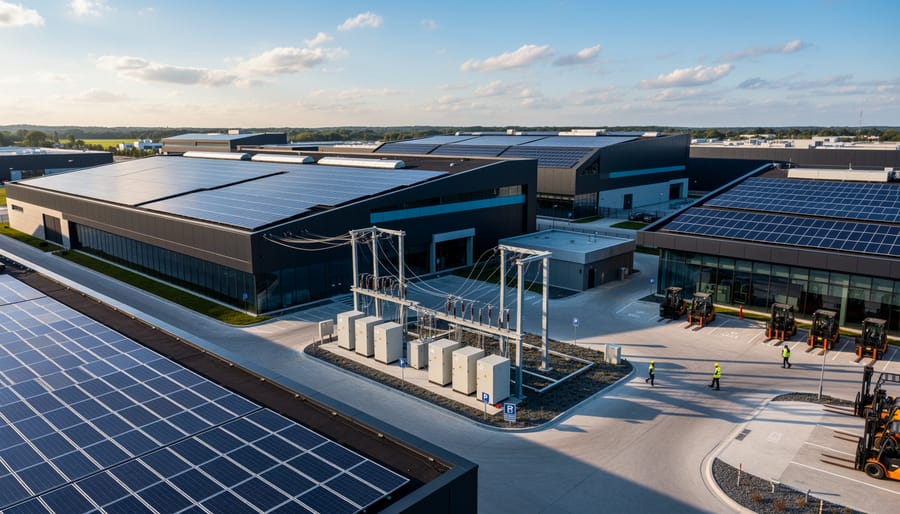
Manufacturing and industrial facilities represent ideal candidates for advanced photovoltaic deployment due to their expansive rooftop space and high daytime energy consumption. Modern high-efficiency solar materials, including perovskite-silicon tandem cells and bifacial modules, can generate 20-30% more electricity per square meter compared to conventional systems, making them particularly valuable where roof space is limited or premium.
These advanced materials deliver measurable operational cost reductions through enhanced performance in challenging industrial environments. For example, facilities in the automotive and food processing sectors have documented 15-25% lower electricity expenses within the first year of installation. The improved temperature coefficients of next-generation materials maintain output efficiency even under the heat load typical of industrial rooftops, while anti-soiling coatings reduce maintenance requirements and extend cleaning intervals.
Return on investment calculations show that high-efficiency installations typically achieve payback periods of 4-7 years, with total cost of ownership benefits extending 25+ years. Energy-intensive operations such as data centers, cold storage facilities, and manufacturing plants experience the most significant financial impact from maximizing on-site generation capacity.
Government and Institutional Buildings
Public sector organizations increasingly leverage advanced photovoltaic technologies to meet ambitious sustainability mandates while managing constrained budgets. The U.S. General Services Administration has implemented bifacial solar panels across multiple federal facilities, achieving 15-20% higher energy yields compared to conventional systems. These installations demonstrate measurable cost savings while advancing carbon neutrality goals.
Municipal buildings present particularly compelling applications for advanced solar materials. Denver’s Justice Center integrated PERC technology across 40,000 square feet of roofing, reducing annual energy costs by $180,000 while meeting the city’s renewable energy requirements. The installation qualified for accelerated depreciation under federal tax incentives, improving the project’s return on investment.
Educational institutions have emerged as early adopters of next-generation photovoltaics. California State University’s system-wide deployment of heterojunction modules across 23 campuses provides both operational savings and living laboratories for research. These projects fulfill dual objectives: reducing operational expenses while demonstrating leadership in sustainability to students and surrounding communities.
Commercial Real Estate and Retail
Commercial real estate presents significant opportunities for advanced photovoltaic deployment, where space optimization directly impacts financial returns. Multi-tenant buildings and shopping centers benefit from high-efficiency modules that generate more power per square foot, maximizing revenue from limited rooftop real estate. Bifacial panels capture reflected light from white commercial roofing membranes, increasing energy output by 15-25% without additional footprint.
Office complexes utilize building-integrated photovoltaics in facades and parking structures, transforming underutilized surfaces into revenue-generating assets. Modern transparent solar windows maintain aesthetic standards while reducing cooling loads. Property managers report typical payback periods of 5-8 years, with systems adding measurable value to property valuations. Advanced materials also enable faster installation schedules, minimizing tenant disruption during retrofits. For retail centers operating on thin margins, the combination of reduced utility costs and enhanced sustainability credentials provides competitive advantages in attracting environmentally conscious tenants and customers.
Evaluating Advanced Photovoltaics for Your Operation
Cost-Benefit Analysis Framework
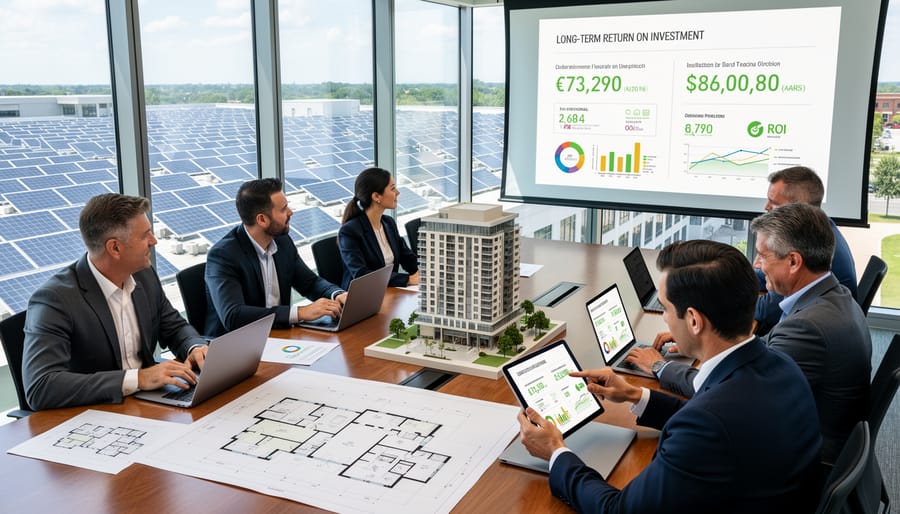
Evaluating advanced photovoltaics requires a comprehensive financial analysis that extends beyond initial capital costs. Decision-makers should calculate the levelized cost of energy (LCOE), which accounts for total system costs divided by expected energy production over the system’s lifetime. While premium materials may command 15-30% higher upfront investment, enhanced efficiency and durability often yield superior returns.
The payback period for advanced photovoltaic systems typically ranges from 5-8 years in commercial applications, compared to 7-10 years for conventional systems. This acceleration stems from increased energy generation per square foot and reduced maintenance requirements. Facilities with limited roof space particularly benefit from high-efficiency modules that maximize output within physical constraints.
Lifecycle cost analysis should incorporate degradation rates, warranty terms, and projected performance over 25-30 years. Advanced materials demonstrating less than 0.5% annual degradation significantly outperform standard modules at 0.7-1% decline. Additionally, factor in potential revenue from renewable energy credits, tax incentives, and avoided utility cost escalations. Quantifying these variables provides clarity on total cost of ownership and enables informed investment decisions that align with organizational sustainability goals and financial objectives.
Installation and Compatibility Considerations
Before implementing advanced photovoltaic systems, conduct a comprehensive site assessment to evaluate structural capacity, electrical infrastructure, and sun exposure patterns. Modern bifacial panels and high-efficiency modules typically require 15-20% less roof space than conventional systems but may need upgraded inverters and monitoring systems to maximize performance benefits.
Compatibility considerations include verifying that existing electrical panels can accommodate higher voltage outputs and ensuring adequate ventilation for panels with enhanced heat dissipation requirements. Perovskite-silicon tandem cells and other next-generation technologies often integrate seamlessly with standard mounting systems, though their higher power density may necessitate reconfigured wiring layouts.
Engage your solar provider in detailed discussions about warranty terms specific to advanced materials, expected degradation rates compared to standard silicon panels, and maintenance protocols. Request performance modeling based on your facility’s actual energy consumption patterns and local climate conditions. Clarify whether the installation requires specialized certifications or training for maintenance staff, as some emerging technologies involve proprietary monitoring systems. Additionally, verify compatibility with energy storage solutions and smart grid integration capabilities to future-proof your investment and maximize operational flexibility.
The landscape of advanced photovoltaic materials has evolved dramatically, moving beyond laboratory curiosity to become commercially viable solutions for forward-thinking organizations. Perovskite cells, bifacial modules, tandem architectures, and emerging technologies now represent accessible options rather than distant possibilities. These innovations deliver measurable advantages: higher efficiency ratings that maximize energy generation per square foot, enhanced durability that extends asset lifecycles, and improved performance across diverse environmental conditions.
For business leaders and facility managers, this transition creates a strategic inflection point. The technology maturity curve has reached a stage where early adopters can capture competitive advantages without shouldering prohibitive risk. Organizations currently planning solar installations or considering system upgrades have an opportunity to specify advanced materials that will deliver superior returns over traditional solutions.
However, successful implementation requires careful evaluation of your specific operational context. Factors including facility location, roof characteristics, energy consumption patterns, budget parameters, and long-term sustainability objectives all influence which advanced photovoltaic technologies align with your needs. Generic solutions rarely optimize outcomes in commercial applications.
We strongly encourage decision-makers to engage with experienced solar providers who maintain expertise in advanced material systems. Professional consultation enables accurate assessment of how these innovations apply to your unique circumstances, ensuring your solar investment delivers maximum financial and environmental returns. The future of photovoltaics has arrived; the question is whether your organization will capitalize on its advantages.