
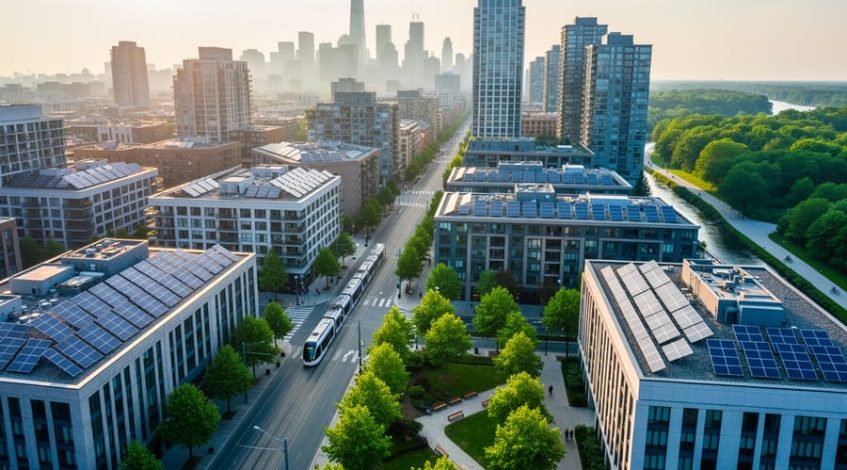
Urbanization concentrates human activity into smaller geographic footprints, fundamentally altering how populations interact with their environment. For every percentage point increase in urban population density, per capita carbon emissions decline by approximately 1.4%, according to research from leading urban planning institutes. This counterintuitive reality challenges conventional assumptions about cities as environmental liabilities and reveals their potential as engines of sustainability.
Dense urban environments create two measurable environmental advantages that directly impact climate mitigation strategies and resource conservation goals. First, concentrated populations enable infrastructure efficiency gains impossible in sprawl development patterns, reducing per capita energy consumption by 20-40% compared to suburban equivalents. Second, urbanization preserves undeveloped land at scale, protecting ecosystems and carbon sinks that would otherwise face conversion pressure from dispersed settlement patterns.
These benefits extend beyond theoretical models into practical applications for facility managers and municipal planners. Commercial buildings in urban cores demonstrate 30% lower energy intensity than comparable suburban structures, primarily through shared wall construction, optimized transportation access, and economies of scale in utility infrastructure. When combined with renewable energy integration, particularly rooftop solar installations on multi-story buildings, urban environments can achieve carbon neutrality targets decades ahead of low-density alternatives.
Understanding these environmental mechanisms equips decision-makers to evaluate development proposals, infrastructure investments, and sustainability initiatives with evidence-based frameworks. The following analysis examines each benefit through quantitative data, real-world implementation examples, and actionable strategies for maximizing environmental returns from urban density.
Understanding Holistic Energy Ecosystems in Urban Environments
The Role of Solar Energy in Urban Energy Networks
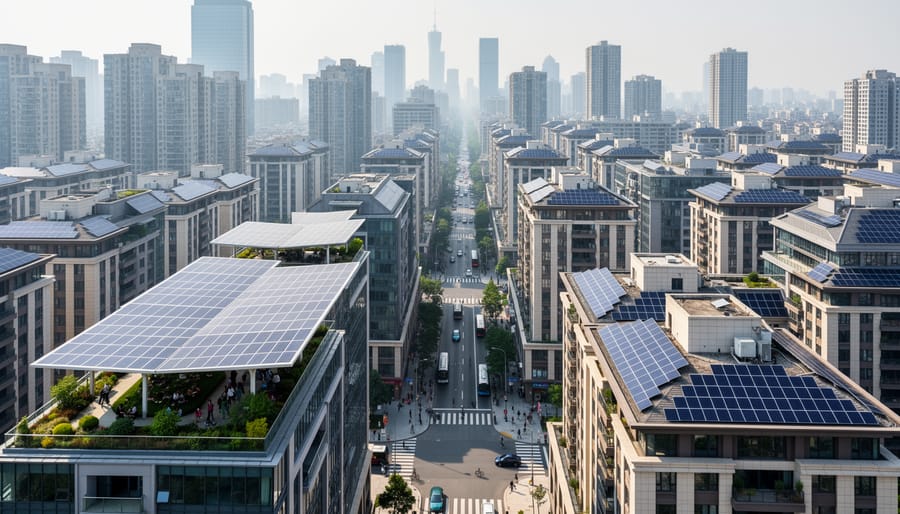
Commercial solar installations function as decentralized power generation nodes within urban energy networks, creating a distributed infrastructure that enhances grid stability and resilience. When multiple commercial buildings deploy photovoltaic systems, they form an interconnected network that reduces transmission losses associated with centralized power plants located far from consumption centers. This proximity between generation and consumption points can decrease energy waste by up to 30% compared to traditional grid configurations.
Advanced metering infrastructure enables commercial solar arrays to operate synergistically with municipal energy systems, allowing excess generation during peak production hours to flow back into the grid for neighboring facilities. In practice, this creates a dynamic energy exchange where a manufacturing facility’s rooftop array might power adjacent office buildings during weekday hours, while commercial solar installations at retail centers contribute during extended operating periods. Energy management systems coordinate these exchanges, optimizing load balancing across the urban landscape and reducing strain on baseload generation facilities during high-demand periods. This integration demonstrates measurable environmental benefits through improved resource utilization and reduced infrastructure redundancy.
Environmental Benefit #1: Radical Reduction in Per-Capita Energy Consumption
Shared Infrastructure and Energy Efficiency Gains
Dense urban environments create exceptional opportunities for infrastructure consolidation that delivers measurable energy savings. When buildings cluster together, they enable district heating and cooling systems, combined heat and power facilities, and integrated electrical grids that operate at efficiency levels impossible in dispersed suburban layouts. These shared systems eliminate the redundancy inherent in individual building utilities, reducing overall energy consumption by 20-40% compared to standalone infrastructure.
District energy networks exemplify this efficiency gain. Rather than each building operating separate heating and cooling equipment, centralized plants distribute thermal energy through underground piping to multiple structures. This consolidation reduces energy waste through optimized load balancing, heat recovery, and economies of scale in equipment operation. Copenhagen’s district heating system, serving 98% of the city, demonstrates how urban energy systems can achieve 30% lower carbon emissions compared to individual building systems.
Combined heat and power installations in urban centers capture waste heat from electricity generation for building heating, achieving 80% efficiency versus 45% for conventional separate systems. For facility managers, this translates to substantial operational cost reductions and predictable energy expenses. Commercial and industrial complexes in dense urban zones can implement microgrid configurations that optimize renewable energy integration, battery storage, and demand response capabilities across multiple buildings, maximizing return on infrastructure investment while minimizing environmental impact through coordinated energy management.
Transportation Energy Savings in Urban Centers
Urban centers demonstrate substantial transportation energy efficiency through reduced vehicle dependency and compressed travel distances. Data from the International Energy Agency reveals that residents in dense urban areas travel 20-30% fewer vehicle miles annually compared to suburban counterparts, directly translating to measurable energy conservation.
This efficiency stems from multiple factors. Urban populations benefit from shorter commute distances, with average trip lengths of 5-8 miles versus 12-15 miles in lower-density areas. Additionally, cities facilitate higher public transit utilization rates, with metropolitan areas showing 40-60% greater public transportation usage compared to less dense regions. Walking and cycling become viable primary transport modes when destinations exist within compact geographic boundaries.
The energy impact proves significant: transportation accounts for approximately 28% of total energy consumption in developed economies, making urban efficiency gains particularly valuable. Studies indicate that doubling residential density can reduce household transportation energy consumption by 25-30%. For facility managers and business owners, urban locations offer reduced employee commuting costs and enhanced access to workforce pools without corresponding increases in transportation infrastructure investment.
These transportation patterns align with comprehensive sustainability strategies, particularly when paired with renewable energy systems that power electric vehicle charging infrastructure and public transit networks throughout urban corridors.
Commercial Solar’s Multiplier Effect in Dense Developments
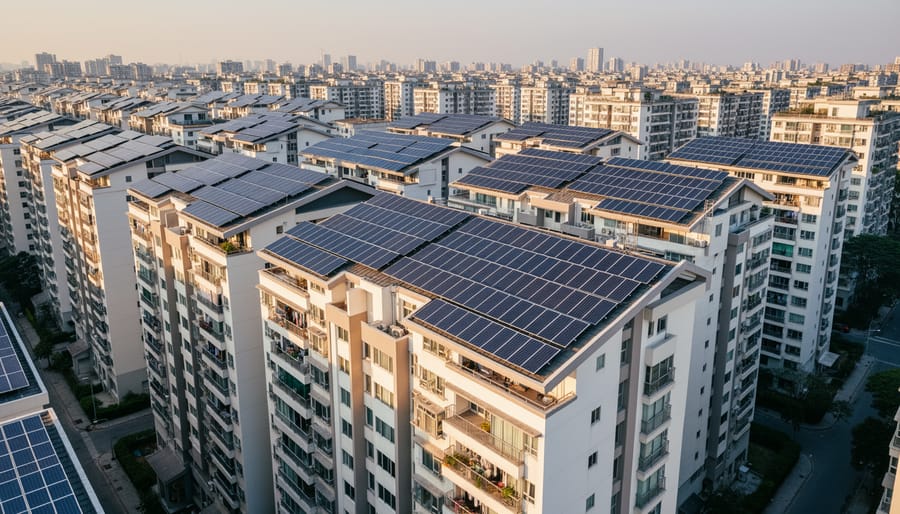
A recent installation in Rotterdam demonstrates this principle effectively. A 250 kW commercial solar system installed on a mixed-use building generates approximately 225,000 kWh annually, serving 18 commercial tenants and 42 residential units. The per-capita carbon reduction reaches 3.7 tons annually, compared to 2.1 tons for equivalent standalone residential installations. This efficiency gain stems from optimized panel placement, reduced permitting costs per beneficiary, and centralized maintenance protocols. The building’s energy management system allocates solar generation based on real-time consumption patterns, achieving 89% utilization rates versus the residential average of 62%. Investment analysis reveals a 40% faster payback period due to economies of scale in equipment procurement and installation labor. Multi-tenant properties in urban cores maximize environmental return by concentrating clean energy production where population density is highest, effectively multiplying the positive impact per square meter of solar infrastructure deployed.
Environmental Benefit #2: Preservation of Natural Ecosystems Through Land-Use Efficiency
The Carbon Sequestration Advantage of Preserved Land
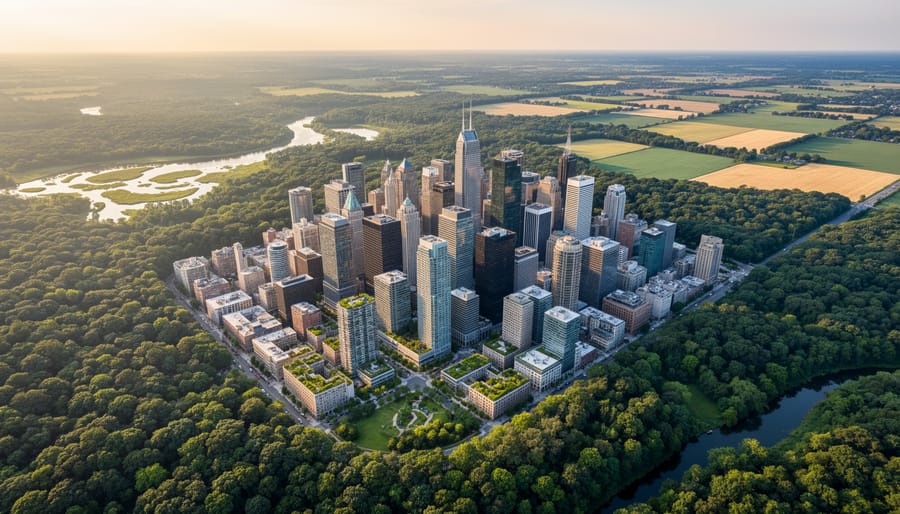
Concentrated urban development creates a measurable carbon sequestration advantage by preserving undeveloped land that functions as critical carbon sinks. Research from the Nature Conservancy demonstrates that compact cities prevent sprawl across an estimated 400 million acres of forests, grasslands, and wetlands globally—ecosystems that collectively sequester approximately 30 billion tons of CO2 annually.
When population density increases vertically rather than horizontally, natural areas remain intact to absorb atmospheric carbon. A comparative analysis shows that metropolitan regions with concentrated development preserve 40% more forest cover within their broader watersheds compared to sprawling counterparts. These preserved landscapes don’t merely store existing carbon; they actively remove CO2 from the atmosphere at rates exceeding 2.5 tons per acre annually in temperate forests.
This environmental benefit multiplies when urban centers integrate renewable energy infrastructure. Commercial and industrial facilities in dense urban areas offer ideal rooftop and structural surfaces for solar installations, reducing both the carbon footprint of energy generation and the pressure to develop green spaces for ground-mounted arrays. The combination of preserved natural carbon sinks surrounding concentrated development, paired with low-emission energy systems within urban cores, creates a powerful dual mechanism for climate mitigation that sprawling development patterns cannot replicate.
Reducing Energy Infrastructure Footprint
Urban population density creates significant infrastructure efficiencies that translate directly into reduced environmental impact. When populations concentrate in cities, electrical distribution networks require fewer transmission lines, substations, and supporting infrastructure per capita compared to dispersed rural development. This concentrated demand pattern enables utilities to deliver power through shorter, more direct routes, minimizing land disturbance, habitat fragmentation, and material consumption.
Research from the International Energy Agency demonstrates that urban areas require approximately 40% less transmission infrastructure per customer than suburban and rural equivalents. This efficiency reduces the environmental footprint associated with clearing rights-of-way, installing tower foundations, and maintaining extensive distribution networks across sensitive ecosystems. Modern smart grid infrastructure further amplifies these benefits by optimizing load distribution and enabling localized renewable energy integration.
For facility managers and government officials, this infrastructure consolidation creates opportunities for strategic solar deployment. Rooftop commercial installations in dense urban areas can feed directly into local distribution networks, reducing transmission losses and infrastructure strain while delivering measurable returns on investment. Urban energy systems inherently support more efficient resource allocation, making sustainability goals more achievable and cost-effective.
Urban Green Spaces and Integrated Solar Solutions
Copenhagen’s Nordhavn district exemplifies how strategic urban planning integrates environmental benefits through design. This mixed-use development combines high-density residential and commercial buildings with 40% green space coverage, including biodiverse parks, green roofs, and waterfront areas that manage stormwater naturally while reducing urban heat island effects by an estimated 3-4 degrees Celsius.
The district incorporates building-integrated photovoltaic systems across commercial facades and rooftops, generating approximately 30% of the neighborhood’s energy needs while maintaining architectural aesthetics. Facility managers report reduced operational costs through combined energy generation and passive cooling provided by strategic vegetation placement, which decreases air conditioning demands by up to 25% during peak summer months.
Similar approaches are being implemented in Singapore’s Marina Bay district and Vancouver’s False Creek neighborhood, where government officials have documented measurable improvements in air quality, energy independence, and climate resilience. These case studies demonstrate that dense urban environments can achieve superior environmental performance compared to sprawling development patterns when green infrastructure and renewable energy systems are integrated from the planning phase forward. The return on investment typically materializes within 7-10 years through energy savings and enhanced property values.
Implementing Sustainable Urban Energy Solutions: Practical Considerations
Commercial Solar Integration in Multi-Use Developments
Implementing solar systems in multi-use urban developments requires strategic planning to maximize both environmental impact and financial returns. Modern commercial solar installations typically achieve ROI within 5-8 years, depending on local incentives and energy consumption patterns. Facility managers should begin with comprehensive energy audits to determine optimal system sizing and placement across rooftops, parking structures, and vertical surfaces.
Key implementation considerations include structural load assessments, utility interconnection requirements, and municipal permitting processes. Advanced monitoring systems enable real-time performance tracking and predictive maintenance scheduling, ensuring systems operate at peak efficiency throughout their 25-30 year lifespan. Integration with building management systems allows for intelligent energy distribution, reducing grid dependence during peak demand periods.
Successful projects in metropolitan areas demonstrate that proper site assessment and professional installation are critical. Working with experienced commercial solar providers ensures compliance with local regulations and optimizes system design for urban constraints. Financial modeling should account for available tax credits, accelerated depreciation schedules, and potential revenue from renewable energy certificates. Many jurisdictions offer additional incentives for developments that incorporate solar into mixed-use spaces, improving overall project economics while contributing to urban sustainability goals.
Government Incentives Supporting Urban Energy Transitions
Government support mechanisms play a pivotal role in accelerating commercial solar adoption within urban environments. Federal and state-level incentives significantly reduce upfront investment costs through programs like the Small-scale Technology Certificates scheme and accelerated depreciation benefits. These financial mechanisms typically offset 20-40% of initial capital expenditure, improving project economics for facility managers and business owners.
Urban planning authorities increasingly mandate energy efficiency standards and renewable energy targets for new commercial developments, creating regulatory frameworks that favor solar integration. Local councils offer streamlined approval processes and reduced permit fees for qualifying solar installations, recognizing their contribution to grid stability and emissions reduction goals.
Feed-in tariff programs and net metering arrangements enable businesses to monetize excess solar generation, creating additional revenue streams beyond operational savings. Progressive jurisdictions have established community solar programs that allow multiple stakeholders to benefit from shared installations, particularly valuable for businesses with unsuitable roof conditions.
Grant programs targeting specific sectors, such as industrial facilities or commercial real estate portfolios, provide capital funding for demonstration projects that showcase scalable solar solutions. These initiatives reduce perceived risks and establish proven implementation pathways for organizations evaluating solar investments as part of their urban sustainability strategies.
The environmental benefits of urbanization—enhanced energy efficiency through concentrated infrastructure and expanded opportunities for renewable energy integration—present compelling evidence for strategically planned urban development. These advantages are not mutually exclusive but rather reinforcing elements of a comprehensive sustainability framework. When cities prioritize dense, mixed-use development patterns alongside renewable energy deployment, they create synergistic effects that multiply environmental returns while supporting economic growth.
For business owners and facility managers, understanding these environmental benefits translates directly into operational advantages. Urban facilities positioned within efficient infrastructure networks reduce energy consumption and operational costs. Government officials and industry leaders face a critical opportunity to shape urban policy that capitalizes on these inherent environmental advantages through integrated energy planning.
The path forward requires commitment from all stakeholders to holistic approaches that consider energy systems as fundamental urban infrastructure. Commercial solar installations, green building standards, and district energy systems should feature prominently in development plans from initial design phases. Real-world applications demonstrate that cities implementing comprehensive energy strategies achieve measurable reductions in emissions while attracting investment and talent.
Decision-makers should evaluate urban projects through a long-term lens, recognizing that upfront investments in sustainable energy infrastructure deliver compounding environmental and economic returns over decades. The question is not whether to integrate renewable energy into urban development, but how quickly and comprehensively stakeholders can mobilize resources to capture these proven benefits. Sustainable urbanization, powered by strategic energy planning, represents the most viable pathway to meeting climate goals while supporting thriving metropolitan economies.