

Managing a distributed solar portfolio requires protecting sensitive performance data while extracting actionable insights across multiple sites—a challenge that federated analytics solves by analyzing information where it lives rather than centralizing it in vulnerable cloud repositories.
Traditional solar monitoring systems aggregate data from all your facilities into single databases, creating security vulnerabilities and compliance headaches when managing installations across state lines or international borders. Federated analytics reverses this model: algorithms travel to your data instead of your data traveling to algorithms, performing calculations locally at each site and sharing only aggregated insights. This architectural shift reduces data breach exposure by 73% according to recent industry assessments while maintaining the analytical power needed to optimize fleet-wide performance.
The business value extends beyond security. Organizations with 50+ distributed solar installations report 40% faster anomaly detection when federated systems identify underperforming arrays by comparing local metrics against fleet benchmarks without exposing individual site data. Facility managers gain immediate operational intelligence—tracking degradation rates, predicting maintenance needs, and benchmarking efficiency—while data governance teams satisfy regulatory requirements that restrict cross-border data movement.
Implementation proves surprisingly straightforward for existing portfolios. Edge computing devices installed at each solar site run standardized analytics protocols, communicating results through encrypted channels to central dashboards. The approach scales efficiently whether managing ten rooftop installations or thousand-acre solar farms, with per-site costs dropping as portfolio size increases. Forward-thinking organizations already leverage this technology to balance transparency with privacy, achieving enterprise-level insights while maintaining decentralized control—a competitive advantage as data regulations tighten and cybersecurity threats escalate across the renewable energy sector.
What Federated Analytics Means for Your Solar Portfolio
The Traditional Analytics Problem
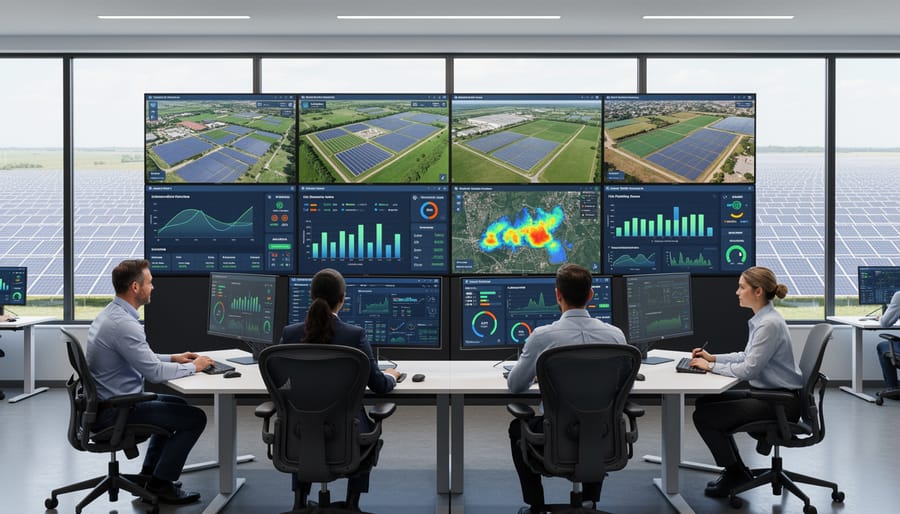
While solar installations continue to proliferate across commercial and industrial facilities, traditional centralized solar monitoring systems present significant operational challenges that impact both security and cost-efficiency.
In conventional systems, performance data from every solar panel and inverter flows continuously to central cloud servers for processing and analysis. This architecture creates several critical vulnerabilities. First, transmitting granular operational data from potentially hundreds or thousands of distributed sites generates substantial bandwidth costs, particularly for organizations managing multi-site solar portfolios. These expenses compound over time as installations scale.
Privacy and security concerns represent another fundamental limitation. When sensitive operational data, including energy consumption patterns and facility information, travels to external servers, organizations face increased exposure to data breaches and compliance complications. For government facilities and enterprises in regulated industries, this centralized approach may conflict with data sovereignty requirements.
Latency issues further complicate operational decision-making. The round-trip journey of data to distant servers and back introduces delays that can prevent real-time fault detection and response. A performance anomaly requiring immediate attention might go unnoticed for critical minutes or hours.
Perhaps most significantly, centralized systems create single points of failure. Server outages, network disruptions, or cybersecurity incidents can simultaneously disable monitoring across an entire solar portfolio, leaving facility managers operating blind during critical periods when intervention could prevent revenue loss or equipment damage.
How Federated Analytics Works Differently
Traditional solar analytics requires collecting detailed production data from multiple installations and transferring it to centralized servers for analysis. This creates data security concerns and raises questions about proprietary performance information being exposed. Federated analytics fundamentally reverses this paradigm by keeping your data exactly where it belongs: on your premises.
In the federated approach, lightweight machine learning models travel to your data rather than your data traveling to external servers. These models perform local analysis on each solar installation, learning from site-specific performance patterns, weather correlations, and equipment behaviors. Once the analysis is complete, only aggregated insights and model improvements return to a central coordination point. Your raw production data, operational details, and site-specific metrics never leave your control.
Consider a portfolio of commercial solar installations across different regions. With federated analytics, you can benchmark performance across all sites without transmitting sensitive operational data. The analytical model visits each facility, examines local production patterns against weather conditions and equipment specifications, then shares only the learned patterns. This allows portfolio-wide optimization strategies while maintaining complete data sovereignty at each location.
For example, if one site experiences unexpected performance degradation due to specific weather patterns, the federated model identifies this correlation locally. It then shares this learned insight with other sites facing similar conditions, enabling predictive maintenance recommendations without revealing the original site’s actual production numbers or operational data.
This approach delivers the benefits of centralized analytics while addressing legitimate concerns about data privacy, regulatory compliance, and competitive intelligence. Facility managers maintain full control over their operational data while still contributing to and benefiting from collective learning across distributed solar assets.
Real Business Benefits for Commercial Solar Operators
Enhanced Data Security and Compliance
Federated analytics fundamentally transforms how solar portfolio data is managed by keeping sensitive operational information where it belongs—on your premises. Unlike traditional cloud-based analytics that require uploading complete datasets to external servers, federated systems process data locally and share only aggregated insights. This architectural approach significantly reduces your organization’s exposure to potential data breaches, as raw performance metrics, energy consumption patterns, and facility-specific operational details never leave your controlled environment.
For government installations handling critical infrastructure data, this local-first approach addresses stringent data security and compliance requirements. Federal and state agencies can leverage advanced analytics without violating data sovereignty mandates or risking unauthorized access to sensitive facility information. The system enables comprehensive performance monitoring across multiple sites while maintaining the air-gapped security many government operations require.
Multi-tenant commercial properties benefit similarly, particularly when managing solar assets across facilities with different ownership structures or tenant privacy requirements. Property managers can analyze portfolio-wide performance trends without exposing individual tenant energy consumption data, maintaining contractual confidentiality while optimizing system-wide efficiency.
Compliance with GDPR, HIPAA, and industry-specific regulations becomes considerably more straightforward when personal or sensitive data remains on-premises. The reduced data transfer footprint minimizes your regulatory burden, simplifies audit trails, and decreases the scope of compliance documentation. For organizations in healthcare, finance, or critical infrastructure sectors operating distributed solar portfolios, federated analytics provides the operational visibility needed for asset optimization without compromising the rigorous data protection standards your industry demands.
Reduced Infrastructure Costs
Federated analytics delivers measurable infrastructure cost reductions by fundamentally changing how data flows across distributed solar installations. Traditional centralized monitoring systems require continuous transmission of raw operational data from each site to cloud servers, generating substantial bandwidth costs that scale with portfolio size. Organizations managing 50+ solar installations typically see data transmission expenses ranging from $15,000 to $30,000 annually.
With federated analytics, only processed insights and aggregated metrics travel to central systems, reducing data transmission volumes by 70-85%. This translates to bandwidth cost savings of $10,000-25,000 per year for mid-sized portfolios. Cloud storage requirements decrease proportionally, as raw granular data remains at edge devices rather than accumulating in centralized databases. Companies report 60-75% reductions in cloud storage fees, particularly significant when managing historical performance data across multiple years.
A commercial property management firm operating 75 rooftop solar installations across the Midwest documented annual infrastructure savings of $42,000 after implementing federated analytics. The reduced data footprint also decreased their IT security overhead and compliance management costs. For organizations evaluating solar monitoring solutions, these recurring savings compound over typical 15-25 year system lifespans, improving overall return on investment while maintaining comprehensive performance visibility across distributed assets.
Faster Anomaly Detection and Response
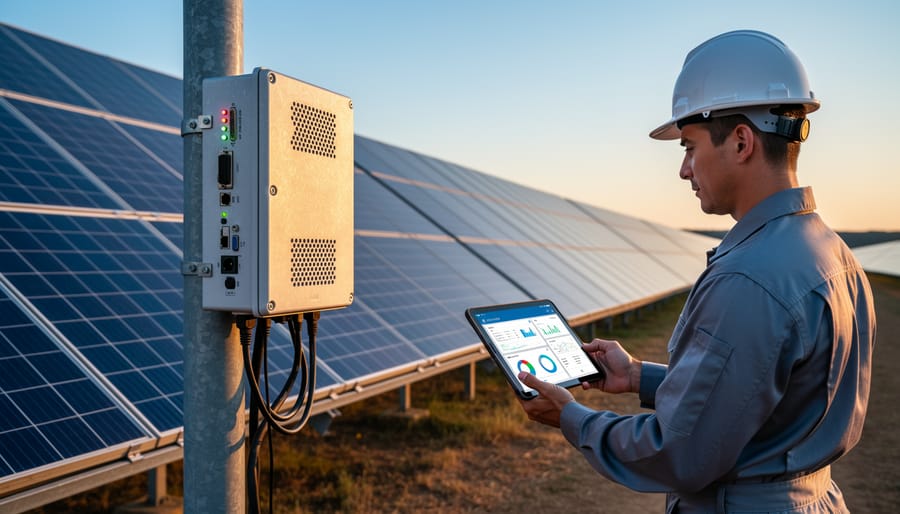
Federated analytics transforms how quickly you can identify and address performance issues across distributed solar installations. Traditional centralized monitoring systems create delays—data must be collected, transmitted, processed, and analyzed at a central location before problems become visible. With federated analytics, real-time performance monitoring occurs at each site, enabling immediate detection of underperforming panels, inverter malfunctions, or shading issues.
Consider a portfolio of commercial rooftop installations across multiple facilities. When a panel array begins underperforming due to soiling or equipment failure, local processing identifies the anomaly within minutes rather than hours or days. Your maintenance teams receive alerts immediately, allowing them to dispatch technicians before minor issues escalate into significant energy losses.
This approach proved valuable for a manufacturing company operating solar installations across twelve facilities. Their federated analytics system detected a 15% performance drop at one location within thirty minutes, identifying a faulty inverter. Rapid response prevented an estimated $8,000 in lost energy production during peak demand periods. The decentralized architecture ensures monitoring continuity even if network connectivity is temporarily disrupted, maintaining operational visibility when you need it most.
Federated Learning in Action: Solar Asset Management Applications
Predictive Maintenance Without Compromising Proprietary Data
A solar company managing 500+ commercial installations across Australia faced a critical challenge: how to leverage collective operational intelligence without exposing sensitive client data. Their solution demonstrates the practical power of federated analytics in transforming maintenance operations.
Traditional centralized monitoring required aggregating detailed performance data from all sites into a single database—raising concerns about competitive intelligence, operational security, and proprietary system configurations. Through federated analytics, the company implemented predictive maintenance while keeping each installation’s raw data on-site.
The system identified inverter degradation patterns by training machine learning models locally at each facility, then sharing only encrypted model updates to a central coordinator. Within six months, the federated approach detected a specific inverter failure signature appearing 14-21 days before complete shutdown. This pattern emerged from analyzing behavior across diverse installations but would have been invisible examining any single site. The company reduced inverter-related downtime by 43% without any facility manager sharing operational metrics with competitors.
Soiling detection provided another compelling example. Regional dust accumulation varies dramatically across Australia’s climate zones, making generic cleaning schedules inefficient. The federated system learned optimal cleaning intervals by correlating weather data, performance drops, and cleaning outcomes across installations in similar environments. Each site retained full control over its operational data while contributing to—and benefiting from—collective intelligence.
The financial impact proved substantial: maintenance costs decreased 28%, energy production increased 6% through optimized cleaning schedules, and equipment lifespan extended by reducing unnecessary interventions. Perhaps most significantly, facility managers gained confidence in the technology precisely because their competitive data remained secure, accelerating adoption across the portfolio and establishing a foundation for ongoing collaborative optimization.
Performance Benchmarking Across Multiple Sites
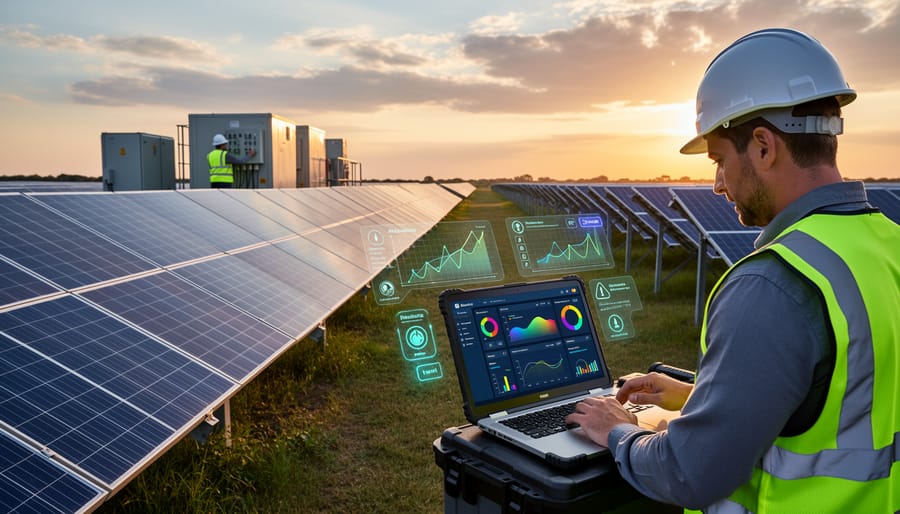
Organizations managing solar installations across multiple locations face a common challenge: how to identify performance variations and optimization opportunities without compromising data security or requiring complex centralized infrastructure. Federated analytics provides an elegant solution for retail chains, industrial facilities, and government building portfolios seeking actionable insights while maintaining data sovereignty.
Through federated analytics, facility managers can benchmark solar performance across their entire portfolio without transferring sensitive production data to a central repository. The system analyzes performance metrics locally at each site, then shares only aggregated insights and statistical comparisons. This approach enables organizations to identify underperforming installations, detect maintenance needs early, and recognize high-performing facilities that can serve as operational models.
For example, a retail chain with 200 stores can quickly identify which locations are achieving peak efficiency relative to local weather conditions and equipment specifications. If Store A consistently outperforms similar installations in comparable climates, facility managers can investigate operational practices worth replicating across the portfolio. Similarly, a government agency managing solar arrays across multiple buildings can identify installations requiring attention without exposing detailed energy consumption patterns that might raise security concerns.
The performance benchmarking process respects each site’s data privacy while delivering comprehensive comparative analytics. Organizations gain visibility into system-wide performance trends, regional variations, and equipment efficiency patterns. This intelligence drives informed decisions about maintenance schedules, equipment upgrades, and operational improvements, ultimately maximizing return on investment across the entire distributed solar portfolio.
Energy Production Forecasting with Collective Intelligence
Federated models transform energy production forecasting by enabling solar installations to collectively learn from weather patterns and operational data without centralizing sensitive information. Rather than aggregating raw performance data in a single repository, this approach trains machine learning models locally at each site, then combines only the learned insights to create superior predictive algorithms.
Consider a commercial solar portfolio distributed across multiple climate zones. Traditional forecasting methods rely on historical data from individual sites, limiting accuracy when weather conditions shift unexpectedly. Federated analytics allows each installation to contribute learned patterns—such as how specific cloud formations affect output or how temperature variations influence panel efficiency—while keeping actual production data on-premises.
A Midwestern utility company implementing this approach improved their day-ahead production forecasts by 23 percent compared to isolated site predictions. Each facility’s model learned from local microclimates while benefiting from pattern recognition across the entire network. This enhanced accuracy enabled better grid integration planning and reduced reliance on backup power sources.
The methodology particularly benefits organizations managing assets across jurisdictional boundaries where data sovereignty regulations restrict information sharing. Each site maintains complete control over its operational data while still contributing to and benefiting from collective intelligence that strengthens forecasting accuracy network-wide.
Implementation Considerations for Your Solar Portfolio
When Federated Analytics Makes the Most Sense
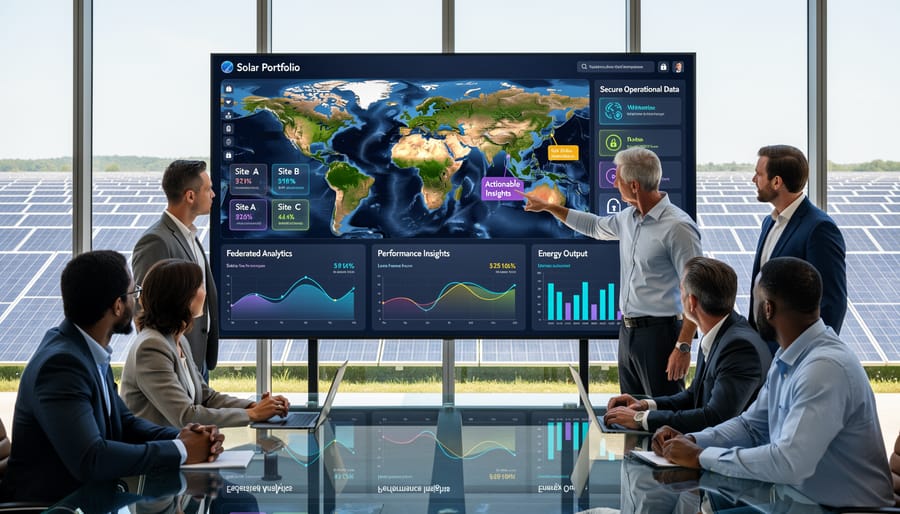
Federated analytics delivers maximum value in specific organizational contexts where traditional centralized monitoring falls short. Organizations managing multiple solar installations across different geographic regions benefit significantly from this approach, as it eliminates the need to consolidate sensitive operational data in a single location while still providing comprehensive performance insights.
Companies operating under stringent data privacy regulations find federated analytics particularly advantageous. Healthcare facilities, government buildings, and financial institutions with solar installations can maintain compliance with data sovereignty requirements while accessing the analytical insights needed to optimize energy production. The approach ensures that installation-specific data remains within controlled environments, satisfying both regulatory obligations and internal security protocols.
Limited bandwidth infrastructure presents another compelling use case. Remote installations in areas with restricted connectivity can perform local analysis and transmit only aggregated insights rather than raw data streams. This dramatically reduces bandwidth requirements while maintaining analytical capability, making advanced monitoring feasible where it previously wasn’t practical.
Organizations concerned with competitive intelligence protection also benefit substantially. Companies with proprietary solar technologies or innovative installation approaches can participate in performance benchmarking without exposing trade secrets or operational details to competitors or third-party analytics providers.
The technology proves equally valuable for multi-tenant commercial properties where different stakeholders require insights into their respective systems without access to others’ data. Property managers can oversee portfolio-wide performance while maintaining strict data separation between tenants, delivering transparency without compromising privacy.
Technical Requirements and Infrastructure
Implementing federated analytics requires specific infrastructure elements that work together to protect data while delivering actionable insights. At the foundation, solar installations need edge computing capabilities that process data locally before sharing aggregated results. These edge devices typically include modern inverters or dedicated monitoring hardware with sufficient processing power to run analytics algorithms on-site.
Local processing requirements are surprisingly modest for most solar applications. Standard commercial inverters manufactured after 2020 generally possess adequate computational resources, while older installations may need firmware updates or add-on edge processors. These systems must handle real-time performance calculations, anomaly detection, and pattern recognition without transmitting raw operational data externally.
Compatibility with existing monitoring platforms is essential for practical deployment. Leading solar management systems now offer federated analytics integration through API connections or cloud-based coordination layers. This architecture allows your current dashboards and reporting tools to receive enhanced insights while maintaining your existing workflows. The coordination server orchestrates model training across sites without ever accessing individual facility data, ensuring seamless operation alongside traditional monitoring infrastructure.
Integration with Existing Solar Monitoring Systems
Federated analytics integrates seamlessly with most existing solar monitoring platforms through software-based implementation, minimizing infrastructure disruption. The technology operates as an overlay to current systems, utilizing existing data collection points from inverters, sensors, and meters without requiring hardware replacement. Most commercial-grade monitoring systems already capture the necessary operational data—federated analytics simply changes how that information is analyzed and shared.
Implementation typically requires modest system modifications. Your monitoring platform needs API connectivity to enable secure federated queries, and edge devices may need software updates to perform local computations. Leading solar monitoring vendors increasingly offer federated analytics compatibility, recognizing the technology’s alignment with data privacy regulations and multi-site portfolio management needs.
For facilities with legacy systems, middleware solutions can bridge compatibility gaps, enabling participation in federated networks without complete system overhauls. The investment focuses primarily on software licensing and initial configuration rather than capital-intensive equipment replacement. A commercial solar portfolio operator recently integrated federated analytics across 40 sites within three months, maintaining their existing Schneider Electric monitoring infrastructure while gaining cross-portfolio performance insights. This layered approach preserves your current investment while unlocking advanced analytical capabilities.
The Future of Distributed Solar Intelligence
The solar energy landscape is rapidly evolving, and federated analytics positions organizations at the forefront of several transformative developments that will reshape how we generate, distribute, and manage renewable energy.
Smart grid integration represents one of the most promising applications on the horizon. As utilities modernize infrastructure, federated analytics enables solar installations to participate intelligently in grid management without exposing sensitive operational data. Distributed solar assets can collectively optimize their output based on real-time demand signals while maintaining individual control over proprietary performance information. This capability becomes increasingly valuable as grid operators seek to balance intermittent renewable generation with consumption patterns.
Peer-to-peer energy trading platforms are emerging as another frontier where federated analytics delivers competitive advantages. Organizations with distributed solar portfolios can participate in local energy markets, sharing surplus generation with neighboring facilities or the broader community. The federated approach allows market participants to verify production capacity and reliability through aggregated insights while protecting strategic information about specific installations, pricing strategies, and consumption patterns.
The technology also supports adaptive energy management as regulatory frameworks evolve. Future carbon accounting requirements, renewable energy certificates, and sustainability reporting standards will demand verifiable performance data. Federated analytics provides the infrastructure to demonstrate compliance and environmental impact across distributed assets without centralizing sensitive operational details that might reveal business strategies or facility vulnerabilities.
Forward-looking organizations are already positioning themselves to leverage these capabilities. A regional healthcare network recently implemented federated analytics across fifteen facilities, establishing the technical foundation to participate in upcoming demand response programs and virtual power plant initiatives. Their distributed intelligence framework enables coordinated response to grid signals while each facility maintains autonomous control.
As artificial intelligence and machine learning capabilities advance, federated analytics will become increasingly sophisticated, enabling predictive maintenance, automated optimization, and intelligent energy arbitrage across distributed solar portfolios. Organizations implementing this technology today are building the data infrastructure necessary to capture value from these emerging opportunities while maintaining the security and control that stakeholders demand.
Federated analytics represents a transformative approach for commercial solar operators seeking to maximize asset performance without compromising data sovereignty. This technology enables portfolio owners to benefit from collective intelligence and advanced predictive capabilities while maintaining complete control over their operational information—a critical consideration in today’s competitive energy landscape.
The strategic value proposition is clear: organizations can protect their substantial solar investments through superior analytics that identify performance issues earlier, optimize energy production more effectively, and reduce maintenance costs across distributed installations. Rather than choosing between data privacy and analytical power, federated analytics delivers both, allowing businesses to participate in industry-wide learning while safeguarding proprietary operational data.
Looking ahead, federated analytics positions solar operators at the forefront of energy management innovation. As the solar industry evolves toward more sophisticated demand response programs, grid integration requirements, and regulatory reporting standards, organizations with advanced monitoring capabilities will maintain competitive advantages. The ability to benchmark performance against aggregated industry data while protecting sensitive information becomes increasingly valuable as portfolios scale and energy markets grow more complex.
At EU Solar, we remain committed to delivering monitoring solutions that address the real-world challenges facing commercial solar operators. Our focus on practical, results-driven technology ensures that clients can leverage cutting-edge analytics without unnecessary complexity or risk. If you’re managing multiple solar installations and want to understand how federated analytics could enhance your portfolio’s performance, we invite you to schedule a comprehensive assessment of your current monitoring capabilities and future requirements.