
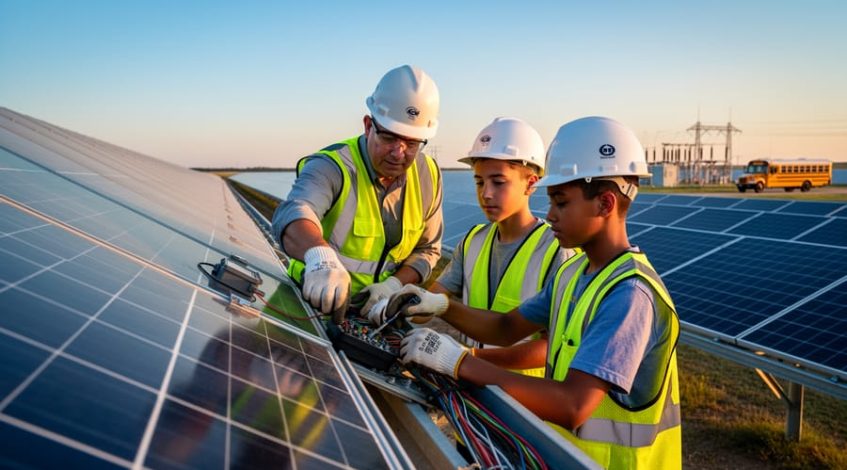
Regional energy access expansion projects deliver measurable returns when they integrate workforce development from the planning stage forward. Energy leaders implementing large-scale solar installations face a critical decision: build infrastructure alone or simultaneously create sustainable employment pipelines that reduce long-term operational costs while strengthening community support.
The business case is quantifiable. Solar projects incorporating K-12 workforce development components report 23-31% higher community approval ratings and access to specialized tax incentives unavailable to standard installations. These initiatives create qualified technician pools, reducing future recruitment costs by an average of $47,000 per position while decreasing project timeline delays caused by skilled labor shortages.
Three factors distinguish successful regional energy access programs from conventional deployments. First, strategic partnerships with local educational institutions establish technical training curricula aligned with actual project specifications, ensuring graduates possess immediately applicable skills. Second, structured internship programs during construction phases provide hands-on experience while accelerating project completion through additional supervised labor capacity. Third, post-installation maintenance contracts prioritizing program graduates create closed-loop employment ecosystems that benefit both energy operators and communities.
Government officials and business leaders evaluating these projects must balance immediate infrastructure needs against long-term operational efficiency. Evidence from completed installations demonstrates that upfront investments in educational programming deliver 3-5 year payback periods through reduced labor costs, improved system performance from locally trained maintenance teams, and enhanced access to workforce development grants averaging $250,000-$2.1 million depending on project scale.
This framework transforms energy access expansion from purely technical infrastructure deployment into strategic community investment, aligning renewable energy adoption with economic development objectives while addressing the solar industry’s persistent skilled workforce shortage.
The Workforce Gap in Renewable Energy Expansion
Understanding the Scale of Regional Energy Projects
Regional energy access expansion projects represent substantial infrastructure investments designed to provide reliable, sustainable power to multiple facilities or entire communities. These initiatives typically fall into three primary categories: commercial installations serving business parks or industrial corridors, municipal systems powering government facilities and public infrastructure, and community solar programs that enable shared renewable energy access across residential and commercial subscribers.
The scope of these projects varies considerably based on geographical coverage and energy demands. A typical regional installation might range from 5 to 50 megawatts of generating capacity, serving anywhere from several dozen to several thousand end users. Project timelines generally span 18 to 36 months from initial planning through full operational deployment, including feasibility studies, permitting, construction, and grid integration phases.
Workforce requirements for regional projects are substantial and diverse. Initial development phases demand energy analysts, engineers, and regulatory specialists. Construction periods require project managers, electricians, equipment installers, and safety coordinators. Ongoing operations necessitate maintenance technicians, system monitors, and customer service personnel. A moderately sized 10-megawatt project typically engages 150 to 250 workers across all phases, with 15 to 30 permanent positions for long-term operations and maintenance.
Understanding these parameters enables stakeholders to accurately assess investment requirements, economic impact potential, and workforce development opportunities. This foundation proves essential when integrating educational components into project planning, creating pathways that transform infrastructure development into community-building initiatives that address both immediate energy needs and long-term workforce sustainability.
Why Traditional Hiring Models Fall Short
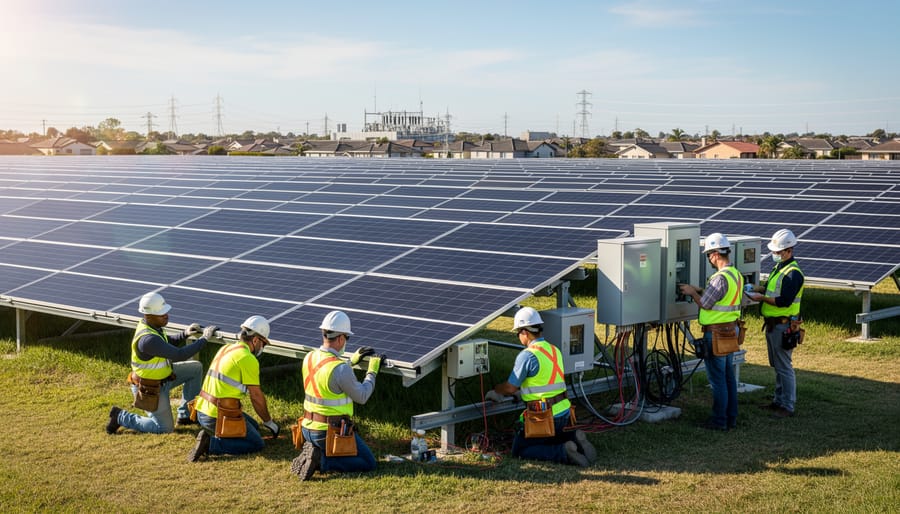
The solar industry faces significant workforce challenges that traditional hiring approaches cannot adequately address. Existing talent pools for specialized roles—including electrical engineers, photovoltaic installers, and energy systems technicians—remain critically limited, creating intense competition among solar companies, utility providers, and government agencies pursuing renewable energy mandates.
This talent shortage directly impacts project timelines and costs. Solar companies report difficulty filling 60-70% of technical positions through conventional recruitment channels, while government agencies struggle to staff regional energy access initiatives within budget constraints. The competitive pressure intensifies as industrial facilities simultaneously seek qualified personnel to manage on-site solar installations.
Traditional hiring models also fail to account for the rapid evolution of solar technology and installation methodologies. Workers trained five years ago may lack current knowledge of bifacial modules, energy storage integration, or advanced monitoring systems. Furthermore, geographic constraints limit workforce mobility, particularly in rural regions where energy access expansion is most critical.
The return on investment for solar projects depends heavily on efficient, skilled installation and maintenance. Companies relying solely on existing workforce pools face extended recruitment periods, increased labor costs, and potential project delays—factors that ultimately affect the economic viability of regional energy expansion efforts.
K-12 Pipelines: A Strategic Workforce Solution

Building Career Pathways from Classroom to Installation
Successful regional energy access expansion projects create structured pathways that guide students from initial awareness through professional employment in the solar industry. This progression begins with early exposure programs in middle schools, where students explore renewable energy concepts through hands-on demonstrations and facility tours. These introductory experiences spark interest and provide foundational knowledge about career opportunities in renewable energy.
The pathway advances through technical training partnerships with community colleges and vocational institutions, where students gain industry-recognized certifications in photovoltaic installation, electrical systems, and safety protocols. Leading projects incorporate dual enrollment programs allowing high school students to earn college credits while completing coursework in solar technology fundamentals and system design.
Apprenticeship programs represent the critical bridge between classroom learning and professional practice. These structured experiences combine supervised on-site training with continued technical education, typically spanning 12-24 months. Apprentices work alongside certified installers on actual project sites, developing practical skills in module mounting, inverter installation, and system commissioning.
Entry-level positions in solar installation and system management provide the final step in this progression. Recent graduates assume roles as installation technicians, maintenance specialists, or project coordinators, applying their training to real-world applications. Many regional projects establish hiring preferences for local program graduates, ensuring workforce investments directly benefit community employment while meeting project staffing requirements. This comprehensive pathway model generates measurable returns through reduced recruitment costs and improved installation quality.
Educational Components That Drive Results
Effective regional energy access expansion projects integrate comprehensive educational frameworks that transform students into qualified renewable energy professionals. Successful curriculum design begins with robust STEM foundations—mathematics for electrical calculations, physics for understanding photovoltaic principles, and engineering concepts that underpin solar system design and installation.
The most impactful programs emphasize hands-on technical competencies. Students gain practical experience with system diagnostics, equipment installation, maintenance protocols, and performance optimization. These solar technician training programs utilize real equipment and simulated work environments, ensuring graduates possess job-ready capabilities that meet industry standards.
Safety certification represents a non-negotiable component. Programs incorporate OSHA standards, electrical safety protocols, fall protection training, and hazardous materials handling. These certifications protect workers while meeting regulatory requirements that employers demand.
Industry-recognized credentials provide measurable value for both students and partnering organizations. North American Board of Certified Energy Practitioners (NABCEP) certifications, state electrical licenses, and manufacturer-specific qualifications validate competency levels. These credentials create immediate workforce readiness, reducing employer training costs and accelerating project timelines.
Beyond technical expertise, successful programs develop cross-disciplinary skills including project management, customer communication, and business operations understanding. This comprehensive approach produces professionals capable of contributing across the renewable energy value chain—from installation teams to project coordination roles—delivering measurable return on investment for regional energy initiatives while building sustainable local workforces.
Real-World Implementation Models
Commercial Solar Companies and School Partnerships
Commercial solar companies are increasingly recognizing that strategic partnerships with K-12 educational institutions create sustainable talent pipelines while advancing regional energy goals. These collaborations transform traditional business-education relationships into comprehensive workforce development ecosystems that deliver measurable returns for all stakeholders.
Leading solar providers partner with school districts to establish technical training programs that align curriculum with industry certification requirements. Students gain hands-on experience with photovoltaic installation, system design, and energy management software through classroom instruction and field placement opportunities. This direct exposure to solar technology creates qualified entry-level candidates ready to contribute immediately upon graduation or program completion.
The mutual benefits extend beyond workforce preparation. Educational institutions receive financial support for upgrading facilities with solar installations that reduce operational costs while serving as living laboratories for student learning. Companies gain access to emerging talent, reduce recruitment expenses, and demonstrate community investment that strengthens their regional market position.
A successful partnership model includes structured internship programs where students work alongside certified installers during summer months and school breaks. Companies provide mentorship, equipment training, and clear pathways to full-time employment. Schools incorporate industry-validated competencies into their technical education tracks, ensuring students develop skills that meet current market demands.
Data from established partnerships shows retention rates exceeding 80 percent for students hired after program completion, significantly higher than traditional recruitment channels. This stability allows companies to scale operations confidently while supporting regional energy access expansion through reliable workforce availability. The approach creates a self-reinforcing cycle where educational investment yields qualified professionals who advance clean energy deployment objectives.
Government-Led Regional Energy and Education Initiatives
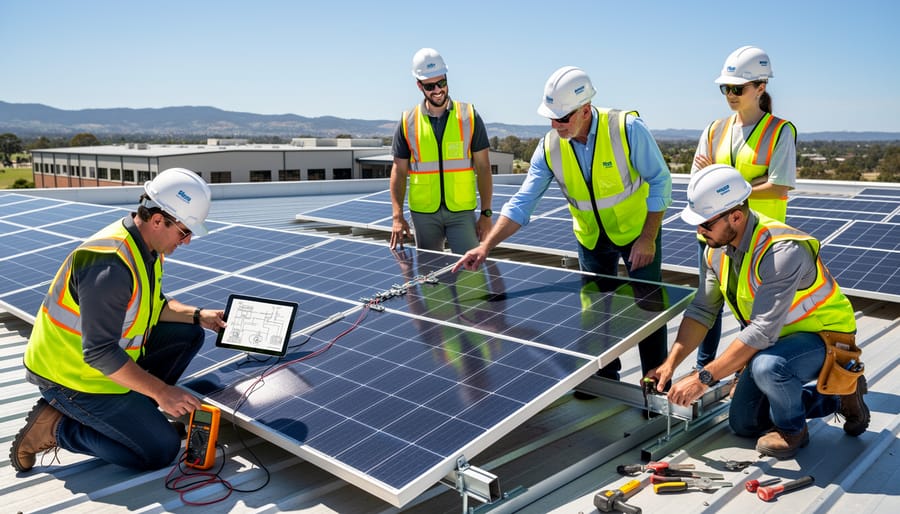
Municipal and county governments across the United States are implementing innovative programs that integrate clean energy infrastructure development with workforce training, creating sustainable economic benefits for their regions. These initiatives demonstrate how public sector leadership can catalyze both energy transition and job creation.
The California Energy Commission’s Clean Energy Workforce Training Program allocates $20 million annually to community colleges and regional partnerships, connecting solar installation projects with apprenticeship programs. Participating counties like Riverside and San Bernardino have documented 40% increases in qualified solar technicians while simultaneously expanding distributed generation capacity by 150 megawatts. The program’s funding structure combines state renewable energy credits with federal grant matching, creating a replicable model for resource-constrained municipalities.
In North Carolina, the Community Solar and Workforce Alliance coordinates between utility companies, technical schools, and local governments to align utility-scale solar development timelines with training program cycles. This stakeholder coordination ensures that graduates enter the workforce precisely when construction phases require skilled labor, reducing project delays by an average of 60 days and lowering recruitment costs by 30%.
The Iowa Clean Energy Collaborative represents a rural-focused approach, where county economic development offices partner with agricultural extension programs to deliver solar training in underserved areas. This program has established 12 regional training centers, each supported by a blend of property tax incentives, state workforce development funds, and utility contributions. Facilities enrolled in these programs report 25% reductions in energy costs while accessing a locally-trained workforce, demonstrating measurable return on investment for both public infrastructure and private sector participants.
Benefits for Project Stakeholders
Advantages for Commercial Solar Providers
Commercial solar providers participating in regional energy access expansion projects gain substantial operational and strategic advantages. Most significantly, these partnerships dramatically reduce recruitment costs by establishing a structured pipeline of qualified candidates already familiar with industry standards and equipped with critical digital skills. Rather than investing heavily in traditional recruitment channels and lengthy onboarding processes, companies can connect directly with program graduates who possess both technical competencies and practical experience.
The partnership model enhances community reputation, positioning providers as committed stakeholders in regional development rather than merely transactional service vendors. This relationship-building proves invaluable when pursuing government contracts or large-scale commercial installations where community engagement matters.
Long-term workforce stability represents another key benefit. Employees recruited through local training programs typically demonstrate higher retention rates, reducing turnover costs and maintaining project continuity. These workers often bring valuable local knowledge, understanding regional infrastructure challenges and community needs. Additionally, providers gain access to emerging talent early in their career development, allowing companies to shape skills training according to specific operational requirements and technological advancements in solar installation and maintenance protocols.
Value Proposition for Facility Managers and Industry Leaders
Investing in regional energy access expansion projects with integrated workforce development delivers measurable returns for facility managers and industry leaders. Better-trained installation teams translate directly to superior project outcomes, including reduced installation timelines, fewer callbacks for repairs, and enhanced system performance. Organizations benefit from working with certified professionals who understand proper mounting techniques, electrical safety protocols, and quality assurance standards.
Beyond immediate project quality improvements, partnering with programs that develop local talent strengthens your supply chain reliability. Companies gain access to a growing pool of qualified technicians familiar with regional conditions and building codes, reducing project delays and coordination challenges. This localized expertise proves particularly valuable for multi-site installations or ongoing maintenance requirements.
The community economic development dimension offers strategic advantages as well. Organizations demonstrating commitment to workforce development enhance their competitive positioning for government contracts, grant opportunities, and corporate sustainability reporting. These initiatives create measurable social impact metrics while addressing the industry’s critical skills gap. Facility managers report improved vendor relationships and smoother project execution when working with teams connected to structured training programs that maintain rigorous performance standards and accountability frameworks.
Implementation Framework for Energy Expansion Projects
Assessment and Partnership Development
Successful regional energy access projects begin with systematic partner identification and needs assessment. Start by engaging local school districts, vocational institutions, and community colleges to evaluate existing renewable energy curricula and capacity for expansion. Conduct regional workforce analysis through collaboration with economic development agencies and industry associations to identify current skill gaps and projected employment demand in the solar sector over the next five to ten years.
Establish a stakeholder advisory committee comprising educational administrators, business leaders, and government representatives to ensure alignment between training programs and industry requirements. This collaborative approach enables institutions to develop curricula that meet real-world certification standards while addressing local employment needs.
Partnership agreements should clearly outline roles, responsibilities, and deliverables with measurable milestones tied to project phases. Include provisions for equipment donations, internship placements, and instructor training opportunities that leverage your organization’s technical expertise. A manufacturing facility in North Carolina successfully partnered with three regional technical colleges, creating a pipeline of 150 certified solar installers over two years by providing hands-on training equipment and guaranteed interview opportunities.
Timeline coordination ensures educational programs launch in sync with construction phases, allowing students to gain practical experience while contributing to actual project implementation. This strategic alignment maximizes return on investment while building sustainable workforce capacity.
Program Design and Resource Allocation
Successful workforce development programs require strategic resource allocation across multiple components. Begin by establishing curriculum partnerships with local school districts, providing age-appropriate materials that align with state educational standards while introducing solar technology fundamentals. Equipment donations should focus on scalable solutions—consider supplying solar demonstration kits, measurement tools, and decommissioned panels for hands-on learning experiences that don’t strain facility budgets.
Mentorship programs deliver exceptional return on investment when structured properly. Allocate resources for employee time commitments, typically 2-4 hours monthly per mentor, and establish clear program objectives that benefit both students and participating organizations. Companies participating in regional energy access initiatives often report enhanced community relations and improved talent pipelines.
Budget allocation should follow a 40-30-30 model: 40 percent for equipment and materials, 30 percent for curriculum development and teacher training, and 30 percent for program administration and mentorship coordination. This framework ensures sustainable program delivery while maintaining quality standards.
Case studies demonstrate that facilities investing $25,000-$50,000 annually in workforce development initiatives see measurable benefits within 18-24 months, including improved local hiring outcomes and strengthened stakeholder relationships. Government officials should explore grant opportunities and tax incentives that offset initial program costs while advancing regional energy access goals.
Measuring Success and Long-Term Impact
Establishing comprehensive metrics is essential for evaluating the effectiveness of workforce pipeline programs within regional energy expansion initiatives. Success measurement requires a dual-focused approach that tracks immediate project outcomes alongside long-term community impact.
Short-term metrics should include participant enrollment numbers, program completion rates, and skill certification achievements. Track the number of students engaged in solar technology courses, internship placements secured, and industry partnerships established. Quantifiable data such as training hours delivered, equipment accessibility, and curriculum implementation across participating schools provides baseline indicators of program reach.
Medium-term evaluation focuses on career pathway progression. Monitor the percentage of program graduates entering post-secondary energy programs, apprenticeships, or direct employment within the sector. These metrics demonstrate the pipeline’s effectiveness in converting educational opportunities into viable career trajectories for future solar industry leaders.
Long-term impact assessment requires sustained data collection over three to five years. Key performance indicators include local employment rates within the renewable energy sector, wage growth for program participants, and workforce retention statistics. Evaluate whether the regional energy expansion has created lasting economic benefits through reduced dependence on external labor sources and increased local expertise.
Community-level metrics provide broader context for program success. Measure improvements in regional energy literacy, public perception of renewable energy careers, and demographic diversity within the workforce pipeline. Track cost savings achieved through local workforce development compared to external recruitment expenses.
Financial return on investment should quantify training program costs against economic benefits generated through employment creation, reduced project delays, and enhanced regional economic development. Regular stakeholder surveys from industry partners, educational institutions, and participating families offer qualitative insights that complement quantitative data, ensuring comprehensive program evaluation and continuous improvement opportunities.
Regional energy access expansion projects represent more than infrastructure development—they constitute strategic investments in long-term industry sustainability. Organizations that integrate K-12 workforce development into project planning position themselves at the forefront of an evolving energy landscape while generating tangible competitive advantages. Early adopters benefit from enhanced community support, preferential regulatory consideration, and access to a growing pipeline of skilled professionals trained specifically in renewable energy technologies.
The evidence is compelling. Regions that have successfully embedded educational components into energy infrastructure projects report accelerated installation timelines, reduced recruitment costs, and stronger stakeholder relationships. These outcomes translate directly to improved project economics and operational efficiency. As the renewable energy sector continues its rapid expansion, the availability of qualified technicians, engineers, and support personnel will increasingly differentiate successful projects from those facing delays and cost overruns.
The strategic imperative is clear: workforce development cannot be treated as an ancillary consideration or public relations opportunity. Instead, it must be integrated into the foundational planning of regional energy access expansion projects. Decision-makers should allocate resources for educational partnerships during initial project scoping, establish measurable workforce development objectives alongside energy production targets, and create accountability structures that ensure sustained commitment.
The transition to renewable energy represents a generational opportunity to build economic resilience while addressing critical energy needs. Stakeholders who recognize workforce development as essential infrastructure—not optional enhancement—will capture the greatest value while contributing to a robust, sustainable energy economy.