

Maximize federal tax credits worth up to 30% of your solar installation costs through the residential energy-efficient property credit, now extended through 2032 under the Inflation Reduction Act. This incentive directly reduces your tax liability dollar-for-dollar, delivering immediate financial returns that significantly shorten payback periods for commercial solar investments.
Calculate your potential savings by multiplying your total system cost—including equipment, labor, and installation—by the applicable credit percentage. For projects completed in 2023, the full 30% credit applies to qualifying solar photovoltaic systems, solar water heaters, and battery storage systems with capacity of at least 3 kilowatt-hours. Unlike deductions that merely reduce taxable income, this credit provides a direct reduction in taxes owed, making it one of the most valuable financing mechanisms available for energy infrastructure upgrades.
Layer this federal incentive with accelerated depreciation through the Modified Accelerated Cost Recovery System (MACRS), which allows businesses to recover 85% of their investment through depreciation deductions over five years. When combined strategically, these two mechanisms can offset 50-60% of total project costs within the first year alone.
Structure your financing approach to capture both immediate tax benefits and long-term operational savings. Business owners consistently report that integrating the residential energy-efficient property credit with power purchase agreements or solar loans creates optimal cash flow outcomes while maintaining balance sheet flexibility for facility expansions and equipment upgrades.
Understanding the Residential Energy-Efficient Property Credit

What Qualifies Under the Credit
The residential energy-efficient property credit covers a comprehensive range of solar equipment and components essential for a functioning photovoltaic system. Understanding these qualifying elements helps facility managers and business owners accurately calculate potential tax benefits when planning solar installations.
Solar photovoltaic panels form the foundation of eligible equipment, regardless of whether they’re monocrystalline, polycrystalline, or thin-film technology. The credit applies to the complete system cost, including all necessary components for energy generation. Inverters, which convert DC power from panels to usable AC electricity, qualify as integral system components. Both string inverters and microinverter configurations meet credit requirements.
Mounting and racking systems represent another qualified expense category. Ground-mount structures, rooftop mounting hardware, and tracking systems that optimize panel orientation all fall under eligible costs. The installation labor directly associated with these components also qualifies, providing substantial savings on total project expenses.
Battery storage systems gained explicit credit eligibility under recent legislative updates, marking a significant expansion for energy independence strategies. Lithium-ion batteries, flow batteries, and other storage technologies that pair with solar installations now qualify for the same credit percentage as generation equipment.
Technical specifications require that equipment meets standard industry certifications. Panels must comply with relevant safety standards, while inverters need appropriate grid-connection certifications. Systems must be new equipment placed in service at the property location, with installation completed by qualified professionals following local electrical codes and permitting requirements.
Credit Percentage and Timeline
The residential energy-efficient property credit currently offers a substantial 30% tax credit on qualified solar installations, representing a significant opportunity for property owners to reduce upfront investment costs. This rate applies to systems placed in service from 2022 through December 31, 2032, providing an extended planning window for facility managers and business decision-makers considering solar energy investments.
Understanding the timeline is essential for strategic planning. Beginning January 1, 2033, the credit rate decreases to 26%, followed by a further reduction to 22% in 2034. After 2034, unless Congress extends the program, the residential credit is scheduled to expire entirely. This step-down schedule creates a clear financial incentive to prioritize installations during the current 30% phase.
For commercial property owners evaluating solar investments, this timeline presents a concrete planning framework. A project installed in 2032 qualifies for the full 30% credit, potentially representing hundreds of thousands in tax savings depending on system size. Delaying until 2033 reduces that benefit by 4%, directly impacting project ROI calculations. Successful implementation requires coordinating with qualified installers, understanding permitting timelines, and ensuring systems are operational before relevant deadlines to capture maximum financial benefits.
How the Credit Works as a Financing Strategy
Direct Cost Reduction Impact
Understanding the financial impact of the residential energy-efficient property credit requires examining concrete scenarios. For a typical 50kW commercial solar installation with a baseline cost of $75,000, the 30% federal tax credit delivers $22,500 in direct savings, reducing the effective project cost to $52,500. This substantial reduction significantly improves payback periods and return on investment calculations.
Consider a mid-sized facility installing a 100kW system at $140,000. The credit provides $42,000 in tax relief, bringing the net investment down to $98,000. When combined with smart energy management systems that optimize consumption patterns, facilities can achieve payback periods of 5-7 years rather than 8-10 years without the credit.
Larger commercial projects demonstrate even more compelling savings. A 250kW installation costing $320,000 receives a $96,000 credit, effectively reducing capital requirements to $224,000. For organizations with sufficient tax liability, this immediate reduction in project costs improves cash flow and allows for faster deployment of additional energy efficiency measures.
The credit applies to equipment and installation costs, including solar panels, inverters, mounting systems, and labor. However, it excludes costs for energy storage systems unless they meet specific charging requirements. Business owners should work with qualified tax professionals to ensure all eligible expenses are properly documented and claimed, maximizing the financial benefit while maintaining compliance with IRS regulations.
Tax Liability Considerations
Understanding your tax liability position is essential when planning to utilize the residential energy-efficient property credit. This nonrefundable credit can only offset your actual tax liability, meaning the credit reduces the amount of tax you owe but won’t generate a refund if it exceeds your liability. Business owners considering solar investments through residential properties or rental units must ensure they have adequate taxable income to capture the full credit value.
For situations where the credit exceeds your current year tax liability, the IRS provides carryforward provisions. Unused portions of the credit can be carried forward to subsequent tax years, preserving the value of your investment incentive. This flexibility allows strategic timing of solar installations based on projected income streams and tax obligations.
Effective tax planning requires analyzing your multi-year tax position before committing to solar projects. Consider coordinating with a tax professional to model various scenarios, including the timing of equipment purchases, installation schedules, and how these decisions interact with other business deductions or credits. Some business owners strategically time installations to align with high-income years, maximizing immediate credit utilization.
Additionally, understanding the interplay between federal credits and state-level incentives becomes crucial for comprehensive planning. Some states offer complementary credits or accelerated depreciation schedules that can further enhance your return on investment. Real-world applications demonstrate that businesses incorporating tax liability analysis into their solar feasibility studies achieve significantly better financial outcomes than those viewing the credit in isolation from their broader tax strategy.

Combining the Credit with Other Financing Options
Solar Loans and the Tax Credit
Solar loans present unique considerations when paired with the residential energy-efficient property credit. These financing products allow property owners to proceed with installations immediately while the tax credit reduces overall project costs by 30 percent. However, understanding the timing gap between loan disbursement and credit realization is essential for cash flow planning.
Most solar loans require monthly payments beginning shortly after installation completion, while the tax credit typically arrives when filing the following year’s tax return. For a commercial facility installing a $100,000 system in June 2024, loan payments commence immediately, but the $30,000 credit won’t materialize until filing 2024 taxes in early 2025. Decision-makers should evaluate their organization’s liquidity to bridge this 6-12 month period.
Some lenders offer deferred payment structures or reduced initial payments specifically designed to align with credit timing. These energy-efficient financing options may carry slightly different interest rates but provide better cash flow alignment. Additionally, organizations with sufficient tax liability can apply the credit directly against their annual tax burden, effectively reducing the true financed amount and accelerating ROI calculations. Facility managers should consult tax advisors to structure loans optimally around expected credit realization timelines.
Power Purchase Agreements (PPAs) and Leasing
For entities without sufficient tax liability to directly benefit from the residential energy-efficient property credit, Power Purchase Agreements (PPAs) and leasing arrangements provide alternative pathways to solar adoption. Under these third-party ownership models, a solar developer or financial institution retains system ownership and claims the associated tax credits, while the host property owner purchases the generated electricity at predetermined rates typically lower than utility prices.
In a PPA structure, the third-party owner finances, installs, operates, and maintains the solar system. The property owner enters into a long-term agreement—usually 15 to 25 years—to purchase the electricity produced at a fixed or escalating rate. This arrangement eliminates upfront capital requirements and transfers performance risk to the system owner, who monetizes the tax credit to improve project economics and offer competitive energy rates.
Leasing follows similar principles, with the property owner making regular payments for system use rather than purchasing electricity directly. Both structures enable organizations with limited tax appetite, such as nonprofits or entities with net operating losses, to access solar energy benefits indirectly through operational expense reductions rather than capital investments. The third-party owner’s ability to fully utilize the tax credit creates a win-win scenario, reducing energy costs for the host while providing attractive returns for the investor.
State and Local Incentive Stacking
Maximizing financial returns on solar investments requires strategic coordination of federal, state, and local incentive programs. The federal residential energy-efficient property credit can be combined with state-level tax credits and rebates without reduction, provided specific documentation requirements are met. For example, a commercial facility implementing solar improvements may claim the federal credit while simultaneously accessing state renewable energy incentives and utility company rebates.
State programs vary significantly by jurisdiction. Some states offer additional tax credits ranging from 10-25% of installation costs, while others provide direct rebates or performance-based incentives. Local utility companies frequently supplement these programs with demand-response credits and time-of-use rate optimization opportunities. When planning comprehensive energy upgrades, facility managers should conduct a complete incentive audit before finalizing project specifications.
Documentation proves critical for successful stacking. Maintain separate records for each incentive program, including itemized invoices, independent third-party certifications, and utility interconnection agreements. Many states require specific forms demonstrating that federal credits claimed do not duplicate state benefits. Professional tax advisors familiar with renewable energy incentives can identify optimal claiming strategies and ensure compliance across multiple jurisdictions, often uncovering additional savings opportunities through strategic project timing and phasing approaches.
Claiming the Credit: Process and Requirements
Required Documentation and Forms
Claiming the residential energy-efficient property credit requires proper documentation to substantiate your investment and ensure compliance with IRS requirements. For residential installations, property owners must complete Form 5695, which calculates the credit amount based on qualified solar expenditures. This form accompanies your annual tax return and captures essential details about the system installation, including costs and placement dates.
Commercial property owners should note that business installations utilize Form 3468 for the Investment Tax Credit, which follows different reporting protocols but shares similar documentation requirements. Regardless of property type, maintaining comprehensive records is critical for audit protection and credit verification.
Essential documentation includes itemized invoices from certified installers, manufacturer certifications confirming equipment meets IRS standards, and proof of payment. The IRS requires that solar panels and related equipment carry appropriate certifications, typically provided by the Solar Rating and Certification Corporation. Property owners should retain installation contracts, permits, interconnection agreements with utility companies, and photographic evidence of the completed system.
Best practices include maintaining a dedicated file with all solar-related documents for at least seven years, organizing receipts chronologically, and keeping digital backups of certification documents. For multi-phase projects, track expenditures separately by tax year to accurately allocate credits across filing periods.
Timeline and Tax Filing Considerations
The residential energy-efficient property credit must be claimed in the tax year when the system becomes operational, not necessarily when equipment is purchased or when initial deposits are made. For installations completed near year-end, careful documentation of the operational date becomes essential for accurate filing. Business entities operating on fiscal years should coordinate installation timelines with their tax planning strategy to optimize cash flow benefits and ensure proper credit utilization.
Taxpayers who discover eligibility after filing can claim the credit through an amended return using Form 1040-X, generally within three years of the original filing date. This provision offers flexibility for facility managers who initially overlooked the credit or completed installations mid-year. For commercial property owners who also invest in residential renewable systems, understanding the distinction between residential credits and commercial Investment Tax Credits prevents filing errors and maximizes available incentives.
Strategic timing considerations include coordinating multiple properties to avoid passive activity limitations and planning for potential carryforward scenarios when current-year tax liability proves insufficient to absorb the full credit. Consultation with tax professionals familiar with renewable energy incentives ensures compliance while identifying opportunities to accelerate depreciation benefits alongside credit claims, creating a comprehensive tax strategy that enhances overall project economics.
Real-World Application: Case Studies
Commercial Facility Solar Installation
A Midwest automotive parts manufacturer provides a compelling illustration of how strategic integration of the residential energy-efficient property credit with solar financing can deliver immediate financial benefits. The facility installed a 750 kW commercial solar array with a total project cost of $1.8 million in 2023.
By combining the federal Investment Tax Credit—worth $540,000 or 30% of the total installation cost—with a solar-specific loan structured over 20 years, the company achieved positive cash flow from the first year of operation. The financing arrangement allowed them to monetize the tax credit immediately, applying it as a principal reduction in year two, which substantially lowered their monthly loan obligations.
The financial metrics demonstrate the project’s viability: annual energy production of 975,000 kWh offset 68% of the facility’s electricity consumption, generating savings of $87,750 in the first year based on their $0.09 per kWh commercial rate. Monthly loan payments of $10,200 were more than covered by the combined monthly savings of $7,312 plus the avoided demand charges of $3,850, creating a net positive cash flow of $962 monthly before the tax credit application.
After applying the federal credit to reduce the loan principal, monthly payments decreased to $7,100, improving cash flow by an additional $3,100 monthly. The facility projects a complete loan payoff in 15.2 years, with 25-plus years of expected system operation, ultimately delivering cumulative savings exceeding $2.1 million over the system’s lifetime while significantly reducing their carbon footprint.

Government Institution Implementation
Government entities face unique challenges when implementing solar energy systems, primarily because they cannot directly utilize federal tax credits due to their tax-exempt status. A municipal water treatment facility in the Southwest successfully navigated this limitation through a strategically structured Power Purchase Agreement (PPA), demonstrating an effective alternative pathway to solar adoption.
The facility partnered with a qualified third-party developer who installed a 500-kilowatt solar array on the property at no upfront cost to the municipality. The developer retained ownership of the system and claimed the 30 percent federal tax credit, passing the savings to the facility through reduced electricity rates. Under the 20-year PPA, the municipality agreed to purchase power at a fixed rate 15 percent below their existing utility costs, generating immediate operational savings.
This arrangement delivered multiple benefits beyond financial savings. The fixed-rate structure protected the facility from utility rate escalations, providing budget certainty across two decades. The municipality achieved its sustainability goals without capital expenditure or ongoing maintenance responsibilities, as the developer maintained full system ownership and operational oversight.
The project’s success hinged on careful contract negotiation. The facility conducted thorough due diligence on the developer’s financial stability and technical capabilities, ensuring long-term partnership viability. They also secured favorable terms for potential system buyout after year seven, maintaining future flexibility.
This case illustrates how government institutions can effectively leverage solar energy despite tax credit limitations, achieving substantial cost reductions while advancing environmental objectives through innovative financing structures that transfer tax benefits through competitive pricing mechanisms.
Maximizing ROI Through Strategic Credit Utilization
Strategic credit utilization begins with precise system sizing aligned to your facility’s actual energy consumption patterns. Oversized systems may exceed practical benefit thresholds, while undersized installations leave potential savings unrealized. Conducting comprehensive energy assessment tools analysis before installation ensures your system captures maximum credit value while meeting operational requirements.
Timing considerations significantly impact ROI optimization. The residential energy-efficient property credit applies to systems placed in service during specific tax years, making installation scheduling crucial. Properties with substantial tax liability in the current year should prioritize immediate installation to capture credits against existing obligations. Conversely, facilities anticipating higher future tax positions may benefit from phased implementations that distribute credit application across multiple years.
Project structuring offers additional optimization opportunities. Breaking larger installations into distinct qualifying components allows flexible credit application timing. For example, separating solar panels, battery storage, and energy management systems into individual phases enables strategic credit utilization matching your organization’s tax planning objectives.
Documentation requirements demand meticulous attention. Maintain comprehensive records of equipment specifications, installation dates, certification statements, and total qualified expenditures. This documentation substantiates credit claims and protects against potential audit challenges. Work with qualified installers who understand credit requirements and provide necessary certification materials.
Consider credit carryforward provisions when planning installations. If current year tax liability cannot absorb the full credit amount, understanding carryforward rules ensures you capture total available benefits across subsequent years. This long-term perspective transforms the credit from a single-year incentive into a multi-year financial asset supporting sustained operational cost reduction and environmental performance improvements.
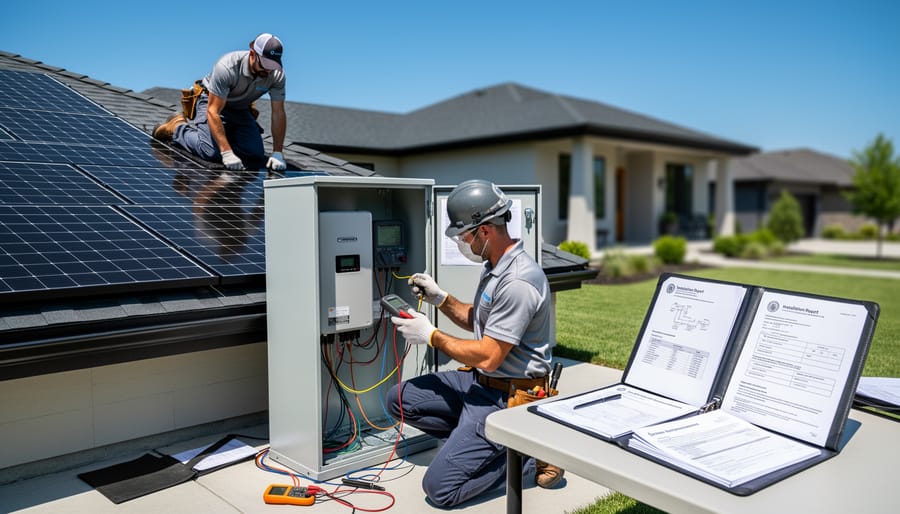
The residential energy-efficient property credit represents a fundamental pillar in making solar energy adoption financially viable for both residential and commercial applications. As federal incentives continue to evolve and strengthen support for renewable energy infrastructure, understanding how to strategically leverage these tax credits becomes essential for maximizing return on investment. The complexities of credit calculations, eligibility requirements, and integration with other financing mechanisms underscore the critical importance of working with experienced professionals who can navigate these opportunities effectively.
Successful implementation requires more than understanding the credit mechanics—it demands a comprehensive approach that considers your facility’s energy profile, long-term operational goals, and financial planning objectives. Professional guidance ensures you capture the full value of available incentives while avoiding common pitfalls that can reduce or eliminate potential benefits. EU Solar combines technical expertise in solar installation with deep knowledge of federal tax incentives, positioning us as your strategic partner in this transition. Our team provides end-to-end support, from initial system design and credit qualification analysis through installation and ongoing performance monitoring, ensuring your solar investment delivers optimal financial returns while advancing your sustainability objectives.