
Understand your financial exposure before signing solar procurement contracts: Extended Producer Responsibility laws now shift end-of-life disposal costs and recycling obligations to manufacturers and importers in an expanding list of jurisdictions, fundamentally altering the economic calculus of photovoltaic investments over their 25-30 year lifecycle.
Verify manufacturer compliance with existing EPR frameworks in France, the Netherlands, and Italy, where producers must finance collection, transportation, and recycling of solar panels through approved collective schemes or individual take-back programs. Non-compliant suppliers expose your organization to liability risks and potential disposal costs exceeding €15-25 per panel.
Incorporate EPR clause requirements into procurement specifications now, even if operating in jurisdictions without current mandates. The European Commission’s proposed EU-wide EPR directive will likely mandate producer responsibility across all member states by 2026, with retroactive application to installations commissioned after 2023.
Calculate total cost of ownership including end-of-life scenarios where EPR coverage proves inadequate or manufacturers cease operations. Industry data shows approximately 8-12% of solar companies active in 2010 no longer exist, creating orphaned installations with unclear disposal responsibility.
Extended Producer Responsibility represents the most significant regulatory shift in solar asset management since feed-in tariff programs, yet remains poorly understood by commercial decision-makers. These laws determine who bears financial responsibility for recycling millions of tons of photovoltaic waste entering the waste stream between 2030-2050, directly impacting project IRR, balance sheet liabilities, and operational risk profiles. The strategic advantage belongs to organizations that integrate EPR compliance verification into vendor selection, contract negotiation, and long-term asset planning today rather than confronting unfunded liabilities during decommissioning phases decades hence.
Understanding Extended Producer Responsibility for Solar Panels
What Extended Producer Responsibility Actually Means
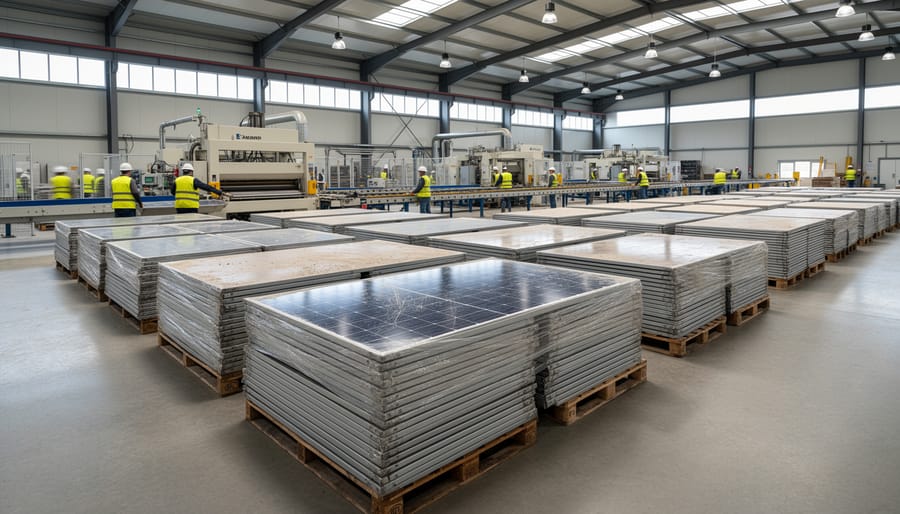
Extended Producer Responsibility (EPR) represents a policy framework that fundamentally shifts accountability for product disposal from municipalities and taxpayers to the manufacturers and importers who introduce products into the market. Originating in Europe during the 1990s, EPR emerged as a response to mounting waste management challenges and growing recognition that production decisions directly influence end-of-life outcomes.
At its core, EPR operates on a straightforward principle: producers bear financial and operational responsibility for their products throughout the entire lifecycle, from design and manufacturing through consumer use and ultimately to collection, recycling, or disposal. This accountability structure aligns with circular economy principles, where materials maintain value and minimize environmental impact through continuous reuse cycles.
For the solar photovoltaic industry, EPR implementation carries particular significance. Solar panel manufacturers must now consider end-of-life logistics during the design phase, investing in take-back programs, recycling infrastructure, and material recovery systems. This requirement incentivizes innovation in panel design—creating products that are easier to disassemble, contain fewer hazardous materials, and yield higher-value recovered components.
The financial mechanism typically involves producers paying fees into collective schemes that fund recycling operations, or establishing individual take-back systems. This structure ensures disposal costs are internalized within product pricing rather than externalized to communities, creating market-driven incentives for sustainable design while providing business owners with transparent compliance pathways and predictable long-term costs for their solar investments.
Why PV Systems Are Now Under EPR Frameworks
The solar energy sector has experienced unprecedented expansion over the past decade, with global photovoltaic installations surging from approximately 40 gigawatts in 2010 to over 230 gigawatts annually by 2023. This remarkable growth trajectory has positioned solar as a cornerstone of the global energy transition, but it has also created an emerging challenge that policymakers can no longer ignore: end-of-life management for millions of aging panels.
Current projections from the International Renewable Energy Agency indicate that photovoltaic waste volumes will reach approximately 1.7 million tonnes by 2030, escalating dramatically to 60-78 million tonnes by 2050. These figures represent a substantial waste stream that, without proper management frameworks, could undermine the environmental benefits that solar energy provides. The sheer scale of this impending waste challenge has prompted regulators across Europe, Asia, and increasingly North America to incorporate PV systems into Extended Producer Responsibility frameworks.
Beyond the volume considerations, photovoltaic panels contain significant quantities of valuable and recoverable materials that justify recycling investments. A typical crystalline silicon panel contains high-purity glass comprising approximately 75% of its weight, aluminum frames representing 10%, silicon wafers at 5%, and critically, precious metals including silver, copper, and tin. The silver content alone, used in panel conduction pathways, can reach 20 grams per panel in older modules, representing considerable economic value at scale.
This combination of factors—explosive market growth, substantial projected waste volumes, and recoverable material value—has made photovoltaic systems a logical candidate for EPR legislation. Regulators recognize that establishing producer responsibility now, while the industry continues maturing, creates better long-term outcomes than attempting retroactive solutions when the waste crisis intensifies in coming decades.
Current EPR Laws and Regulations for Solar Panel End-of-Life
The European Union’s WEEE Directive and Solar Panels
The European Union established the Waste Electrical and Electronic Equipment (WEEE) Directive in 2003, with subsequent amendments in 2012 that explicitly included photovoltaic panels under Category 4 (large equipment) and later Category 5 (small equipment, depending on dimensions). This directive represents one of the most comprehensive EPR frameworks globally, establishing clear obligations for solar panel manufacturers and importers operating within EU member states.
Under the WEEE Directive, producers must register with national authorities and participate in collective take-back systems or establish individual compliance schemes. The directive mandates that producers finance the collection, treatment, and recovery of solar panels placed on the market after August 13, 2012. For systems installed before this date, responsibility typically falls to the current owner, though many member states have implemented transition provisions.
The directive sets ambitious collection and recovery targets. Member states must achieve minimum collection rates of 65 percent of electrical and electronic equipment placed on the market or 85 percent of waste generated. For photovoltaic modules specifically, recovery targets stand at 80 percent by weight, with material recycling requirements of 70 percent. These targets drive innovation in recycling technologies and infrastructure development across the EU.
Compliance requires manufacturers to clearly mark products with the crossed-out wheeled bin symbol and provide information about proper disposal. Producers must also report annually on volumes placed on the market and waste collected. Non-compliance can result in substantial penalties, market access restrictions, and reputational damage.
For businesses investing in solar installations, understanding producer compliance is essential. Working with manufacturers who demonstrate robust WEEE compliance ensures end-of-life management is properly financed and reduces future liability risks. Most reputable European producers participate in collective schemes like PV CYCLE, which operates specialized collection points and recycling facilities throughout member states, providing practical pathways for responsible panel disposal when systems reach end-of-life.
EPR Developments in Other Key Markets
Unlike the European Union’s comprehensive regulatory framework, the United States has adopted a fragmented, state-level approach to EPR for solar equipment. California leads with its Universal Waste Rule, which classifies photovoltaic modules containing hazardous materials and requires proper handling through approved facilities. Washington State has introduced producer responsibility legislation requiring manufacturers to finance collection and recycling programs. New York, Connecticut, and several other states are actively developing similar frameworks, creating a patchwork of compliance obligations that businesses with multi-state operations must navigate carefully.
In the Asia-Pacific region, Japan established EPR guidelines through the Japan Photovoltaic Energy Association, encouraging voluntary industry participation in collection and recycling initiatives. China, now the world’s largest solar market, has implemented national policies requiring manufacturers to participate in recycling efforts, though enforcement mechanisms remain under development. Australia operates primarily through voluntary product stewardship schemes, with the National Television and Computer Recycling Scheme serving as a potential model for solar panel regulation.
Emerging solar markets in Southeast Asia, India, and Latin America are beginning to recognize the importance of end-of-life planning as their installations from the early 2010s approach decommissioning. India’s draft EPR framework proposes manufacturer-funded collection centers, while Chile and Brazil are incorporating solar equipment into broader electronic waste regulations. For multinational companies, understanding these diverse regulatory landscapes is essential for long-term investment planning and risk management, particularly as regulatory convergence toward producer responsibility appears inevitable across major markets.

What These Laws Mean for Commercial Solar Owners
Extended producer responsibility laws fundamentally shift disposal costs and compliance obligations from solar asset owners to manufacturers and importers. Under most EPR frameworks, producers must fund end-of-life management through direct take-back programs or financial contributions to collective schemes. For commercial solar owners, this means manufacturers typically bear recycling costs, though facility managers remain responsible for proper panel removal and transport to authorized collection points.
Documentation requirements are substantial. Business owners must maintain records proving their solar equipment originated from EPR-compliant manufacturers, track serial numbers, and retain proof of proper disposal when systems reach end-of-life. Facilities purchasing panels from non-compliant suppliers may face unexpected disposal costs and regulatory penalties.
Liability considerations extend beyond simple disposal. Facility managers must ensure decommissioned panels enter legitimate recycling streams rather than landfills, as improper disposal can result in significant fines. Understanding solar panel recycling logistics becomes essential for compliance planning and budget forecasting.
Procurement teams should verify manufacturer EPR compliance before purchase, as this determines future disposal obligations. Systems installed before EPR implementation dates may fall outside regulatory frameworks, requiring owners to self-fund recycling through independent providers.
The Technical and Economic Reality of Solar Panel Recycling
How Solar Panel Recycling Actually Works
Solar panel recycling employs multiple processing methods, each with distinct material recovery capabilities and economic implications. Understanding these technical differences is essential for organizations navigating extended producer responsibility requirements and planning long-term asset management strategies.
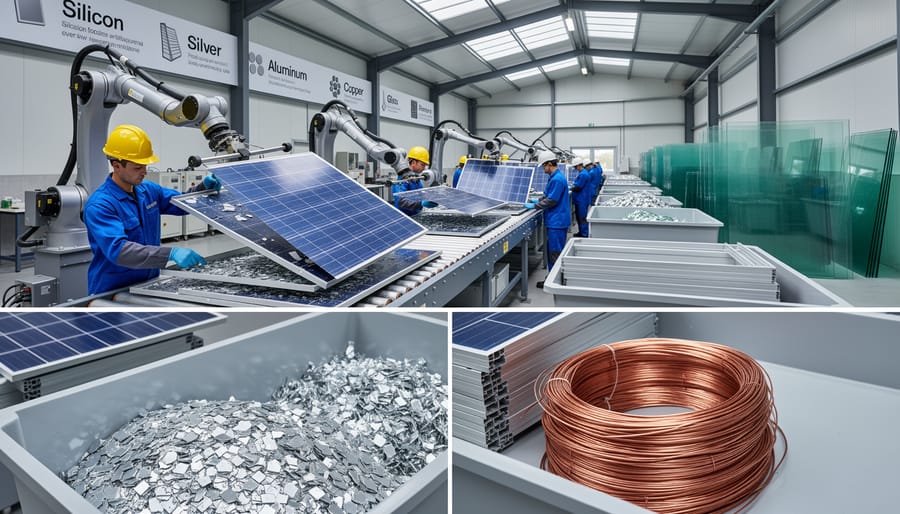
Basic mechanical recycling, the most widely deployed approach, achieves material recovery rates of approximately 85-90% by weight. This process involves dismantling panels, separating aluminum frames and junction boxes, and crushing the remaining materials. The recovered aluminum and glass represent the bulk of recoverable value, with glass typically repurposed for construction applications or abrasive materials rather than new solar panels due to impurity levels. While cost-effective and scalable, this method recovers minimal high-value materials embedded within the photovoltaic cells themselves.
Advanced material recovery technologies employ thermal, chemical, or hybrid processes to extract silicon wafers, silver contacts, and copper interconnects. These methods achieve recovery rates exceeding 95% and capture materials worth 10-20 times more per panel than basic recycling. Silicon recovered through advanced processing can be refined and reused in semiconductor applications, while silver recovery addresses supply chain vulnerabilities for this critical conductor material.
The economic viability gap between these approaches directly influences EPR program design. Basic recycling generates revenue of approximately $3-5 per panel from recovered materials, insufficient to cover collection and processing costs. Advanced recovery can yield $15-30 per panel but requires substantial capital investment and processing volumes. Consequently, most EPR frameworks must incorporate producer fees to bridge this funding gap, making recovery technology selection a critical factor in determining compliance costs for manufacturers and end-users alike.
The True Cost of Compliance and Recycling
Understanding the financial implications of EPR compliance is essential for commercial solar operators making informed investment decisions. Under extended producer responsibility frameworks, end-of-life costs typically range from $15 to $30 per panel, depending on regional infrastructure and collection logistics. These fees cover transportation, disassembly, material separation, and proper disposal of hazardous components.
EPR fees operate through two primary models: advance disposal fees collected at purchase or ongoing manufacturer contributions to collective schemes. In the European Union, producers finance pan-European compliance systems that guarantee panel collection and recycling regardless of brand availability. Australian businesses should anticipate similar structures as domestic regulations mature, with costs potentially integrated into upfront procurement or allocated through industry stewardship programs.
Comparing these structured recycling costs against conventional landfill disposal reveals compelling economic logic. While landfill fees may appear lower initially at $10 to $20 per panel, this calculation excludes environmental liabilities, regulatory penalties for hazardous waste disposal, and lost material recovery value. Silicon, silver, copper, and aluminum extracted through recycling programs generate revenue streams that offset processing costs, with recovered materials valued at approximately $3 to $5 per panel under current market conditions.
As recycling infrastructure scales over the next decade, industry projections indicate declining compliance costs. Advanced automated sorting technologies and regional processing facilities should reduce logistics expenses by 20 to 30 percent by 2030. Early adopters establishing relationships with certified recyclers and exploring end-of-life management options now position themselves advantageously for future regulatory requirements while potentially accessing preferential service agreements. Commercial operators should budget 1.5 to 2 percent of total system cost for lifecycle disposal when evaluating solar investments.
Strategic Implications for Commercial Solar Investment Decisions
Questions to Ask Your Solar Provider Today
Before committing to a solar installation, ensure your provider has comprehensive end-of-life management strategies aligned with evolving EPR regulations. Start by asking who assumes responsibility for panel disposal when your system reaches retirement—typically 25-30 years from installation. Request specific details about their decommissioning process and whether these obligations are explicitly documented in your contract.
Inquire whether your provider participates in manufacturer take-back programs or industry-led recycling schemes. Providers with established partnerships demonstrate proactive compliance and reduce your long-term liability exposure. Ask for evidence of their recycling network, including certified facilities they work with and documented recovery rates for materials like silicon, silver, and aluminum.
Examine contractual provisions related to EPR compliance. Does your agreement specify who bears financial responsibility if recycling costs increase due to regulatory changes? Request clarity on whether end-of-life services are included in your initial investment or will incur additional charges decades later.
Evaluate their long-term support infrastructure. Will the company still exist when your panels need replacement? Ask about financial reserves, insurance policies, or third-party guarantees that ensure continuity of service obligations. Understanding whether they contribute to industry stewardship funds provides additional assurance.
Finally, request transparency about their supply chain. Providers sourcing from manufacturers with robust EPR programs offer better protection against future compliance risks. Ask for documentation proving their equipment suppliers maintain recycling infrastructure and meet international environmental standards. These questions position you to make informed decisions that protect both your investment and environmental responsibilities.
Building End-of-Life Costs Into Your ROI Calculations
Incorporating end-of-life disposal costs into your financial projections ensures accurate return-on-investment calculations and prevents unexpected expenses down the line. Standard solar ROI models typically account for installation, maintenance, and energy savings, but forward-thinking organizations now include decommissioning and recycling expenses in their planning.
Begin by estimating end-of-life costs at approximately 1-3% of initial system investment, though this figure varies based on system size, technology type, and applicable regulations. Advanced lifecycle assessment tools can provide more precise calculations by factoring in projected recycling fees, labor costs, and transportation expenses over your system’s 25-30 year operational lifespan.
When evaluating payback periods, discount these future costs to present value using appropriate rates. While end-of-life expenses occur decades away, including them from the outset provides a complete financial picture. Organizations that establish dedicated reserves for decommissioning—setting aside small annual amounts—avoid financial strain when replacement time arrives.
Future-proofing against regulatory evolution requires flexible financial modeling. Build scenarios that account for potential EPR fee increases, stricter recycling mandates, or expanded producer responsibility requirements. Consider partnering with manufacturers offering take-back programs or working with installers who guarantee end-of-life services as part of their contracts.
Leading organizations also factor in potential revenue from material recovery. As recycling technologies improve and material markets develop, recovered silicon, silver, and aluminum may offset disposal costs, transforming end-of-life management from pure expense into partial revenue stream. This comprehensive approach demonstrates fiscal responsibility while ensuring compliance readiness.

Case Study: How Leading Organizations Are Addressing PV End-of-Life
When Germany implemented its comprehensive EPR framework in 2015, BMW Group’s Leipzig manufacturing facility recognized the opportunity to establish a leadership position in regulatory compliance while securing long-term value from their 7.5 MW rooftop solar installation. Their proactive approach provides valuable insights for organizations navigating evolving EPR requirements.
BMW partnered with First Solar, selecting their thin-film technology specifically for its established take-back program and documented recycling capabilities. This partnership predated mandatory compliance requirements by three years, demonstrating strategic foresight. The facility management team negotiated module collection and recycling provisions directly into their procurement contract, establishing clear cost structures and performance metrics from the outset.
The company implemented a comprehensive tracking system that documented panel location, installation dates, and anticipated decommissioning schedules. This database integrated with their facilities management software, enabling accurate financial planning for eventual end-of-life costs. By incorporating these expenses into their total cost of ownership calculations, BMW avoided the budget surprises that many organizations face when compliance deadlines approach.
Through their early engagement with EPR-compliant suppliers, BMW achieved several measurable outcomes. Their procurement team secured fixed recycling costs at 2015 rates, protecting against inflation in waste management expenses. The facility gained recognition from German environmental authorities as an EPR best-practice example, strengthening their corporate sustainability credentials. Most significantly, their approach eliminated compliance uncertainty, allowing energy management teams to focus on operational optimization rather than regulatory concerns.
The primary lesson from BMW’s experience centers on the value of early supplier engagement. Organizations that address EPR compliance during procurement gain negotiating leverage and cost certainty that becomes unavailable once installations are operational. Additionally, their integration of end-of-life costs into initial financial modeling established realistic performance expectations and prevented the common mistake of evaluating solar investments without considering complete lifecycle obligations.
The expansion of extended producer responsibility laws across global markets represents not a possibility, but an inevitability. As solar installations continue their exponential growth and early systems approach end-of-life, regulatory frameworks will evolve to address the mounting challenge of photovoltaic waste management. Organizations that recognize this trajectory and integrate EPR considerations into their procurement decisions today position themselves ahead of competitors who will scramble to adapt when mandates arrive.
Forward-thinking facility managers and sustainability leaders understand that proper end-of-life planning distinguishes exceptional solar partnerships from transactional vendor relationships. When evaluating installation proposals, EPR compliance readiness serves as a powerful indicator of a provider’s long-term viability and commitment to comprehensive service. Companies that proactively address decommissioning responsibilities demonstrate the operational maturity and financial stability essential for multi-decade energy partnerships.
The competitive advantages extend beyond regulatory compliance. Early adopters of EPR-aligned practices often qualify for preferential treatment in government procurement processes, enhanced sustainability ratings, and improved access to green financing instruments. These benefits compound over time as stakeholder expectations and reporting requirements intensify.
Now is the moment to conduct a thorough assessment of your existing solar agreements and upcoming installation plans through the EPR lens. Review contractual language regarding system ownership, maintenance responsibilities, and end-of-life obligations. Engage potential partners in detailed conversations about their recycling capabilities, financial guarantees, and regulatory compliance strategies. The decisions you make today will determine whether EPR requirements represent a manageable business consideration or an unexpected liability years down the line.