
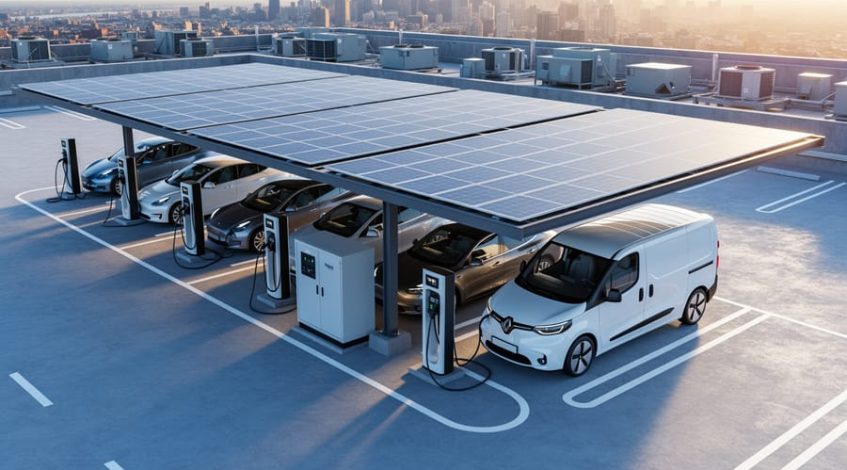
Assess your property’s electrical capacity before planning EV charging infrastructure—most facilities require 100-400 amp service upgrades to support Level 2 chargers, with each station drawing 30-80 amps depending on charging speed requirements. Conduct a load analysis during peak operational hours to determine if your existing electrical panel can accommodate additional charging stations or if transformer upgrades become necessary, typically costing $15,000-$50,000 for commercial installations.
Integrate solar photovoltaic systems directly with charging infrastructure to offset 60-80% of operational electricity costs while qualifying for federal Investment Tax Credit incentives and accelerated depreciation schedules. A properly sized solar array—generally 5-7 kW per charging station—generates sufficient daytime power to support workplace charging programs while reducing demand charges that often represent 30-50% of monthly utility expenses for commercial facilities.
Select charging equipment based on dwell time patterns rather than maximum charging speed alone. Level 2 chargers (7-19 kW) suit workplace and retail locations where vehicles park 2-8 hours, while DC fast chargers (50-350 kW) serve highway corridors and quick-service applications with 15-45 minute charging sessions. This strategic matching of technology to use case prevents overinvestment in unnecessary charging capacity.
Evaluate network management software that provides load balancing, user authentication, and revenue collection capabilities essential for multi-tenant properties and public installations. These platforms enable dynamic power distribution across multiple charging ports, preventing electrical system overloads while maximizing station utilization rates—critical factors for achieving positive ROI within 3-7 years.
The convergence of electric transportation and renewable energy represents a fundamental shift in how modern facilities approach energy management. As urban mobility solutions continue evolving, strategic charging infrastructure deployment becomes essential for property competitiveness, sustainability commitments, and long-term operational efficiency.
The Urban EV Charging Challenge: Why Traditional Grid-Dependent Models Don’t Work
As electric vehicle adoption accelerates across urban centers, the infrastructure required to support widespread charging faces significant obstacles that traditional grid-dependent models cannot adequately address. Understanding these limitations is essential for business owners and facility managers planning sustainable charging solutions.
The primary challenge centers on grid capacity constraints. Urban electrical grids were designed decades ago to meet residential and commercial power demands that didn’t anticipate the substantial load increases from EV charging. A single Level 2 charging station draws approximately 7-19 kW, while DC fast chargers can demand 50-350 kW. When multiple charging stations operate simultaneously during peak hours, the cumulative load can overwhelm local distribution systems, triggering voltage fluctuations and potential brownouts.
Peak demand issues compound this problem. Most EV owners charge vehicles when returning from work, typically between 5 PM and 9 PM—precisely when grid demand already reaches daily maximums. This overlap creates demand spikes that stress infrastructure and drive utility costs upward through time-of-use pricing penalties. For commercial properties, these peak charges can represent 30-70 percent of total electricity expenses.
Utility upgrade costs present another substantial barrier. Installing charging infrastructure often requires transformer replacements, panel upgrades, and enhanced service connections. These utility-side improvements frequently cost between $50,000 and $500,000 per site, with installation timelines extending 12-24 months. Many properties lack the electrical capacity headroom to accommodate even modest charging deployments without expensive infrastructure overhauls.
The environmental sustainability concerns surrounding grid-dependent charging also warrant consideration. In regions where fossil fuels generate a significant portion of electricity, EVs charged exclusively from grid power deliver diminished environmental benefits. This reality contradicts the sustainability objectives driving many organizations toward electrified transportation.
These converging challenges demonstrate why conventional approaches prove inadequate for scalable urban EV charging deployment. Urban solar integration offers a practical solution by generating clean power on-site, reducing grid dependence, mitigating peak demand charges, and providing the capacity needed to support growing charging requirements without prohibitive utility upgrades. This integrated approach transforms EV charging from an infrastructure liability into a manageable, cost-effective operation that aligns with both fiscal responsibility and environmental stewardship.
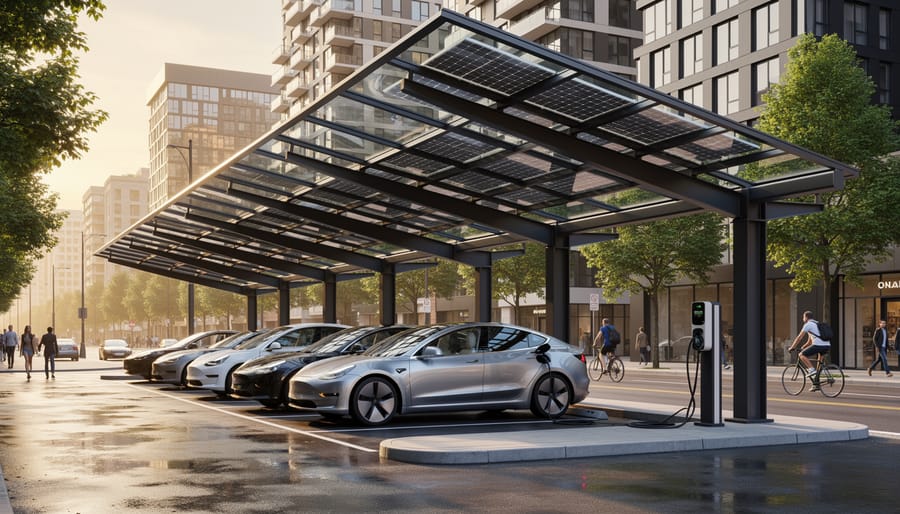
Essential Components of Solar-Powered EV Charging Infrastructure
Photovoltaic Array Sizing and Placement
Determining the appropriate photovoltaic array size requires careful analysis of your facility’s charging demand, available installation area, and site-specific solar resource potential. Begin by calculating your expected daily and peak charging loads based on the number of EVs served, their average battery capacities, and usage patterns. A workplace charging station serving 20 vehicles might require 100-200 kWh daily, while a public fast-charging hub could demand significantly more.
Next, assess your available installation space. Rooftop installations typically yield 10-15 watts per square foot with standard efficiency panels, while solar canopies over parking areas provide both energy generation and weather protection for vehicles. A 50 kW solar array requires approximately 3,500-4,000 square feet of unshaded area. Local solar irradiance data, measured in peak sun hours, directly impacts system sizing. Facilities in sunny climates like California or Arizona may achieve 5-6 peak sun hours daily, while northeastern locations average 3-4 hours, requiring larger arrays for equivalent output.
Urban environments present unique challenges, particularly shading from adjacent buildings, trees, and infrastructure. Conduct a comprehensive shade analysis throughout the year to identify optimal panel placement. Even partial shading can significantly reduce array performance. Consider adjustable mounting systems or microinverters to minimize shading impacts on individual panels.
Financial modeling should account for net metering policies, time-of-use rates, and available incentives. A properly sized system balances upfront investment with long-term energy offset, typically targeting 70-100% of charging demand to optimize return on investment while maintaining grid connectivity for reliability.
Energy Storage Systems and Battery Integration
Battery energy storage systems (BESS) represent a critical component of solar-powered EV charging infrastructure, bridging the gap between intermittent generation and consistent charging demand. These systems capture excess solar energy during peak production hours and discharge it during evening periods or cloudy conditions, enabling round-the-clock charging operations without grid dependency.
For commercial applications, lithium-ion battery arrays typically range from 50 kWh to 500 kWh capacity, scaled according to facility charging requirements and solar array output. A properly sized storage system can reduce grid reliance by 60-80%, while providing demand charge management that lowers monthly electricity costs by up to 40%. Modern solar infrastructure solutions integrate battery management systems that optimize charge-discharge cycles based on real-time pricing, weather forecasts, and charging patterns.
Beyond operational benefits, battery storage enhances grid resilience by providing backup power during outages and participating in demand response programs. Many jurisdictions now offer incentives for storage installations, with payback periods typically ranging from 5-8 years when combining energy arbitrage, demand charge reduction, and incentive programs.
The cost-benefit analysis should evaluate total system costs against avoided demand charges, energy cost savings, and potential revenue from grid services. Current battery prices averaging $300-500 per kWh installed make storage increasingly viable, particularly for facilities with high daily charging volumes or significant solar generation variability.
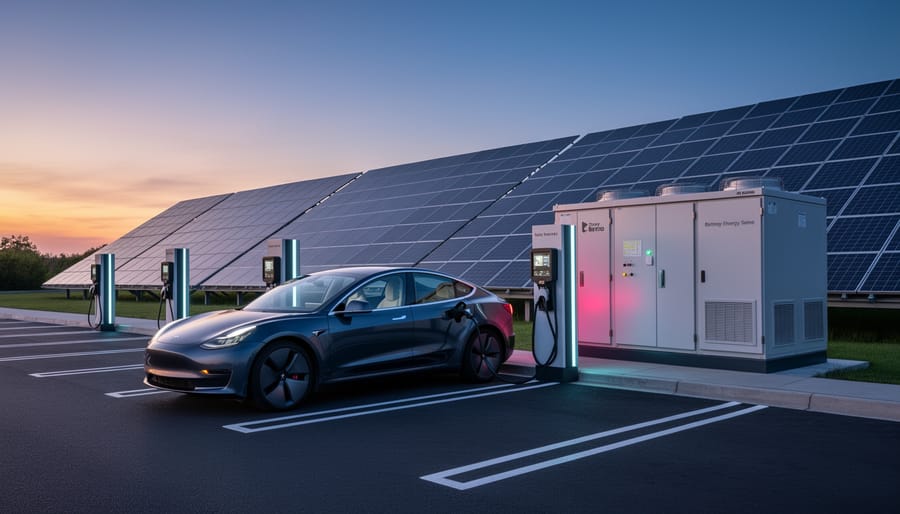
Charging Station Technology and Level Selection
Selecting the appropriate charging technology requires aligning infrastructure capacity with user behavior patterns and dwell times. Level 2 charging stations, operating at 208-240 volts with power outputs between 3.3 kW and 19.2 kW, deliver approximately 25-30 miles of range per hour of charging. This solution proves optimal for workplace environments where vehicles remain parked for six to eight hours, retail locations with extended shopping periods, and residential complexes. The lower installation costs and reduced electrical infrastructure requirements make Level 2 stations financially attractive for facilities with adequate parking duration.
DC fast charging stations, delivering 50 kW to 350 kW, provide 100-200 miles of range in 20-30 minutes, serving high-turnover applications such as highway corridors, convenience stores, and public parking facilities where rapid vehicle circulation is essential. However, these systems demand substantial electrical service upgrades, including dedicated transformers and utility coordination, resulting in installation costs typically three to five times higher than Level 2 infrastructure.
Facility managers should evaluate average vehicle dwell times, daily visitor volumes, and available electrical capacity when determining the optimal charging level. Mixed deployments combining both technologies often deliver superior ROI, matching charging speed precisely to user needs while maximizing station utilization rates and revenue generation potential.
Grid Interconnection and Smart Energy Management
Solar EV charging systems integrate seamlessly with existing electrical infrastructure through smart grid integration and advanced inverter technology. Modern installations support bidirectional power flow, enabling excess solar generation to feed back into the grid through net metering arrangements. This creates revenue opportunities while reducing electricity costs during peak demand periods.
Intelligent load management systems optimize solar utilization by prioritizing EV charging when generation is highest, typically between 10 AM and 3 PM. These systems automatically adjust charging rates based on available solar capacity, grid demand, and time-of-use pricing. Battery storage integration further enhances efficiency by storing surplus solar energy for evening charging sessions.
Real-world applications demonstrate significant cost savings, with facilities achieving 60-80% solar self-consumption rates through proper load management. The technology also provides grid stability services, helping utilities manage demand fluctuations while maximizing the financial return on solar investments.
Strategic Site Selection for Urban Solar Charging Hubs
Commercial Real Estate Opportunities
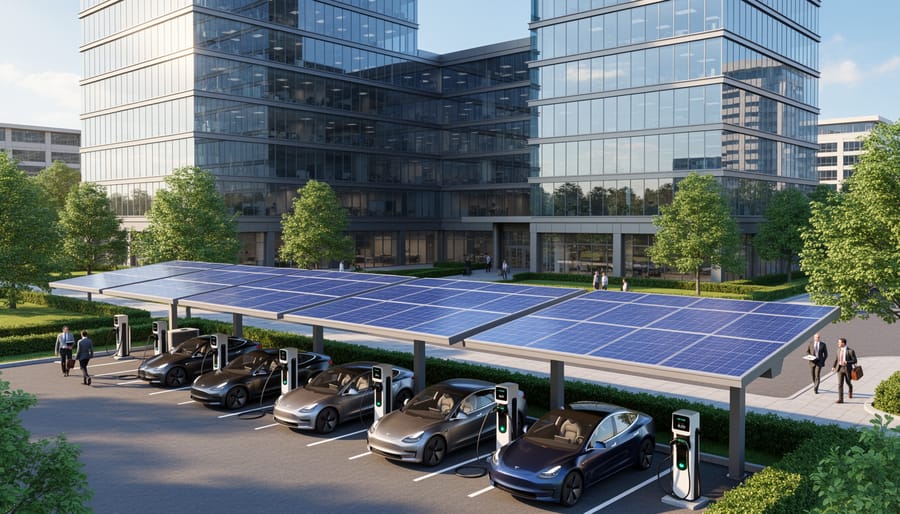
Commercial real estate properties represent high-value locations for EV charging infrastructure deployment. Office buildings, shopping centers, and parking facilities experience concentrated daily traffic patterns that align perfectly with charging session durations, making them strategically positioned to serve the growing electric vehicle market.
Property owners who integrate EV charging stations gain multiple competitive advantages. For office buildings, charging access has become an increasingly valued amenity that attracts quality tenants and supports employee retention. Shopping centers benefit from extended dwell times, as EV drivers typically spend 30-60 minutes charging—time directly correlated with increased retail opportunities. Multi-level parking facilities can optimize underutilized spaces by designating premium charging spots at higher rate structures.
The revenue potential extends beyond simple charging fees. Forward-thinking property managers are incorporating green building solutions that combine solar canopies with charging infrastructure, creating dual income streams through electricity generation and charging services. This approach reduces grid dependence while enhancing property valuations and sustainability credentials.
Implementation typically involves networked charging management systems that enable dynamic pricing, usage tracking, and seamless payment processing. These platforms provide property owners with detailed analytics on utilization patterns, supporting data-driven decisions about capacity expansion and pricing optimization strategies that maximize return on infrastructure investment.
Municipal and Government Facilities
Municipal and government facilities represent strategic anchor points for establishing comprehensive community charging networks. Public parking structures, transit centers, and government buildings typically feature existing electrical infrastructure, ample parking capacity, and consistent daytime usage patterns that align perfectly with solar energy generation peaks. These locations serve dual purposes: providing essential charging access for municipal fleets while offering public charging to increase overall network utilization and revenue potential.
Government entities benefit from significant regulatory advantages when deploying charging infrastructure. Streamlined permitting processes, potential exemptions from certain zoning restrictions, and access to federal and state grant programs specifically designated for public sector initiatives substantially reduce implementation barriers. The Federal Highway Administration’s Charging and Fueling Infrastructure grants, for example, prioritize publicly accessible locations.
Public-private partnership models have proven particularly effective in this sector. Municipalities provide the physical location and expedited approvals, while private operators finance, install, and maintain the charging equipment in exchange for revenue sharing agreements. This approach minimizes public capital expenditure while ensuring professional operation and maintenance. A notable example includes the City of San Diego’s partnership with private charging networks, which deployed over 180 charging ports across municipal facilities with zero upfront city investment, demonstrating how strategic partnerships accelerate infrastructure deployment while maintaining fiscal responsibility.
Multi-Unit Residential Buildings
Multi-unit residential buildings present unique challenges for EV charging infrastructure, but solar integration offers viable solutions for apartment and condo communities. Property managers face limited parking space, constrained electrical capacity, and cost allocation complexities that require strategic planning. Shared solar carports or canopy systems can serve multiple parking spaces simultaneously while generating renewable energy to offset charging costs. These installations typically require 20-30% less electrical infrastructure upgrades compared to conventional grid-only systems, as solar production helps balance daytime charging demand. Successful implementations utilize smart charging management systems that distribute available power equitably among residents while prioritizing solar-generated electricity. A 50-unit apartment complex in San Diego installed a 75kW solar canopy serving 20 EV charging stations, reducing building electricity costs by 18% annually while providing residents with charging rates 25% below commercial alternatives. Property managers should evaluate existing electrical service capacity, available parking configurations, and resident EV adoption projections when designing systems. Load-sharing technologies and time-of-use scheduling maximize solar utilization while preventing electrical panel overloads. This approach transforms parking areas into revenue-generating amenities that increase property values and attract environmentally conscious tenants.
Financial Modeling and ROI Considerations
Capital Investment and Payback Periods
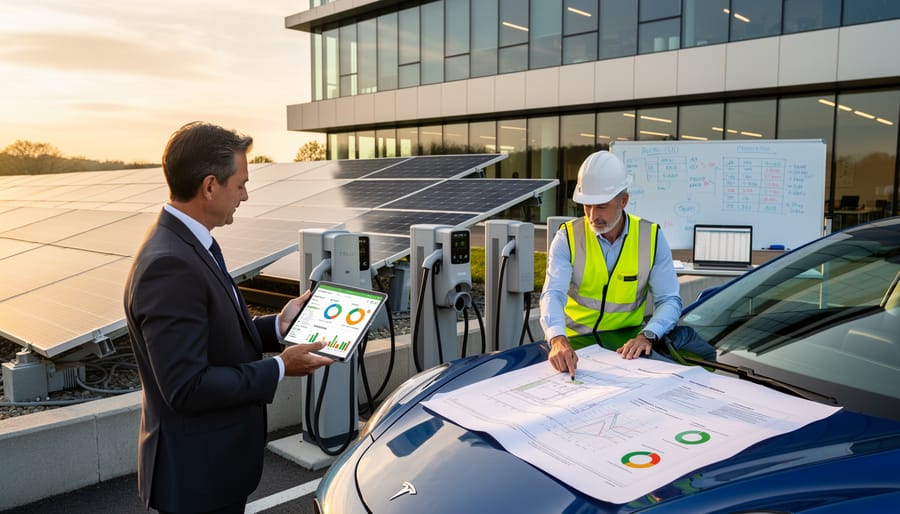
Integrated solar EV charging systems typically require capital investments ranging from $15,000 to $75,000 per charging station, depending on system capacity, solar array size, and installation complexity. This represents a 30-50% premium over grid-only charging infrastructure, which generally costs $10,000 to $40,000 per station for Level 2 chargers. However, this comparison shifts considerably when factoring in ongoing operational costs and potential revenue generation.
Grid-only installations incur continuous electricity expenses that compound over time, whereas solar-integrated systems dramatically reduce or eliminate these costs after installation. Payback periods for solar charging infrastructure vary significantly based on utilization rates and local electricity prices. High-traffic commercial installations with utilization rates above 60% typically achieve payback within 5-7 years in markets with electricity costs exceeding $0.12 per kWh. Moderate-use facilities may see payback periods extending to 8-12 years.
Federal investment tax credits currently offset 30% of solar installation costs, substantially improving return timelines. Municipal fleet applications demonstrate particularly favorable economics, with some jurisdictions reporting payback periods under 4 years due to high daily utilization and avoided fuel costs. Decision-makers should model scenarios using their specific usage projections and local utility rates to determine site-specific financial viability.
Revenue Streams and Operational Savings
Solar-powered EV charging infrastructure creates multiple revenue opportunities while simultaneously reducing operational costs. The primary revenue stream comes from charging fees, which can be structured as pay-per-use, subscription-based, or tiered pricing models depending on your business objectives and customer base. Current market rates range from $0.30 to $0.60 per kilowatt-hour, providing substantial income potential for high-traffic locations.
Demand charge avoidance represents one of the most significant financial benefits. Commercial electricity rates often include demand charges based on peak power consumption, which can account for 30-70% of a facility’s total electricity bill. Solar generation paired with battery storage systems can dramatically reduce these charges by offsetting peak demand periods when EV charging loads are highest.
Long-term operational savings stem from solar’s ability to lock in predictable energy costs. While grid electricity prices typically increase 2-4% annually, solar systems provide stable, fixed-cost energy for 25-30 years after the initial investment. This price certainty enables more accurate financial forecasting and protects against utility rate volatility.
Forward-thinking operators are also capitalizing on grid services revenue opportunities. Vehicle-to-grid technology and battery storage systems can participate in demand response programs, frequency regulation markets, and capacity auctions, generating additional income streams. A California corporate campus reported saving $180,000 annually through combined demand charge management and grid services participation after installing a 500kW solar array with 400kWh of battery storage to support their charging infrastructure.
Regulatory Framework and Permitting Requirements
Successfully deploying solar-powered EV charging infrastructure requires navigating a complex regulatory environment that varies significantly by jurisdiction. Understanding and anticipating these requirements can substantially reduce project timelines and costs.
The permitting process typically begins with building permits and electrical permits, which ensure installations comply with local building codes and the National Electrical Code (NEC). Article 625 of the NEC specifically addresses EV charging equipment, setting standards for installation, grounding, and overcurrent protection. Facility managers should engage licensed electrical contractors familiar with both solar and EV charging requirements early in the planning process to identify potential code conflicts before design finalization.
Utility interconnection agreements represent a critical regulatory hurdle that often creates unexpected delays. These agreements govern how solar systems connect to the grid, establishing technical requirements, safety protocols, and net metering arrangements. Processing times vary from 30 days to six months depending on system size and utility procedures. Properties installing combined solar-EV charging systems may face additional scrutiny regarding load management and demand charges. Proactive engagement with utility representatives and submission of complete documentation accelerates approval.
Zoning ordinances and land use regulations may restrict charging station placement, particularly in historic districts or areas with specific aesthetic requirements. Some municipalities have established expedited permitting tracks for EV infrastructure to encourage adoption. For example, Los Angeles implemented a streamlined approval process that reduced typical permitting from 90 days to under 30 days for qualifying projects.
ADA compliance requirements must be addressed when installing publicly accessible charging stations, including accessible parking spaces, clear path widths, and appropriate signage. Federal tax credit eligibility also depends on meeting specific regulatory criteria for both solar installations and EV charging equipment.
Best practices for streamlined approvals include assembling comprehensive documentation packages, scheduling pre-application consultations with permitting authorities, and leveraging pre-approved equipment lists where available. Engaging experienced contractors with proven track records in your jurisdiction significantly reduces regulatory complications and ensures compliance throughout the project lifecycle.
Real-World Implementation: Commercial Solar EV Charging Case Study
In 2022, a mixed-use commercial development in downtown Seattle implemented a comprehensive solar-integrated EV charging solution that demonstrates the viability of sustainable transportation infrastructure in urban environments. The parking facility, serving 240 spaces across retail tenants and office workers, provides valuable insights into practical deployment strategies.
The site presented typical urban constraints: limited ground space, multi-story construction, and high property values. The facility management team selected a hybrid approach, installing a 150kW rooftop solar array complemented by carport-mounted panels covering 40 premium parking spaces. The system specification included twelve Level 2 charging stations and two DC fast chargers, with smart energy management software optimizing power distribution between solar generation, battery storage, and grid supplementation.
Implementation required nine months from initial assessment to full operation. The project timeline included three months for feasibility studies and permitting, four months for construction and installation, and two months for testing and commissioning. Early challenges centered on structural reinforcement requirements for rooftop solar loads and coordinating utility interconnection approvals. The development team also navigated complex building code requirements specific to combining solar generation with EV charging infrastructure.
After eighteen months of operation, the installation has generated measurable results. The solar array produces approximately 185,000 kWh annually, covering 62 percent of the charging station energy demand. The facility has completed over 14,500 charging sessions, supporting an estimated 875,000 electric miles driven. Operating cost analysis reveals 43 percent reduction in electricity expenses compared to grid-only charging, with the system projected to achieve full payback within 7.2 years.
User satisfaction surveys indicate 89 percent approval ratings among regular users, with tenants citing charging availability as a significant amenity factor. Three commercial tenants have transitioned portions of their fleets to electric vehicles specifically because of on-site charging access. The property management company reports that charging infrastructure has enhanced tenant retention and commanded a 4 percent rental premium for spaces with dedicated charging access.
This implementation validates the integration of planning principles discussed throughout this article, demonstrating that careful site assessment, appropriate technology selection, and phased deployment can overcome urban infrastructure challenges while delivering financial and environmental returns.
The successful deployment of urban solar EV charging infrastructure represents more than a technological upgrade—it constitutes a strategic investment in operational resilience, environmental responsibility, and long-term cost reduction. As this analysis has demonstrated, the integration of photovoltaic systems with electric vehicle charging demands comprehensive planning that addresses site assessment, electrical capacity, utility coordination, regulatory compliance, and financial modeling from the project’s inception.
For commercial property owners and facility managers, the business case extends beyond immediate energy savings. Solar-powered EV charging enhances property value, attracts environmentally conscious tenants and customers, provides predictable energy costs over 25-year system lifespans, and positions organizations as sustainability leaders within their communities. Government entities gain additional advantages through greenhouse gas reduction achievements, economic development opportunities, and demonstration of climate action commitments.
The infrastructure complexity—from appropriate panel orientation and inverter selection to proper conduit routing and load management systems—underscores the importance of partnering with experienced solar providers who understand both photovoltaic design and EV charging requirements. Site-specific feasibility analysis remains the essential first step, evaluating roof or ground conditions, electrical service capacity, available incentives, and projected utilization patterns.
The transition to electrified transportation is accelerating regardless of individual adoption timelines. Property owners and municipal planners who proactively assess their facilities for solar EV charging potential today position themselves advantageously for tomorrow’s requirements. Begin by conducting a comprehensive site evaluation with qualified solar professionals to determine technical feasibility, project economics, and implementation pathways specific to your property’s characteristics and organizational objectives.