
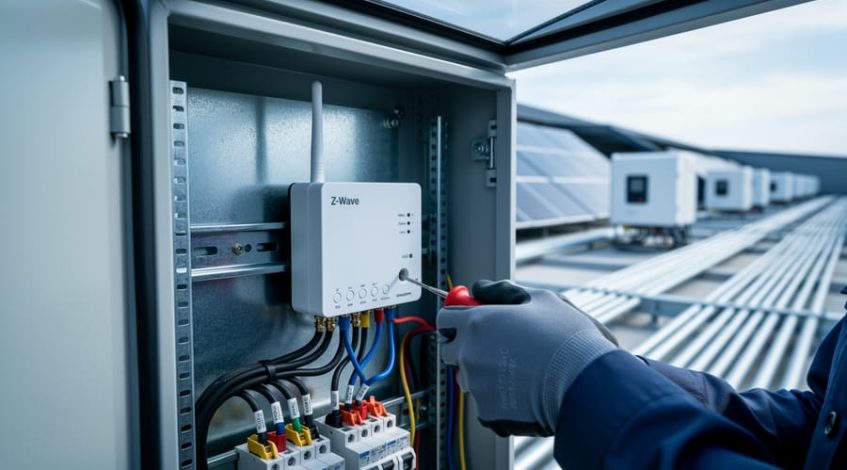
Evaluate whether Z-Wave technology aligns with your commercial solar infrastructure by first assessing your facility’s existing network architecture and determining if wireless mesh capabilities would eliminate costly hardwiring across distributed solar arrays. Z-Wave energy monitors operate on a dedicated 908.42 MHz frequency in North America and 868.42 MHz in Europe, providing interference-free communication that traditional Wi-Fi-based systems often struggle to maintain in industrial environments with metal roofing or electromagnetic interference from inverters and transformers.
Deploy Z-Wave monitors at critical measurement points—main service panels, individual inverter outputs, and high-consumption equipment—to create granular energy flow mapping that identifies exactly where solar generation meets demand and where grid dependency occurs. This level of precision enables you to optimize battery storage dispatch timing and identify phantom loads that erode your solar ROI by up to 15 percent annually.
Compare Z-Wave’s mesh network resilience against centralized monitoring systems by calculating your tolerance for data gaps during communication failures. Each Z-Wave device acts as a signal repeater, creating self-healing networks that maintain monitoring continuity even when individual nodes fail—a critical advantage for facilities where energy data gaps translate directly to lost optimization opportunities and billing disputes.
Integrate Z-Wave monitors with Advanced Solar Energy Monitoring Systems that provide real-time consumption analytics rather than basic generation metrics. The distinction matters: generation data shows what your panels produce, while consumption correlation reveals whether that energy displaces expensive peak-demand charges or feeds back to the grid at minimal feed-in tariff rates. This intelligence transforms monitoring from passive observation into active financial management, delivering measurable returns through demand charge avoidance and consumption pattern optimization.
Understanding Z-Wave Technology in Solar Energy Monitoring
The Z-Wave Protocol Advantage
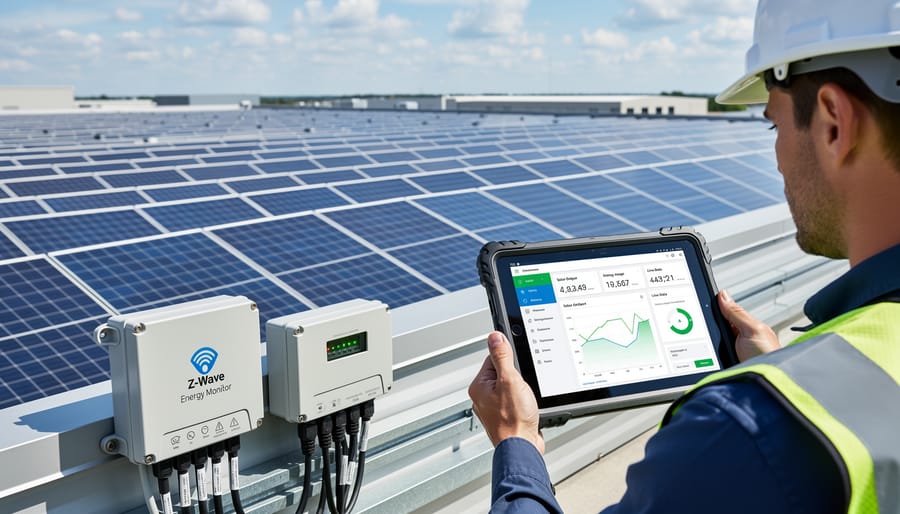
Z-Wave technology represents a significant advancement in energy monitoring infrastructure, offering distinct advantages over conventional monitoring approaches. As a low-power wireless communication protocol operating on sub-gigahertz radio frequencies, Z-Wave consumes minimal energy while maintaining robust, reliable connections across commercial facilities.
Unlike Wi-Fi-based monitoring systems that drain power and face interference from numerous devices competing for bandwidth, Z-Wave creates a dedicated mesh network specifically designed for building automation and energy management. Each Z-Wave device acts as a signal repeater, extending range and ensuring data reliability even in large commercial installations or facilities with challenging architectural layouts.
The protocol’s architecture delivers exceptional reliability, with less than 1% packet loss in typical deployments. This consistency proves essential for facility managers requiring accurate, real-time energy data to make informed decisions about solar performance and consumption patterns. Traditional monitoring approaches often rely on hardwired connections or cellular networks, introducing installation complexity and ongoing data costs that diminish return on investment.
Z-Wave’s standardized communication protocol ensures interoperability between devices from different manufacturers, providing businesses with flexibility in system design and preventing vendor lock-in. The technology supports up to 232 devices on a single network, scaling efficiently from small commercial installations to enterprise-level facilities.
For organizations evaluating monitoring technologies, Z-Wave’s combination of low power consumption, reliable mesh networking, and cost-effective deployment presents compelling advantages. Real-world implementations demonstrate that facilities utilizing Z-Wave energy monitors achieve comprehensive visibility into solar production and consumption patterns without the infrastructure costs and complexity associated with traditional monitoring systems.
Integration with Solar Infrastructure
Z-Wave energy monitors integrate seamlessly with commercial solar installations through multiple connection points. These wireless devices typically interface with solar inverters via compatible communication protocols, collecting production data in real-time without requiring extensive hardwiring throughout your facility.
Modern Z-Wave monitors connect directly to inverter monitoring ports or through dedicated energy management gateways. This architecture allows facility managers to consolidate solar production data, grid consumption metrics, and battery storage levels into a single monitoring platform. The wireless mesh network topology ensures reliable data transmission even across large commercial properties with multiple solar arrays.
Integration with existing building management systems occurs through API connections or cloud-based platforms. Many Z-Wave solutions support standard protocols like Modbus or REST APIs, enabling data exchange with HVAC controls, lighting systems, and other automated building functions. This interconnectivity facilitates demand response strategies and load balancing based on solar production patterns.
For installations with battery storage, Z-Wave monitors track charge cycles, discharge rates, and state-of-charge metrics. This comprehensive visibility enables optimized energy arbitrage and backup power management. The scalable nature of Z-Wave networks allows businesses to start with basic monitoring and expand capabilities as operational needs evolve, protecting initial technology investments while maintaining flexibility for future enhancements.
Key Benefits for Commercial Solar Operations
Granular Energy Data at Circuit Level
Z-Wave technology transforms energy management by enabling circuit-level monitoring that provides unprecedented visibility into power consumption patterns. Unlike traditional whole-building meters, Z-Wave energy monitors can track individual circuits, specific equipment loads, and even dedicated solar production lines. This granular approach allows facility managers to identify which systems consume the most energy, when peak usage occurs, and where inefficiencies exist.
For commercial solar installations, circuit-level data reveals critical optimization opportunities. A manufacturing facility in Rotterdam implemented Z-Wave monitoring across 47 individual circuits, discovering that three idle production lines were consuming 18% of their total energy during off-peak hours. This actionable intelligence enabled targeted interventions that reduced waste by €23,000 annually.
The wireless mesh network architecture of Z-Wave makes installation straightforward without extensive rewiring. Monitors can be deployed on lighting systems, HVAC units, production equipment, and solar inverters simultaneously, creating a comprehensive energy profile. This detailed breakdown empowers decision-makers to prioritize efficiency upgrades based on quantifiable data rather than assumptions, ensuring capital investments deliver measurable returns while maximizing solar energy utilization across operations.
Reduced Installation and Infrastructure Costs
Z-Wave energy monitoring systems deliver substantial cost savings during installation, particularly in large commercial solar facilities. Traditional hardwired monitoring solutions require extensive cabling throughout a building, demanding labor-intensive installation that can cost between $50 to $150 per sensor point when factoring in materials, conduit, and skilled electrician hours. In contrast, Z-Wave’s wireless mesh network eliminates up to 80% of these infrastructure expenses, as sensors communicate wirelessly without dedicated data cabling.
For a typical 100,000-square-foot commercial facility, this translates to savings of $15,000 to $40,000 in installation costs alone. A California manufacturing plant implementing Z-Wave monitoring across their 250kW solar array reported installation completion in just three days compared to the estimated two-week timeline for hardwired alternatives. The wireless approach also reduces ongoing maintenance expenses, as technicians can relocate or add sensors without rewiring.
The scalability advantage becomes particularly evident in multi-building campuses or facilities with challenging architectural layouts. Z-Wave devices self-configure into reliable mesh networks, extending range through neighboring nodes without additional infrastructure investment. This flexibility allows facility managers to expand monitoring coverage incrementally as budgets permit, avoiding the all-or-nothing approach often required with hardwired systems while maintaining comprehensive oversight of energy production and consumption patterns.
Scalability for Growing Solar Arrays
Z-Wave mesh networks provide exceptional scalability advantages for commercial solar installations planning future expansion. As your organization adds solar panels to meet growing energy demands, Z-Wave monitors seamlessly integrate additional nodes without requiring expensive infrastructure upgrades or network redesigns. Each new monitoring device strengthens the mesh network’s communication pathways, automatically routing data through the most efficient channels.
A California distribution center demonstrates this scalability in practice. The facility initially installed a 250kW solar array with basic Z-Wave monitoring, then expanded to 600kW over three years. The existing network accommodated 40 additional monitoring points with minimal configuration, requiring only plug-and-play device installation. Total integration costs represented less than 2% of the expansion budget, compared to 8-12% typical for wired alternatives.
The self-healing mesh architecture ensures reliability even as networks grow, with each device serving as a potential signal repeater. This distributed approach eliminates single points of failure and maintains consistent performance across installations ranging from small rooftop systems to multi-building solar farms.
Real-Time Performance Alerts
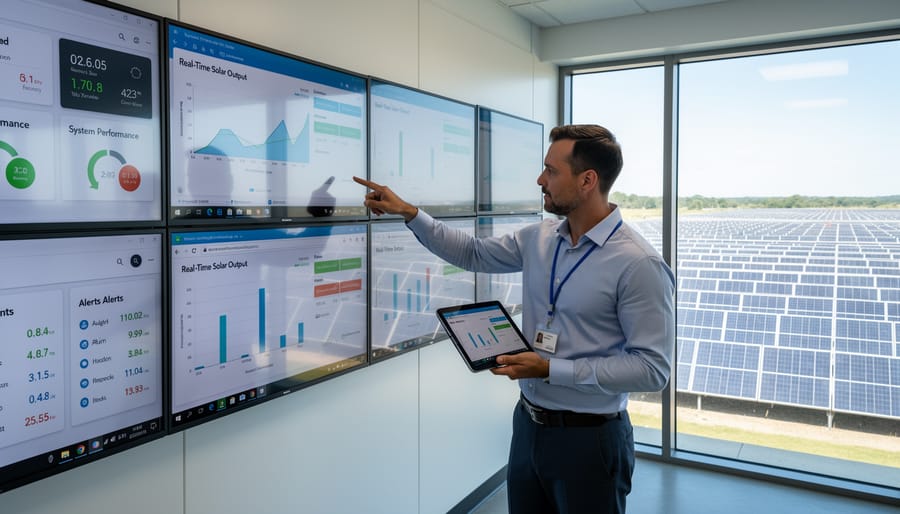
Z-Wave energy monitoring systems deliver real-time performance alerts that enable immediate response to system irregularities. When inverter performance drops, unusual consumption patterns emerge, or equipment malfunctions occur, facility managers receive instant notifications via mobile devices or email. This proactive approach minimizes downtime and revenue loss by addressing issues within minutes rather than days or weeks. For commercial solar installations, early detection of performance degradation can prevent thousands of dollars in lost production. A manufacturing facility in Queensland reduced its average response time from 72 hours to under 30 minutes after implementing Z-Wave monitoring with customized alert thresholds, preventing an estimated $15,000 in annual energy losses from undetected system faults.
Z-Wave vs. Traditional Solar Monitoring Solutions
Comparison with Hardwired Monitoring Systems
When evaluating Z-Wave energy monitors against traditional hardwired monitoring systems, several critical factors emerge. Hardwired systems typically require extensive electrical work, including conduit installation, dedicated circuit runs, and licensed electrician involvement throughout deployment. This translates to installation costs ranging from $5,000 to $15,000 for commercial facilities, with timelines extending two to four weeks. In contrast, Z-Wave solutions offer plug-and-play installation that facility managers can often complete within hours, reducing initial capital expenditure by 60-70 percent.
Reliability comparisons reveal nuanced differences. Hardwired systems provide dedicated communication pathways less susceptible to interference, delivering 99.9 percent uptime in optimal conditions. Z-Wave networks achieve 98-99 percent reliability through mesh topology, where multiple devices create redundant communication paths. For most commercial solar installations, this difference proves negligible given proper network design.
Scalability favors wireless solutions significantly. Expanding hardwired monitoring requires additional wiring and electrical modifications, while Z-Wave systems accommodate new monitoring points through simple device pairing. A manufacturing facility case study demonstrated adding twelve monitoring points to an existing Z-Wave network in one afternoon versus the three-week timeline quoted for hardwired expansion. For organizations prioritizing flexibility and future adaptability, wireless monitoring systems deliver superior long-term value despite marginally lower theoretical reliability metrics.
Positioning Against WiFi and Cellular Solutions
Z-Wave energy monitors deliver distinct advantages over WiFi and cellular alternatives through their dedicated mesh network architecture. Unlike WiFi solutions that compete with existing wireless traffic and require robust internet connectivity, Z-Wave operates on a separate frequency band specifically designed for home and building automation. This ensures reliable data transmission without bandwidth conflicts or network congestion.
The mesh network topology enables each Z-Wave device to act as a signal repeater, extending range up to 600 feet between nodes without additional infrastructure costs. In contrast, WiFi monitors often require expensive range extenders or access point upgrades in larger commercial facilities. Cellular-based monitors, while offering remote access, incur ongoing data plan expenses that accumulate significantly over a 25-year solar system lifespan.
Power consumption represents another critical differentiator. Z-Wave devices consume approximately 1/10th the power of comparable WiFi monitors, reducing battery replacement frequency and maintenance requirements. This efficiency proves particularly valuable for distributed monitoring across multiple panel arrays or remote installations where power access is limited. For facility managers evaluating total cost of ownership, Z-Wave’s combination of low operational expenses, infrastructure independence, and superior range makes it an economically sound choice for comprehensive solar monitoring.
When Z-Wave Makes the Most Sense
Z-Wave energy monitoring delivers maximum value in multi-building facilities where wireless communication prevents costly hardwiring installations. Medium-sized commercial solar installations between 100-500kW particularly benefit from Z-Wave’s scalable network architecture. Educational campuses, healthcare facilities, and multi-tenant commercial properties achieve strong ROI through real-time monitoring across distributed solar arrays without dedicated network infrastructure. Retrofit scenarios where existing buildings lack suitable conduit pathways represent ideal applications, as Z-Wave eliminates structural modifications. Government buildings seeking cost-effective monitoring compliance and retail chains managing multiple locations find Z-Wave’s standardized protocol simplifies deployment and maintenance. Facilities prioritizing cybersecurity appreciate the isolated mesh network that operates independently from primary IT systems while still providing comprehensive energy visibility and optimization opportunities.
Real-World Application: Manufacturing Facility Case Study
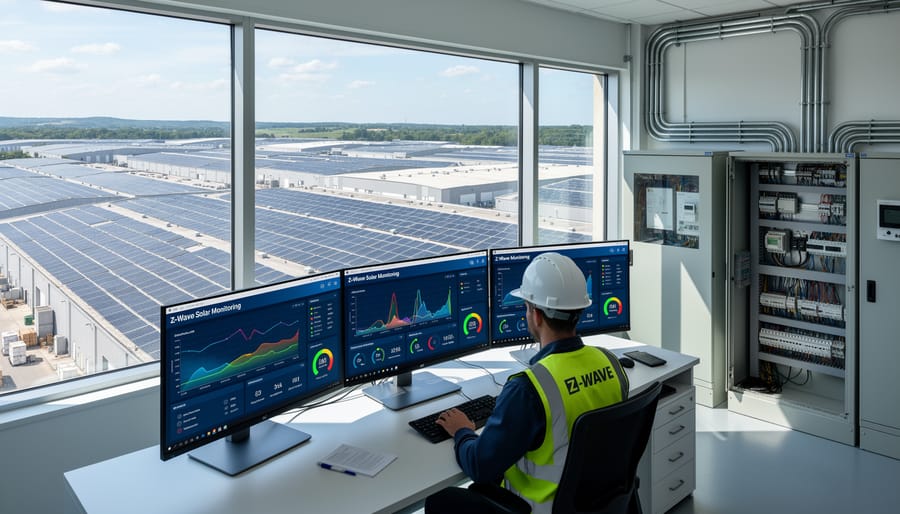
Precision Metal Works, a mid-sized manufacturing facility in Rotterdam with a 250kW rooftop solar installation, faced a persistent challenge: despite investing significantly in renewable energy, they lacked granular visibility into their system’s performance and consumption patterns. The facility’s existing monitoring solution provided only basic production data, leaving the energy management team unable to identify inefficiencies or optimize their self-consumption ratio.
In March 2023, the facility implemented a comprehensive Z-Wave energy monitoring system across their operation. The deployment included twelve Z-Wave power meters strategically positioned to monitor individual production lines, HVAC systems, and solar array performance. The wireless mesh network architecture proved particularly valuable in the facility’s metal-rich environment, where traditional wired solutions would have required extensive conduit installation and potential production shutdowns.
Within the first month, the monitoring system revealed critical insights. The data showed that their largest CNC machining line was drawing substantial power during off-peak solar production hours, while running at reduced capacity during peak generation periods. By adjusting the production schedule to align with solar availability, Precision Metal Works increased their solar self-consumption from 62% to 81%, reducing grid dependency significantly.
The implementation also identified a persistent parasitic load of 18kW occurring during non-production hours. Investigation traced this to legacy climate control systems that weren’t properly integrated with the facility’s building management system. Corrective action eliminated this waste, translating to approximately 157,680 kWh in annual savings.
Financial results exceeded expectations. The complete Z-Wave monitoring infrastructure, including professional installation, totaled €8,400. Combined energy savings and optimized consumption patterns delivered annual cost reductions of €14,200, achieving payback in just 7.1 months. Additionally, the real-time monitoring capabilities enabled the facility to document their renewable energy utilization for sustainability reporting requirements and qualify for enhanced green energy certificates.
The system’s scalability has proven equally valuable. As Precision Metal Works plans a 100kW solar expansion in 2024, the existing Z-Wave network can accommodate additional monitors without infrastructure modifications, protecting their technology investment while supporting continued growth in renewable energy capacity.
Implementation Considerations for Commercial Installations
Technical Requirements and Compatibility
Successful deployment of Z-Wave energy monitors requires several key infrastructure components. First, facilities need a Z-Wave gateway or hub that serves as the central communication point, typically connecting to your existing network via Ethernet or Wi-Fi. This hub coordinates data transmission between monitors and your building management system.
The monitors themselves require proximity to electrical panels and operate on the 908.42 MHz frequency in North America or 868.42 MHz in Europe. Most units support up to 232 hop communications, allowing signal relay through other Z-Wave devices to extend range across large facilities. For commercial solar installations, ensure your gateway supports the Z-Wave Plus certification for enhanced security and battery efficiency.
Integration capabilities are essential for maximizing value. Leading Z-Wave energy monitors offer API access and support protocols like MQTT or RESTful APIs, enabling seamless connection with existing energy management systems, SCADA platforms, and building automation software. Cloud-based dashboards typically require minimal IT infrastructure, though some organizations prefer local data storage for enhanced security.
A practical example: A 500kW commercial solar facility in California achieved full monitoring coverage using one central hub and twelve Z-Wave monitors, with total infrastructure costs under $3,000—demonstrating the technology’s scalability and cost-effectiveness for professional installations.
Integration with Existing Building Management Systems
Z-Wave energy monitors seamlessly integrate with enterprise energy management platforms and SCADA systems through standardized communication protocols. These monitors utilize wireless mesh networking to transmit real-time consumption data to central management systems, enabling facility managers to consolidate energy metrics across multiple sites. Integration typically occurs through API connections or gateway devices that translate Z-Wave signals into formats compatible with existing building automation systems. For commercial solar installations, this interoperability allows operators to view solar production alongside overall energy consumption within a unified dashboard. A Melbourne-based manufacturing facility demonstrated this capability by connecting 47 Z-Wave monitors to their existing Schneider Electric system, achieving complete visibility across their 500kW solar array without infrastructure overhaul. The resulting data integration reduced energy waste by 18% within six months while maintaining compatibility with legacy monitoring equipment.
Professional Installation vs. DIY Considerations
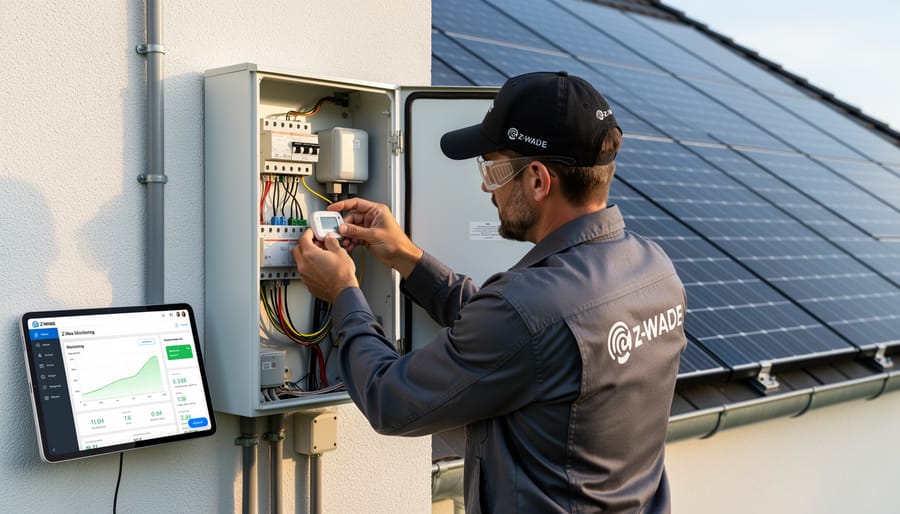
While Z-Wave energy monitors offer straightforward plug-and-play capabilities for basic residential applications, commercial solar installations typically benefit from professional installation. Experienced technicians ensure optimal sensor placement at critical electrical junction points, proper network configuration to minimize interference in large facilities, and integration with existing building management systems. Professional installers verify current transformer placement accuracy, which directly impacts monitoring precision and ROI calculations. For facilities managing multiple solar arrays or complex electrical infrastructure, certified installation eliminates configuration errors that could compromise data integrity. A regional distribution center case study demonstrated that professional installation reduced commissioning time by 60% compared to internal facility staff attempts, while ensuring compliance with electrical codes and warranty requirements. Consider professional services when deploying enterprise-scale monitoring solutions where accuracy directly influences financial planning and energy procurement strategies.
Maximizing ROI Through Advanced Monitoring Data
Identifying System Inefficiencies and Underperformance
Granular monitoring data from Z-Wave energy systems provides facility managers with the intelligence needed to identify performance degradation before minor issues escalate into costly problems. By tracking panel-level production data in real-time, these systems detect anomalies that aggregate monitoring solutions might miss—such as individual panel soiling, microfractures, or inverter inefficiencies affecting specific circuits.
A manufacturing facility in Queensland discovered through Z-Wave monitoring that three panels in a 200-panel array were underperforming by 15% due to shading from newly installed HVAC equipment. The early detection allowed for immediate corrective action, preventing an estimated $3,200 in annual energy losses. This proactive approach to maintenance proves essential for maximizing ROI across commercial installations.
Z-Wave systems can also establish performance baselines for your installation, triggering alerts when production deviates from expected parameters based on weather conditions and historical data. This predictive capability enables scheduled maintenance during off-peak periods rather than reactive emergency repairs, reducing operational disruption and extending system lifespan while maintaining optimal energy generation throughout the asset’s productive years.
Optimizing Energy Consumption Patterns
Z-Wave energy monitoring provides the granular data necessary to strategically align facility operations with periods of maximum solar energy production. By tracking consumption patterns down to individual circuits and equipment, facility managers can identify which operations consume the most energy and schedule them during peak solar generation hours, typically between 10 AM and 3 PM.
This optimization reduces grid dependency and maximizes the return on solar investments. For instance, a manufacturing facility in Baden-Württemberg utilized Z-Wave monitoring data to reschedule high-energy processes such as HVAC system maintenance, water heating, and industrial equipment operation to coincide with solar peak production. The result was a 23% reduction in grid-sourced electricity costs within the first year.
The real-time feedback from Z-Wave sensors enables dynamic load management, automatically triggering non-critical systems during solar abundance while deferring less urgent operations to off-peak periods. This intelligent consumption pattern creates measurable cost savings while improving overall energy efficiency and supporting sustainability goals that resonate with stakeholders and regulatory requirements.
Z-Wave energy monitors represent a significant advancement in commercial solar monitoring, providing facility managers and business owners with an accessible, cost-effective pathway to enhanced system visibility and performance optimization. These wireless monitoring solutions bridge the gap between basic system oversight and comprehensive energy management, delivering actionable insights without the complexity and expense traditionally associated with enterprise-level monitoring platforms.
The evidence from real-world implementations demonstrates that Z-Wave technology offers tangible benefits across diverse commercial applications. From manufacturing facilities reducing operational costs through precise load balancing to multi-tenant properties enabling transparent energy allocation, these systems deliver measurable returns on investment while maintaining the flexibility to scale alongside evolving business requirements.
However, successful implementation depends on careful alignment between monitoring capabilities and long-term operational goals. Business decision-makers should evaluate Z-Wave solutions within the context of their specific facility requirements, considering factors such as system complexity, integration needs, and future expansion plans. While Z-Wave excels in many commercial scenarios, some enterprises may benefit from hybrid approaches or alternative technologies depending on their unique circumstances.
Professional support throughout the selection and implementation process remains critical to maximizing system performance. Working with experienced solar integrators ensures proper network design, optimal sensor placement, and seamless integration with existing infrastructure. This collaborative approach transforms monitoring technology from a passive data collection tool into an active driver of operational efficiency, empowering organizations to optimize their solar investments and advance their sustainability objectives with confidence.