
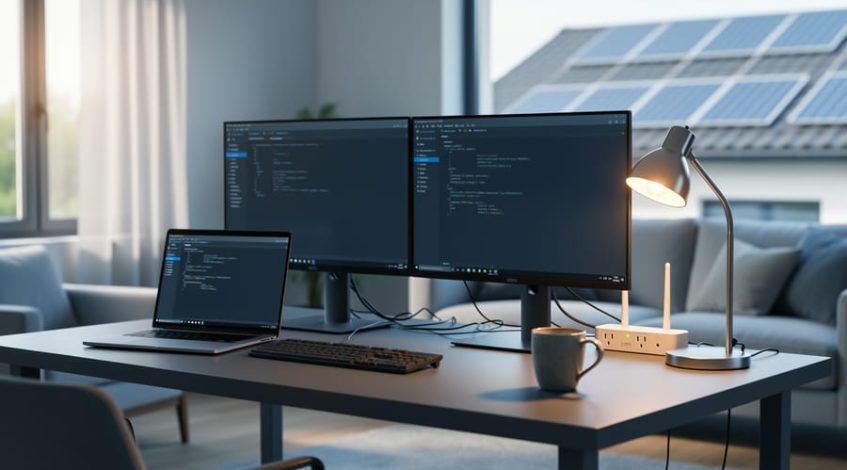
Working from home increases electricity costs by 10-30% for the average household, translating to an additional $150-$300 annually per remote worker. Recent analysis of the work-from-home revolution reveals that residential energy consumption has risen substantially during business hours, with peak demand shifting from commercial buildings to homes. This shift affects not only individual households but also commercial property owners facing reduced energy requirements in their facilities while managing distributed workforce costs.
The primary drivers behind increased home electricity bills include continuous HVAC operation during work hours (accounting for 40-50% of the increase), extended use of computers and monitors, additional lighting requirements, and frequent use of kitchen appliances throughout the day. For business owners with hybrid work policies, this represents a complex energy cost equation: while office building consumption may decrease, overall organizational energy expenditure often remains constant or increases when factoring in employee utility stipends and distributed infrastructure costs.
Understanding these consumption patterns enables strategic decision-making around energy management. Forward-thinking organizations and homeowners are addressing this challenge through distributed solar solutions that offset increased daytime electricity consumption with on-site generation during peak remote work hours. This approach transforms the work-from-home energy cost challenge into an opportunity for long-term utility savings and energy independence.
The Real Numbers: How Much Does Working From Home Increase Your Electric Bill?
Daily Energy Consumption Breakdown for Remote Workers
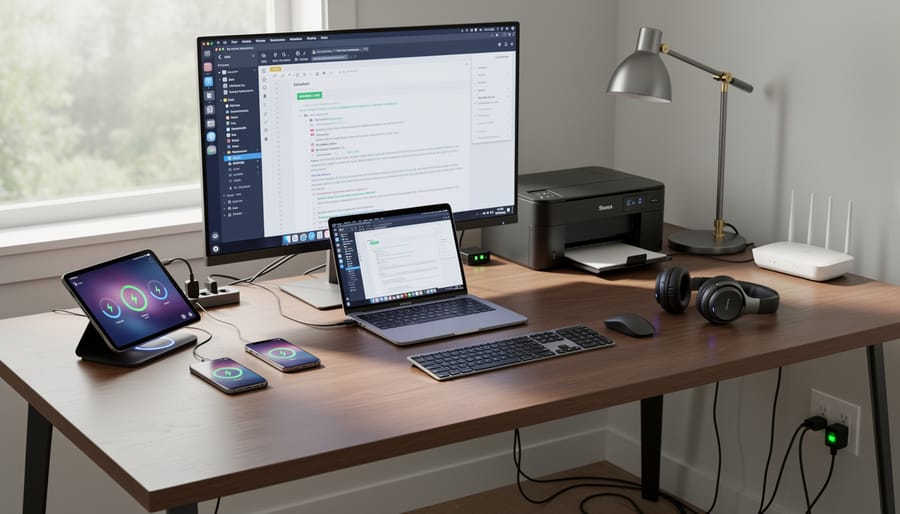
Understanding the specific energy consumption patterns of remote workers requires examining hour-by-hour usage throughout the workday. Traditional office workers typically maintain minimal home electricity consumption between 8 AM and 6 PM, limited primarily to refrigerator operation, standby power for electronics, and basic climate control. Remote workers, conversely, generate continuous demand across multiple categories during these same hours.
Computer equipment represents the foundational increase. A desktop workstation consuming 200-400 watts operates 8-10 hours daily, contributing 1.6-4 kWh per workday. Laptops prove more efficient at 50-100 watts but still add 0.4-1 kWh daily. Multiple monitors, printers, routers, and charging devices collectively add another 100-300 watts of sustained load.
Climate control constitutes the largest single contributor to increased consumption. Heating and cooling systems that would typically operate on reduced settings now maintain comfortable temperatures throughout work hours. A central air conditioning system running an additional 6 hours daily can consume 9-18 kWh, depending on unit efficiency and climate zone. Similarly, winter heating demands increase by 15-30 kWh daily in colder regions when maintaining optimal indoor temperatures.
Lighting requirements extend beyond natural daylight hours, particularly for video conferencing and task illumination. Home office lighting typically adds 0.3-0.6 kWh daily. Kitchen appliances see increased midday usage as remote workers prepare lunch at home rather than eating out, contributing an additional 0.5-1.5 kWh daily through microwave, stovetop, and coffee maker operation.
When aggregated, these consumption categories explain why remote workers experience daily increases of 25-50 kWh compared to traditional work arrangements, translating directly to higher monthly billing cycles and creating opportunities for strategic energy management solutions.
Seasonal Variations in Energy Costs
The financial impact of working from home varies significantly throughout the year, with seasonal temperature extremes driving substantial cost fluctuations. During summer months, home air conditioning systems operate for extended periods, typically increasing electricity consumption by 30-50% compared to spring or autumn baseline usage. Winter heating, whether electric or gas-powered, creates similar spikes in energy expenses that employees previously shared with their employers through office utility costs.
Commercial facilities benefit from economies of scale in climate control, distributing heating and cooling costs across hundreds or thousands of square meters. Individual homes lack this efficiency advantage, resulting in higher per-person energy expenditure. A typical office worker might have represented just $200-300 annually in their employer’s climate control costs, but that same comfort level at home can cost $800-1,200 depending on local climate conditions and home insulation quality.
Remote workers in extreme climate regions face the most pronounced seasonal variations. Australian businesses transitioning to hybrid models should recognize that employees in Queensland experience different summer cooling costs than those in Tasmania facing winter heating demands. This geographical dispersion is reshaping energy demand patterns across residential sectors.
Data from energy retailers indicates that homes with full-time remote workers experience 25-40% higher seasonal peak usage compared to pre-pandemic patterns. These seasonal surges represent the most significant opportunity for cost mitigation through renewable energy solutions, as peak demand periods often align with optimal solar generation hours during summer months.
The Hidden Energy Drains in Your Home Office
Technology and Equipment Power Draw
Remote work infrastructure creates a substantial and often underestimated electrical load in residential settings. A typical home office setup consuming power throughout standard business hours represents a significant shift from traditional household energy patterns.
Desktop computers draw between 60-300 watts during active use, while laptops consume a more modest 30-60 watts. However, the peripheral equipment amplifies this consumption considerably. Dual monitor configurations add 40-70 watts per display, while docking stations contribute an additional 15-45 watts. High-performance workstations used for design, engineering, or data analysis can exceed 400 watts during intensive operations.
Network infrastructure operates continuously, with routers consuming 6-20 watts and mesh network systems drawing up to 40 watts collectively. Printers in standby mode use 5-15 watts, spiking to 300-500 watts during active printing. External hard drives, webcams, and charging stations for mobile devices collectively add another 20-50 watts to the baseline load.
Real-world data from energy monitoring studies indicates that a fully equipped home office operates 8-10 hours daily, consuming approximately 2-5 kWh per workday. For professionals working five days weekly, this translates to 40-100 kWh monthly—roughly 15-30% of average household electricity consumption. This represents an annual increase of 480-1,200 kWh, adding approximately 50-150 dollars to electricity bills depending on regional rates.
Organizations managing distributed workforces face compounded costs across their employee base, making energy efficiency strategies and alternative power solutions increasingly relevant to operational planning and sustainability objectives.

Climate Control: The Biggest Cost Factor
Climate control represents the single largest contributor to increased electricity consumption for remote workers, accounting for approximately 50-70% of the additional costs. When employees work from home, heating and cooling systems that would typically cycle down or enter setback mode during standard office hours must instead maintain comfortable temperatures throughout the workday.
Research from the American Society of Heating, Refrigerating and Air-Conditioning Engineers indicates that HVAC systems in occupied homes run 3-5 hours longer daily compared to empty residences. During peak summer months, this translates to air conditioning units operating 8-10 hours per day rather than the typical 4-6 hours for unoccupied homes. Winter heating demands show similar patterns, with furnaces cycling significantly more frequently to maintain consistent temperatures.
The financial impact varies considerably by region and season. In moderate climates, additional HVAC costs range from $40-80 monthly, while extreme temperature zones can see increases of $120-200 during peak seasons. A study of 2,000 remote workers across various climate zones revealed average annual HVAC cost increases of $600-900, representing expenses previously absorbed by commercial facilities.
For business owners managing hybrid workforces, this shift transfers substantial operational costs from centralized office buildings to distributed residential locations. Organizations implementing comprehensive remote work policies should consider these transferred expenses when calculating total cost of ownership. Strategic investments in distributed energy solutions, including residential solar installations, can offset these increased consumption patterns while providing long-term financial benefits and supporting corporate sustainability objectives.
Commercial Facilities Face the Reverse Problem
While residential electric bills climb with remote work arrangements, commercial facilities face an equally challenging scenario. Office buildings, corporate campuses, and business centers continue operating base systems for significantly reduced occupancy levels, creating substantial inefficiencies in energy management.
The shift to hybrid work schedules has fundamentally altered commercial energy consumption patterns. Facility managers report that maintaining HVAC systems, lighting, security protocols, and essential infrastructure for buildings operating at 30-50% capacity proves remarkably inefficient. Unlike residential settings where occupants directly benefit from energy expenditures, commercial facilities consume power for largely empty spaces.
The economics become particularly challenging during unpredictable occupancy patterns. Many organizations implement flexible schedules where employee presence varies daily, making it difficult to program building management systems effectively. Climate control systems designed for full occupancy operate inefficiently at reduced loads, while completely shutting down systems creates comfort and air quality issues when staff arrive.
Energy waste manifests across multiple building systems. Parking structures maintain full lighting despite sparse vehicle counts. Conference rooms remain climate-controlled for occasional meetings. Common areas, lobbies, and amenities continue standard operations. Data from facility management studies indicate commercial buildings with hybrid workforces experience 20-35% higher energy costs per occupied square foot compared to pre-pandemic levels.
This inefficiency presents a dual challenge: rising operational costs coupled with pressure to meet corporate sustainability commitments. Forward-thinking facility managers increasingly recognize that traditional grid-dependent operations cannot adequately address this new reality. The solution requires reimagining commercial energy infrastructure to accommodate variable occupancy while maintaining cost-effectiveness and environmental responsibility. Solar energy systems, paired with intelligent building management technologies, offer facility managers the flexibility to reduce grid dependence while controlling operational expenses during this transition period.
Solar Energy as the Strategic Response to Rising Residential Costs
ROI Analysis for Remote Workers Installing Residential Solar
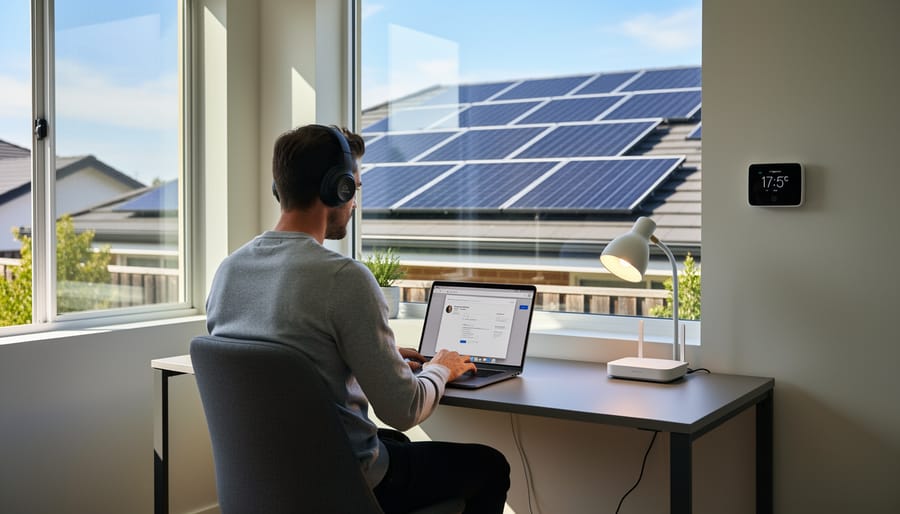
For remote workers experiencing elevated electricity costs, residential solar installation presents a compelling financial opportunity with accelerated return timelines. The economics become particularly favorable when daytime consumption aligns with peak solar generation periods.
Current data indicates typical residential solar systems range from $15,000 to $25,000 before incentives, with average payback periods of 6-8 years under standard consumption patterns. However, remote workers who consume 40-60% of their electricity during daylight hours can reduce this timeline to 5-7 years, optimizing their investment returns through direct consumption rather than grid export.
The federal Investment Tax Credit remains a primary financial driver, offering 30% of installation costs as a direct tax credit through 2032. On a $20,000 system, this translates to $6,000 in immediate savings, reducing net investment to $14,000. Many states and municipalities layer additional incentives, with programs offering rebates ranging from $1,000 to $5,000 depending on system size and location.
The remote work advantage becomes evident in net metering scenarios. Traditional households export excess daytime generation at wholesale rates while purchasing evening electricity at retail prices. Remote workers instead consume their generated power directly during production hours, capturing full retail value and minimizing grid dependency. This shift can increase effective solar utilization rates from 30-40% to 60-75%, substantially improving return calculations.
Commercial property managers evaluating solar for mixed-use facilities with remote work components see similar dynamics at scale. A recent case study involving a 50kW installation serving office spaces with flexible work arrangements demonstrated a 23% reduction in payback period compared to traditional commercial buildings, driven by consistent daytime occupancy patterns that matched solar production curves. These economics support strategic energy planning for organizations navigating hybrid workplace transitions.
Commercial Solar Solutions for Hybrid Work Environments
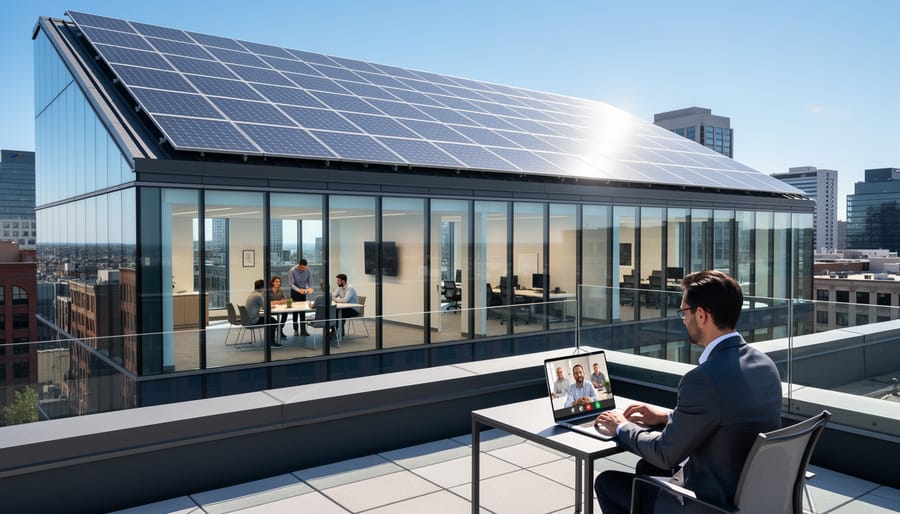
The shift to hybrid work models has created a unique challenge for businesses managing commercial facilities. While employees working from home experience increased residential electricity costs, commercial properties continue consuming significant energy despite reduced occupancy levels. Base load consumption—including HVAC systems, security lighting, server rooms, and essential equipment—persists regardless of how many employees occupy the building on any given day.
Commercial solar installations provide an effective strategy for mitigating these ongoing operational expenses. By generating clean energy on-site, businesses can significantly reduce commercial energy costs while maintaining facility readiness for flexible workforce schedules. The economics become particularly compelling when considering that commercial electricity rates typically exceed residential rates, often by 30-50 percent depending on location and usage patterns.
Modern solar systems equipped with monitoring technology enable facility managers to optimize energy consumption across variable occupancy scenarios. During low-occupancy periods, excess solar generation can be exported to the grid for feed-in credits, effectively monetizing unused capacity. When employees return to the office, the solar array offsets peak demand charges, which represent a substantial portion of commercial electricity expenses.
A practical example demonstrates this value proposition: A 100-kilowatt commercial solar installation on a suburban office building can generate approximately 140,000 kilowatt-hours annually, offsetting 60-70 percent of facility energy costs even with fluctuating occupancy. The typical return on investment ranges from 4-6 years, with systems designed to operate efficiently for 25 years or more.
This approach ensures businesses maintain cost-effective operations regardless of workforce distribution, protecting profit margins while advancing sustainability commitments that increasingly influence client relationships and corporate reputation.
Real-World Impact: Case Studies and Applications
Organizations and individuals across Europe have implemented strategic solutions to address the increased energy consumption associated with remote work arrangements. Analysis of actual deployment scenarios reveals measurable benefits from proactive energy management approaches.
A commercial property management firm in Amsterdam documented the energy patterns of a 12-unit residential complex where 75% of tenants transitioned to full-time remote work in 2020. Initial monitoring showed average household electricity consumption increased by 32% during working hours. The management company subsequently installed a 45kW rooftop solar array across the building. Within the first year, the system offset 68% of the additional daytime consumption attributed to remote work, reducing individual tenant energy costs by an average of €42 monthly during peak remote work periods.
In a separate case, a technology company operating a distributed workforce across Southern Europe provided energy consumption data from 150 employees working from home. The study revealed that households with pre-existing residential solar installations experienced 41% lower electricity cost increases compared to those without solar capacity. Employees with 4-6kW solar systems reported minimal financial impact from the work-from-home transition, with daytime solar generation closely matching increased consumption from home office equipment, climate control, and additional lighting requirements.
A government office building in Portugal addressed hybrid work challenges by analyzing occupancy patterns and energy usage. With 40% of staff working remotely on any given day, facility managers identified opportunities to reduce building-wide consumption while supporting home-based workers. The organization implemented a solar installation program offering subsidized residential systems to employees. Participating households installed an average of 5.2kW capacity, resulting in documented annual savings of €520-€780 per household based on regional electricity rates and consumption patterns.
Manufacturing facilities have similarly addressed energy considerations for administrative staff transitioning to remote arrangements. A Belgian industrial company tracked energy metrics across 85 remote workers over 18 months. Data indicated that households investing in solar capacity within the first six months of remote work arrangements achieved break-even on installation costs approximately 14 months earlier than standard residential timelines, due to higher daytime consumption rates that maximized solar utilization and self-consumption ratios.
These applications demonstrate quantifiable approaches to managing work-from-home energy challenges through strategic solar adoption and consumption monitoring.
Making the Transition: Practical Steps Forward
Transitioning to solar energy to offset increased electricity consumption from remote work requires a structured approach that balances immediate needs with long-term sustainability goals. For residential users and commercial facility managers alike, the first step involves conducting a comprehensive energy audit to establish baseline consumption patterns and identify the incremental increase attributable to work-from-home arrangements.
Begin by analyzing utility bills from the past 12-24 months, comparing pre-pandemic usage with current consumption levels. This data provides the foundation for accurate system sizing. Most residential systems addressing work-from-home increases require an additional 2-4 kilowatts of capacity beyond standard household needs, while commercial facilities accommodating hybrid work models should anticipate 15-25 percent reductions in central office consumption alongside distributed residential increases.
The assessment process should include a professional site evaluation examining roof orientation, shading patterns, available mounting space, and electrical infrastructure capacity. For commercial decision-makers managing multiple locations, prioritizing facilities with the highest consumption increases and optimal solar potential maximizes return on investment.
System sizing calculations must account for future growth. Remote work trends suggest sustained elevated consumption, making it prudent to design systems with 10-15 percent overhead capacity. Implementation timelines typically span 2-4 months from initial consultation to system activation, encompassing permitting, procurement, installation, and grid interconnection.
Financial considerations extend beyond equipment costs. Residential users should explore federal tax credits, state incentives, and net metering programs that can reduce effective system costs by 30-50 percent. Commercial entities benefit from accelerated depreciation schedules and renewable energy certificates that enhance project economics.
For organizations managing distributed workforces, establishing employee solar incentive programs demonstrates commitment to sustainability while addressing the cost burden workers face. Some forward-thinking companies now offer subsidized residential solar installations as part of comprehensive remote work support packages, recognizing that shared investment in distributed energy infrastructure benefits all stakeholders.
The transition timeline allows for phased implementation, enabling organizations to pilot programs, measure results, and scale successful approaches across broader portfolios while maintaining operational continuity and financial flexibility.
The data confirms what remote workers across sectors have experienced firsthand: working from home does increase electricity costs, typically by 15-30% depending on usage patterns, home size, and regional rates. For organizations managing hybrid workforces or maintaining residential properties, these incremental increases compound across multiple locations and represent a sustained operational expense that will persist as remote work remains integral to modern business operations.
However, this challenge presents a strategic opportunity rather than simply an unavoidable cost. Solar energy systems offer facility managers, business owners, and property decision-makers a pathway to convert escalating electricity expenses into controlled, predictable energy costs. By generating power on-site, whether for commercial facilities, multi-family residential properties, or distributed home office environments, organizations gain immunity from utility rate fluctuations while reducing their carbon footprint—a dual benefit that aligns operational efficiency with sustainability commitments.
The financial case strengthens over time. Solar installations deliver returns through immediate utility savings, available tax incentives, and decades of reduced energy dependence. For organizations evaluating energy strategies in the context of permanent remote and hybrid work models, solar represents not merely a cost mitigation tool but a forward-looking infrastructure investment that enhances property value and corporate responsibility profiles.
We encourage decision-makers to conduct comprehensive energy assessments of their facilities and distributed work environments. Understanding your current consumption patterns and future energy needs positions you to identify solar solutions scaled appropriately to your operational requirements—whether that involves rooftop commercial installations, community solar programs, or strategic partnerships that extend clean energy benefits across your organization’s footprint.