
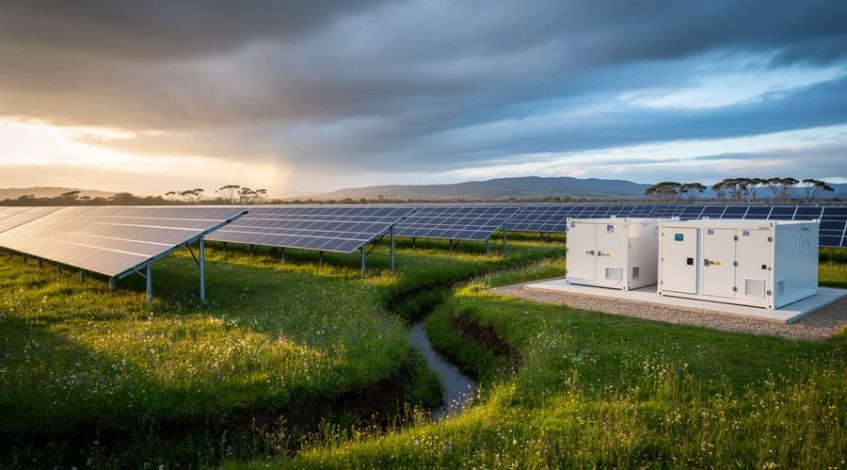
Climate disruption no longer represents a distant threat to energy infrastructure—it demands immediate strategic response. In the past five years alone, extreme weather events have caused $145 billion in utility-scale energy system failures, forcing business leaders to reconsider their approach to power generation and distribution. Ecological resilience, the capacity of natural and engineered systems to absorb disturbance while maintaining essential functions, has emerged as the defining framework for energy investment decisions in the 2020s.
Traditional energy planning assumed relatively stable environmental conditions. That assumption no longer holds. Solar installations now face unprecedented challenges: intensifying hurricanes, shifting precipitation patterns affecting cooling systems, increased dust deposition reducing panel efficiency, and temperature extremes that stress electrical components. Yet paradoxically, distributed solar energy offers unique advantages in building climate-adaptive power systems when designed with ecological resilience principles.
Resilient energy systems share three characteristics: redundancy that prevents single points of failure, flexibility to adapt to changing conditions, and integration with natural processes rather than opposition to them. A solar array that incorporates native vegetation for temperature moderation, incorporates battery storage for grid independence during extreme weather, and uses elevation analysis to avoid flood risk demonstrates resilience thinking in practice. These installations consistently outperform conventional designs during climate stress events by 40-60 percent in documented case studies.
For facility managers and business owners, ecological resilience translates directly to protected revenue streams, reduced insurance costs, and extended asset lifespans. A manufacturing plant in the Southeast that integrated resilience principles into its solar installation maintained 94 percent operational capacity during Hurricane Florence, while competitors without resilient design experienced complete power loss for seven days. The financial calculus has shifted: resilience features that add 8-12 percent to upfront costs typically deliver 300 percent ROI within the system’s first decade through avoided losses and operational continuity.
Understanding Ecological Resilience in Energy Systems
The Three Pillars of Energy Ecosystem Resilience
Solar energy systems face an increasingly volatile climate landscape, making resilience a critical investment consideration. Drawing from natural ecosystem principles, energy resilience rests on three interconnected pillars that determine system viability during and after climate-related disruptions.
Resistance represents the system’s ability to withstand immediate stress without compromising performance. For solar installations, this includes structural engineering capable of handling extreme weather events, from cyclonic winds to hail impact. Modern photovoltaic systems now incorporate reinforced mounting systems, impact-resistant glass, and waterproofing technologies that maintain operational integrity during storms. Advanced inverter designs with wider operating temperature ranges ensure continuous generation even during heat waves, while strategic panel placement minimizes vulnerability to debris and flooding.
Recovery measures how quickly systems return to full functionality after disruption. Smart monitoring systems detect performance anomalies in real-time, enabling rapid response to component failures. Modular design principles allow for swift replacement of damaged sections without system-wide shutdowns. Battery storage integration provides continuity during grid outages, maintaining critical operations while repairs proceed. Leading installations now achieve 72-hour recovery timelines for most weather-related incidents, compared to weeks for conventional infrastructure.
Adaptation encompasses the system’s capacity to evolve with changing conditions. This includes software updates that optimize performance parameters based on shifting weather patterns, expandable architectures that accommodate future capacity needs, and flexible grid integration allowing seamless transitions between energy sources. Forward-thinking organizations incorporate climate projection data into initial system design, ensuring infrastructure remains effective across 25-year operational lifespans. This adaptive approach transforms solar investments from static installations into dynamic energy assets capable of meeting tomorrow’s challenges.
Why Traditional Energy Planning Falls Short
Traditional energy planning typically follows a linear, predict-and-provide model that assumes relatively stable conditions. Planners forecast future demand based on historical trends, then build infrastructure sized to meet peak loads with minimal safety margins. This approach works adequately in stable environments but creates significant vulnerabilities when conditions change unexpectedly.
The fundamental limitation lies in static design. Once infrastructure is built, it cannot easily adapt to shifting weather patterns, evolving demand profiles, or emerging technologies. When heat waves intensify or storm frequency increases, these rigid systems face capacity constraints or outright failures. The 2021 Texas power crisis exemplified this vulnerability, where a system optimized for typical conditions proved catastrophic when confronted with extreme weather.
In contrast, ecological approaches recognize that energy systems operate in dynamic environments requiring built-in adaptability. Rather than designing for a single future scenario, resilient energy planning creates flexible infrastructure that responds to changing conditions. Solar installations with modular expansion capabilities, integrated storage systems, and smart controls embody this principle, allowing facilities to adjust capacity and operation modes as circumstances evolve. This adaptive capacity transforms energy systems from brittle, vulnerable assets into robust infrastructure that maintains performance across varied conditions while delivering measurable returns through reduced downtime and operational flexibility.
Building Holistic Energy Ecosystems: Beyond Single-Point Solutions
Diversification and Redundancy in Solar Design
Ecological resilience in solar energy systems mirrors nature’s approach to survival: multiple pathways, distributed resources, and adaptive capacity. Rather than relying on a single point of failure, resilient solar designs incorporate diversification strategies that maintain power availability even when individual components face disruption.
Distributed solar arrays represent the foundation of this approach. By installing multiple smaller arrays across different roof sections or ground locations, facilities reduce vulnerability to localized damage from severe weather, equipment failure, or shading issues. A manufacturing facility in coastal Florida demonstrated this principle by deploying four separate 250kW arrays across its campus. When Hurricane Ian damaged one section, the remaining arrays continued generating 75% of baseline production, enabling critical operations to continue.
Battery storage integration adds temporal redundancy to spatial distribution. Modern lithium-ion systems store excess daytime generation for evening peak demand or emergency backup, creating energy availability beyond solar production hours. Organizations typically achieve 4-8 hours of backup capacity for essential loads, with payback periods of 7-10 years when factoring in demand charge reduction and grid service revenue opportunities.
Grid-connected systems with strategic islanding capability provide the ultimate redundancy layer. These hybrid configurations draw from solar, battery, and utility sources simultaneously, automatically switching between pathways based on availability and cost. A distribution center in Texas reduced annual energy costs by 43% while maintaining 99.9% uptime through this multi-pathway approach. The system intelligence determines optimal energy sourcing in real-time, maximizing both economic efficiency and operational reliability.
Interconnected Systems and Smart Monitoring
Modern solar installations increasingly incorporate smart monitoring systems that function similarly to the feedback mechanisms found in natural ecosystems. These interconnected platforms continuously track performance metrics including energy production, consumption patterns, and equipment health across your entire facility.
Real-time monitoring enables immediate detection of performance anomalies, from inverter inefficiencies to panel degradation. When a component underperforms, the system automatically alerts facility managers while simultaneously adjusting operations to maintain optimal output. This automated response mirrors how healthy ecosystems redistribute resources when individual elements face stress.
Predictive maintenance capabilities analyze historical data and current conditions to forecast equipment issues before they escalate into costly failures. One Australian manufacturing facility reduced downtime by 42 percent after implementing predictive analytics, translating to significant cost savings and uninterrupted operations. The system identified inverter stress patterns three weeks before traditional monitoring would have detected the problem.
Adaptive controls represent the most sophisticated layer of system intelligence. These platforms automatically optimize energy distribution based on weather forecasts, grid conditions, and facility demand. During peak production periods, excess energy routes to storage systems or feeds back to the grid. When production dips, the system seamlessly transitions to stored reserves or grid power, ensuring continuous operations without manual intervention.
This integrated approach transforms static solar installations into dynamic energy ecosystems that self-regulate and adapt to changing conditions, maximizing both resilience and return on investment.
Symbiotic Relationships: Solar and Site Ecology
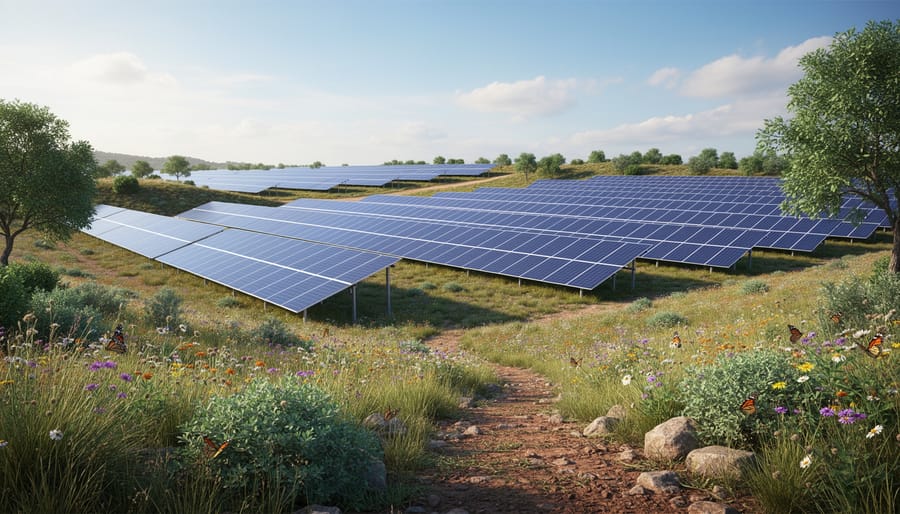
Solar installations designed with ecological awareness can enhance local ecosystems rather than displace them. Strategic vegetation management beneath and around solar arrays creates pollinator habitats, reduces maintenance costs, and improves site drainage. Native grasses and wildflowers planted under panels provide ground cover that prevents erosion while supporting beneficial insects and birds. This approach, known as agrivoltaics or solar grazing, demonstrates measurable returns: reduced mowing expenses, improved stormwater management, and enhanced community relations. Sites implementing dual-use strategies report 30-40% lower grounds maintenance costs while contributing to regional biodiversity goals. For facility managers, this represents an opportunity to achieve sustainability targets without compromising energy production. Thoughtful site design transforms solar arrays from purely energy infrastructure into multifunctional assets that deliver environmental and financial value simultaneously.
Climate Resilience Through Solar: Preparing for Extreme Weather
Engineering for Extreme Conditions
Climate patterns are shifting, bringing more severe weather events that directly impact solar infrastructure investments. Modern solar installations must account for intensifying conditions that previous design standards didn’t anticipate. Engineering for resilience means selecting components and configurations that withstand these challenges while maintaining optimal performance.
Wind resistance has become a critical specification as extreme weather events increase in frequency and intensity. Commercial solar arrays now require structural calculations that account for wind speeds exceeding historical norms by 20-30%. Mounting systems must use enhanced ballasting, reinforced attachment points, and aerodynamic panel configurations that reduce uplift forces. Facilities in hurricane-prone regions particularly benefit from wind-tunnel-tested mounting solutions and impact-resistant framing.
Snow load considerations extend beyond traditional calculations for northern climates. Areas experiencing unprecedented winter storms need systems designed with steeper tilt angles, reinforced racking, and adequate spacing to prevent accumulation damage. The structural framework must support loads that may exceed local building codes developed from historical data no longer representative of current conditions.
Hail protection requires tempered glass rated for impacts from increasingly large hailstones. Standard 3.2mm glass provides baseline protection, but facilities in high-risk zones should specify 4mm or thicker options with enhanced impact resistance. Temperature extremes also demand attention, as panels experience thermal cycling between record highs and lows. Quality junction boxes, weatherproof connections, and materials with broad temperature tolerances prevent premature degradation and maintain warranty coverage throughout the system’s operational lifetime.
Maintaining Operations During Grid Instability
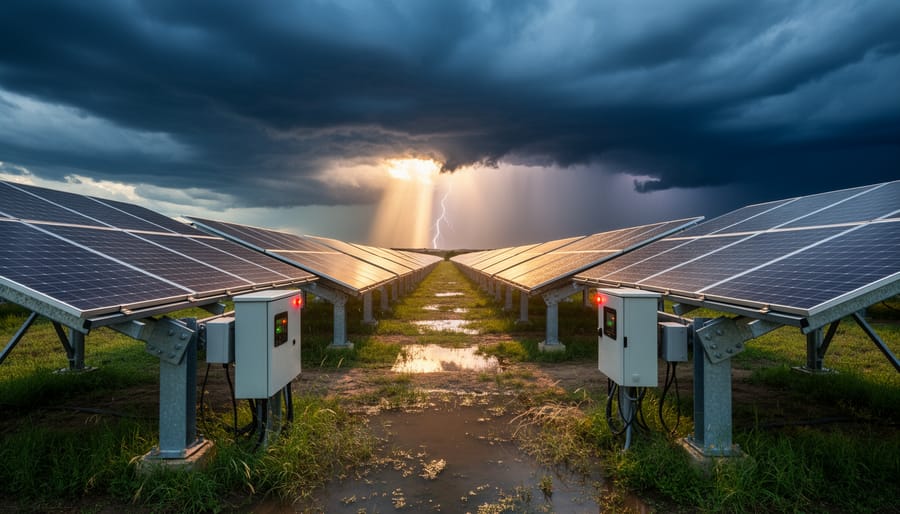
Climate-driven weather events increasingly threaten grid stability, with extreme heat, wildfires, and severe storms causing prolonged outages that disrupt business operations and critical services. Properly engineered solar systems integrated with battery storage provide a decisive advantage during these disruptions, enabling facilities to maintain essential functions when the conventional grid fails.
Strategic implementation focuses on identifying mission-critical loads that must continue operating during outages. These typically include security systems, refrigeration, data centers, communication equipment, and essential manufacturing processes. Advanced inverter technology automatically transitions these loads to battery storage within milliseconds of detecting grid failure, ensuring seamless operation without manual intervention.
Real-world performance validates this approach. A California distribution center maintained full refrigeration operations during the 2020 public safety power shutoffs, preventing inventory losses that would have exceeded $2 million. Similarly, a Texas manufacturing facility continued production through Winter Storm Uri using its solar-plus-storage system, while competitors faced week-long shutdowns.
The resilience value extends beyond immediate operational continuity. Facilities equipped with backup capability avoid revenue loss, protect brand reputation, maintain customer commitments, and reduce insurance premiums. Financial modeling demonstrates that resilience benefits often justify storage investments within three to five years, independent of utility rate savings.
Flood and Fire Risk Mitigation
Solar installations in flood-prone regions require strategic waterproofing measures, including sealed electrical components and corrosion-resistant mounting systems rated for submersion. Elevating inverters and electrical equipment above projected flood levels—typically 2-3 feet above the 100-year floodplain—protects critical infrastructure while maintaining system functionality. In wildfire-susceptible areas, Class A fire-rated materials for racking systems and non-combustible ground cover reduce ignition risk. California’s recent installations demonstrate success with defensible space protocols, positioning arrays at least 30 feet from vegetation. These protective measures add approximately 8-12% to initial costs but prevent catastrophic losses averaging $150,000 per incident. Climate adaptation planning now routinely incorporates both flood elevation standards and fire-resistant specifications, ensuring solar investments deliver anticipated returns across 25-30 year lifecycles despite intensifying environmental threats.
The Business Case: ROI of Resilient Solar Systems
Reduced Downtime and Insurance Costs
Resilient energy systems deliver measurable financial benefits by minimizing operational disruptions and associated costs. According to industry data, commercial facilities experience an average of $9,000 per hour in lost revenue during power outages, with critical operations facing even steeper losses. Solar installations with integrated battery storage and microgrid capabilities can maintain operations during grid failures, protecting revenue streams and preventing costly production halts.
Beyond immediate downtime prevention, resilient systems are increasingly recognized by insurance providers as risk-mitigation measures. Facilities equipped with backup power capabilities and climate-adaptive infrastructure may qualify for reduced premiums on business interruption and property insurance policies. Some commercial property insurers now offer discounts ranging from 5% to 15% for buildings with demonstrated energy resilience features, recognizing the reduced likelihood of weather-related claims and operational losses.
The combined financial impact extends beyond insurance savings. Businesses with resilient energy infrastructure report fewer emergency repair costs, reduced equipment damage from power fluctuations, and improved business continuity ratings. These advantages translate into enhanced stakeholder confidence and competitive positioning, particularly in industries where operational reliability directly influences customer relationships and contractual obligations.
Long-Term Savings Through Adaptive Design
Designing solar energy systems for future climate conditions rather than current baselines delivers substantial financial advantages over the system’s operational lifespan. Adaptive design anticipates temperature increases, extreme weather frequency, and shifting energy demand patterns, embedding resilience from the outset rather than addressing vulnerabilities through expensive modifications later.
Traditional solar installations optimized only for present conditions often require costly upgrades as climate impacts intensify. Panels rated for lower temperature thresholds lose efficiency faster in heatwave conditions, mounting systems inadequate for stronger winds necessitate reinforcement, and drainage solutions insufficient for heavier rainfall events demand retrofit construction. These reactive expenses typically exceed the initial investment required for climate-adaptive specifications by 40-60 percent, while also causing operational disruptions during upgrade work.
Forward-looking installations incorporate elevated wind loading standards, enhanced thermal management, flood-resistant electrical components, and modular architectures that accommodate capacity expansion. This approach protects long-term solar investment value by maintaining optimal performance despite environmental changes. Australian commercial facilities using climate-informed design specifications have documented 25-35 percent lower maintenance costs compared to standard installations over ten-year periods.
The upfront premium for adaptive design typically adds 8-12 percent to initial capital costs but yields returns through extended asset lifespan, reduced downtime, lower insurance premiums, and avoided retrofit expenses. For organizations planning 25-30 year system lifespans, this represents significant total cost of ownership reduction while ensuring continuous energy security as climate conditions evolve.
Real-World Applications: Resilient Solar in Action
Manufacturing Facility: Maintaining Production Through Weather Extremes
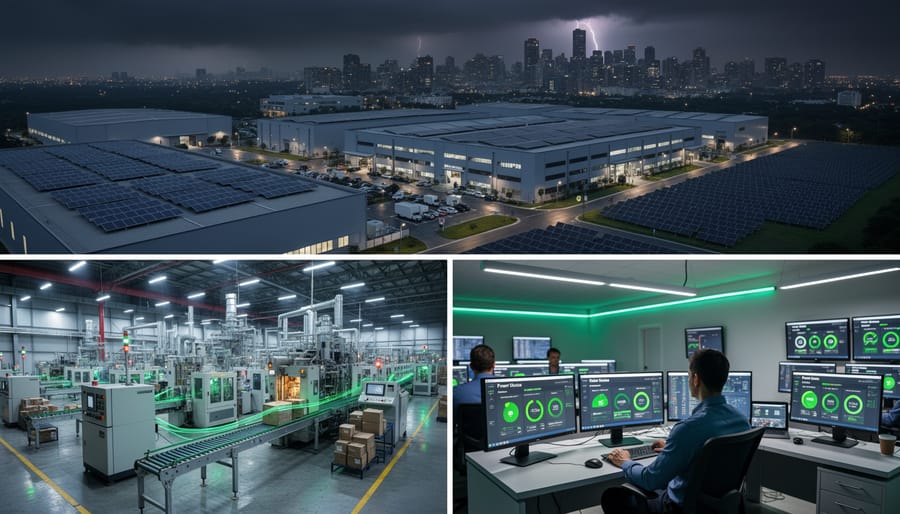
When a severe ice storm struck the Midwest in February 2023, disrupting power to over 400,000 customers for up to 72 hours, a 250,000-square-foot manufacturing facility in Illinois maintained continuous operations while competitors shut down. The difference: a resilient solar-plus-storage system designed specifically for grid independence during extreme weather events.
The facility had installed a 2-megawatt rooftop solar array integrated with 1.5 megawatt-hours of battery storage eighteen months prior. The system was engineered with ecological resilience principles at its core, including advanced weather monitoring, automated load management, and redundant inverter configurations. When grid power failed during the storm’s peak, the facility’s energy management system automatically transitioned to island mode within milliseconds, maintaining power to critical manufacturing lines and refrigeration systems.
During the 68-hour outage, the solar-plus-storage system sustained approximately 60 percent of normal operations despite heavy cloud cover, thanks to the strategic battery reserve and intelligent load prioritization. The facility processed orders worth $340,000 during this period while three nearby competitors remained offline, resulting in captured market share and strengthened client relationships.
The financial impact extended beyond immediate revenue preservation. The facility avoided an estimated $180,000 in lost productivity costs, $45,000 in spoiled inventory, and potential penalties from unfulfilled contracts. Post-crisis analysis revealed the system paid for itself three years ahead of initial projections when accounting for avoided losses and continued revenue generation during the regional power crisis.
Government Institution: Adaptive Design for Critical Services
The Metropolitan Water Authority of Sacramento demonstrated exceptional foresight in 2019 when it integrated a hybrid solar-plus-storage system across three critical treatment facilities. Recognizing that service interruptions were not an option for their 1.4 million customers, the authority implemented a multi-layered resilience strategy combining renewable energy with grid independence capabilities.
The facility deployed a 2.5 MW solar array paired with 4 MWh of battery storage, creating operational redundancy that ensures continuous water treatment during grid outages. Smart monitoring systems track energy generation, consumption patterns, and storage levels in real-time, automatically switching to backup power within milliseconds of detecting grid instability. This adaptive design proved invaluable during the 2020 Public Safety Power Shutoffs, when facilities maintained full operations for 72 consecutive hours without grid connection.
The financial metrics further validated the investment. Beyond the 40% reduction in annual energy costs, the authority avoided an estimated $2.3 million in potential emergency response costs and liability exposure during the first two years of operation. The system also qualified for federal resilience grants, reducing upfront capital expenditure by 25%.
Key to success was the integration of predictive analytics that optimize battery charging based on weather forecasts and historical demand patterns. This intelligent approach maximizes solar utilization while maintaining adequate reserves for emergency scenarios, demonstrating how public institutions can achieve both sustainability goals and mission-critical reliability through strategic energy infrastructure planning.
Implementing Ecological Resilience in Your Solar Strategy
Assessment: Evaluating Your Facility’s Vulnerability
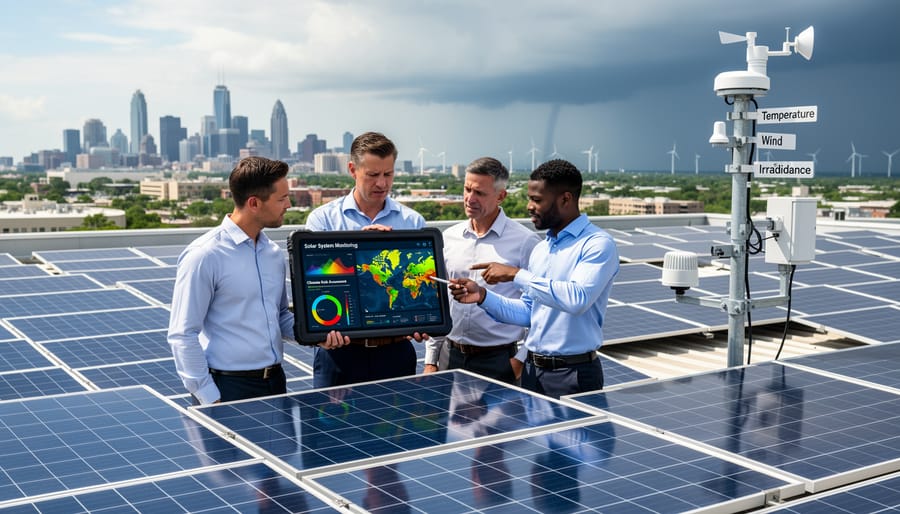
A comprehensive vulnerability assessment serves as the foundation for building ecological resilience into your energy infrastructure. Begin by analyzing climate projections specific to your geographic region over the next 20-30 years, the typical lifespan of solar installations. Examine historical weather patterns, including extreme temperature ranges, precipitation trends, wind speeds, and frequency of severe weather events. Local meteorological data combined with climate modeling can reveal increasing risks from flooding, drought, hurricanes, or heat waves.
Next, evaluate your facility’s operational requirements and how climate disruptions could impact them. Critical infrastructure like hospitals, data centers, and manufacturing facilities require different resilience thresholds than general commercial buildings. Consider your tolerance for downtime and the financial consequences of power interruptions.
Industry-specific vulnerabilities also warrant attention. Coastal facilities face saltwater corrosion and storm surge risks, while desert installations must account for dust accumulation and extreme heat degradation. Agricultural operations need to assess how changing precipitation patterns affect both energy needs and production cycles.
Document your findings in a risk matrix that prioritizes vulnerabilities by likelihood and potential impact. This assessment becomes your roadmap for designing resilient solar solutions that address your facility’s unique challenges while maintaining operational continuity through environmental changes.
Design Priorities for Maximum Resilience
When specifying solar installations for ecological resilience, facility managers should prioritize systems designed to withstand environmental stresses while maintaining operational continuity. Request weather-resistant components rated for extreme conditions specific to your region, including hurricane-force winds, hail impact resistance, and temperature fluctuations. Specify mounting systems engineered for enhanced structural integrity, with corrosion-resistant materials suitable for coastal or high-humidity environments.
Demand flexible system architecture that accommodates future capacity expansion without complete redesign. This includes oversized inverters, scalable battery storage integration, and modular panel arrays. Smart monitoring systems with predictive maintenance capabilities enable early detection of performance degradation, reducing downtime and extending equipment lifespan.
Prioritize redundancy in critical system components, particularly for operations requiring uninterrupted power supply. Dual inverter configurations and battery backup systems provide failover protection during component failures or grid disturbances. Request providers demonstrate their equipment’s performance history in similar climatic conditions and specify warranty terms covering environmental stress factors. Additionally, ensure installation teams follow industry best practices for drainage management and electrical protection to prevent water damage and lightning strikes, two common causes of premature system failure in resilience-focused applications.
Ongoing Management and Adaptation
Establish quarterly performance reviews to assess system output against climate projections and operational benchmarks. Deploy remote monitoring systems that track real-time energy production, weather patterns, and grid integration metrics. Document deviations from expected performance to identify emerging vulnerabilities early. Update risk assessments annually to incorporate new climate data and technological advancements. Maintain relationships with equipment suppliers to access firmware updates and component upgrades that enhance system resilience. Create contingency protocols for extreme weather events, including emergency shutdown procedures and rapid recovery processes. Allocate budget reserves specifically for adaptation measures, ensuring financial flexibility to implement necessary modifications without disrupting operations or compromising return on investment timelines.
For organizations navigating an increasingly volatile climate landscape, ecological resilience represents essential risk management rather than an optional sustainability initiative. The question facing business leaders today isn’t whether to prioritize resilience, but how quickly they can implement systems that protect their operations from escalating environmental disruption.
Energy infrastructure built on resilience principles delivers measurable advantages that extend far beyond environmental benefits. Companies that invest in holistic energy ecosystems—integrating distributed solar generation, energy storage, and adaptive management systems—create robust defense mechanisms against grid failures, extreme weather events, and supply chain volatility. These systems protect capital investments, ensure business continuity during critical periods, and reduce exposure to unpredictable energy costs that can erode profit margins.
The financial case becomes increasingly compelling as climate-related disruptions intensify. Organizations with resilient energy infrastructure demonstrate superior operational stability, reduced insurance costs, and enhanced asset valuations. They’re positioned to maintain productivity when competitors face shutdowns, deliver on commitments when supply chains falter, and capitalize on opportunities while others manage crisis response.
Moving forward, the competitive landscape will increasingly favor organizations that recognize energy resilience as strategic infrastructure rather than discretionary spending. Companies that act now gain first-mover advantages: locking in favorable economics, developing institutional knowledge, and building operational capabilities that competitors will scramble to replicate under less favorable conditions.
As you evaluate your organization’s energy future, examine your current infrastructure through a resilience lens. Consider not only what your systems deliver today, but whether they’ll maintain performance through the disruptions ahead. The investments you make in ecological resilience today determine whether your organization navigates future uncertainty from a position of strength or vulnerability. The time to build that foundation is now, before the next disruption tests your current limits.