
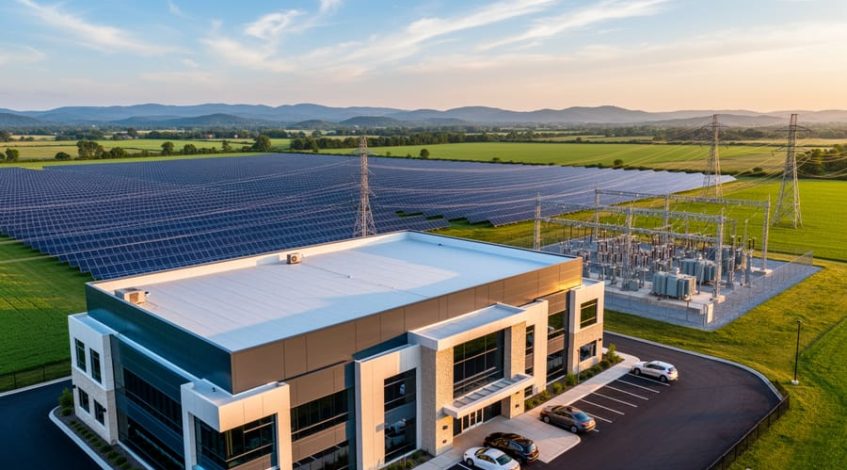
Community solar programs enable businesses to access renewable energy without installing panels on their property—a solution that eliminates upfront capital expenditure while delivering 10-20% energy cost reductions. Instead of traditional rooftop installations, multiple subscribers share the output from a centralized solar array located off-site, receiving credits on their electricity bills proportional to their subscription allocation.
For facility managers facing roof limitations, structural constraints, or leasing arrangements that prohibit on-site installations, community solar provides immediate access to clean energy benefits. This model particularly serves businesses operating in multi-tenant buildings, organizations with insufficient roof space, or facilities where panel installation proves technically unfeasible. The subscription structure requires no equipment ownership, no maintenance responsibilities, and no long-term property commitments.
The business case centers on predictable energy costs and sustainability goal achievement without infrastructure investment. Companies subscribe to a portion of a solar farm’s capacity, typically through 5-15 year agreements that lock in electricity rates below utility pricing. The shared array generates power that feeds directly into the grid, with participants receiving monthly bill credits reflecting their proportional generation share.
This approach democratizes solar access for commercial entities previously excluded from renewable energy adoption. Understanding community solar’s operational mechanics, financial structure, and strategic applications enables informed decision-making about whether this increasingly prevalent model aligns with your organization’s energy strategy and fiscal objectives.
What Is Community Solar? The Fundamentals
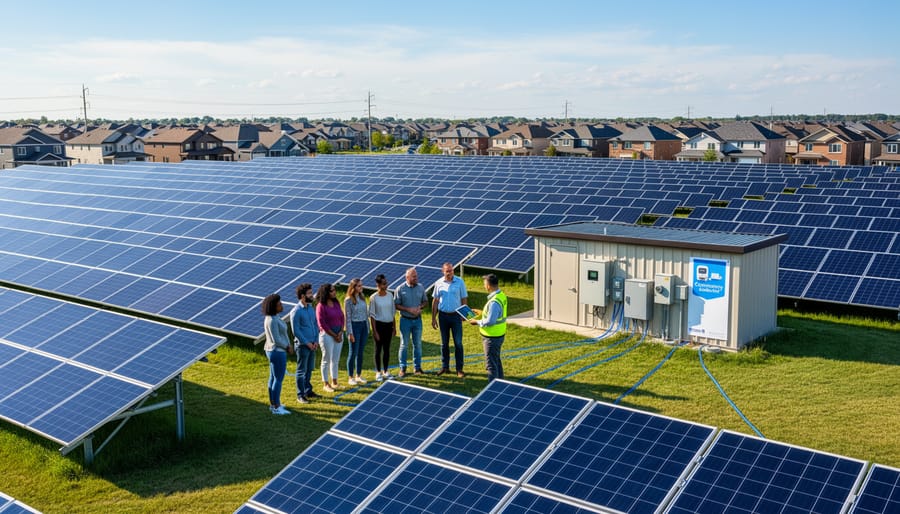
How Community Solar Works
Community solar operates through a straightforward process that transforms solar energy into measurable savings for subscribers. Understanding this workflow helps business decision-makers evaluate how community solar integrates with existing utility infrastructure and financial planning.
The process begins when a solar developer constructs a photovoltaic array, typically ranging from 1 to 5 megawatts, in a location with optimal sun exposure. Unlike traditional utility-scale projects, these installations are specifically designed to serve local subscribers within the same utility service territory.
Once operational, the solar farm generates electricity that feeds directly into the regional power grid. Advanced metering systems track the total energy production in real-time, measured in kilowatt-hours (kWh). This data flows to the utility company and program administrator, ensuring accurate allocation.
Subscribers receive energy credits proportional to their purchased share of the solar farm’s output. For example, if your business subscribes to 40 percent of a 100 kW installation producing 12,000 kWh monthly, you receive credits for approximately 4,800 kWh. These credits appear as line items on your standard utility bill, offsetting consumption charges at the retail electricity rate.
The administrative framework varies by state and utility, but most programs operate on monthly billing cycles. Subscribers maintain their existing utility relationship while receiving supplemental credits from solar production. Excess credits typically roll forward to subsequent billing periods, maximizing value during seasonal production variations.
This model eliminates the complexity of managing physical solar infrastructure while providing transparent, verifiable savings through existing utility billing systems.
Community Solar vs. Traditional Solar Installations
| Feature | Community Solar | Traditional Solar Installation |
|---|---|---|
| Initial Investment | Lower subscription-based costs; no upfront capital required | Significant capital expenditure for equipment and installation |
| Ownership Model | Shared ownership or subscription rights to energy credits | Full ownership of system and all generated power |
| Maintenance Responsibility | Handled by project developer or operator | Business owner responsible for all maintenance and repairs |
| Site Requirements | No roof space or property modifications needed | Requires suitable roof space or land; may include building-integrated solar panels |
| Best Suited For | Tenants, businesses with unsuitable roofs, organizations seeking immediate savings | Property owners with adequate space, long-term facility plans, and capital availability |
Both models deliver renewable energy benefits and cost savings, but community solar offers flexibility for businesses facing space constraints or capital limitations, while traditional installations provide maximum long-term returns for suitable properties.
Community-Integrated Solar Spaces: The Next Evolution
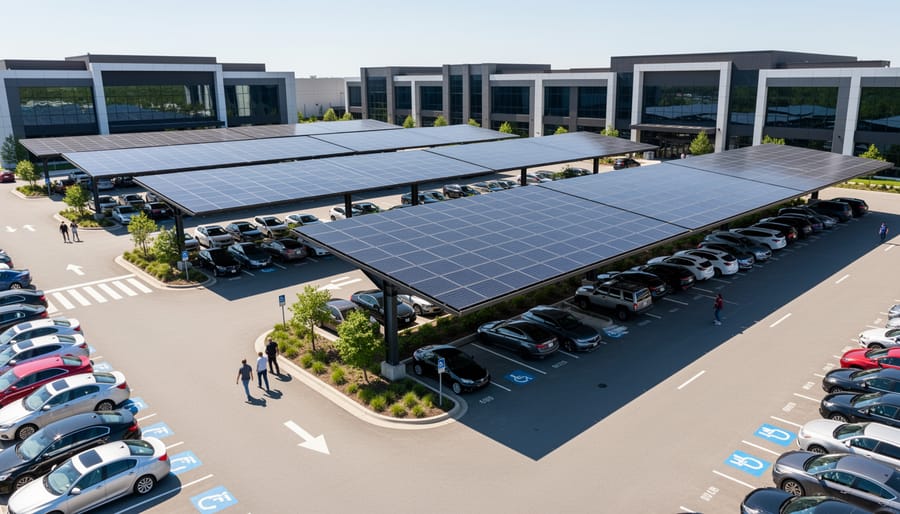
Multi-Purpose Solar Developments
Community solar installations increasingly serve dual purposes, maximizing land value and delivering multiple benefits to stakeholders. These innovative approaches demonstrate how energy generation can complement existing infrastructure and business operations while contributing to more sustainable urban energy economics.
Solar carport installations represent one of the most practical multi-purpose applications. Commercial properties, retail centers, and corporate campuses utilize parking structures equipped with overhead solar arrays to generate electricity while providing shade and weather protection for vehicles. These installations typically deliver 10-15 kW per parking space, transforming underutilized areas into revenue-generating assets. Major distribution centers and manufacturing facilities have adopted this model, reducing electricity costs while enhancing employee satisfaction through covered parking.
Agrivoltaics combines agricultural production with solar energy generation on the same land parcel. Elevated solar panels allow crops to grow underneath or livestock to graze between panel rows. This approach proves particularly valuable for farmers seeking additional revenue streams while maintaining agricultural operations. Research shows certain crops actually benefit from partial shade, improving yields while conserving water.
Commercial developments increasingly integrate solar installations into building design, incorporating panels into facades, canopies, and rooftop structures. Mixed-use developments leverage these systems to power common areas, electric vehicle charging stations, and tenant spaces. These projects demonstrate how thoughtful design converts functional structures into energy-producing assets, improving property values while reducing operational expenses and meeting sustainability targets.
Who Benefits from Community Solar?
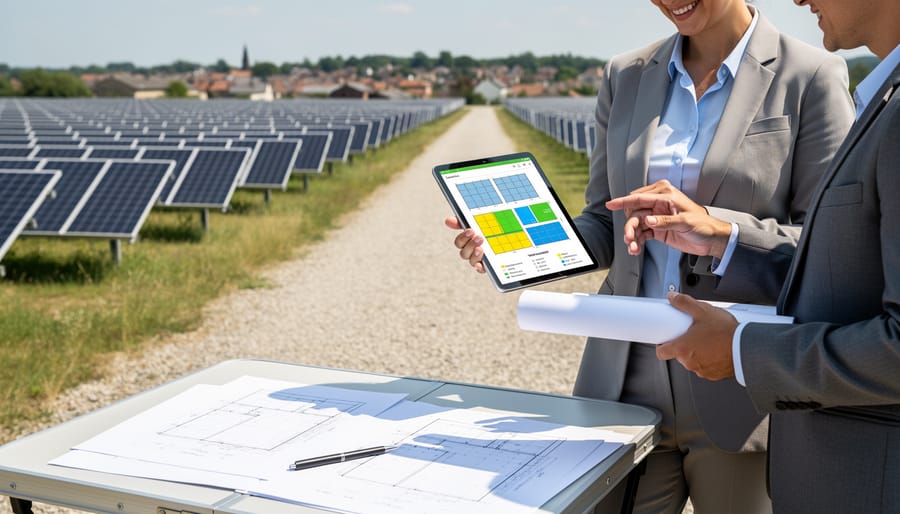
Commercial and Industrial Applications
Community solar presents strategic advantages for commercial and industrial entities facing physical or operational constraints. Businesses operating in leased facilities often lack authorization to install rooftop systems, while those with aging or structurally inadequate buildings may find traditional installations cost-prohibitive. Community solar eliminates these barriers by providing access to renewable energy without on-site infrastructure requirements.
Organizations managing multiple locations benefit significantly from centralized energy procurement through a single community solar subscription. This approach streamlines energy management across portfolios while delivering consistent cost savings and sustainability metrics. Manufacturing facilities with high daytime energy consumption align particularly well with solar generation profiles, maximizing financial returns.
Companies pursuing corporate sustainability goals leverage community solar to secure renewable energy credits and reduce Scope 2 emissions without capital expenditure. This proves especially valuable for businesses prioritizing operational flexibility or requiring short-term renewable energy solutions. Properties unsuitable for solar retrofits due to shading, orientation, or structural limitations gain immediate access to clean energy through off-site generation.
The subscription model transfers maintenance responsibilities and performance risks to project operators, allowing businesses to focus resources on core operations while securing predictable energy costs over extended contract terms.
Government and Institutional Use Cases
Community solar programs deliver substantial value to government entities, municipalities, schools, and public institutions seeking to meet sustainability mandates without significant capital investment. Unlike traditional solar installations requiring substantial upfront costs and ongoing maintenance responsibilities, community solar enables public organizations to subscribe to off-site solar facilities and receive energy credits directly on their utility bills.
This subscription-based model proves particularly advantageous for institutions operating under tight budget constraints or managing buildings unsuitable for rooftop installations. Schools and municipal facilities can demonstrate environmental leadership while achieving measurable cost savings, typically reducing electricity expenses by 10-15% annually. These savings can be redirected toward core programs and services without the complexities of system ownership.
Public sector adoption of community solar supports broader urban sustainability initiatives, contributing to smart growth cities and reducing municipal carbon footprints. Many jurisdictions face renewable energy procurement targets; community solar provides a straightforward compliance pathway without burdening limited capital budgets or requiring specialized technical expertise for system management. Additionally, participation demonstrates fiscal responsibility and environmental stewardship to constituents, enhancing public trust while supporting local clean energy development.
Financial and Operational Advantages
ROI Considerations and Cost Structure
Community solar subscriptions typically operate on a straightforward cost structure with minimal upfront investment. Subscribers generally pay monthly fees that correspond to their allocated portion of the solar array’s energy production, with costs ranging from 5-15% below standard utility rates depending on the program and location. Unlike traditional solar installations requiring significant capital expenditure, community solar eliminates equipment costs, installation fees, and maintenance expenses.
The financial model centers on immediate savings rather than long-term payback calculations. Most subscribers begin realizing cost reductions from their first billing cycle, with annual savings averaging 10-20% compared to conventional utility bills. For a mid-sized commercial facility consuming 50,000 kWh monthly, this translates to approximately $6,000-$12,000 in annual savings depending on regional electricity rates and subscription terms.
Return on investment becomes particularly attractive when considering the absence of upfront capital requirements. While rooftop solar installations typically require 5-8 years for payback, community solar subscribers achieve positive cash flow immediately through reduced monthly energy costs. Additionally, many programs offer flexible contract terms ranging from one to twenty years, allowing organizations to align commitments with their operational planning horizons.
The risk profile further enhances the value proposition. Subscribers avoid exposure to equipment depreciation, performance degradation, and technological obsolescence. System maintenance, insurance, and operational oversight remain the responsibility of the solar array operator, ensuring consistent performance without additional administrative burden or unexpected expenses for participating organizations.
Risk Mitigation and Maintenance Benefits
Community solar programs eliminate the substantial capital investment, technical risks, and ongoing maintenance responsibilities associated with traditional on-site solar installations. Subscribers avoid the challenges of equipment ownership, including potential panel degradation, inverter failures, and weather-related damage. The community solar provider assumes full responsibility for system performance, monitoring, repairs, and component replacements throughout the project lifecycle.
This operational model proves particularly valuable for organizations operating in leased facilities, buildings with unsuitable roof conditions, or locations where installing dedicated solar arrays isn’t financially viable. Maintenance obligations that typically require specialized expertise and budgetary allocation are transferred entirely to the solar farm operator, who manages these tasks at scale across the entire installation.
Performance risk mitigation represents another significant advantage. Subscribers receive guaranteed credit percentages based on their allocated portion of the array’s production, with the provider bearing responsibility for maintaining optimal system efficiency. This arrangement delivers predictable energy cost savings without the uncertainty of individual system performance variability. Organizations can redirect capital and operational resources toward core business functions while still achieving measurable sustainability objectives and reducing their carbon footprint through clean energy consumption.
Real-World Applications: Case Studies
Case Study: Multi-Location Retail Chain
A regional retail chain operating 15 locations across three states faced mounting energy costs and limited options for on-site solar installations. Many of their stores occupied leased spaces in commercial developments, while others had unsuitable roof conditions or shading issues that made traditional solar installations impractical or economically unfeasible.
The company enrolled all 15 locations in a community solar program, subscribing to energy credits equivalent to 65% of their combined annual electricity consumption. The implementation required minimal administrative effort—corporate headquarters coordinated the enrollment process, and billing credits automatically appeared on each location’s utility statement within 45 days.
Over the first 12 months, the retail chain achieved an 18% reduction in total energy costs across all participating locations, translating to $127,000 in annual savings. The fixed-rate structure of their community solar subscription protected them from three utility rate increases during this period, contributing an additional $31,000 in avoided costs.
The program required zero capital investment, eliminating the financial barriers associated with traditional solar installations. Property managers at leased locations approved participation immediately since no physical modifications were required. The company redirected their energy savings toward LED lighting upgrades and HVAC improvements, compounding their operational efficiency gains.
This case demonstrates how community solar enables businesses with complex real estate portfolios to access renewable energy benefits regardless of property ownership status or physical site limitations, delivering measurable financial returns through a straightforward subscription model.
Case Study: Municipal Government Complex
A mid-sized municipal government in the Northeast enrolled 12 public facilities in a community solar program to address aging infrastructure constraints and meet climate action plan commitments. The municipality faced significant challenges: several buildings required costly electrical upgrades to accommodate rooftop installations, while historic district regulations prohibited solar panels on city hall and the public library.
By subscribing to community solar, the government secured immediate renewable energy credits without capital expenditure. The enrollment delivered 15-18% annual electricity cost savings across participating facilities, translating to approximately $47,000 in first-year budget relief. These savings were redirected to other municipal services, demonstrating fiscal responsibility while advancing sustainability objectives.
The program proved particularly valuable for facilities with unsuitable roofs or shaded properties. The wastewater treatment plant, fire stations, and community center all benefited from clean energy without site-specific installations. The municipality locked in predictable energy costs through the subscription agreement, protecting against utility rate fluctuations that had previously complicated multi-year budget planning.
Within 18 months, the city achieved 35% of its renewable energy targets through community solar alone. The procurement process required minimal staff time compared to competitive bidding for physical installations. Additionally, the arrangement required no ongoing maintenance responsibilities, allowing facility managers to focus on core operational priorities. This case demonstrates how community solar enables government entities to achieve environmental goals while maintaining fiduciary responsibility to taxpayers.
Implementation Considerations
Key Questions Before Enrollment
Before committing to a community solar program, business decision-makers should evaluate several critical factors to ensure alignment with operational requirements and financial objectives. First, confirm location availability, as community solar projects must typically be within your utility service territory and may have geographic restrictions. Understanding credit allocation methods is essential—verify how bill credits are calculated, whether they reflect retail or wholesale rates, and if they apply to demand charges. Review contract terms carefully, as subscription agreements often range from one to twenty-five years, with longer commitments potentially offering better rates but less flexibility.
Exit provisions warrant particular attention. Examine cancellation policies, transfer options if you relocate facilities, and any penalties for early termination. Some programs allow subscription transfers to new tenants or business locations, which can be valuable for growing organizations. Request detailed savings guarantees in writing, including baseline comparisons and methodology for calculating reductions. Consider whether the program accommodates future expansion, particularly if you’re planning facility upgrades or exploring complementary solutions like building-integrated photovoltaics. Finally, assess the developer’s track record, financial stability, and system performance history to ensure reliable long-term operation and projected returns on your energy investment.
Community solar represents a strategic opportunity for commercial and institutional energy consumers seeking to advance sustainability goals while maintaining financial discipline. This model delivers the environmental benefits of renewable energy without the capital expenditure, physical constraints, or operational responsibilities associated with on-site installations. For organizations managing multiple facilities, limited roof space, or buildings unsuitable for traditional solar arrays, community solar provides essential flexibility that aligns with diverse real estate portfolios and operational requirements.
The cost-effectiveness of subscription-based participation, combined with predictable energy savings and minimal implementation complexity, makes community solar particularly attractive for organizations evaluating their energy procurement strategies. Real-world applications across healthcare, education, municipal operations, and commercial sectors demonstrate measurable results in both cost reduction and carbon footprint improvement.
As you evaluate renewable energy options for your organization, consider community solar alongside traditional installations. Assess your facility characteristics, energy consumption patterns, and sustainability objectives to determine the optimal approach. Whether pursuing community solar independently or as part of a comprehensive energy strategy, this accessible pathway to renewable energy deserves thorough evaluation in your organization’s sustainability and financial planning initiatives.