
Deposit-refund systems are reshaping how the solar industry addresses end-of-life panel management by creating financial incentives that guarantee proper recycling and recovery of valuable materials. Under these mechanisms, solar system owners or installers pay an upfront deposit at the time of installation—typically $10 to $30 per panel—which is fully refunded when the panels are returned to certified recycling facilities after their 25-30 year operational lifespan.
The economic logic is straightforward: deposits internalize future disposal costs into today’s investment decisions, eliminating the problem of “orphaned” panels that might otherwise enter landfills when decommissioning costs exceed scrap value. France implemented Europe’s first mandatory photovoltaic deposit scheme in 2022, requiring manufacturers to contribute to a collective fund managed by the organization Soren, which has already processed over 15,000 metric tons of panel waste. Washington State launched a similar producer responsibility program in 2017, demonstrating the model’s viability across different regulatory environments.
For commercial solar investors, these systems provide two strategic advantages: guaranteed compliance with tightening environmental regulations and protection against future liability exposure from improper disposal. The refundable deposit structure transforms waste management from an uncertain future cost into a recoverable asset, improving long-term project economics while supporting circular economy principles. Understanding how these schemes operate—and preparing for their likely expansion across jurisdictions—has become essential for sustainable solar portfolio management.
The Looming Solar Waste Challenge Your Business Needs to Understand
What Happens When Commercial Solar Panels Reach End-of-Life
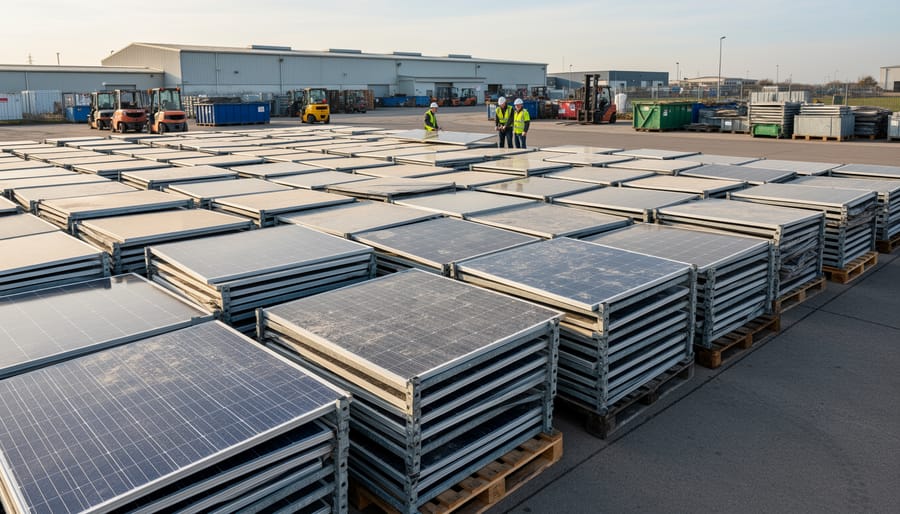
As commercial solar installations from the early 2000s approach their 25-30 year operational lifespan, the industry faces a significant end-of-life management challenge. Currently, most decommissioned photovoltaic panels follow one of three paths: landfill disposal, rudimentary recycling that recovers only aluminum frames and junction boxes, or indefinite storage at facilities awaiting better processing options.
The environmental concerns are substantial. A typical commercial solar panel contains valuable materials including silicon, silver, copper, and glass, yet conventional disposal methods recover less than 30% of these resources. Without proper processing, panels may release trace amounts of heavy metals like lead and cadmium into soil and groundwater. The Solar Energy Industries Association estimates that by 2050, end-of-life panels could represent 10% of global electronic waste without intervention.
The fundamental challenge lies in infrastructure gaps. Advanced PV recycling facilities capable of recovering 95% of panel materials exist but remain scarce, with fewer than a dozen operating in North America. Transportation logistics compound the problem, as shipping decommissioned panels to distant recycling centers often proves economically unviable for individual facility operators.
This circular economy deficit creates uncertainty for business owners planning long-term solar investments. The absence of standardized take-back programs means decommissioning costs remain unpredictable, potentially impacting total cost of ownership calculations. Industry leaders increasingly recognize that addressing this infrastructure gap requires coordinated policy mechanisms that align economic incentives with environmental responsibility, setting the stage for deposit-refund systems as a promising solution.
The Business Case for Planning Ahead
Failing to plan for end-of-life management of commercial solar installations exposes organizations to significant financial and regulatory risks. As jurisdictions worldwide implement stricter end-of-life regulations, businesses that lack disposal strategies may face unexpected costs when decommissioning large-scale arrays. Without adequate reserves, companies could encounter disposal fees ranging from $15 to $45 per panel, creating substantial unbudgeted expenses for multi-megawatt installations.
Beyond immediate costs, regulatory non-compliance carries penalties and reputational damage that can affect stakeholder confidence and market positioning. Facilities without certified recycling partnerships risk project delays during decommissioning, while those demonstrating proactive end-of-life planning strengthen their environmental credentials and competitive advantage.
Forward-thinking organizations recognize that deposit-refund systems provide cost certainty and regulatory compliance insurance. By establishing financial provisions today, businesses protect against future price volatility in recycling markets and ensure seamless transitions when assets reach retirement. This approach transforms end-of-life management from a future liability into a planned, manageable component of total ownership costs, supporting long-term financial stability and sustainability commitments.
How PV Deposit-Refund Systems Actually Work
The Mechanics Behind the System
Deposit-refund systems for photovoltaic installations operate through a structured financial mechanism designed to ensure responsible end-of-life management. Understanding this process is essential for business owners evaluating the long-term financial implications of solar investments.
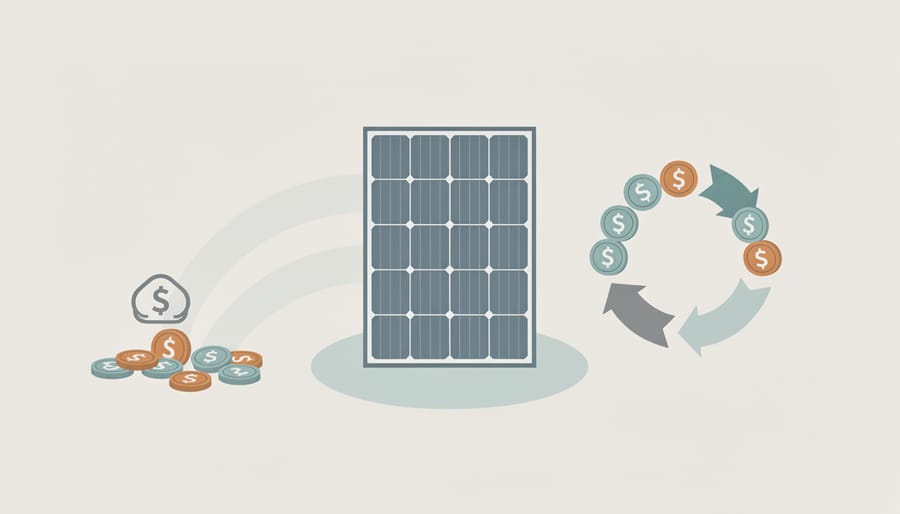
The system begins at the point of sale or installation. When a commercial facility purchases a PV system, a predetermined deposit amount is collected alongside the initial investment. This deposit typically ranges from 1-3% of the total system cost, though percentages vary by jurisdiction and system size. The collected funds are immediately transferred to a designated escrow account or third-party administrator, ensuring these resources remain protected and available for future recycling needs.
Escrow management involves professional fund administrators who maintain transparent records and invest deposits conservatively to preserve capital while generating modest returns. These administrators operate under strict regulatory oversight, providing quarterly reporting to stakeholders and maintaining separate accounts to prevent commingling of funds.
The verification process activates when a system reaches end-of-life, typically after 25-30 years of operation. System owners initiate claims by submitting documentation to certified recycling facilities that meet established environmental and technical standards. These facilities process the decommissioned equipment and provide verification certificates confirming proper material recovery and disposal procedures were followed.
Refund triggers occur upon successful verification. The escrow administrator reviews submitted documentation, validates recycling facility credentials, and processes payment within a defined timeframe, usually 30-60 days. The refund amount may include the original deposit plus any accumulated interest, minus administrative fees typically ranging from 2-5% of the total.
This structured approach creates financial incentives for proper disposal while establishing clear accountability throughout the equipment lifecycle, ultimately supporting circular economy objectives within the solar industry.
Who Manages the Deposits and Refunds
Deposit-refund system administration typically involves a collaborative framework between multiple stakeholders to ensure operational efficiency and accountability. Third-party administrators often serve as the operational backbone, managing deposit collection, fund custody, and refund processing. These specialized entities bring expertise in financial management and compliance tracking, reducing administrative burden on individual solar installers and system owners.
Government oversight plays a crucial regulatory role, establishing performance standards, audit requirements, and enforcement mechanisms. Regulatory bodies monitor fund solvency, verify recycling outcomes, and ensure scheme participants meet their end-of-life obligations. This oversight protects stakeholders from financial mismanagement while maintaining public confidence in the system’s environmental objectives.
Industry consortiums frequently coordinate deposit-refund schemes across multiple manufacturers and installers, creating economies of scale that reduce per-panel administration costs. These collaborative arrangements standardize deposit amounts, recycling protocols, and integration with reverse logistics systems. In practice, European programs demonstrate how shared administration platforms can process thousands of transactions monthly while maintaining transparency. This multi-stakeholder approach distributes financial risk, leverages specialized expertise, and creates accountability checkpoints that enhance scheme credibility and long-term viability for commercial solar operators.
Real-World Results: Where PV Deposit-Refund Schemes Are Already Working
European Pioneer Programs Setting the Standard
Europe has emerged as the global leader in implementing deposit-refund systems for photovoltaic panels, establishing regulatory frameworks that balance environmental responsibility with economic viability. These pioneering programs offer valuable insights for businesses evaluating their long-term solar investment strategies.
Germany’s approach centers on the Electrical and Electronic Equipment Act, which mandates manufacturers to finance collection and recycling infrastructure. The country has achieved remarkable results, with over 95% of decommissioned panels entering proper recycling channels. German producers typically incorporate deposit costs of 1-3 euros per panel into their pricing structures, which are refunded upon verified recycling. This system has created a robust secondary market for recovered materials, with silicon recovery rates exceeding 85%.
France implemented its mandatory Extended Producer Responsibility scheme in 2014, requiring all solar equipment manufacturers to join approved collection organizations. The nonprofit organization Soren manages the primary collection network, operating over 300 dedicated collection points nationwide. French businesses benefit from predictable fee structures averaging 0.12 euros per watt, providing clear cost projections for lifecycle management. The program has successfully processed over 12,000 tons of photovoltaic waste since inception, demonstrating scalability.
The Netherlands has integrated deposit-refund mechanisms into broader circular economy legislation, emphasizing material recovery optimization. Dutch regulations require 80% material recovery by weight, incentivizing advanced recycling technologies. Commercial installations over 100 kW must register with the national tracking system, ensuring accountability throughout the panel lifecycle.
These European models demonstrate that well-designed deposit-refund systems create minimal administrative burden while delivering measurable environmental outcomes. For business owners planning solar investments, understanding these frameworks provides crucial context for anticipating similar requirements in emerging markets and structuring financially resilient projects.
Recovery Rates and Material Value Recapture
Current recovery rates for solar panel materials demonstrate significant progress, though substantial room for improvement remains. Industry data indicates that conventional recycling processes recover approximately 70-80% of materials by weight from crystalline silicon panels, primarily capturing aluminum frames and glass. However, the extraction of high-value materials like silicon, silver, and copper presents greater technical challenges, with recovery rates for these critical components typically ranging between 85-95% when advanced recycling technologies are employed.
The economic value recapture varies considerably based on processing methods and market conditions. Standard mechanical recycling yields approximately $3-4 per panel in recovered materials, while sophisticated thermal and chemical processing can extract $12-20 per panel. Silicon wafers represent the most valuable component, accounting for roughly 60% of recoverable material value when properly processed. Silver content, though comprising less than 1% of panel weight, contributes approximately 10-15% of total material value due to current market prices.
Deposit-refund systems directly influence these recovery economics by establishing predictable material streams and incentivizing investment in enhanced processing infrastructure. European programs implementing deposit schemes have achieved recovery rates exceeding 95%, demonstrating how financial mechanisms drive operational improvements. For commercial solar operators, understanding these recovery metrics enables more accurate end-of-life cost projections and informs decisions about system expansion timing, ultimately improving total lifecycle return on investment calculations.
What This Means for Your Commercial Solar Investment
How Deposit Fees Affect Your Solar Project Budget
Deposit requirements in PV circularity programs typically range from $50 to $200 per panel, depending on jurisdictional regulations and system design. For a commercial installation of 500 panels, this translates to an upfront deposit of $25,000 to $100,000, representing approximately 3-8% of total project costs for most medium-scale deployments.
These deposits function as financial assurance mechanisms rather than additional expenses. The funds remain earmarked for eventual panel recovery and recycling, with refund structures varying by program design. Some jurisdictions return deposits incrementally throughout the system’s operational life, while others provide full reimbursement upon proper end-of-life management.
From a financing perspective, deposits require careful consideration in capital planning. Organizations should evaluate whether deposit obligations affect debt-to-equity ratios or impact available credit lines. Many commercial lenders now recognize deposits as recoverable assets, which can improve loan terms when properly documented in financial statements.
Tax treatment varies by jurisdiction, but deposits may qualify for deferred recognition, preventing immediate impact on taxable income. Finance teams should consult with specialized solar accounting professionals to optimize treatment under current regulations.
For businesses comparing multiple solar proposals, understanding deposit structures proves essential. A lower-cost installation with higher deposit requirements may yield different long-term economics than a premium system with minimal circularity fees. Comprehensive total cost of ownership analysis should incorporate deposit timing, refund schedules, and opportunity costs of capital committed to these programs. This financial due diligence ensures accurate project budgeting and prevents unexpected cash flow constraints during implementation.
Calculating the Extended ROI with End-of-Life Refunds
Integrating deposit refunds into your solar investment’s financial projections requires a methodical approach that extends beyond traditional payback calculations. Rather than viewing end-of-life as a cost center, deposit-refund systems transform decommissioning into a recoverable asset class.
Begin by establishing your baseline financial model using standard metrics: initial capital expenditure, operational savings, tax incentives, and energy production forecasts. Next, incorporate the deposit component as a recoverable asset with a defined maturity date corresponding to your system’s operational lifespan, typically 25-30 years. This deposit amount—often 1-3% of initial system costs in established programs—should be accounted for separately in your balance sheet projections.
The refund calculation depends on verifiable end-of-life compliance. Most programs structure refunds around recycling rates, with full reimbursement requiring 85-95% material recovery. Work with your financial team to model three scenarios: full refund (compliant recycling), partial refund (incomplete documentation), and zero refund (non-compliance). This risk-adjusted approach provides realistic projections.
Advanced modeling should integrate life cycle assessment tools that track material composition and recyclability metrics throughout your system’s operational phase. These platforms enable precise refund forecasting based on actual panel degradation and technological advancements in recycling efficiency.
Consider the time value of money when projecting returns. A deposit refunded in 30 years requires present value discounting to accurately reflect its contribution to overall ROI. Most commercial solar investments incorporating deposit-refund mechanisms show 0.5-1.2% improvement in internal rate of return when properly modeled—a significant enhancement for large-scale deployments.
Creating Value Through Circularity: Beyond Basic Compliance
How Refund Incentives Drive Better Panel Design
Deposit-refund systems create powerful financial incentives that influence solar panel manufacturing from the initial design phase. When manufacturers know their products will enter a recovery system with refundable value, they face direct economic pressure to optimize panels for disassembly and material recovery. This market-driven approach transforms end-of-life considerations from an afterthought into a core design principle.
Leading manufacturers participating in European deposit-refund schemes have already begun redesigning junction boxes with tool-free removal features and standardizing frame attachment methods. These modifications reduce dismantling time by up to 40 percent, directly lowering processing costs and increasing refund margins. Companies like First Solar have demonstrated that design-for-recycling approaches can maintain performance while enabling 90 percent material recovery rates.
The financial architecture of deposit systems rewards this innovation. Manufacturers designing for easier material separation receive faster processing at collection facilities, reducing their operational costs when reclaiming deposits. This competitive advantage encourages industry-wide adoption of circular economy principles, creating a positive feedback loop where better design reduces system costs for all stakeholders.
For facility managers and business owners, this means future panel investments will increasingly offer both superior environmental performance and enhanced end-of-life value recovery, protecting long-term asset value while supporting sustainability objectives.
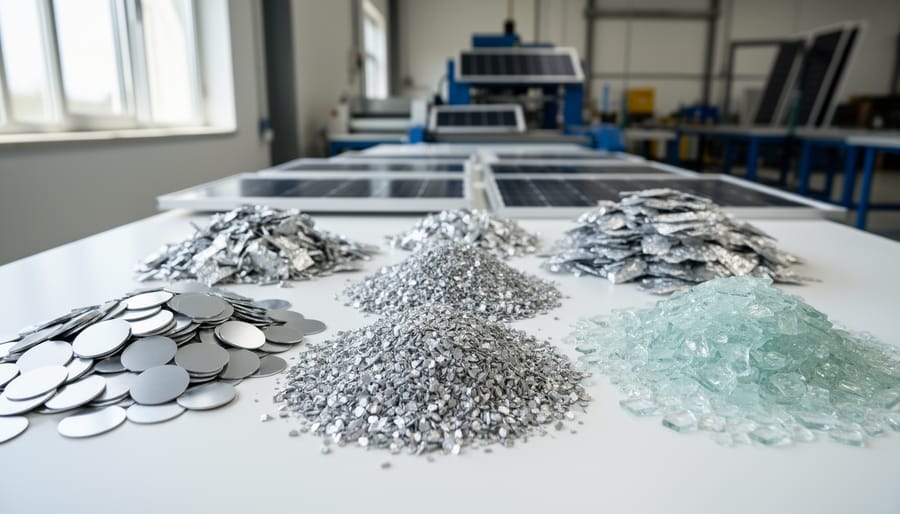
The Emerging Market for Recovered Solar Materials
Systematic recovery of end-of-life solar panels creates substantial economic opportunities in secondary materials markets. A typical crystalline silicon panel contains approximately 76% glass, 10% polymer, 8% aluminum, 5% silicon, and traces of high-value metals including silver and copper. With global solar capacity expected to generate 78 million metric tons of panel waste by 2050, the recovered material value represents a multi-billion dollar market opportunity.
Silicon represents the most significant value proposition. High-purity silicon recovered through advanced recycling processes can be reintroduced into manufacturing supply chains at costs 30-40% below virgin material production. The European PV CYCLE program has demonstrated commercial viability, recovering over 96% of glass and 95% of semiconductor materials from collected panels.
Silver recovery presents particularly compelling economics. Each panel contains 0.5-1 gram of silver, and with current market prices exceeding $700 per kilogram, systematic recovery generates substantial returns. Japanese recycling facilities report extracting silver at purities exceeding 99.9%, commanding premium pricing in secondary metals markets.
Aluminum frames and junction boxes contribute additional revenue streams. Recovered aluminum maintains high market value with minimal quality degradation, while copper from electrical components provides consistent commodity returns. Forward-thinking businesses incorporating deposit-refund participation can access these emerging markets while strengthening their sustainability credentials and offsetting long-term system ownership costs.
Preparing Your Organization for PV Deposit-Refund Requirements
What to Look for in Installation Partners
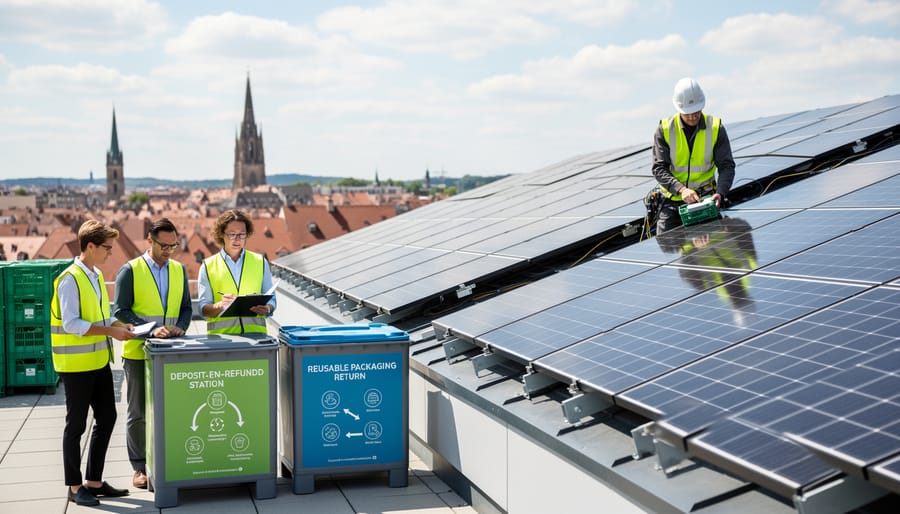
When selecting solar installation partners, their approach to end-of-life management should be a central evaluation criterion. Begin by asking whether they participate in established deposit-refund schemes or manufacturer take-back programs. Request documentation of their partnerships with certified recycling facilities and inquire about their track record in recovering materials from decommissioned systems.
Key questions should include: What specific procedures do they follow for panel collection and transportation? How do they track and report recycling metrics? Can they provide evidence of compliance with emerging extended producer responsibility regulations in your jurisdiction? Request references from clients who have completed full-lifecycle projects, including decommissioning.
Evaluate whether installers offer comprehensive service agreements that explicitly address end-of-life scenarios, including financial provisions for future recycling costs. Forward-thinking partners should demonstrate familiarity with deposit-refund mechanisms and explain how these programs affect your total cost of ownership. Ask for transparency regarding any fees allocated to recycling funds and how these amounts are calculated.
Additionally, verify that installers maintain updated knowledge of evolving regulatory requirements and can provide guidance on preparing for upcoming mandates. Partners with established relationships within circular economy networks often deliver superior long-term value, reducing future liability while supporting your sustainability objectives.
Documentation and Tracking Best Practices
Effective documentation practices form the foundation of successful long-term deposit-refund programs, particularly when dealing with photovoltaic systems that may operate for 25-30 years before decommissioning. Business owners should establish comprehensive record-keeping protocols from the initial installation phase, maintaining detailed documentation of deposit amounts, payment dates, system specifications, and warranty information in both digital and physical formats with redundant backup systems.
Critical documentation includes original purchase invoices, deposit receipts with unique identification numbers, manufacturer specifications, installation certificates, and periodic maintenance records. These documents should be stored in centralized management systems accessible to multiple stakeholders, ensuring continuity even during organizational transitions or ownership changes. Consider implementing blockchain-based tracking solutions or certified third-party escrow services that provide immutable records and independent verification.
Facility managers must also maintain photographic evidence of system condition at installation, supported by serial number documentation for all major components including panels, inverters, and mounting systems. This baseline documentation becomes essential when claiming refunds decades later, as it establishes the original system configuration and validates end-of-life material recovery claims.
Real-world experience from European markets demonstrates that companies with robust documentation practices recover deposits 30-40 percent faster than those with incomplete records. Establish annual audit procedures to verify document integrity and update contact information for all stakeholders. Digital transformation of these processes, including cloud-based management platforms with automated reminders and compliance tracking, significantly reduces administrative burden while ensuring regulatory compliance throughout the system lifecycle.
Deposit-refund systems represent a fundamental shift in how we conceptualize solar energy investments. Rather than viewing photovoltaic installations as assets that depreciate to zero value over their operational lifetime, these schemes transform solar panels into circular commodities with inherent residual worth. This paradigm change carries significant implications for financial modeling, procurement decisions, and sustainability reporting.
For business owners and facility managers evaluating solar investments today, factoring end-of-life value into your total cost of ownership calculations is no longer optional. Organizations operating under deposit-refund frameworks have documented reductions in effective system costs ranging from 8-15% when recovered deposits and material values are properly accounted for. This incremental improvement can meaningfully enhance project ROI and shorten payback periods, particularly for large-scale commercial installations.
Government officials and policymakers should recognize that deposit-refund mechanisms create market incentives that align environmental objectives with economic rationality. By ensuring proper material recovery, these systems reduce landfill burdens, minimize illegal dumping, and support domestic recycling infrastructure development. The evidence from European implementations demonstrates that well-designed programs achieve collection rates exceeding 90% without imposing excessive administrative burdens.
As this transition accelerates, the competitive advantage will belong to organizations that act proactively. When planning your next solar project, engage installers and developers who demonstrate knowledge of emerging deposit-refund requirements and maintain relationships with certified recycling partners. Request transparency regarding end-of-life planning during the procurement process. Evaluate proposals not solely on installation costs but on lifecycle value optimization. The solar industry is evolving from linear consumption to circular stewardship. Position your organization at the forefront of this transformation by making informed decisions that recognize the full economic and environmental potential of photovoltaic technology.