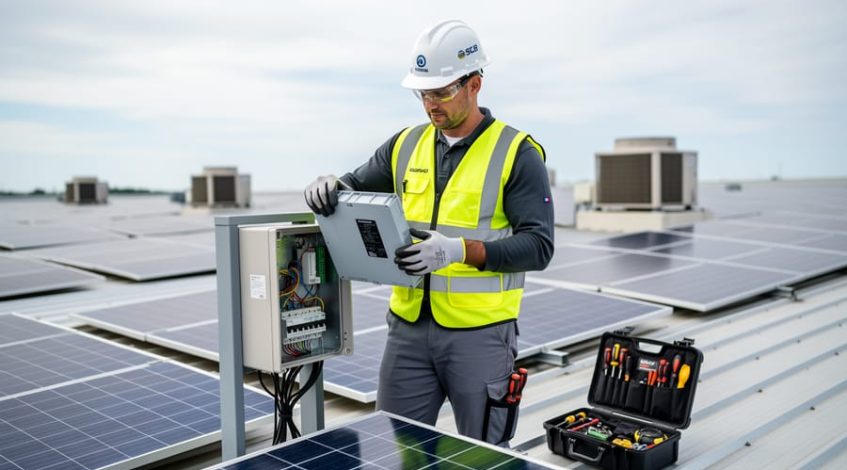
Establish a preventive maintenance schedule that addresses the most common failure points in commercial solar installations: inverter diagnostics every six months, connection point inspections quarterly, and panel cleaning based on environmental conditions. This proactive approach reduces emergency repair costs by up to 60% and extends system lifespan from the industry average of 25 years to 30-plus years.
Document every component’s warranty terms, repair provisions, and manufacturer support commitments before installation. Solar inverters typically carry 10-year warranties with repair options, while panels offer 25-year performance guarantees but limited physical damage coverage. Understanding these distinctions prevents costly out-of-pocket repairs and informs smarter procurement decisions when comparing vendors.
Develop relationships with certified repair technicians now, before system failures occur. The solar service industry faces a growing skills gap, with qualified technicians becoming scarce in many regions. Facilities that establish service agreements early secure priority response times and locked-in labor rates, avoiding the premium costs associated with emergency callouts that can exceed standard rates by 150%.
Evaluate total cost of ownership rather than initial installation price when selecting equipment. Systems designed with modular, replaceable components cost 15-20% more upfront but deliver substantially lower lifetime maintenance expenses. A European manufacturing facility recently demonstrated this principle by reducing annual repair budgets from €45,000 to €18,000 after transitioning to repairable solar infrastructure.
The emerging Right-to-Repair movement presents strategic opportunities for commercial solar operators. Legislative changes in multiple jurisdictions now require manufacturers to provide diagnostic tools, spare parts, and technical documentation to independent repair providers. This regulatory shift fundamentally alters the commercial solar maintenance landscape, enabling facility managers to control repair costs and reduce system downtime through competitive service sourcing.
Understanding Solar Module Repairability: What It Means for Your Business
Common Solar Module Failures That Impact Commercial Operations
Understanding common failure modes helps facility managers make informed decisions about repair versus replacement strategies for their commercial solar installations. The most frequently encountered issues fall into several distinct categories, each with different implications for operational continuity and maintenance budgets.
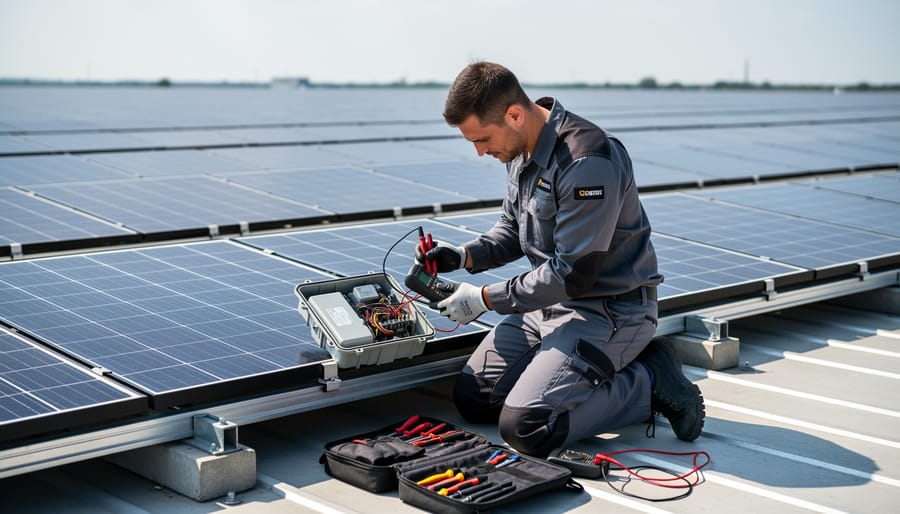
Junction box failures represent one of the most repairable module defects. These sealed enclosures protect electrical connections from environmental exposure, but can fail due to moisture ingress or thermal cycling. When detected early through thermal imaging during routine inspections, junction boxes can often be replaced or resealed at a fraction of module replacement cost, though this requires specialized training and proper safety protocols.
Cell degradation manifests as gradual power output decline, typically caused by potential-induced degradation, microcracks, or light-induced degradation. While individual cell replacement is technically possible, current industry practices rarely justify this approach economically for standard modules. However, understanding degradation patterns helps facility managers optimize system performance through string-level reconfigurations rather than wholesale replacements.
Delamination occurs when encapsulant layers separate from cells or glass, allowing moisture penetration and accelerating performance loss. This failure mode generally necessitates module replacement, as relamination processes are not commercially viable for most installations. Warranty coverage often applies when delamination appears prematurely.
Connector problems, including MC4 connector corrosion or loose connections, are highly repairable field issues. Regular maintenance protocols should include connector inspection, as addressing these issues promptly prevents arc faults and voltage drops that compromise system performance. For multi-megawatt installations, proactive connector maintenance delivers measurable returns on investment through sustained energy production.
The Current State of Solar Module Repair Services
The commercial solar module repair landscape currently presents limited options for facility managers and business owners. Most solar installations rely primarily on manufacturer warranty services, which typically cover defects for 10-25 years but exclude damage from external factors, weather events, or normal wear. These warranty programs often require entire module replacement rather than component-level repairs, creating unnecessary waste and extended downtime.
Third-party repair providers have emerged to fill gaps in manufacturer services, offering solutions for cracked glass, junction box replacements, and bypass diode repairs. However, their capabilities remain constrained by proprietary components, sealed enclosures, and design limitations that prevent economical repairs. Many providers focus on field-level troubleshooting rather than actual module restoration.
The primary challenge facing commercial operators is the lack of standardized repair protocols and component availability. Manufacturers rarely provide access to replacement parts or technical documentation necessary for independent repairs. This creates a dependency model where system owners face binary choices: operate with reduced capacity or replace entire modules at significant capital expense. For large commercial installations, this approach directly impacts return on investment calculations and long-term operational budgets.
Right-to-Repair Legislation and Its Impact on Solar Investments
How Repair Rights Affect Your Solar System’s Total Cost of Ownership
Understanding repair rights’ financial implications requires analyzing how equipment accessibility affects your solar system’s total cost of ownership over its operational lifespan. Restricted repair access can substantially increase lifetime expenses through multiple cost pathways that extend well beyond initial purchase price.
When proprietary systems require manufacturer-exclusive repairs, facilities face elevated service costs averaging 40-60% higher than open-access alternatives. Consider a 500kW commercial installation: restricted repair rights might add $75,000-$125,000 in excess maintenance expenses over 25 years compared to systems supporting independent servicing options.
Replacement costs present another significant factor. Systems with limited repair options often necessitate complete component replacement rather than targeted repairs. A facility manager at a Queensland manufacturing plant documented this firsthand when inverter failure in a proprietary system required $28,000 in replacements, while comparable open-architecture systems enabled diagnostic repairs costing $4,200.
Production downtime represents substantial hidden costs. Restricted systems typically experience 3-5 times longer service intervals due to specialized technician availability and proprietary part procurement. For energy-intensive operations, each day of system downtime can mean $500-$2,000 in lost production value and grid electricity costs.
Calculate your exposure using this framework: multiply your system’s daily energy production value by average repair downtime, add differential service costs, and factor component replacement premiums. A comprehensive analysis typically reveals that repair-friendly systems deliver 15-25% lower total ownership costs.
Forward-thinking procurement strategies now incorporate repairability assessments alongside efficiency ratings and warranty terms. Organizations prioritizing repair accessibility report improved budget predictability, reduced operational risk, and enhanced ability to optimize system performance throughout the installation’s productive life.
Warranty Considerations and Independent Repair Options
Understanding warranty parameters is essential when developing your solar asset management strategy. Most commercial solar installations include manufacturer warranties covering panels (typically 25 years for performance) and inverters (10-15 years), alongside workmanship warranties from installers. However, unauthorized repairs or modifications can void these protections, creating significant financial exposure.
Before initiating any repair work, facility managers should review warranty documentation to identify permissible repair activities. Many manufacturers now specify authorized service networks, though right-to-repair legislation is expanding options. Using non-certified technicians or third-party components may invalidate coverage, but increasingly, manufacturers cannot automatically void warranties simply because independent repairs were performed—they must prove the repair caused subsequent damage.
Document all maintenance activities meticulously, including service dates, technician certifications, and parts specifications. This record-keeping protects your warranty rights and demonstrates due diligence during claims processes. For systems nearing warranty expiration, consider negotiating extended service agreements that preserve independent repair flexibility while maintaining coverage.
A manufacturing facility in Germany successfully balanced these considerations by establishing a hybrid approach: warranty-period repairs through certified providers, transitioning to qualified independent technicians post-warranty. This strategy reduced maintenance costs by 30 percent while maintaining comprehensive system protection throughout the asset lifecycle.
Design for Repairability: What to Look for When Procuring Solar Systems
Module Design Features That Enable or Restrict Repairs
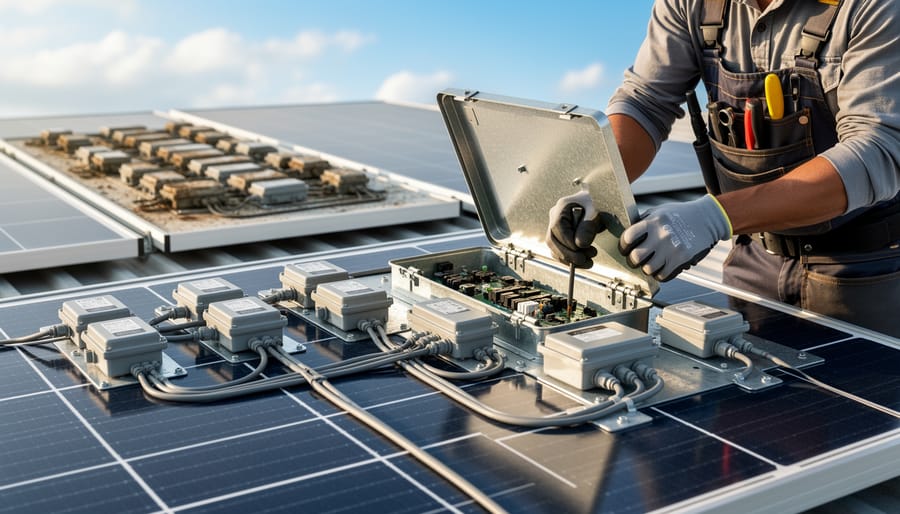
When evaluating solar installations for long-term viability, specific design features significantly impact maintenance costs and system longevity. Accessible junction boxes positioned for easy technician access reduce repair time and costs substantially. Systems designed with standardized components allow facility managers to source replacement parts from multiple suppliers, avoiding vendor lock-in and ensuring continuity even if the original manufacturer discontinues a product line.
Modular panel designs enable individual component replacement rather than entire system overhauls. This approach aligns with circular economy principles by extending system lifespan and reducing waste. Consider a commercial installation in Brisbane where modular inverters allowed partial system upgrades without complete replacement, saving the facility 60% compared to full replacement costs.
Conversely, proprietary connectors, sealed junction boxes requiring specialized tools, and integrated components that cannot be separated create repair barriers. Some manufacturers embed monitoring systems directly into panels with non-replaceable batteries, making simple repairs impossible. Potted electronics sealed with epoxy effectively prevent component-level repairs, forcing entire unit replacement for minor failures.
When procuring solar systems, request detailed documentation on component accessibility, parts availability commitments, and compatibility with industry-standard replacement parts. Systems designed for repairability may cost marginally more initially but deliver substantial savings over 25-year operational periods. Evaluate warranty terms carefully, ensuring they support rather than restrict independent maintenance options as systems age beyond initial coverage periods.
Questions to Ask Your Solar Installer About System Repairability
Before finalizing your solar procurement decision, pose these essential questions to your installer to ensure long-term system maintainability and operational efficiency:
What is the expected lifespan of each major component, and which parts typically require replacement first? Understanding component durability helps you anticipate future repair costs and budget accordingly.
Do you use proprietary components, or are industry-standard parts available from multiple suppliers? Access to non-proprietary parts prevents vendor lock-in and ensures competitive pricing for replacements.
What diagnostic tools and monitoring systems come with the installation, and can our facility team access real-time performance data? Transparent system monitoring enables early issue detection and supports informed maintenance decisions.
Can you provide detailed documentation including wiring diagrams, component specifications, and maintenance schedules? Comprehensive technical documentation empowers your team or third-party contractors to perform repairs efficiently.
What is your warranty coverage for parts and labor, and what repair scenarios fall outside warranty terms? Clear warranty understanding prevents unexpected expenses during the system’s operational life.
Are technicians required to be manufacturer-certified for repairs, or can qualified local electricians service the system? Flexibility in service providers reduces downtime and maintenance costs, particularly for multi-location facilities.
These questions establish a framework for evaluating total cost of ownership beyond initial installation expenses.
Case Study: The Real Cost of Non-Repairable Solar Infrastructure
To illustrate the financial implications of repairability decisions, consider two commercial facilities that installed comparable 250kW solar arrays in 2010. Both systems were designed to meet identical energy requirements for manufacturing operations, but their maintenance approaches diverged significantly.
Facility A selected an open-architecture system with industry-standard components and accessible design. The installation featured modular inverters, easily replaceable monitoring equipment, and mounting systems designed for panel-level access. Initial capital investment totaled $625,000.
Facility B chose a turnkey solution from a manufacturer offering proprietary integrated systems with sealed inverter units and specialized mounting hardware. The sleek, streamlined design came at a slightly lower upfront cost of $590,000.
Over the subsequent 20 years, the operational cost differential became substantial. Facility A experienced three inverter failures requiring component-level repairs. Each incident was resolved within 48 hours using readily available parts, with average repair costs of $3,200 per event. When monitoring equipment required upgrading in year 12, the open architecture allowed integration of newer technology for $8,500. Total maintenance and repair expenditures reached $87,300.
Facility B encountered similar inverter failures, but the proprietary sealed units required complete replacement at $28,000 per incident. When the original manufacturer discontinued support in year 14, sourcing compatible replacement units became problematic, eventually necessitating a complete inverter system overhaul costing $112,000. The facility also experienced extended downtime during each failure—averaging 12 days per incident—while waiting for specialized technician availability and proprietary components. Total maintenance costs exceeded $246,000.
The downtime differential proved equally significant. Facility B’s production disruptions during the seven major outages resulted in estimated energy cost increases of $43,000 due to grid electricity purchases during repair periods. Facility A’s rapid repair capability minimized such impacts to approximately $6,800.
Calculating total cost of ownership over 20 years, Facility A’s investment totaled $719,100 compared to Facility B’s $879,000—a difference of $159,900. When factoring in reduced operational disruptions and retained system value, the repairable infrastructure delivered superior return on investment while maintaining optimal energy production throughout its operational life.
This comparison demonstrates that initial cost savings from proprietary systems often prove illusory when evaluated against long-term operational realities and maintenance requirements.
Building a Maintenance Strategy Around Repairability
Predictive Monitoring and Early Intervention
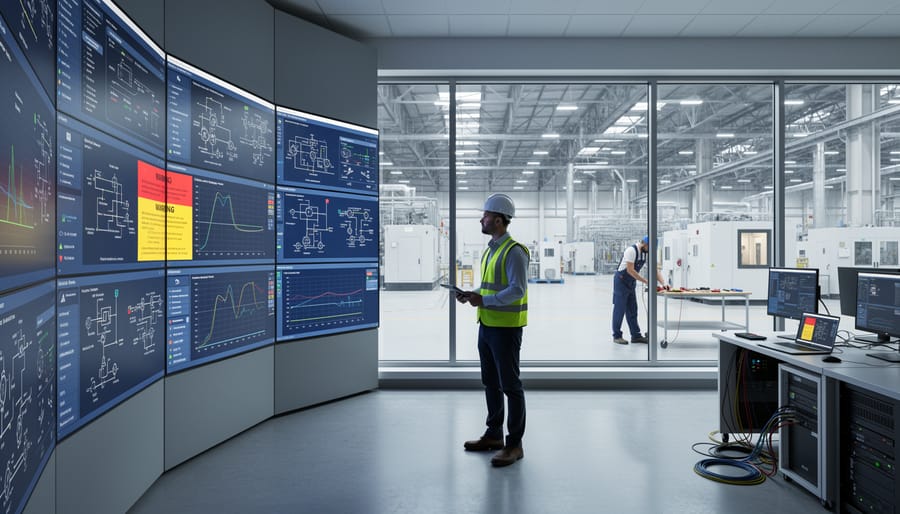
Modern monitoring systems have transformed solar maintenance from reactive troubleshooting to proactive asset management. Advanced diagnostic tools continuously track performance metrics at the module, string, and system levels, detecting subtle degradation patterns that indicate emerging issues. By identifying underperforming components early—often months before complete failure—facility managers can schedule repairs during planned maintenance windows rather than responding to unexpected outages.
This predictive approach delivers measurable financial benefits. A commercial installation in California reduced replacement costs by 34% after implementing real-time monitoring that flagged modules experiencing gradual efficiency decline. Early intervention allowed technicians to address connection issues and hotspots through targeted repairs rather than full module replacement.
Monitoring platforms now incorporate machine learning algorithms that establish baseline performance expectations and flag anomalies requiring investigation. These systems analyze factors including temperature coefficients, shading patterns, and electrical characteristics to distinguish between normal operational variations and genuine defects. The resulting data empowers decision-makers to optimize maintenance budgets, extend equipment lifecycles, and maintain peak energy production. For organizations managing multiple installations, centralized monitoring provides portfolio-wide visibility, enabling strategic resource allocation and preventing small issues from escalating into costly system-wide problems.
Spare Parts Inventory and Repair Service Agreements
Proactive spare parts management significantly reduces downtime during solar system failures. Commercial installations should maintain an on-site inventory of critical components such as fuses, connectors, monitoring equipment, and commonly failing parts specific to their system configuration. Industry data shows that facilities with organized spare parts inventories reduce average repair times by 40-60% compared to those ordering components as needed.
Establishing comprehensive service agreements with qualified repair providers before issues arise ensures priority response times and predictable maintenance costs. When evaluating service contracts, prioritize providers offering guaranteed response windows, transparent pricing structures, and demonstrated expertise with your specific equipment brands. Leading facility managers negotiate agreements that include annual preventive maintenance visits, emergency repair coverage, and access to manufacturer-certified technicians.
Consider partnering with multiple service providers to avoid single-vendor dependency, particularly for large installations spanning multiple locations. Real-world application demonstrates that organizations maintaining relationships with both local technicians for routine work and specialized providers for complex inverter or monitoring system repairs achieve optimal cost-performance balance. Document all component serial numbers and maintain digital records of system specifications to expedite parts identification during urgent repair situations.
Prioritizing repairability in solar system procurement represents a strategic imperative for organizations committed to maximizing return on investment while advancing sustainability objectives. The evidence presented throughout this analysis demonstrates that repair rights and module repairability fundamentally influence the total cost of ownership, operational continuity, and environmental performance of commercial solar installations.
Facility managers who incorporate repairability criteria into their procurement processes gain tangible advantages. Systems designed with accessible components and standardized interfaces reduce downtime during maintenance events, while modular architectures enable targeted repairs that cost significantly less than wholesale replacements. Organizations that negotiated repair provisions in their initial contracts have demonstrated maintenance cost reductions of 30-40% over system lifetimes compared to those locked into proprietary service agreements.
The operational resilience benefits extend beyond immediate cost savings. When panels, inverters, and monitoring systems can be serviced by qualified technicians rather than sole-source providers, organizations maintain greater control over their energy infrastructure and avoid the risks associated with manufacturer discontinuations or service delays.
From a sustainability perspective, repairable systems align directly with circular economy principles and corporate environmental commitments. Extending component lifespans through repair rather than replacement reduces embodied carbon, manufacturing waste, and resource consumption while supporting organizations’ net-zero targets.
As the regulatory landscape evolves to support stronger repair rights, forward-thinking facility managers should immediately integrate repairability assessments into their solar investment decisions. Request detailed documentation on component accessibility, spare parts availability, service network capabilities, and warranty terms that explicitly preserve repair options. These considerations will prove decisive in achieving both financial performance and sustainability outcomes over the 25-plus year operational horizon of commercial solar systems.