
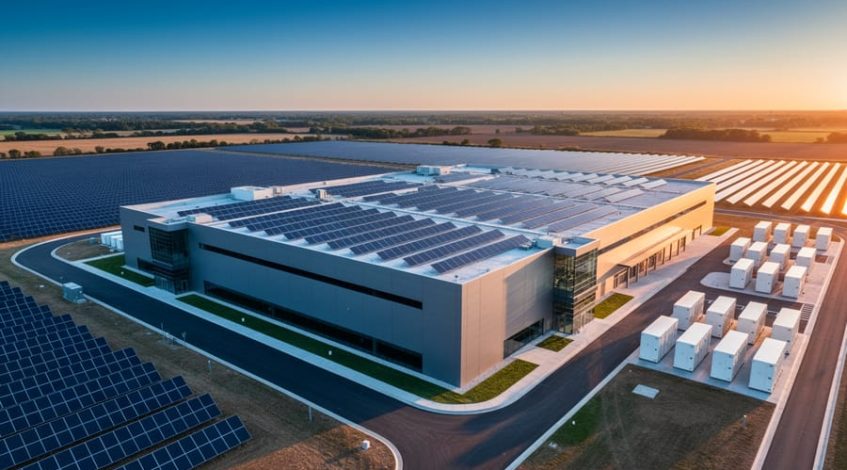
Data centers consume approximately 1-2% of global electricity—a figure projected to triple by 2030 as digital infrastructure expands. For facility managers and business owners facing rising energy costs and mounting pressure to meet sustainability benchmarks, solar power represents a strategic solution that addresses both financial and environmental imperatives simultaneously.
The business case for solar-powered data centers has fundamentally shifted. Installation costs have declined 89% since 2010, while utility rates continue climbing at 2-3% annually. Leading enterprises including Google, Apple, and Microsoft now operate multiple solar-powered facilities, demonstrating that renewable energy integration is both technically feasible and economically advantageous at scale.
Three factors drive this transition. First, photovoltaic systems provide predictable energy costs over 25-30 year lifespans, insulating operations from volatile electricity markets. Second, corporate sustainability mandates and regulatory frameworks increasingly require measurable carbon reduction, making renewable energy adoption a compliance necessity rather than an optional enhancement. Third, technological advances in battery storage and hybrid grid systems have eliminated concerns about intermittency that previously deterred industrial adoption.
This comprehensive analysis examines the practical realities of implementing solar infrastructure for data center operations. You will find detailed cost-benefit calculations, technical integration requirements, site assessment criteria, and documented case studies from operational facilities. Whether you manage a single server room or oversee multiple enterprise-scale installations, understanding solar power’s role in modern data center strategy is essential for maintaining competitive advantage while achieving measurable sustainability outcomes.
The Energy Challenge Facing Industrial Data Centers
Understanding Data Center Power Loads
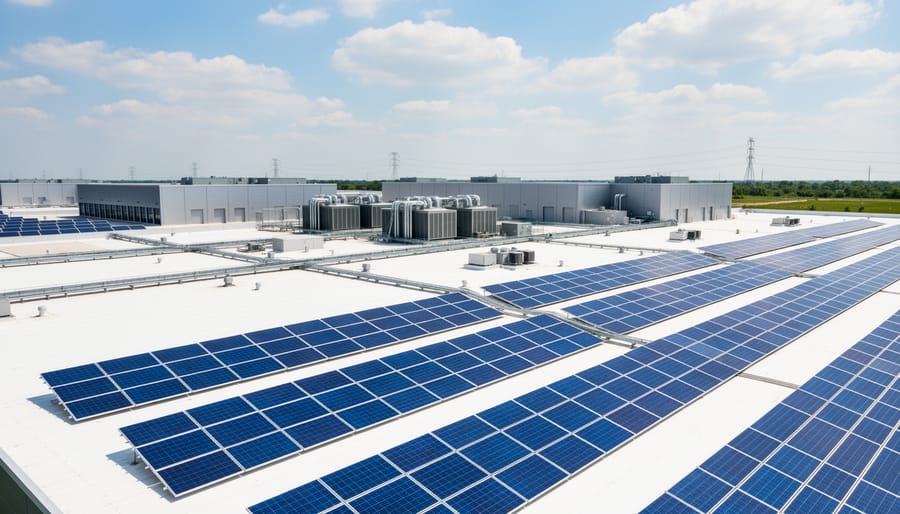
Data center power consumption follows a predictable distribution across core operational components. Computing infrastructure, including servers, storage systems, and network equipment, typically accounts for 40-50% of total energy demand. These systems operate continuously to maintain uptime requirements, creating consistent baseline power loads that range from 100 to over 500 watts per server depending on configuration and utilization rates.
Cooling and HVAC systems represent the second-largest energy consumer, utilizing 30-40% of total power to maintain optimal operating temperatures between 64-80°F. Modern data centers employ various cooling strategies, from traditional computer room air conditioning units to advanced liquid cooling systems, each with distinct power profiles.
Power distribution and conditioning equipment, including uninterruptible power supplies and voltage regulators, consume an additional 10-15% of facility energy. These systems ensure clean, reliable power delivery while providing backup protection during grid interruptions. Lighting, security systems, and auxiliary equipment account for the remaining 5-10% of power demand. Understanding this breakdown enables facility managers to identify optimization opportunities and accurately size solar installations to match actual consumption patterns, ensuring maximum return on renewable energy investments.
The Financial Impact of Rising Energy Costs
Data centers face mounting financial pressure as traditional energy costs continue their upward trajectory. Recent industry analyses indicate that electricity expenses represent 60-70% of total operational costs for large-scale facilities, with projections suggesting a 15-25% increase over the next five years. This escalation directly impacts profitability margins and competitive positioning in an increasingly cost-sensitive market.
Traditional grid-dependent operations expose facilities to price volatility, demand charges, and peak-rate premiums that can fluctuate significantly based on regional market conditions and seasonal demand. A typical 10-megawatt data center currently spends approximately $6-8 million annually on electricity alone. Without intervention, these costs are projected to reach $9-12 million by 2028, creating substantial pressure on long-term financial planning.
The compounding effect of rising energy costs extends beyond immediate operational expenses. Higher electricity bills reduce available capital for infrastructure upgrades, limit expansion opportunities, and diminish investor returns. Organizations exploring industrial energy solutions recognize that proactive energy management strategies become essential for maintaining competitive advantage and ensuring sustainable growth in an era of increasing power demands and environmental accountability requirements.
Why Solar Energy Makes Sense for Data Centers
Long-Term Cost Predictability and ROI
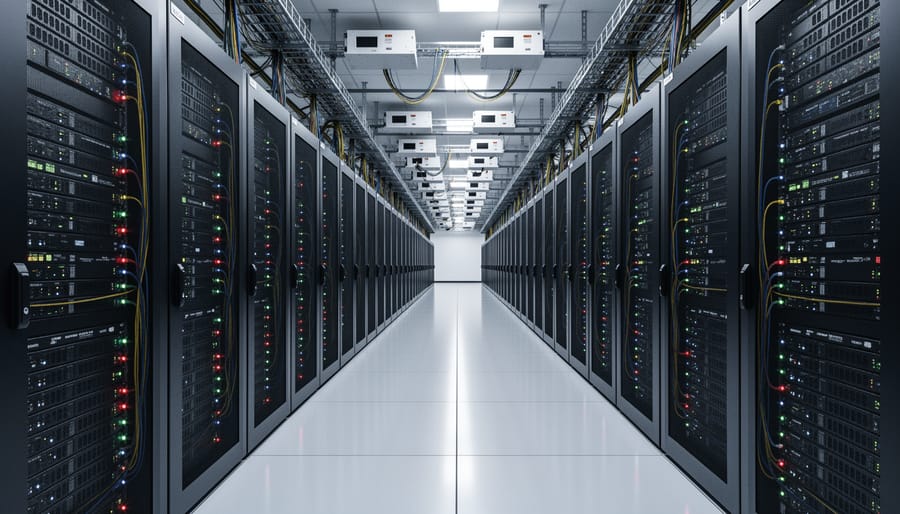
Solar installations deliver exceptional long-term financial stability through fixed energy costs that remain predictable for 25 to 30 years or more. Unlike utility electricity, which fluctuates with market conditions and regulatory changes, solar power locks in your energy expenses at installation, effectively hedging against future rate increases that typically average 2-3% annually.
Data centers investing in solar typically achieve payback periods ranging from 5 to 10 years, depending on factors including local electricity rates, available incentives, and system size. Facilities in regions with high utility costs or substantial tax credits often see accelerated returns. After reaching payback, organizations essentially generate free electricity for the remaining system lifespan, translating to significant cumulative savings.
Return on investment metrics for data center solar projects commonly demonstrate internal rates of return between 8-15%, comparing favorably with many traditional capital investments. The calculation becomes even more attractive when factoring in avoided costs from grid dependency, reduced demand charges, and protection against peak pricing periods.
Consider the real-world application at a mid-sized colocation facility in California that installed a 2-megawatt solar array. The project achieved a 7-year payback period through combined utility savings and state incentives, with projected lifetime savings exceeding $8 million. This predictability enables precise long-term budget forecasting and improves financial planning accuracy.
Modern solar systems require minimal maintenance, with performance warranties guaranteeing 80-90% efficiency after 25 years, ensuring sustained cost benefits. Additionally, the tangible asset value of solar installations can enhance property valuations and strengthen corporate balance sheets while supporting sustainability commitments that increasingly influence investor decisions and corporate partnerships.
Meeting Corporate Sustainability Mandates
Data centers face increasing pressure to demonstrate environmental responsibility as stakeholders, investors, and regulatory bodies intensify their focus on corporate sustainability performance. Solar power installations provide a measurable pathway for meeting Environmental, Social, and Governance (ESG) requirements while achieving renewable energy targets that align with corporate responsibility commitments.
Major technology companies have established ambitious renewable energy goals, with many committing to 100% renewable power by 2030 or earlier. Solar installations enable data centers to track and report verifiable renewable energy consumption, directly contributing to these targets. The transparency of solar generation data supports accurate ESG reporting frameworks including GRI, CDP, and SASB standards.
Beyond compliance, solar adoption strengthens competitive positioning as clients increasingly prioritize vendors with robust sustainability credentials. Enterprise customers conducting supply chain audits favor data center operators demonstrating concrete environmental initiatives. This alignment between sustainability and ROI creates mutual value, reducing operational expenses while meeting stakeholder expectations.
Regulatory trends further underscore the strategic importance of renewable energy integration. Several jurisdictions now mandate renewable energy percentages for large facilities, while carbon pricing mechanisms increase the financial burden of fossil fuel dependence. Proactive solar adoption positions data centers ahead of regulatory requirements, avoiding potential penalties and demonstrating leadership in sustainable infrastructure development.
Solar Power Solutions for Different Data Center Configurations
On-Site Solar Arrays
On-site solar installations offer data centers a direct path to renewable energy generation, with two primary deployment options: rooftop arrays and ground-mounted systems. Rooftop installations maximize existing infrastructure by utilizing available roof space, making them particularly suitable for urban or space-constrained facilities. However, structural assessments are essential to verify load-bearing capacity, as commercial solar panels typically add 3-4 pounds per square foot. Ground-mounted arrays provide greater flexibility in system sizing and orientation, often achieving 10-15% higher efficiency due to optimal tilt angles and improved airflow for cooling.
Space requirements vary significantly based on energy needs. A typical data center consuming 1 megawatt of power requires approximately 5-7 acres for ground-mounted solar or 50,000-70,000 square feet of roof space to generate equivalent capacity. Most facilities can offset 20-40% of their power consumption through on-site solar, though actual capacity depends on geographic location, available land, and local solar irradiance levels.
Leading technology companies have demonstrated this approach successfully. Apple’s data center in Maiden, North Carolina features a 100-acre solar farm generating 42 megawatts, while Switch’s facilities employ rooftop arrays combined with nearby solar fields to achieve 100% renewable energy targets.
Off-Site Solar Farms and Power Purchase Agreements
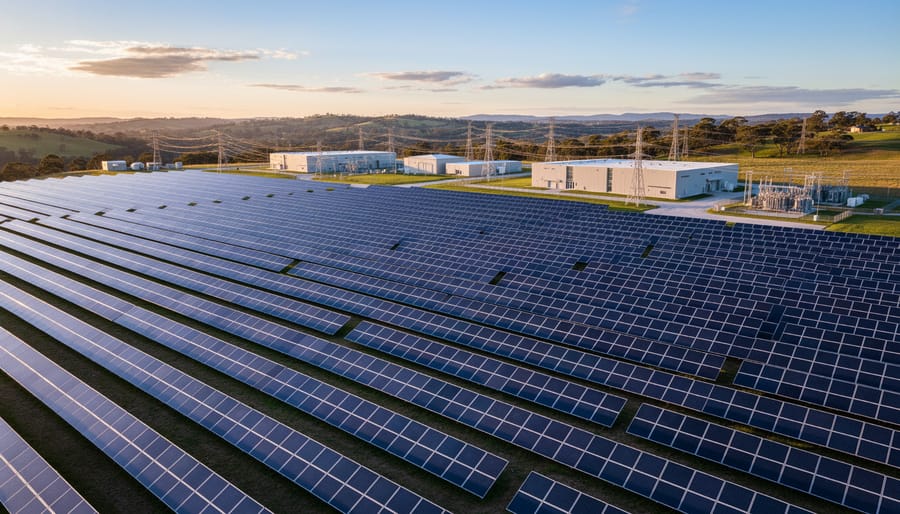
Data centers facing space limitations or unfavorable site conditions can leverage off-site solar farms through Power Purchase Agreements (PPAs). These arrangements enable organizations to access clean energy without requiring physical installation on their property, offering a viable pathway to sustainability goals and cost reduction.
Under a typical PPA structure, a third-party developer finances, constructs, and operates a solar farm at a remote location. The data center then purchases the generated electricity at a predetermined rate, often below retail utility prices, for a contract period of 15 to 25 years. This model eliminates upfront capital expenditure while providing long-term price stability and protection against energy cost inflation.
Virtual PPAs represent another option, where data centers receive financial benefits from solar generation through renewable energy credits without direct electricity transmission. This flexibility allows organizations to support solar development in regions with optimal solar resources, regardless of their operational location.
Major technology companies have successfully implemented this approach. For instance, Microsoft has executed multiple PPAs totaling hundreds of megawatts to power its data center operations globally. These agreements not only meet corporate sustainability commitments but also demonstrate significant operational savings, with many organizations reporting 10-20 percent reduction in energy costs over contract lifespans.
Hybrid Systems with Battery Storage
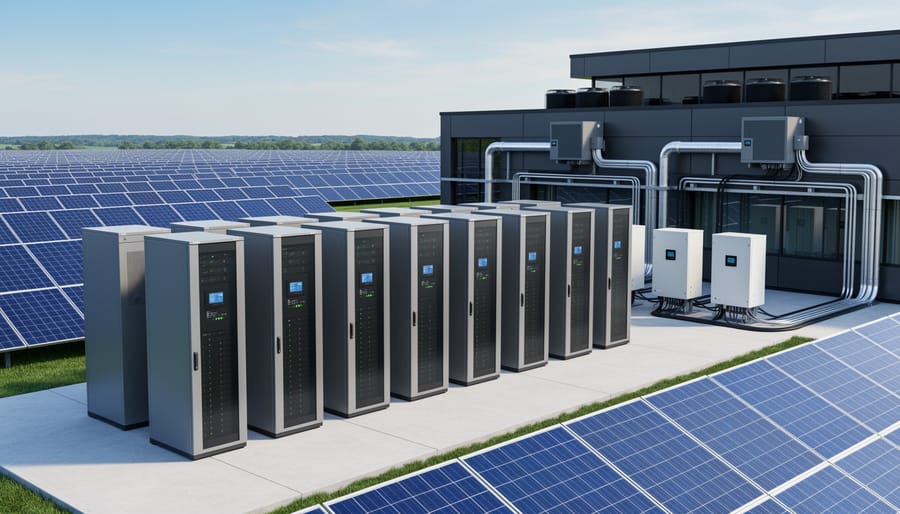
Integrating energy storage systems with solar installations addresses the inherent challenge of solar intermittency while maximizing operational efficiency for data centers. Battery storage enables facilities to capture excess solar generation during peak production hours and deploy it during evening periods or cloudy conditions, significantly increasing self-consumption rates from typical 30-40% to over 70%. This configuration reduces grid dependency and provides critical backup power during outages, enhancing reliability for mission-critical operations. Advanced battery management systems optimize charge-discharge cycles based on real-time demand patterns and utility rate structures, delivering measurable cost savings. For facilities in regions with time-of-use pricing, stored energy can be strategically discharged during expensive peak periods, further improving return on investment while maintaining uninterrupted operations.
Technical Considerations for Solar-Powered Data Centers
Grid Integration and Power Quality
Integrating solar power with data center electrical infrastructure requires sophisticated technology to ensure seamless operation and the uninterrupted, high-quality power these facilities demand. Modern solar installations typically connect through advanced inverter systems that convert DC power from solar panels into AC power compatible with existing grid infrastructure. These systems employ automatic transfer switches and power conditioning equipment to maintain voltage stability and frequency regulation within the strict parameters data centers require.
To address solar power’s inherent variability, facilities implement hybrid configurations combining solar arrays with battery energy storage systems and grid connectivity. This approach ensures continuous power availability during periods of low solar production while maintaining the consistent power quality critical for sensitive IT equipment. Power quality metrics including total harmonic distortion, voltage fluctuations, and transient response remain within acceptable limits through real-time monitoring and adjustment systems.
Leading implementations demonstrate successful integration strategies. Switch’s Nevada data center complex utilizes advanced grid integration technology to balance solar generation with facility loads, achieving seamless transitions between power sources without service disruption. The integration includes redundant pathways and backup systems that preserve the multiple layers of power reliability data centers demand, effectively combining renewable energy benefits with the operational consistency that business continuity requires.
Backup Power and Redundancy Planning
Solar energy integration for data centers requires a comprehensive approach to backup power that ensures uninterrupted operations during grid outages or solar production gaps. While solar installations significantly reduce reliance on conventional power sources, they function optimally within a multi-layered redundancy strategy that includes traditional backup systems.
Modern data centers implementing solar power typically maintain diesel or natural gas generators as the final failsafe for critical loads. These generators activate automatically when both solar and grid power become unavailable, providing the same level of protection facilities have always depended upon. The key difference is that with solar infrastructure in place, generator runtime decreases substantially, reducing fuel costs and extending equipment lifespan.
Uninterruptible Power Supply (UPS) systems remain essential components in solar-equipped facilities, bridging the milliseconds between power loss and generator startup. Battery storage systems connected to solar arrays can extend this bridge significantly, sometimes eliminating generator activation entirely during brief outages. Many facilities now deploy lithium-ion battery banks that charge from solar panels during peak production hours, then discharge during evening demand peaks or emergencies.
The integration requires sophisticated monitoring and automatic transfer switches that seamlessly manage power routing between solar, grid, battery storage, and generator sources. Real-world implementations, such as Switch’s Nevada data center campus, demonstrate how solar arrays producing over 100 megawatts work alongside conventional backup systems to maintain 99.999% uptime while achieving substantial carbon reduction goals. This layered approach provides superior reliability compared to single-source power configurations while maximizing the financial and environmental benefits of renewable energy adoption.
Real-World Applications: Data Centers Making the Solar Transition
Case Study: Large-Scale Enterprise Data Center
Microsoft’s Dublin data center serves as a compelling demonstration of large-scale solar integration in enterprise operations. The facility implemented a 11-megawatt solar array across available roof space and adjacent land, representing one of Europe’s most significant data center solar deployments to date.
The project required an initial capital investment of approximately $8.2 million, with installation completed over an eight-month period. The solar system now generates 12,400 megawatt-hours annually, offsetting roughly 23 percent of the facility’s total electricity consumption during peak production periods. This translates to a reduction of approximately 4,800 metric tons of carbon emissions per year.
Financial performance has exceeded initial projections. The installation achieved break-even status in year seven, two years ahead of the original ten-year forecast, primarily due to Ireland’s favorable feed-in tariffs and corporate renewable energy incentives. Current annual savings stand at $1.4 million when accounting for both direct energy cost reductions and avoided grid charges.
The facility employs a hybrid energy management system that seamlessly transitions between solar power, grid electricity, and battery storage based on real-time demand patterns. During optimal conditions, solar power can sustain up to 40 percent of operational load, with surplus energy either stored in a 2-megawatt battery system or sold back to the grid. This configuration has improved overall energy resilience while demonstrating viable economics for similar implementations across the industry.
Case Study: Mid-Size Industrial Facility
A 2.5-megawatt data center in Phoenix, Arizona demonstrates how mid-sized operations can leverage solar power effectively without the massive capital investments associated with hyperscale facilities. Operating 120 server racks across 25,000 square feet, the facility partnered with a regional solar developer to implement a hybrid rooftop and ground-mounted system.
The installation consisted of 1,200 solar panels generating approximately 1.8 megawatts of power, supplemented by a 500-kilowatt-hour battery storage system. This configuration covers roughly 40 percent of the facility’s total energy demand during peak production hours, with battery storage providing critical load balancing during evening periods and brief outages.
The total project cost reached $2.1 million, with the facility securing a power purchase agreement that eliminated upfront capital expenditure. Combined federal tax credits and state renewable energy incentives reduced the effective cost by 35 percent. Monthly energy costs decreased by $18,000, projecting a payback period of approximately seven years under the PPA structure.
Beyond financial metrics, the facility achieved measurable operational improvements. Power Usage Effectiveness improved from 1.58 to 1.42, while grid dependency decreased significantly. The company now markets its carbon-reduced infrastructure as a competitive advantage when bidding for contracts with sustainability-focused clients.
This case illustrates that mid-sized data centers can realize substantial benefits from solar adoption through strategic partnerships, creative financing arrangements, and appropriately scaled systems that match operational requirements and available space constraints.
Financial Incentives and Support Programs
Data center operators can leverage numerous financial incentives and support programs to offset the substantial upfront investment in solar infrastructure. Understanding these opportunities is essential for maximizing return on investment and accelerating project timelines.
The federal Investment Tax Credit (ITC) remains the cornerstone of solar financing, currently offering a 30% tax credit on the total system cost through 2032. This credit applies to both equipment and installation expenses, significantly reducing the effective capital outlay. Many facilities can claim the full credit in the year of installation, substantially improving project economics. For projects exceeding 1 megawatt, bonus credits may apply if domestic content requirements are met, adding another 10% to the baseline incentive.
State and local governments provide additional incentives that vary by jurisdiction. These include property tax exemptions, accelerated depreciation schedules through the Modified Accelerated Cost Recovery System (MACRS), and performance-based incentives that reward actual energy production. Several states offer grants specifically for renewable energy installations at critical infrastructure facilities, with data centers often receiving priority consideration given their economic importance.
Utility companies increasingly offer rebate programs and net metering arrangements that credit excess solar generation back to the facility. These programs can reduce electricity costs by 40-60% depending on local regulations and rate structures. Power Purchase Agreements (PPAs) eliminate upfront costs entirely, allowing third-party developers to install and maintain systems while data centers purchase electricity at predetermined rates below market prices.
Exploring commercial solar financing options enables facilities to implement solar projects with minimal capital expenditure, preserving budget for core operations while immediately benefiting from reduced energy costs and enhanced sustainability credentials.
Planning Your Data Center Solar Installation
Initial Site Assessment and Feasibility Analysis
Before committing to solar power implementation, data center operators must conduct a thorough feasibility assessment to ensure optimal return on investment and operational compatibility. The evaluation begins with geographic analysis, examining solar irradiance levels specific to your facility’s location. Regions receiving 4-6 peak sun hours daily generally present the strongest economic case for solar integration.
Available installation space represents a critical factor, as data centers typically require substantial energy capacity. Evaluate rooftop square footage, structural load-bearing capacity, and potential ground-mount areas on adjacent property. A medium-sized facility consuming 5 megawatts may need 30,000-40,000 square feet of solar arrays to achieve meaningful energy offset.
Energy consumption patterns warrant detailed examination through historical utility data analysis. Data centers with consistent baseload demand align well with solar generation when coupled with battery storage systems or grid connectivity. Consider seasonal variations, peak demand periods, and future expansion plans that may affect energy requirements.
Additional factors include local utility rates, available incentives, interconnection policies, and zoning regulations. Facilities in high-cost electricity markets with favorable net metering policies typically achieve faster payback periods. Engaging experienced solar consultants during this phase ensures comprehensive evaluation of technical, financial, and regulatory considerations before proceeding with detailed design and implementation planning.
Selecting Qualified Solar Installation Partners
Selecting the right solar installation partner is critical for data center projects given their technical complexity and substantial investment requirements. Begin by verifying credentials including Clean Energy Council accreditation, electrical contractor licenses, and comprehensive insurance coverage. Prioritize providers with demonstrated experience in large-scale commercial installations, particularly those familiar with data center power requirements and uptime demands.
Request detailed case studies showcasing similar projects, including capacity specifications, integration methods, and performance outcomes. Qualified partners should conduct thorough site assessments evaluating roof structural integrity, electrical infrastructure compatibility, and cooling system impacts. They must also demonstrate expertise in grid integration, battery storage solutions, and backup power coordination.
Evaluate their project management capabilities, including timeline adherence, safety protocols, and ongoing maintenance support. For comprehensive guidance on evaluating commercial solar providers, refer to our commercial solar energy guide. Request multiple detailed proposals comparing system designs, equipment specifications, warranties, and financial projections. The ideal partner will collaborate with your IT team to ensure seamless integration without compromising operational continuity or reliability standards.
The strategic adoption of solar power for industrial data centers represents far more than an environmental initiative—it is a fundamental business imperative that delivers measurable financial returns while positioning organizations for long-term competitive advantage. As demonstrated through numerous implementations across the industry, data centers integrating solar infrastructure consistently achieve operational cost reductions of 30-50% over system lifespans, while simultaneously insulating themselves from volatile energy market fluctuations and increasingly stringent regulatory requirements.
The convergence of declining solar technology costs, improved energy storage solutions, and rising electricity prices has created an unprecedented opportunity window for data center operators. Forward-thinking organizations recognizing this alignment are securing 20-25 year cost predictability through solar investments, transforming energy expenditure from an unpredictable operational burden into a controlled capital asset. Moreover, the sustainability credentials gained through renewable energy adoption have evolved from optional marketing benefits to essential requirements for securing enterprise contracts and maintaining investor confidence.
Looking ahead, emerging technologies including bifacial panels, advanced tracking systems, and AI-optimized energy management platforms promise to enhance solar viability further. Data centers that establish renewable energy infrastructure today position themselves to seamlessly integrate these innovations, maintaining operational efficiency advantages while competitors face escalating conventional energy costs. The question facing industry leaders is no longer whether to adopt solar power, but how quickly implementation can be strategically executed to maximize competitive positioning and financial returns in an increasingly sustainability-focused marketplace.