
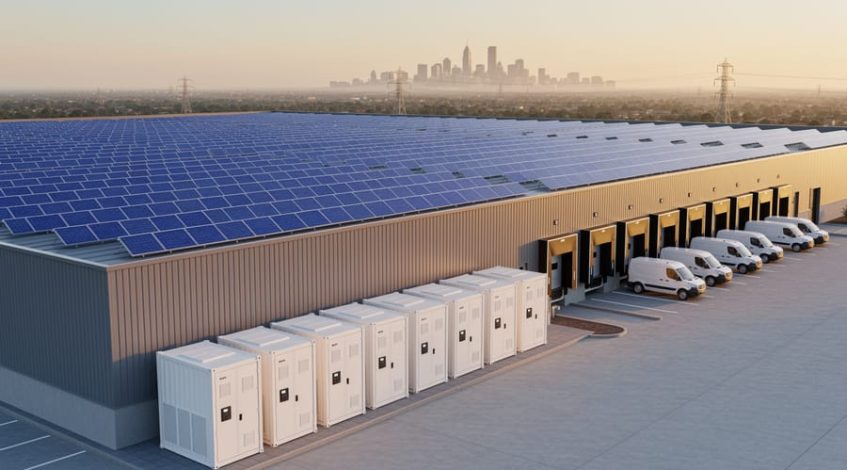
The solar-plus-storage market has reached an inflection point, transforming from a niche technology into a strategic imperative for commercial, industrial, and government facilities. Current market data reveals deployment of integrated solar and battery systems grew 43% year-over-year in 2023, driven by three converging forces: volatile utility rates, grid reliability concerns, and evolving financial incentives that dramatically improve project economics.
Business decision-makers now face a fundamentally different energy landscape than even two years ago. Battery storage costs have declined 89% since 2010, while federal Investment Tax Credits now cover 30% of combined system costs through 2032. This convergence enables facilities to capture solar energy during peak production hours and deploy it strategically during high-cost demand periods, delivering payback periods as short as 5-7 years for well-designed installations.
The technology’s maturation addresses critical pain points for facility managers: backup power during outages eliminates costly operational disruptions, demand charge management reduces utility bills by 20-40%, and resilience planning satisfies regulatory requirements for critical infrastructure. However, successful implementation requires understanding which system configurations align with your facility’s load profile, utility rate structure, and operational priorities.
This analysis examines current market dynamics, implementation frameworks, and financial modeling approaches that separate high-performing installations from underutilized assets. The evidence demonstrates that organizations treating solar-plus-storage as a strategic infrastructure investment rather than simple energy procurement consistently achieve superior operational and financial outcomes.
Why Solar-Plus-Storage Has Become the New Standard
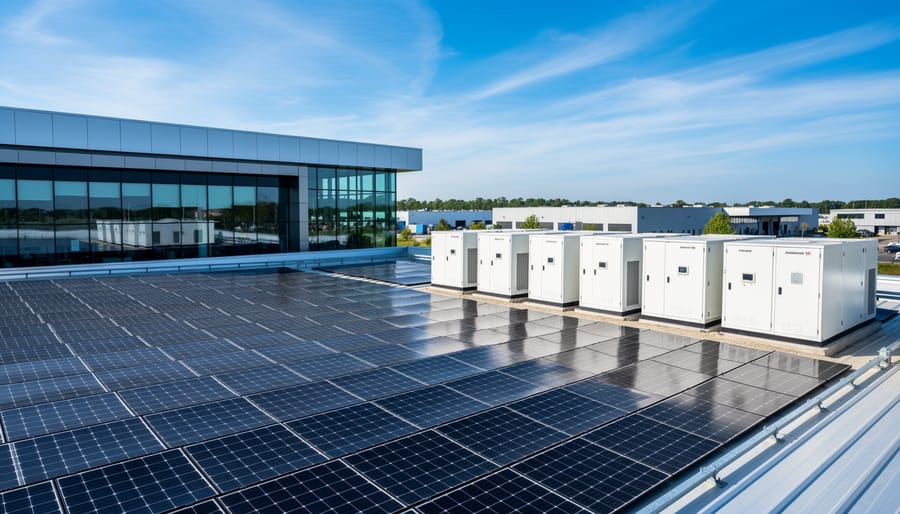
The Economics of Energy Storage Have Finally Made Sense
The financial equation for solar energy has fundamentally shifted with the dramatic reduction in battery storage costs. Over the past five years, lithium-ion battery prices have declined by approximately 70%, transforming energy storage systems from a luxury addition into a strategic investment. This cost reduction, combined with technological improvements in battery efficiency and lifespan, has created a compelling business case for integrated solar-plus-storage installations.
Current return on investment timelines for combined systems now range between 5 to 8 years for commercial applications, compared to 7 to 10 years for solar-only installations when factoring in demand charge management and backup power value. The key differentiator lies in the ability to optimize energy consumption patterns and capture additional revenue streams through grid services participation.
A manufacturing facility in Queensland demonstrated this shift by implementing a 500kW solar array with 400kWh of battery storage. The integrated system reduced their energy costs by 65% through strategic load shifting and peak demand management, achieving full payback in just 6.2 years. Without storage, their solar-only scenario would have delivered only 40% cost reduction and extended the payback period significantly.
Technology improvements have also extended battery warranties to 10-15 years with 80% capacity retention, reducing replacement concerns and improving long-term financial predictability for business planning.
Grid Instability Creates New Opportunities
The increasing frequency and severity of power disruptions has fundamentally altered how businesses evaluate energy infrastructure investments. In 2023 alone, commercial facilities experienced an average of 7.8 hours of power interruptions, with costs reaching $150 per minute for manufacturing operations and up to $540 per minute for data centers. These mounting financial impacts have elevated energy resilience from a contingency consideration to a strategic imperative.
Solar-plus-storage systems now offer commercial and industrial operations a practical solution to grid vulnerabilities. Unlike traditional backup generators that require fossil fuels and regular maintenance, integrated battery storage paired with solar generation provides automatic, seamless power continuity during outages while reducing ongoing operational costs. Distribution centers, food processing facilities, and healthcare institutions are particularly well-positioned to benefit from this dual advantage of reliability and cost reduction.
The economic case strengthens further when considering demand charge management. Facilities can strategically discharge stored solar energy during peak pricing periods, achieving 20-30% reductions in monthly electricity expenses. Manufacturing operations in regions with aging grid infrastructure are increasingly viewing solar-plus-storage not as an optional upgrade but as essential infrastructure that protects production schedules and maintains competitive positioning in their respective markets.
Market Growth Patterns Reshaping the Industry
Commercial Sector Leadership
The commercial sector has emerged as a powerful driver of solar-plus-storage adoption, with retail chains, warehousing facilities, and office complexes recognizing the dual benefits of cost reduction and operational resilience. These facilities typically face substantial demand charges—fees based on peak electricity consumption—which can account for 30-50% of monthly utility bills. Solar-plus-storage systems enable businesses to strategically manage these charges by storing excess solar energy and deploying it during peak demand periods, resulting in significant operational savings.
Major retailers are leading this transformation, with companies installing megawatt-scale systems across their store networks. A regional supermarket chain recently deployed solar-plus-storage at 47 locations, achieving a 38% reduction in demand charges while ensuring refrigeration continuity during grid disruptions. This approach protects temperature-sensitive inventory and maintains customer service during outages, demonstrating how energy infrastructure directly supports business continuity.
Warehouse and logistics facilities present particularly compelling use cases due to their extensive roof space and high daytime energy consumption that aligns with solar generation patterns. Distribution centers are installing systems ranging from 500 kW to 2 MW, paired with battery storage to maintain material handling operations and climate control systems during peak periods and grid emergencies.
Office buildings in urban centers are adopting solar-plus-storage to meet sustainability goals while managing escalating energy costs. Advanced energy management systems optimize battery discharge timing based on utility rate structures and building occupancy patterns, maximizing financial returns. The combination of immediate cost savings, enhanced reliability, and sustainability credentials makes commercial solar-plus-storage an increasingly strategic investment for forward-thinking facility managers.
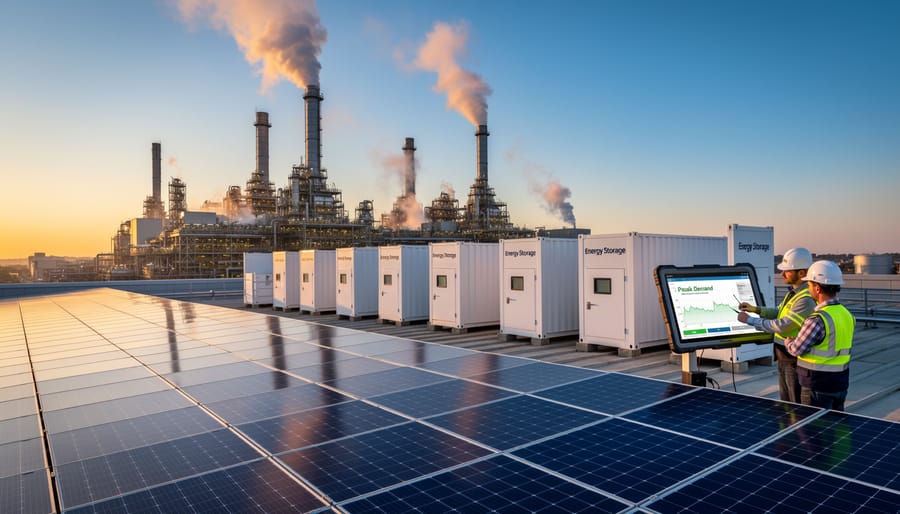
Industrial and Manufacturing Applications
Energy-intensive manufacturers are increasingly adopting solar-plus-storage systems to address two critical challenges: reducing operational costs and maintaining production continuity during grid instability. These integrated solutions enable facilities to shift their energy consumption patterns strategically while building resilience against power disruptions.
A prominent automotive parts manufacturer in Germany recently implemented a 2 MW solar array coupled with 1.5 MWh of battery storage, achieving a 40% reduction in peak demand charges within the first year. The facility uses storage to power critical production lines during high-rate periods while recharging batteries during off-peak hours and peak solar generation times. This approach has reduced energy costs by approximately $180,000 annually while maintaining uninterrupted manufacturing operations.
Similarly, a food processing plant in California deployed a solar-plus-storage system to address both cost optimization and cold storage requirements. The 3 MW installation with 2 MWh battery capacity ensures refrigeration systems remain operational during grid outages, preventing product spoilage losses that previously averaged $50,000 per incident. The facility now operates refrigeration equipment primarily on stored solar energy during evening hours, when electricity rates peak.
Chemical manufacturers are also leveraging storage to balance intermittent processes with energy availability. One facility reduced grid dependency by 65% through strategic battery deployment, running energy-intensive mixing and heating operations exclusively during solar generation hours. The system paid for itself within six years through combined demand charge reductions and avoided downtime costs, demonstrating clear return on investment for heavy industrial applications.
Technology Advances Enabling Practical Implementation
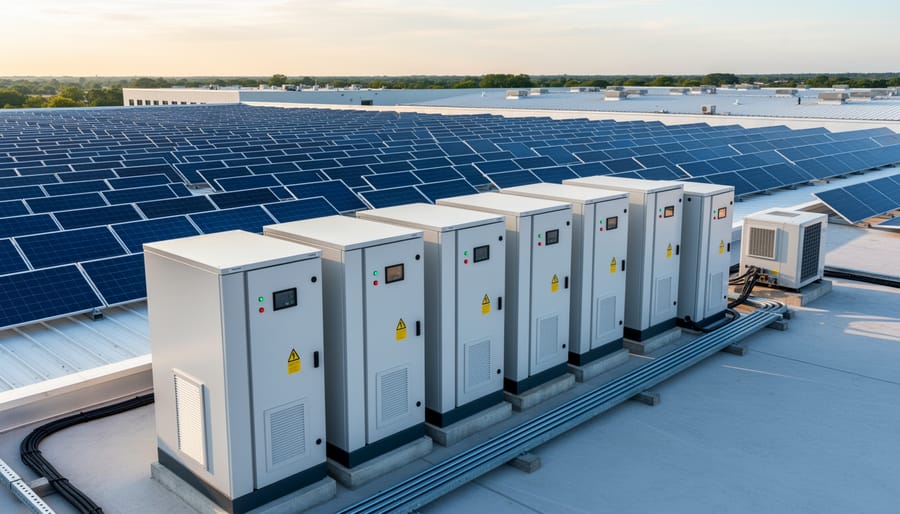
Battery Chemistry and Performance Evolution
The commercial solar-plus-storage market has witnessed remarkable battery technology improvements driven by advances in lithium-ion chemistry and emerging alternatives. Lithium iron phosphate (LFP) batteries now dominate commercial installations, offering 15-20 year lifespans with enhanced thermal stability and minimal degradation. These systems maintain 80% capacity after 6,000-10,000 cycles, significantly improving return on investment for facility managers.
Manufacturing scale has reduced lithium-ion costs by 89% since 2010, making energy storage financially viable for peak demand management and grid services. Enterprise-scale installations now achieve installed costs below $400 per kilowatt-hour, with projections indicating continued 15% annual cost reductions through 2025.
Emerging technologies are reshaping long-duration storage applications. Sodium-ion batteries offer lower material costs and improved cold-weather performance, particularly suited for regions with extreme temperature variations. Flow batteries provide scalable storage exceeding four hours, enabling commercial facilities to maximize solar self-consumption and participate in energy arbitrage programs.
Safety standards have evolved alongside chemistry improvements. Modern battery management systems incorporate multi-layer protection protocols, thermal monitoring, and fire suppression capabilities, addressing insurance and regulatory requirements for commercial deployments. These advancements position energy storage as a mature, bankable technology for strategic energy planning.
Intelligent Energy Management Systems
Modern intelligent energy management systems represent a fundamental shift in how organizations extract value from solar-plus-storage investments. These AI-driven platforms continuously analyze multiple data streams—including real-time energy prices, weather forecasts, facility consumption patterns, and grid demand signals—to make split-second decisions about energy deployment.
The financial impact is substantial. Leading systems can increase return on investment by 15-30% compared to basic battery operations by optimizing when to store excess solar generation, when to discharge stored energy during peak-rate periods, and when to participate in demand response programs. For a commercial facility with 500kW of solar and 1MWh of storage, this optimization typically translates to $40,000-80,000 in additional annual savings.
Advanced platforms also enable participation in wholesale energy markets and grid services. Facilities can sell stored energy back to the grid during high-demand periods or provide frequency regulation services, creating new revenue streams that significantly improve project economics. A manufacturing facility in South Australia recently achieved 18-month payback acceleration through strategic grid service participation managed entirely by automated energy management software.
These systems continuously learn from operational data, refining their algorithms to adapt to changing energy rates, seasonal variations, and evolving facility requirements without manual intervention.
Policy and Regulatory Tailwinds Accelerating Adoption
European Policy Landscape
European policy frameworks continue to accelerate commercial solar-plus-storage deployment through coordinated incentives and regulatory support. The European Green Deal and REPowerEU initiative have elevated energy storage to critical infrastructure status, with member states implementing targeted programs to reduce grid dependency and enhance energy security.
The revised Renewable Energy Directive III mandates that EU countries achieve 42.5% renewable energy by 2030, with storage systems recognized as essential enablers. This directive removes previous regulatory barriers that classified storage as energy consumption rather than infrastructure, eliminating double taxation and streamlining permitting processes across member states.
Germany’s Federal Funding for Efficient Buildings program offers grants covering up to 40% of commercial storage system costs, while France’s investment tax credit provides 20% deductions for integrated solar-storage installations. Spain’s strategic storage reserve program compensates businesses for providing grid stabilization services, creating additional revenue streams beyond energy savings.
The EU’s Innovation Fund allocates substantial capital for large-scale renewable energy projects, with recent awards exceeding €1.2 billion for commercial storage deployments. National implementation varies considerably, with Northern European countries leading adoption through feed-in premium schemes and capacity market mechanisms.
These coordinated policies have reduced payback periods for commercial installations to 5-7 years in most markets, making solar-plus-storage financially attractive without subsidies in high-consumption facilities. The regulatory environment continues evolving toward market-based mechanisms that reward flexibility and grid support capabilities.
Grid Services and Revenue Opportunities
Commercial solar installations with battery storage are increasingly positioned to participate in grid services and revenue programs that extend beyond traditional energy savings. Virtual power plants aggregate distributed solar and storage assets to provide grid stabilization services, with participants earning between $10,000 and $50,000 annually per megawatt of capacity. Demand response programs compensate businesses for reducing consumption during peak periods, creating additional income streams while supporting grid reliability. Forward-thinking organizations are leveraging frequency control ancillary services markets, where rapid battery response capabilities command premium rates. A manufacturing facility in South Australia generated $45,000 in annual grid services revenue while maintaining full operational control of its storage system. These opportunities transform solar installations from cost-reduction measures into revenue-generating assets, improving project ROI by 15-25 percent while contributing to broader grid resilience objectives.
Financial Models and Return on Investment
Demand Charge Reduction in Action
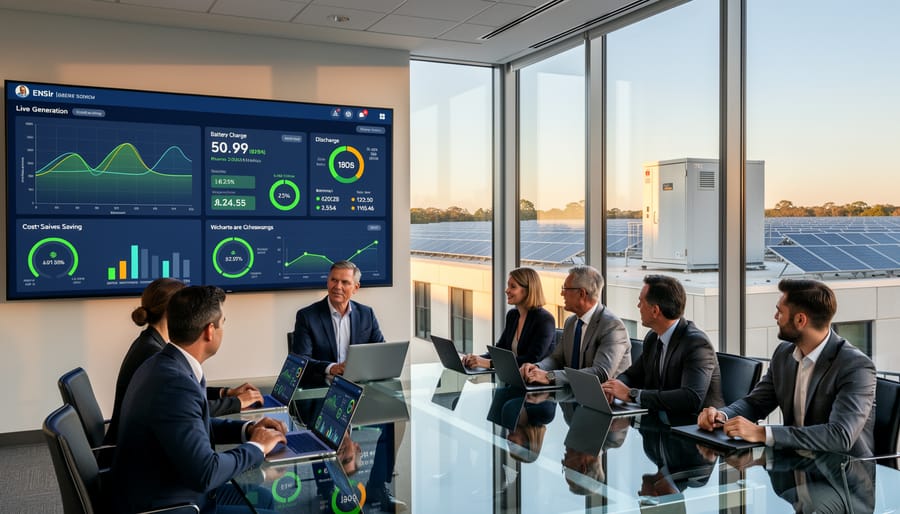
Commercial facilities across diverse sectors are achieving significant cost reductions through strategic demand charge management with battery storage systems. A California manufacturing facility reduced monthly demand charges by 42% within the first year of operation by deploying a 500 kWh battery system that automatically discharges during high-consumption periods. The system paid for itself in under four years while providing backup power capabilities.
A regional medical center in Texas implemented solar-plus-storage to address afternoon demand spikes from HVAC systems. By storing solar energy during mid-day hours and deploying it during peak periods, the facility cut demand charges by $18,000 monthly and improved grid resilience for critical operations. The integrated system also qualified for accelerated depreciation under federal tax incentives.
Warehouse operations present particularly strong opportunities for demand charge reduction. A 200,000 square-foot distribution center in Arizona reduced its highest 15-minute interval consumption from 850 kW to 620 kW using predictive analytics and automated battery dispatch. This intervention delivered $127,000 in annual savings while supporting the company’s sustainability commitments.
These applications demonstrate that effective demand charge management requires proper system sizing, accurate load forecasting, and intelligent controls that respond to facility-specific consumption patterns. Return on investment typically ranges from three to six years depending on local utility rate structures and available incentives.
Financing and Procurement Strategies
Integrated solar-plus-storage systems offer three primary financing pathways, each with distinct advantages for different organizational structures. Direct purchase provides maximum long-term savings and immediate asset ownership, making it ideal for organizations with available capital and strong balance sheets. This approach delivers the highest return on investment over the system’s 25-30 year lifespan, particularly when combined with available tax incentives and depreciation benefits.
Power Purchase Agreements (PPAs) have gained significant traction in commercial and government sectors, allowing organizations to adopt solar-plus-storage with zero upfront capital expenditure. Under this model, third-party developers own and maintain the system while customers purchase electricity at predetermined rates, typically below utility costs. This structure proves especially valuable for municipal and government entities facing budget constraints or seeking to preserve capital for core operations.
Lease arrangements offer a middle ground, providing system access through fixed monthly payments while transferring maintenance responsibilities to the lessor. Recent market data indicates that 60 percent of commercial installations utilize some form of third-party financing, reflecting the appeal of reduced financial risk and operational complexity.
Government institutions should evaluate financing options against procurement regulations, budget cycles, and energy resilience objectives. Many public entities have successfully structured PPAs to comply with procurement requirements while achieving 15-30 percent energy cost reductions. Analyzing total cost of ownership, including demand charge management and resilience benefits, proves essential for selecting the optimal financing strategy.
Implementation Considerations for Business Decision-Makers
Right-Sizing Your Storage Capacity
Determining optimal battery capacity requires analyzing three critical factors: facility load profiles, backup duration requirements, and financial objectives. Begin by conducting a comprehensive energy audit to understand consumption patterns throughout the day and across seasons. Peak demand periods, minimum load requirements, and operational schedules directly influence storage sizing decisions.
For backup applications, identify mission-critical loads requiring uninterrupted power during outages. A manufacturing facility might prioritize refrigeration systems and safety equipment, requiring 4-8 hours of backup capacity, while a government building may need extended 12-24 hour reserves for emergency operations. These determinations shape minimum capacity thresholds.
Financial optimization involves balancing capital investment against operational returns. Oversized systems increase upfront costs without proportional benefits, while undersized storage limits demand charge reduction and energy arbitrage opportunities. Advanced modeling tools can simulate various capacity scenarios against utility rate structures and usage patterns.
A practical approach for commercial facilities typically involves sizing storage to cover 2-4 hours of peak demand, enabling effective demand charge management while maintaining reasonable payback periods. Industrial operations with predictable consumption may benefit from larger 6-8 hour systems that maximize time-of-use savings. Government facilities often prioritize resilience, justifying premium capacity for extended backup capabilities. Consulting with experienced energy storage providers ensures configurations align with both technical requirements and organizational priorities.
Integration with Existing Infrastructure
Retrofitting energy storage to existing solar installations requires careful assessment of several technical factors. Legacy systems typically need inverter upgrades or replacement to accommodate battery integration, as older models often lack bidirectional power flow capabilities. Electrical infrastructure must support additional load requirements, and proper sizing calculations ensure storage capacity aligns with actual energy consumption patterns rather than theoretical maximums.
Modern integrated systems designed from inception offer superior performance and cost efficiency. These installations utilize hybrid inverters that manage both solar generation and battery storage through a single control system, reducing equipment redundancy and simplifying monitoring. Advanced energy management systems optimize charging cycles, time-of-use arbitrage, and demand response participation automatically.
For commercial facilities, the technical evaluation should include roof load analysis, available space for battery installation, and existing electrical panel capacity. A manufacturing facility in California recently integrated 500 kWh of storage with its 250 kW solar array, utilizing existing conduit infrastructure and mounting systems to reduce installation costs by 18 percent compared to standalone deployment.
Grid interconnection requirements vary by utility and jurisdiction, necessitating early engagement with local authorities. Proper documentation of system specifications, safety protocols, and utility-grade metering ensures compliant integration while preserving eligibility for incentive programs and net metering arrangements.
The convergence of solar energy and battery storage represents a transformative opportunity for organizations seeking both economic resilience and operational sustainability. As demonstrated throughout this analysis, the business case for solar-plus-storage continues strengthening as technology costs decline, policy incentives expand, and grid challenges intensify. Organizations implementing these systems today are realizing immediate benefits through reduced energy costs, enhanced reliability, and protection against utility rate escalation.
Looking forward, industry projections indicate continued cost reductions of 15-25% over the next five years, driven by manufacturing scale, improved battery chemistry, and streamlined installation processes. Emerging technologies including solid-state batteries, AI-powered energy management systems, and vehicle-to-grid integration will further enhance system performance and value proposition. The regulatory landscape increasingly favors distributed energy resources, with expanding incentive programs and market participation opportunities for commercial and industrial installations.
For organizations evaluating solar-plus-storage implementation, the path forward involves several critical steps. Begin with a comprehensive energy audit to understand current consumption patterns and identify optimization opportunities. Engage qualified system integrators to assess site-specific potential and develop detailed financial projections. Evaluate available incentives at federal, state, and local levels to maximize project economics. Consider phased implementation strategies that allow for scalability as technology advances and organizational needs evolve.
The transition to integrated solar and storage systems represents not merely an environmental initiative but a strategic business decision that delivers measurable financial returns, operational advantages, and competitive differentiation in an increasingly sustainability-focused marketplace.