
Solar contract disputes cost the industry an estimated $2.8 billion annually in legal fees, delayed payments, and failed installations. Quantum blockchain technology offers a solution by creating immutable, quantum-resistant records that eliminate contract manipulation while reducing administrative overhead by up to 60%.
Traditional blockchain systems securing solar agreements face a critical vulnerability: quantum computers capable of breaking current cryptographic standards are projected to emerge within the next decade. For solar installations with 25-year power purchase agreements worth millions of dollars, this represents an existential security threat. Quantum blockchain addresses this challenge by implementing post-quantum cryptographic algorithms that remain secure against both classical and quantum computing attacks.
The practical implications for solar stakeholders are substantial. Government agencies managing utility-scale solar procurement can verify contractor credentials, performance milestones, and payment triggers without intermediaries. Commercial property owners gain automated payment systems that release funds only when verified performance data confirms contractual obligations are met. Solar developers secure intellectual property and performance guarantees that cannot be disputed or altered retroactively.
Early adopters are already demonstrating measurable returns. A 2023 pilot program involving municipal solar contracts reduced verification time from 14 days to 4 hours while cutting administrative costs by 47%. Another implementation eliminated payment disputes entirely across a portfolio of 200 megawatts in distributed solar assets.
This technology integration requires understanding three core components: quantum-resistant cryptography that protects long-term contract integrity, distributed ledger architecture that ensures transparency among multiple stakeholders, and smart contract automation that eliminates manual verification bottlenecks. The following analysis examines how these elements combine to transform solar contract management from a liability into a competitive advantage.

Why Traditional Solar Contracts Create Trust Gaps
Performance Verification Bottlenecks
Traditional solar contract performance verification relies heavily on manual inspection processes and third-party audits, creating significant operational inefficiencies that impact project timelines and budgets. When solar installations require performance validation, facility managers typically wait 30-90 days for independent auditors to review system output data, weather conditions, and compliance metrics. This extended verification period delays milestone payments to contractors and equipment suppliers, straining cash flow for all parties involved.
The costs associated with conventional verification methods add 3-7% to overall project expenses. Third-party auditors charge premium fees for their services, while stakeholders absorb additional administrative costs coordinating inspections and compiling documentation. For large-scale commercial installations, these verification expenses can exceed $50,000 per project phase.
Manual verification also introduces accuracy concerns. Human error in data collection and analysis can lead to disputes between solar developers and clients regarding system performance benchmarks. Resolution of these disagreements often requires additional audits, further compounding delays and expenses. Government officials overseeing public solar projects face particular challenges, as accountability requirements mandate extensive documentation trails that current manual processes struggle to provide efficiently. These bottlenecks ultimately reduce return on investment and diminish stakeholder confidence in project execution timelines.
Payment and Incentive Disputes
Payment disputes represent one of the most persistent challenges in solar energy contracts, often arising from discrepancies in energy production measurements, delayed incentive disbursements, and conflicting ROI calculations. Traditional contract structures lack real-time verification mechanisms, creating opportunities for disagreements between solar producers, distributors, and end customers. Quantum blockchain technology addresses these conflicts by establishing immutable, time-stamped records of energy generation and financial transactions that all parties can verify independently.
Government incentive programs, including feed-in tariffs and renewable energy certificates, frequently become contested when production data cannot be reliably validated. Manual verification processes create delays averaging 60-90 days, impacting cash flow for solar operators. A Queensland commercial solar facility recently implemented quantum blockchain verification, reducing payment processing time from 75 days to 48 hours while eliminating disputed invoices entirely. The system automatically reconciles production data with contracted rates and government incentive formulas, triggering payments when predetermined thresholds are met.
ROI calculations present another friction point, particularly when performance guarantees are involved. Quantum blockchain’s transparent ledger enables stakeholders to access consistent data sets, eliminating the selective reporting that often occurs in traditional systems. This transparency proves particularly valuable during customer journey optimization, where clear performance metrics build trust from initial consultation through long-term partnership. Financial institutions financing solar projects increasingly require blockchain-verified payment histories, recognizing that dispute-free transaction records significantly reduce investment risk and improve loan terms for solar operators.
Understanding Quantum Blockchain Technology
Blockchain Basics for Solar Contracts
Standard blockchain technology provides solar contract management with a distributed ledger system that records transactions across multiple computers simultaneously. This creates an immutable audit trail where no single party can alter agreements or performance data without network consensus, addressing a critical challenge in solar project verification and payment disputes.
Smart contracts execute automatically when predetermined conditions are met, eliminating intermediaries and reducing administrative overhead. For solar agreements, this means automated payment releases when energy production reaches specified thresholds, verified through Internet of Things sensors feeding real-time generation data to the blockchain. A 2022 implementation by Brooklyn Microgrid demonstrated this capability, processing over 3,000 peer-to-peer energy transactions with zero disputes regarding payment timing or accuracy.
The transparency inherent in blockchain systems allows all authorized stakeholders—developers, financiers, utilities, and facility managers—to access identical contract terms and performance metrics simultaneously. This shared visibility reduces conflicts arising from information asymmetry and accelerates dispute resolution from weeks to hours. Organizations adopting blockchain for solar power purchase agreements report 30-40 percent reductions in contract administration costs while improving trust between parties through cryptographically secured, tamper-proof records of every transaction and modification.
The Quantum Security Advantage
Traditional encryption methods face a significant vulnerability: quantum computers, expected to achieve commercial viability within the next decade, will possess the computational power to break conventional cryptographic protocols. For solar installations backed by 25 to 30-year performance warranties, this presents a substantial risk to contract integrity and long-term financial security.
Quantum-resistant blockchain implementations address this challenge by employing post-quantum cryptographic algorithms designed to withstand attacks from both classical and quantum computers. This protection proves essential for solar contracts that must remain legally enforceable and tamper-proof for decades. Consider a municipal solar installation worth $15 million with a 25-year power purchase agreement—any compromise of the underlying contract data could result in disputes over performance metrics, payment terms, or warranty claims years after initial deployment.
Leading solar developers are already implementing lattice-based and hash-based cryptographic signatures in their blockchain frameworks. A recent pilot program involving a 50-megawatt solar farm in California demonstrated how quantum-resistant encryption maintained contract authenticity while providing real-time verification of energy production data. This future-proof approach protects stakeholders from technological obsolescence and ensures that warranty claims, maintenance schedules, and financial obligations remain verifiable throughout the entire contract lifecycle, delivering measurable risk reduction for investors and facility managers alike.

Smart Contracts on Steroids
Quantum computing brings unprecedented processing power to smart contract execution in solar agreements. Traditional blockchain contracts can struggle with complex calculations involving real-time performance metrics, dynamic pricing models, and multi-party verification requirements. Quantum-enhanced systems process these computations exponentially faster, enabling instant settlement of performance-based payments tied to actual energy generation data.
For large-scale commercial solar installations, this advancement means automated payments can trigger based on verified production thresholds, weather-adjusted performance expectations, and grid contribution levels—all calculated simultaneously. Similar to AI-powered automation in customer service, quantum-enabled contracts eliminate manual intervention and reduce payment processing from days to seconds.
Queensland’s Port of Brisbane tested quantum-accelerated contracts for their 1.2 MW solar array, reducing reconciliation time by 94 percent while improving accuracy in performance-based incentive payments. This technology particularly benefits power purchase agreements where complex variables determine payment structures, offering facility managers transparent, dispute-free transactions that enhance project ROI through operational efficiency.
Practical Applications in Commercial Solar Agreements
Automated Performance Payments
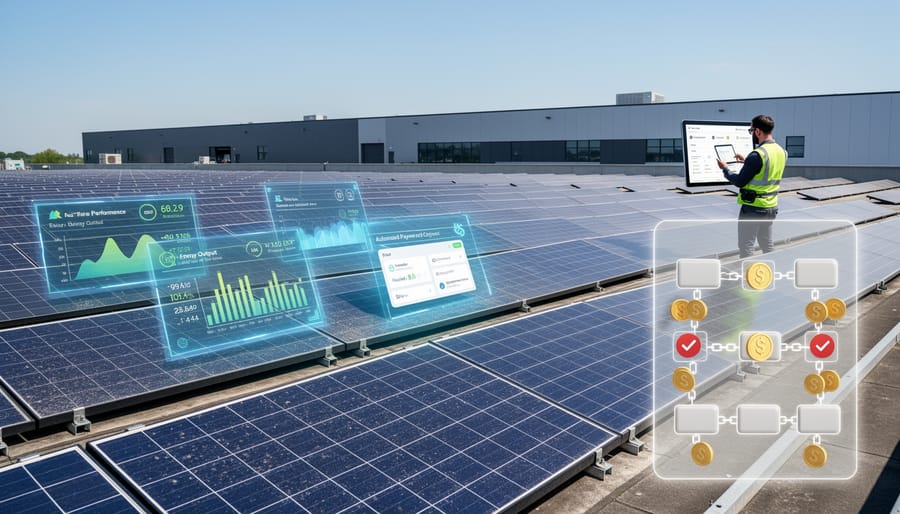
Quantum blockchain technology fundamentally transforms how solar energy producers receive compensation by enabling automated performance payments based on real-time production data. Traditional payment systems often involve monthly billing cycles, manual meter readings, and delayed fund transfers that create cash flow challenges for solar installations. With quantum blockchain integration, smart meters connected to the distributed ledger automatically record energy production data with cryptographic verification, creating an immutable record that cannot be altered by any party.
When production milestones are reached, smart contracts execute payment transfers instantly without manual intervention. This automation eliminates the 30-60 day payment delays common in conventional solar agreements. For community solar projects and power purchase agreements, this means smaller producers gain immediate access to revenue, improving their financial sustainability.
The quantum-resistant encryption ensures meter data remains tamper-proof even against future computational threats, addressing a critical concern for long-term solar contracts spanning 20-25 years. One municipal solar installation in California reduced payment processing time from 45 days to under 24 hours while eliminating disputed invoices entirely. The system’s transparency allows both energy producers and purchasers to verify production claims in real-time, building trust and reducing administrative overhead by approximately 40 percent compared to traditional verification methods.
Transparent Warranty Management
Quantum blockchain technology transforms warranty management by creating permanent, tamper-proof records of equipment performance throughout a solar installation’s lifecycle. Every inverter reading, panel output metric, and maintenance activity is automatically logged on the distributed ledger, eliminating disputes over equipment failures and warranty eligibility. For facility managers, this transparency means warranty claims process in days rather than months, with smart contracts automatically verifying conditions and triggering approvals when predetermined thresholds are met.
The technology integrates seamlessly with customer feedback systems, creating comprehensive digital twins of installations that document both technical performance and service interactions. When equipment underperforms, the immutable record provides irrefutable evidence for claims, while manufacturers benefit from reduced fraud and administrative costs. This dual transparency builds trust between all stakeholders while protecting solar investments through faster resolution times. Industry data indicates quantum blockchain-enabled warranty systems reduce claim processing costs by up to 60% while improving approval rates for legitimate claims, delivering measurable ROI for large-scale commercial deployments.
Multi-Party Government Contract Compliance
Government solar installations typically involve multiple agencies, contractors, and oversight bodies, each requiring specific documentation and compliance verification. Blockchain technology creates a unified, transparent platform where all stakeholders can access real-time compliance data without redundant reporting processes. Each regulatory requirement—from environmental impact assessments to labor compliance certifications—can be recorded as immutable entries on the blockchain, automatically visible to authorized parties.
In a recent Department of Energy pilot program, a federal facility reduced compliance reporting time by 60% using blockchain to coordinate between the contractor, two regulatory agencies, and three oversight committees. The system automatically flagged potential compliance issues before they became violations, saving an estimated $340,000 in potential penalties and remediation costs.
The distributed ledger ensures that inspection reports, safety certifications, and performance metrics are instantly verifiable by auditors without manual data requests. Smart contracts can automatically generate compliance reports when triggered by specific milestones, ensuring timely submission to regulatory bodies. This automation reduces administrative burden while maintaining rigorous accountability standards required for public sector projects, ultimately delivering more efficient use of taxpayer resources.
Supply Chain Verification
Quantum blockchain technology enables comprehensive tracking of solar panel manufacturing origins, shipping routes, and handling conditions through immutable supply chain records. Each panel receives a unique quantum-encrypted identifier at the factory, creating a permanent digital trail that verifies manufacturer certifications, quality testing results, and compliance with international standards. Installation contractors must similarly register their credentials, licenses, and insurance documentation on the blockchain, allowing project owners to verify qualifications instantly before contract execution. This verification system significantly reduces the risk of counterfeit components or unqualified installers entering solar projects. In a recent municipal solar deployment, quantum blockchain verification identified three panels with fraudulent efficiency certifications before installation, preventing potential performance shortfalls and warranty disputes. The technology provides facility managers and government procurement officials with real-time visibility into every component’s journey, ensuring that contractual quality standards are met and creating an auditable record that satisfies regulatory requirements while protecting long-term system performance investments.
Case Study: Blockchain-Enabled Solar Contract in Action
In 2023, Precision Manufacturing Group, a 250,000-square-foot automotive parts facility in Nevada, implemented a blockchain-enabled solar power purchase agreement to address persistent challenges with their existing 3.2 MW rooftop solar installation. The facility had experienced significant operational friction under their traditional contract structure, including payment disputes averaging 45 days to resolve and limited visibility into actual energy production versus contracted deliverables.
The implementation process began with a six-month pilot program partnering with a solar developer experienced in distributed ledger technology. The blockchain platform integrated directly with the facility’s existing smart meter infrastructure and the solar array’s monitoring systems. Each kilowatt-hour generated was automatically recorded as an immutable transaction on the blockchain, creating a transparent, tamper-proof record of energy production and consumption.
Critical to success was establishing clear data validation protocols. IoT sensors deployed across the solar array fed real-time performance data into the blockchain network, with automated smart contracts triggering payments when predetermined energy delivery thresholds were met. The facility’s financial systems interfaced with the blockchain through secure APIs, enabling seamless payment processing without manual intervention.
The challenges encountered during deployment were primarily organizational rather than technical. Precision Manufacturing’s legal team required extensive education on blockchain-based contract enforcement and its legal standing. Additionally, integrating legacy accounting systems with blockchain payment triggers necessitated custom middleware development, adding three weeks to the initial timeline.
The measurable outcomes proved compelling. Dispute resolution time decreased from 45 days to an average of 72 hours, as both parties could immediately access verified production data. Payment processing accelerated from monthly cycles to near-instantaneous settlements upon energy delivery verification. This improved cash flow benefited both the facility and the solar developer, reducing administrative overhead by approximately 60 percent.
Transparency increased substantially, with all stakeholders accessing real-time dashboards showing energy production, consumption patterns, and payment status. This visibility enabled Precision Manufacturing to optimize their energy usage during peak production hours, increasing their solar energy utilization by 18 percent within the first year.
The case demonstrates that blockchain-enabled contracts deliver tangible operational and financial benefits when properly implemented, particularly for facilities seeking to maximize solar investment returns while minimizing administrative burden and contractual friction.

Implementation Considerations for Your Organization
Current Technology Readiness
The current state of quantum blockchain technology requires a balanced perspective. Today, quantum-resistant cryptographic protocols exist and are being tested in controlled environments, but fully operational quantum blockchain networks for commercial solar applications remain in early development stages. Several research institutions and technology firms have demonstrated proof-of-concept implementations, showing promise for securing high-value energy contracts against future quantum computing threats.
In practical terms, the solar industry currently relies on traditional blockchain solutions with planned upgrade paths to quantum-resistant alternatives. Hybrid approaches are emerging as the most viable near-term option, combining conventional blockchain infrastructure with quantum-safe encryption layers. These transitional systems allow organizations to protect their solar contract data today while preparing for quantum computing advancement.
The timeline for widespread quantum blockchain deployment in solar contracts realistically extends three to five years for pilot programs and seven to ten years for mature, industry-standard solutions. Organizations evaluating this technology should focus on partnerships with vendors committed to quantum-ready roadmaps rather than waiting for complete solutions. Early adopters in the solar sector are currently conducting small-scale trials, primarily for large-scale power purchase agreements where contract values justify the investment in emerging security technologies.
Integration with Existing Systems
Modern quantum blockchain solutions integrate seamlessly with established solar infrastructure through standardized application programming interfaces (APIs) and middleware platforms. Leading solar companies have successfully connected blockchain-based smart contracts with existing SCADA systems, allowing real-time performance data to automatically trigger payment releases and warranty claims without manual intervention.
The integration typically occurs at three critical touchpoints. First, monitoring platforms feed production data directly into blockchain networks, creating immutable performance records that both parties can verify independently. Major providers like SolarEdge and Enphase have developed blockchain-ready data export functions that timestamp and authenticate energy generation metrics every fifteen minutes.
Second, enterprise resource planning (ERP) systems connect through secure blockchain gateways to process automated payments based on contractual milestones. This integration eliminates reconciliation delays that traditionally extend payment cycles by 30-45 days. Financial teams maintain familiar accounting workflows while gaining enhanced audit trails and dispute resolution capabilities.
Third, energy management software synchronizes with blockchain protocols to optimize consumption patterns and validate renewable energy credits. Facilities managers can track carbon offset achievements and regulatory compliance through unified dashboards that aggregate blockchain-verified data alongside conventional analytics.
Implementation typically requires 4-6 weeks for pilot programs, with proven frameworks available from established technology partners. Organizations preserve their existing software investments while adding quantum-secured verification layers that reduce contract administration costs by approximately 23% according to recent industry implementations.
ROI and Business Benefits Beyond Trust
The financial advantages of implementing quantum blockchain technology in solar contracts extend significantly beyond enhanced security and transparency. Organizations adopting this technology report measurable improvements across multiple operational dimensions, creating compelling business cases for investment.
Administrative cost reduction represents one of the most immediate benefits. Traditional contract management for commercial solar investments typically requires substantial human resources for document verification, compliance monitoring, and record-keeping. Quantum blockchain automates these processes, with early adopters reporting administrative overhead reductions of 35-50%. Smart contracts eliminate repetitive manual tasks, freeing personnel to focus on strategic initiatives while reducing error rates associated with human data entry.
Dispute resolution timelines demonstrate dramatic improvement under quantum blockchain frameworks. Conventional solar contract disputes often require 90-180 days to resolve, involving legal teams, document review, and extensive back-and-forth communication. Quantum blockchain’s immutable record-keeping and transparent audit trails reduce resolution timeframes to 15-30 days on average. This acceleration minimizes costly project delays and maintains productive stakeholder relationships.
Cash flow optimization through automated payment triggers delivers tangible financial benefits. When performance milestones are cryptographically verified and recorded on the blockchain, payment releases occur automatically without manual approval processes. Project developers report payment cycle improvements from 45-60 days down to 5-10 days, significantly enhancing working capital management and reducing financing costs.
Enhanced stakeholder confidence generates long-term strategic value that transcends immediate cost savings. Government agencies, private investors, and corporate partners increasingly prioritize partners demonstrating technological sophistication and robust governance frameworks. Quantum blockchain implementation signals commitment to accountability and innovation, facilitating access to premium financing rates and larger-scale partnership opportunities. Organizations report 20-30% increases in successful bid rates for competitive solar projects after implementing blockchain-based contract management systems, demonstrating how technological adoption translates directly into market advantage and revenue growth.
Quantum blockchain technology represents a significant evolution in solar contract management, though organizations should approach adoption with realistic expectations and strategic planning. While fully quantum-resistant blockchain networks remain in development, the convergence of these technologies is expected to reach commercial viability for solar contracts within the next five to seven years. Early adopters in commercial solar projects are already piloting hybrid systems that combine classical blockchain security with quantum-ready protocols, demonstrating measurable improvements in contract execution speed and dispute resolution.
For organizations preparing to leverage blockchain-based solar agreements, the time to act is now. Begin by conducting a comprehensive assessment of your current contract management processes to identify specific pain points that blockchain technology addresses, such as payment verification delays, performance tracking inefficiencies, or multi-party coordination challenges. Establish partnerships with technology providers who demonstrate quantum-readiness in their roadmaps and maintain active involvement in industry standards development.
Practical next steps include allocating budget for pilot programs, engaging legal counsel familiar with smart contract frameworks, and participating in industry consortiums that are shaping blockchain standards for renewable energy. Organizations that invest in understanding and preparing for this technology transition will gain competitive advantages in contract efficiency, risk mitigation, and stakeholder trust. The integration of quantum blockchain into solar contracts is not merely a technological upgrade but a fundamental shift toward transparent, automated, and secure energy agreements that will define the next generation of sustainable infrastructure investment.