

Establish robust measurement, reporting, and verification (MRV) protocols to transform carbon reduction claims from aspirational statements into defensible, auditable data that satisfies regulatory requirements and stakeholder scrutiny. MRV carbon systems provide the essential framework for quantifying emission reductions, ensuring compliance with emerging climate disclosure mandates, and unlocking access to carbon credit markets—particularly critical as organizations pursue renewable energy integration strategies.
Implement automated monitoring systems that capture energy consumption and generation data at 15-minute intervals, creating granular records that withstand third-party verification while eliminating manual reporting errors that compromise carbon accounting accuracy. This precision becomes indispensable when calculating Scope 2 emission reductions from solar installations or documenting additionality requirements for voluntary carbon markets.
Deploy blockchain-enabled verification platforms or ISO 14064-certified methodologies to establish tamper-proof audit trails that regulatory bodies and carbon registries demand. Organizations without rigorous MRV infrastructure face mounting risks: failed compliance audits, rejected carbon credit applications, and reputational damage from unsubstantiated sustainability claims.
Integrate MRV requirements into project planning from inception rather than retrofitting measurement systems after installation. Solar energy projects exemplify this approach—properly configured systems track generation data, calculate avoided emissions using location-based grid factors, and produce verification-ready reports automatically. The resulting data integrity supports carbon neutrality commitments, satisfies CDP and TCFD reporting frameworks, and demonstrates quantifiable progress toward science-based targets that investors increasingly scrutinize.
What MRV Carbon Actually Means for Your Business
The Three Pillars of Carbon MRV
Carbon MRV operates through three interconnected pillars that establish credibility and transparency in emissions reduction efforts.
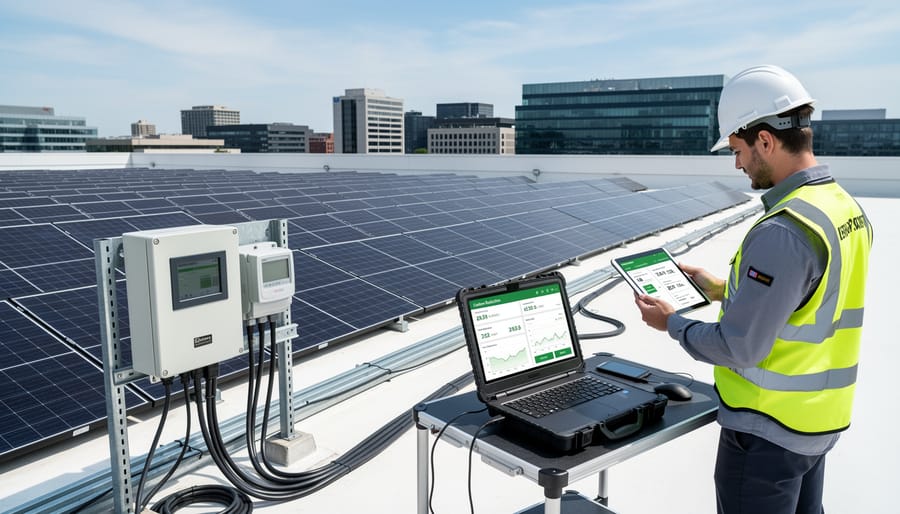
Monitoring encompasses systematic data collection methods that track carbon emissions and reductions in real-time. For solar energy installations, this involves metering systems that measure electricity generation, displacement of grid power, and associated emissions avoided. Advanced sensors and IoT devices continuously capture performance data, while satellite imagery and remote sensing technologies provide verification of system operation. Organizations typically deploy automated monitoring platforms that integrate with existing energy management systems, ensuring accurate baseline establishment and ongoing measurement of carbon impact.
Reporting transforms raw monitoring data into standardized documentation that stakeholders can understand and compare. Frameworks such as the Greenhouse Gas Protocol, CDP (Carbon Disclosure Project), and ISO 14064 provide consistent methodologies for calculating and presenting emissions data. For commercial solar projects, reporting includes quantifying avoided emissions based on regional grid carbon intensity factors, documenting renewable energy certificates (RECs), and demonstrating compliance with regulatory requirements. Organizations must maintain detailed records of system specifications, performance metrics, and calculation methodologies to support their carbon claims.
Verification involves independent third-party validation of monitoring data and reporting accuracy. Accredited verifiers conduct site visits, audit documentation, and assess whether methodologies align with recognized standards. In practice, a manufacturing facility implementing solar arrays would engage ISO-certified auditors to validate their emissions reduction claims before incorporating them into sustainability reports or carbon credit applications. This independent validation ensures data integrity, prevents greenwashing, and builds stakeholder confidence in reported carbon benefits. Verification frequency typically ranges from annual reviews to project-specific assessments depending on regulatory requirements and organizational commitments.
How MRV Differs from Traditional Carbon Accounting
Traditional carbon accounting typically involves periodic measurements and estimations of greenhouse gas emissions, often relying on industry averages or simplified calculation methods. While these basic carbon footprint calculations serve as starting points, they lack the rigor required for carbon credit markets, regulatory compliance, and investor-grade reporting.
MRV carbon differs fundamentally through its emphasis on continuous monitoring, independent verification, and comprehensive documentation. Rather than accepting estimated emissions factors, MRV systems require actual measurement data from installed monitoring equipment, creating an auditable trail of evidence. This approach provides stakeholders with verifiable proof of emission reductions, essential for carbon credit trading and compliance with emerging regulations.
The transparency component distinguishes MRV from conventional accounting. Every data point must be traceable to its source, with clear methodologies documented and accessible for third-party review. For organizations implementing carbon reduction strategies like solar energy installations, MRV systems track actual generation and displacement of grid electricity with granular precision.
Credibility represents another critical differentiator. MRV frameworks require independent verification by accredited bodies, ensuring data integrity and preventing greenwashing. This verification process transforms carbon data from internal estimates into market-ready, bankable environmental commodities that command premium valuations and satisfy institutional investor requirements.
Why Regulators and Investors Are Demanding MRV Compliance
Current Regulatory Landscape
The regulatory environment surrounding MRV carbon protocols has evolved significantly in recent years, creating both obligations and opportunities for commercial and industrial entities. At the international level, the Paris Agreement established foundational requirements for countries to track and report emissions through Enhanced Transparency Framework provisions, which became effective in 2024. These international commitments cascade down to national and regional regulations that directly impact business operations.
In the United States, the Securities and Exchange Commission has proposed climate disclosure rules requiring publicly traded companies to report Scope 1 and 2 emissions with third-party attestation. California’s AB 1305 and SB 253, effective 2025-2026, mandate comprehensive emissions reporting for large companies operating in the state. The European Union’s Corporate Sustainability Reporting Directive extends MRV requirements to approximately 50,000 companies, including non-EU entities with substantial European operations, with phased implementation beginning in 2024.
Voluntary carbon markets also impose stringent MRV standards. Leading registries including Verra, Gold Standard, and the Climate Action Reserve require detailed monitoring plans, regular verification by accredited third parties, and transparent public reporting. For commercial solar installations claiming carbon credits or renewable energy certificates, verification cycles typically occur annually or bi-annually, with monitoring data collected continuously through digital platforms.
Compliance timelines vary by jurisdiction and organization size, but the trend is clear: regulatory frameworks are tightening, verification standards are becoming more rigorous, and transparency expectations continue to rise. Organizations should begin building MRV capabilities now to meet evolving requirements.

The Business Case Beyond Compliance
While regulatory compliance provides the initial impetus for implementing MRV systems, forward-thinking organizations recognize that robust carbon monitoring delivers substantial business value beyond meeting legal obligations. Companies with verified emissions data can monetize carbon reduction achievements through voluntary and compliance carbon markets, generating new revenue streams that improve project economics. For facilities pursuing industrial decarbonization through solar installations, credible MRV documentation transforms emission reductions into tradable carbon credits, creating additional financial returns on sustainability investments.
Transparent measurement and reporting also strengthens competitive positioning. Organizations demonstrating verified environmental performance attract ESG-focused investors, secure favorable financing terms, and meet increasingly stringent supply chain requirements from major corporations. A manufacturing facility that implemented comprehensive MRV protocols alongside its solar array documented a 40% emissions reduction, enabling qualification for preferential supplier status with three Fortune 500 clients. Enhanced stakeholder trust represents another critical advantage—customers, employees, and community members increasingly expect verifiable environmental claims rather than general sustainability statements. Robust MRV systems provide the credibility that differentiates genuine environmental leadership from greenwashing, building lasting reputation value.
Implementing MRV for Solar Energy Installations
Monitoring Solar Carbon Impact
Effective monitoring of solar carbon impact requires sophisticated technologies that capture real-time generation data and translate it into verifiable emissions reductions. Modern solar monitoring systems combine hardware sensors, data loggers, and cloud-based analytics platforms to maintain continuous oversight of energy production and environmental performance.
Solar monitoring begins with production meters that track kilowatt-hours generated at inverter or array level. These devices record granular data at intervals ranging from seconds to minutes, creating detailed production profiles. Advanced systems integrate weather stations that measure irradiance, temperature, and atmospheric conditions, enabling more accurate performance analysis and emissions calculations.
IoT-enabled monitoring platforms aggregate data from multiple sources and apply standardized methodologies to calculate avoided emissions. These calculations typically reference regional grid emission factors published by authorities like the EPA or local utilities. For example, a manufacturing facility in California using a 500-kW solar array might track that each megawatt-hour generated avoids approximately 0.2 metric tons of CO2 compared to grid electricity. The monitoring system automatically converts production data into emissions reductions using these established factors.
Leading monitoring solutions employ blockchain technology or secure cloud storage to maintain immutable records that satisfy MRV requirements. These systems generate automated reports formatted for carbon registries, sustainability frameworks like CDP and GRI, and regulatory submissions. Notable examples include commercial platforms such as SolarEdge monitoring with integrated carbon tracking, Enphase Enlighten’s environmental impact dashboard, and enterprise energy management systems from companies like Schneider Electric.
Integration capabilities allow solar monitoring data to feed directly into corporate sustainability reporting systems, eliminating manual data entry and reducing verification costs. For organizations pursuing carbon credits or renewable energy certificates, this continuous monitoring infrastructure provides the documentation foundation necessary for successful certification and ongoing compliance verification.
Reporting Standards and Frameworks
Establishing robust reporting standards is essential for credible carbon accounting in solar energy projects. The GHG Protocol serves as the foundational framework, providing comprehensive guidelines for measuring and reporting greenhouse gas emissions across Scopes 1, 2, and 3. For solar installations, this protocol helps quantify avoided emissions by comparing actual energy generation against conventional grid-based alternatives, enabling organizations to demonstrate tangible environmental impact.
ISO 14064 offers a complementary international standard specifically designed for greenhouse gas accounting and verification. This framework provides detailed requirements for quantifying, monitoring, and reporting emission reductions at both organizational and project levels. Solar energy facilities benefit from ISO 14064’s structured approach to establishing baseline scenarios, calculating emission reductions, and ensuring data quality throughout the reporting period.
The Carbon Disclosure Project (CDP) represents another critical reporting mechanism, particularly for organizations seeking to communicate climate performance to investors and stakeholders. CDP’s standardized questionnaires enable companies to disclose renewable energy investments, including solar installations, within a globally recognized format that facilitates benchmarking and comparison.
When structuring reports for solar energy projects, organizations should document key performance indicators including energy generation data, capacity factors, grid displacement calculations, and verification methodologies. Reports must clearly articulate measurement boundaries, data collection processes, quality assurance procedures, and any assumptions used in emission reduction calculations. Including third-party verification statements strengthens credibility and demonstrates commitment to transparency. These frameworks collectively provide the structure needed to transform raw solar energy data into actionable carbon accounting insights that satisfy regulatory requirements and stakeholder expectations.
Third-Party Verification Process
Third-party verification audits provide independent validation of your carbon accounting data, ensuring credibility with stakeholders, regulators, and carbon markets. During an audit, verifiers examine your MRV systems, documentation, and emission calculations against established standards like ISO 14064-3 or program-specific protocols. Expect detailed reviews of measurement equipment calibration records, data management procedures, and calculation methodologies. Auditors may conduct site visits to solar installations, interview personnel, and request supporting documentation for reported emission reductions.
Selecting an accredited verifier requires evaluating their certification credentials, industry experience, and familiarity with renewable energy projects. Look for verification bodies accredited by recognized organizations such as ANAB or equivalent national accreditation bodies. Consider verifiers with proven track records in solar energy carbon accounting and relevant sectoral expertise. Request references from similar organizations and compare pricing structures alongside service scope.
Maintaining verification-ready documentation throughout the reporting period significantly reduces audit preparation time and costs. Establish centralized digital repositories for calibration certificates, maintenance logs, energy production data, and calculation worksheets. Implement regular internal reviews to identify and correct discrepancies before external audits. Document all methodology changes, system upgrades, or operational modifications that might affect emissions reporting. This proactive approach demonstrates organizational commitment to data integrity while streamlining the verification process and minimizing potential audit findings.

Real-World Applications: MRV in Action
Commercial Facility Case Study
A leading retail distribution center in California demonstrates the practical value of comprehensive MRV in solar operations. The 500,000 square-foot facility installed a 2.3 MW rooftop solar array, supplemented by ground-mounted panels, generating approximately 3.8 million kWh annually. Management recognized that accurate carbon reporting would be essential for meeting corporate sustainability targets and qualifying for carbon credit programs.
The facility implemented an advanced MRV system integrating real-time monitoring equipment with automated reporting software. Initial challenges included data integration across multiple monitoring platforms and establishing reliable baseline measurements for carbon displacement calculations. The team worked with third-party verification specialists to ensure compliance with ISO 14064 standards.
Within the first year, the MRV system documented a verified reduction of 1,890 metric tons of CO2 equivalent emissions. This data enabled the facility to secure renewable energy credits valued at $47,000 and qualify for accelerated depreciation benefits. The comprehensive tracking also identified underperforming panels, leading to maintenance interventions that improved system efficiency by 7 percent. Most significantly, the verified carbon reduction data strengthened the company’s sustainability reporting and enhanced stakeholder confidence in their environmental commitments.
Government Institution Implementation
Government agencies worldwide are implementing robust MRV frameworks to demonstrate progress toward climate commitments and renewable energy targets. Public sector entities utilize MRV systems to track emissions reductions from solar installations on government facilities, verify compliance with renewable energy mandates, and report accurate data to national and international bodies like the UNFCCC.
The transparency inherent in MRV processes builds public trust and enables accountability in taxpayer-funded sustainability initiatives. For example, several U.S. federal agencies now employ standardized MRV protocols to document solar energy generation across their building portfolios, providing verifiable evidence of cost savings and environmental impact. These agencies publish annual reports showing precise carbon offset calculations, energy production metrics, and return on investment timelines.
Municipal governments similarly leverage MRV data to support green bond issuances, where verified emissions reductions from solar projects strengthen investor confidence. The European Union’s renewable energy directive mandates MRV reporting for member states, driving standardization in how public institutions measure and communicate their solar energy contributions. This systematic approach enables governments to make data-driven policy decisions, allocate resources effectively, and demonstrate leadership in the renewable energy transition while maintaining fiscal responsibility.
Building Your MRV Strategy: Practical Steps Forward
Developing a robust MRV strategy requires careful planning and systematic implementation. Begin by assessing your organization’s current emissions baseline and identifying which scopes of emissions you need to monitor. For most commercial and industrial facilities, Scope 2 emissions from purchased electricity represent the largest controllable carbon footprint component, making energy infrastructure the logical starting point for MRV implementation.
The first practical step involves selecting appropriate measurement technologies. For facilities considering decarbonization, solar energy installations offer inherent MRV advantages. Modern solar systems include integrated monitoring platforms that automatically track electricity generation at 15-minute intervals, creating a continuous, verifiable data stream. This built-in measurement capability eliminates the need for separate monitoring infrastructure while providing transparent documentation of emission reductions.
When evaluating technology solutions, prioritize systems that offer standardized data outputs compatible with major carbon accounting platforms. Look for IoT-enabled meters, automated data collection systems, and cloud-based reporting tools that can integrate with your existing energy management systems. The initial investment in quality monitoring infrastructure typically ranges from 3-8 percent of total project costs but delivers long-term value through reduced reporting overhead and improved data accuracy.
Internal capacity building represents another critical component. Designate a cross-functional team including representatives from facilities management, finance, and sustainability departments. Provide training on emissions calculations, data verification protocols, and reporting requirements specific to your industry and regulatory environment. Many organizations find value in starting with pilot projects at a single facility to refine processes before scaling across multiple locations.
Solar energy projects serve as excellent pilot opportunities because they combine significant emission reductions with straightforward MRV implementation. A 500-kilowatt commercial solar installation, for example, generates approximately 750,000 kilowatt-hours annually in favorable locations, displacing roughly 400 metric tons of CO2 equivalent. The generation data flows automatically from inverters to monitoring platforms, creating auditable records that satisfy voluntary and compliance reporting standards.
Budget considerations should account for both initial setup costs and ongoing operational expenses. While comprehensive MRV systems require upfront investment, the combination of reduced emissions, lower energy costs, and improved ESG reporting capabilities typically delivers positive returns within 3-5 years for commercial facilities implementing solar-based decarbonization strategies.
In today’s competitive business landscape, credible carbon accounting has evolved from a compliance exercise to a strategic imperative. Organizations that implement robust MRV systems position themselves advantageously in markets increasingly driven by environmental transparency and sustainability commitments. The evidence is clear: stakeholders, investors, and customers demand verifiable proof of carbon reduction efforts, not aspirational claims.
Commercial solar installations represent one of the most measurable and verifiable pathways to achieving meaningful carbon reductions. Unlike many decarbonization initiatives that rely on complex calculations or disputed methodologies, solar energy systems generate quantifiable data through digital monitoring systems, providing the precise measurement, reporting, and verification required for credible carbon accounting. This transparency strengthens your organization’s position in the zero-carbon transition.
The question for business leaders is no longer whether to implement MRV protocols, but how quickly to establish these systems. Begin by assessing your current carbon accounting practices against emerging regulatory requirements and industry standards. Identify gaps in your measurement capabilities and explore how solar energy installations can provide both emission reductions and the verified data your organization needs to demonstrate environmental leadership in an increasingly transparent marketplace.