
Understand how Illinois’s Renewable Portfolio Standard mandates that utilities procure 50% of their electricity from renewable sources by 2040, with solar energy required to comprise 20% of total generation by that date. These escalating requirements create immediate market opportunities for commercial and industrial facilities to monetize their renewable energy investments through Solar Renewable Energy Credits (SRECs), which currently trade between $70-90 per megawatt-hour in Illinois markets.
Calculate your facility’s potential SREC revenue by multiplying your annual solar production in megawatt-hours by current market rates, then factor in the Long-Term Renewable Resources Procurement Plan’s guaranteed 15-year pricing for qualified systems. Illinois businesses installing solar between now and 2030 can secure fixed SREC prices that protect against market volatility while generating predictable revenue streams that often reduce solar payback periods by 40-60%.
Review your current electricity procurement strategy against the Adjustable Block Program’s declining incentive structure, which reduces compensation rates by 5% annually as program capacity fills. Organizations that act within the next enrollment period lock in higher rates while positioning themselves ahead of competitors who delay implementation.
Assess whether your facility qualifies as an equity eligible contractor or participates in designated environmental justice communities, as these classifications unlock additional incentive multipliers worth up to 50% beyond standard SREC values. The Illinois Power Agency’s administrator has prioritized these categories to accelerate deployment in underserved markets, creating financial advantages that significantly improve project economics.
These renewable portfolio standards represent more than regulatory compliance—they establish a framework where businesses convert clean energy mandates into quantifiable financial returns through strategic timing and program participation.
Understanding Illinois Renewable Portfolio Standard: The Foundation
Current RPS Targets and Timeline
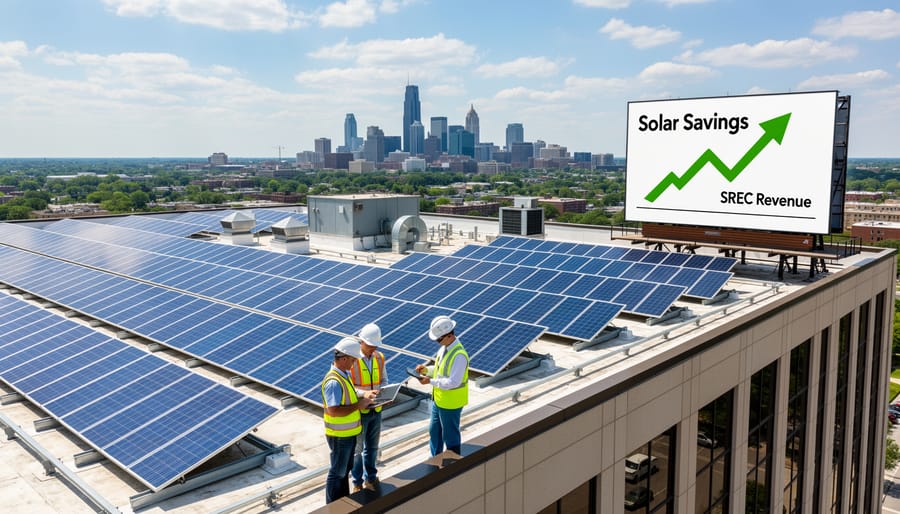
Illinois has established one of the most ambitious renewable energy roadmaps in the nation through its Renewable Portfolio Standard. The Climate and Equitable Jobs Act (CEJA), signed into law in 2021, set forth clear milestones that directly impact how businesses and facilities must approach their energy strategies.
Under the current framework, Illinois utilities must source 25% of their electricity from renewable sources by 2025. This target increases progressively, requiring 40% renewable energy by 2030 and 50% by 2040. The ultimate goal mandates 100% clean energy by 2050, positioning Illinois as a leader in the transition to sustainable power generation.
For commercial and industrial stakeholders, these targets translate into concrete market opportunities. The pathway to 50% renewables by 2040 creates sustained demand for solar energy certificates (SRECs) and other renewable energy credits, providing revenue streams for businesses that invest in on-site generation. Facility managers should note that the incremental nature of these requirements means consistent growth in renewable energy infrastructure over the next two decades.
The 2030 milestone is particularly significant for business planning, as the jump from 25% to 40% in just five years represents substantial market expansion. Organizations implementing renewable energy solutions now position themselves to capitalize on increasing SREC values and potential capacity constraints as utilities work to meet these mandates. The predictable timeline allows for strategic capital planning and demonstrates Illinois’s commitment to creating a stable, long-term renewable energy market that rewards early adopters while providing compliance pathways for all participants.
Who Must Comply and What It Means
Illinois’ Renewable Portfolio Standard establishes clear compliance obligations for specific entities within the state’s electricity market. The mandate applies to all electric utilities serving more than 100,000 customers and alternative retail electric suppliers (ARES) operating in Illinois. This includes major providers such as ComEd and Ameren Illinois, along with competitive suppliers offering retail electricity services to commercial and industrial customers.
These obligated entities must procure renewable energy credits (RECs) equivalent to specific percentages of their total electricity sales each year. The requirement escalates annually, reaching 40% by 2030 and 50% by 2040, with solar energy comprising a substantial portion through dedicated carve-outs. Utilities demonstrate compliance by retiring the appropriate number of RECs, which represent the environmental attributes of renewable energy generation.
This compliance framework creates robust market demand for renewable energy projects across Illinois. When utilities and suppliers need RECs to meet their obligations, they purchase them from renewable energy generators, including businesses that have installed solar systems. This mechanism transforms commercial solar opportunities into revenue-generating assets through Solar Renewable Energy Credit (SREC) sales.
For business owners and facility managers, understanding this compliance structure reveals strategic advantages. Your solar installation not only reduces operational costs but also produces valuable SRECs that utilities must purchase to satisfy their RPS obligations. This guaranteed demand creates predictable revenue streams and enhances project economics, making commercial solar investments increasingly attractive in Illinois’ regulated marketplace.
Illinois Solar Carve-Out: Your Competitive Advantage
Solar-Specific Requirements Under Illinois Law
Illinois law establishes distinct solar-specific mandates within the broader Renewable Portfolio Standard framework. The state requires that utilities procure Solar Renewable Energy Credits (SRECs) as a dedicated subset of their overall renewable energy obligations. Unlike general Renewable Energy Credits (RECs) that can come from wind, hydroelectric, or biomass sources, SRECs must originate exclusively from photovoltaic solar installations within Illinois or adjacent states.
The solar carve-out targets have increased progressively under the Climate and Equitable Jobs Act. By 2030, solar energy must constitute a significant portion of the state’s renewable energy mix, with specific allocations for distributed generation projects under 5 megawatts. This creates a separate market for SRECs, typically commanding higher prices than standard RECs due to the solar-specific demand.
For business owners and facility managers, understanding this distinction is essential for maximizing returns on solar investments. While a commercial solar installation generates both electricity savings and environmental attributes, the SREC represents the renewable aspect that can be sold separately. The Illinois Power Agency administers SREC procurement through the Adjustable Block Program, establishing fixed prices for different project categories.
Facilities installing solar systems can monetize their SRECs through long-term contracts, providing predictable revenue streams that significantly improve project economics. This dual-value proposition—combining operational savings with SREC income—makes solar investments particularly attractive under Illinois regulations compared to states with less structured solar incentive programs.
The Illinois Shines Program Connection
Illinois Shines serves as the state’s primary mechanism for achieving solar energy carve-out targets within the Renewable Portfolio Standard framework. Administered by the Illinois Power Agency, this program operates through the Adjustable Block Program, which allocates incentives based on project size and type, creating distinct advantages for commercial installations.
The program structure directly supports RPS compliance by purchasing Renewable Energy Credits from qualified solar projects at predetermined prices. Commercial facilities installing solar systems between 100 kW and 2 MW qualify for dedicated incentive blocks, with payment rates that reflect project economics and market conditions. These incentives significantly improve return on investment timelines, typically reducing payback periods by 30 to 40 percent compared to unsubsidized installations.
For business owners and facility managers, Illinois Shines provides financial certainty through fixed REC pricing over 15-year contract periods. This long-term commitment stabilizes cash flow projections and facilitates financing arrangements. The program’s recent expansion allocated additional funding specifically for larger commercial projects, recognizing their critical role in meeting state renewable energy targets.
Applications follow a transparent approval process with clearly defined technical requirements and interconnection standards. Approved projects receive upfront incentive payments upon system commissioning, improving project economics without requiring ongoing administrative burden. This streamlined approach makes compliance-driven solar investments both accessible and financially attractive for commercial entities seeking to reduce energy costs while contributing to Illinois’ clean energy transition.
Financial Incentives Driving Commercial Solar Investment
Solar Renewable Energy Credits (SRECs) Revenue Stream
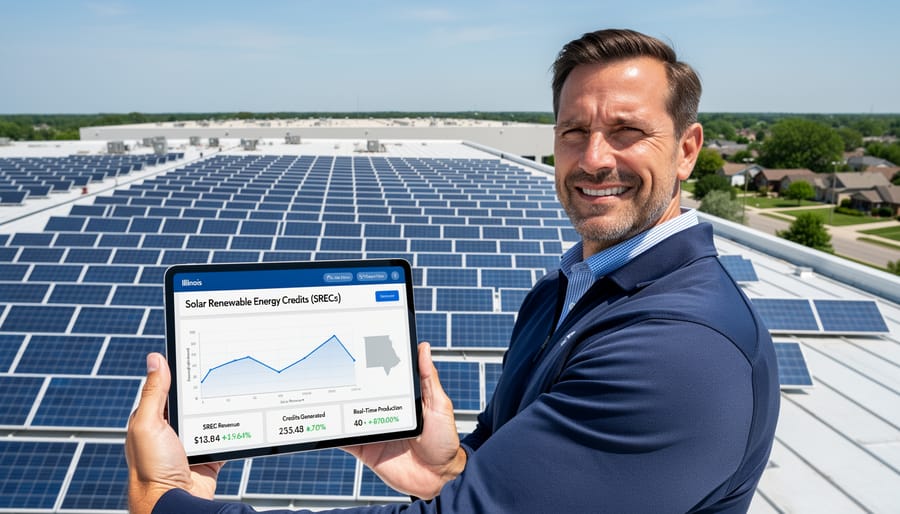
Illinois businesses that install qualifying solar systems generate Solar Renewable Energy Credits (SRECs) as a valuable revenue stream alongside their energy production. For every 1,000 kilowatt-hours (1 megawatt-hour) of solar electricity generated, the system owner earns one SREC, which can be sold to utilities obligated to meet renewable energy requirements under Illinois’ Renewable Portfolio Standard.
The SREC market in Illinois operates through the Adjustable Block Program, where credits are purchased at predetermined rates rather than fluctuating market prices. This structure provides businesses with predictable, long-term revenue forecasting. As of 2024, SREC values typically range from $70 to $80 per credit, though rates vary based on system size, location, and program capacity. A commercial facility with a 100-kilowatt system generating approximately 120,000 kWh annually could produce 120 SRECs, creating an additional revenue stream of $8,400 to $9,600 per year.
Revenue projections extend over 15-year contract periods, providing substantial returns when combined with other solar energy incentives and energy cost savings. Businesses should factor in declining SREC generation as panels age, typically at 0.5% to 0.8% annually. Advanced monitoring systems track generation precisely, ensuring accurate credit certification and timely payments.
Facility managers should engage qualified solar developers who handle SREC registration, reporting, and sales processes, streamlining administrative requirements while maximizing revenue capture from this state-mandated program.
Federal and State Tax Benefits
Illinois businesses pursuing solar installations under the Renewable Portfolio Standard can leverage substantial federal tax incentives that significantly improve project economics. The federal Investment Tax Credit (ITC) currently allows businesses to deduct 30% of solar installation costs from their federal taxes, providing immediate capital recovery. When combined with Modified Accelerated Cost Recovery System (MACRS) depreciation, companies can depreciate the remaining system value over five years, further reducing taxable income and accelerating payback periods.
Illinois supplements these federal benefits with state-specific incentives. The Illinois Shines program facilitates Solar Renewable Energy Credit (SREC) generation, creating an additional revenue stream for qualifying projects. Commercial and industrial facilities can monetize these credits while advancing toward RPS compliance targets. Public sector entities and nonprofits may access alternative incentive structures through the Illinois Power Agency’s Adjustable Block Program. These combined incentives typically reduce total project costs by 40-50%, transforming solar investments into financially compelling opportunities with ROI periods of 4-7 years for most commercial installations.
Net Metering and Energy Cost Reduction
Illinois net metering policies complement the state’s Renewable Portfolio Standard by enabling commercial facilities to offset electricity consumption with on-site renewable generation. Under current regulations, businesses generating solar power can credit excess production against future consumption, effectively spinning the meter backward during peak generation periods. This mechanism directly reduces utility bills while simultaneously contributing to RPS compliance through SREC generation.
Commercial facilities benefit from both immediate cost savings through reduced electricity purchases and long-term revenue from selling SRECs to utilities meeting RPS obligations. The combination creates a dual revenue stream that significantly improves solar investment returns. Net metering credits remain valid for multiple billing cycles, providing flexibility for facilities with variable energy usage patterns. For larger commercial installations, understanding capacity thresholds and interconnection requirements ensures maximum financial benefit while supporting Illinois’s clean energy transition goals.
Real-World Impact: Illinois Commercial Solar Success
Manufacturing Facility Case Study
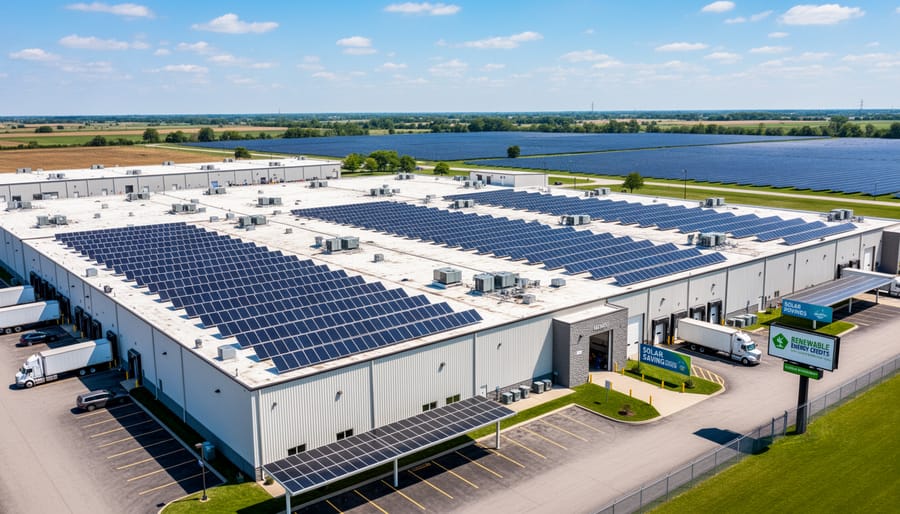
A central Illinois manufacturing facility with 250,000 square feet of roof space installed a 1.2 MW solar array in 2021, strategically positioning itself to capitalize on Illinois RPS requirements. The company invested $2.1 million in the solar installation, receiving $630,000 in federal tax credits and qualifying for Illinois Adjustable Block Program incentives.
The facility now generates approximately 1,500 MWh annually, covering 35% of its electricity needs and reducing energy costs by $165,000 per year. Through SREC revenue under the Illinois RPS framework, the operation generates an additional $85,000 annually by selling renewable energy credits to utilities obligated to meet clean energy mandates.
The combined energy savings and SREC income provide a 7.2-year payback period, with projected 25-year savings exceeding $6.2 million. The solar installation also insulated the facility from 80% of utility rate increases and improved the company’s sustainability profile, enhancing its competitive position with environmentally conscious clients.
This case demonstrates how Illinois RPS creates dual revenue streams for commercial solar adopters while supporting the state’s goal of 25% renewable energy by 2025. Manufacturing operations with substantial roof space or land availability represent ideal candidates for similar strategic implementations.
Municipal and Government Applications
Illinois government entities are uniquely positioned to capitalize on the state’s Renewable Portfolio Standard requirements, particularly the substantial solar carve-out provisions that mandate utilities source specific percentages of electricity from solar generation. Municipalities, school districts, counties, and state facilities can leverage these mandates to achieve dual objectives: meeting sustainability commitments while generating significant long-term budget savings.
Government institutions installing solar systems generate Solar Renewable Energy Credits that can be sold into the compliance market, creating an additional revenue stream beyond utility bill reductions. Many municipalities have successfully financed solar installations through power purchase agreements or performance contracts that require zero upfront capital, allowing them to redirect operational savings toward other priorities immediately.
The Illinois Shines program specifically supports public sector projects with favorable incentive structures and streamlined application processes. Schools and municipal buildings with large roof areas or available land parcels are particularly well-suited for solar development, often achieving 20-year energy cost reductions exceeding 50 percent.
Public sector solar installations also demonstrate community leadership in sustainability, often catalyzing broader renewable energy adoption within their jurisdictions. Government facilities that implement solar projects fulfill RPS objectives while establishing predictable energy costs immune to utility rate volatility, strengthening fiscal planning capabilities across multi-year budget cycles.
Multi-Site Commercial Operations
Multi-facility operations across Illinois are strategically deploying solar installations to capitalize on RPS-driven incentives while reducing operational costs. Several retail chains have implemented standardized solar arrays across their Illinois locations, generating substantial SREC revenue streams while meeting corporate sustainability targets. Distribution centers and warehouse operations prove particularly advantageous due to expansive roof space and high daytime electricity consumption that aligns with solar production peaks. A regional grocery chain recently completed solar installations across fifteen Illinois stores, collectively generating over 2 megawatts of capacity. This distributed approach allows businesses to aggregate SREC earnings while maintaining manageable project scales at individual facilities. Manufacturing facilities with multiple Illinois plants are following similar strategies, installing solar where facility characteristics and utility interconnection terms prove most favorable. The key advantage for multi-site operators lies in portfolio diversification—different locations may benefit from varying utility incentive programs and SREC pricing dynamics. Facility managers should conduct site-specific assessments considering roof conditions, electrical infrastructure, and local utility programs to prioritize deployment sequences that maximize RPS-related financial returns across their entire Illinois portfolio.
Navigating Compliance and Maximizing Your Benefits
Project Sizing and System Design Considerations
Determining the optimal solar installation size requires careful analysis of three critical factors: current and projected energy consumption, available roof or ground space, and SREC revenue potential under Illinois’ Renewable Portfolio Standard.
Begin by conducting a comprehensive energy audit examining at least 12 months of utility bills to establish baseline consumption patterns. Commercial facilities typically see the strongest return on investment when sizing systems to offset 70-90% of annual electricity usage, preserving utility grid connection while maximizing SREC generation.
Physical space constraints often dictate practical capacity limits. Commercial rooftop installations require structural assessments to verify load-bearing capacity, typically needing 100 square feet per kilowatt of solar capacity. Ground-mounted systems offer greater flexibility but must account for setback requirements and future expansion needs.
SREC production calculations should factor in Illinois’ current credit value and your facility’s eligibility category within the Adjustable Block Program. A 100-kilowatt system in northern Illinois generates approximately 120-130 SRECs annually, while southern installations may produce 135-145 credits due to increased solar irradiance.
Consider scalability in your design. Many successful commercial installations begin with a pilot phase covering 30-40% of energy needs, then expand based on performance data and available incentive allocations. This phased approach reduces initial capital requirements while establishing operational experience before full deployment.
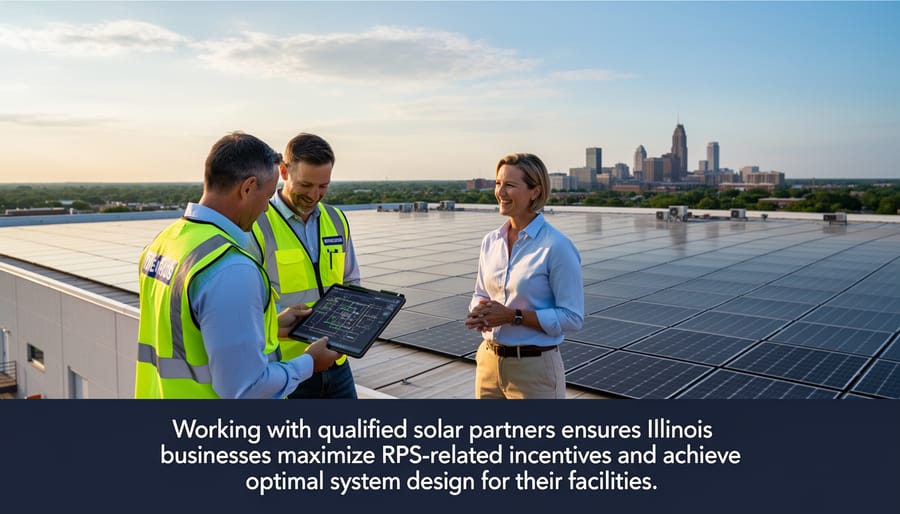
Working with Qualified Solar Partners
Selecting the right commercial solar partner is essential for navigating Illinois RPS requirements and optimizing financial returns. A qualified provider should demonstrate comprehensive knowledge of the Illinois Shines program, SREC registration processes, and utility-specific interconnection requirements. Look for partners with proven experience in commercial-scale installations within Illinois, as they will understand local compliance and regulations that affect project timelines and costs.
Your solar partner should offer end-to-end services including feasibility assessments, financial modeling, permitting, installation, and ongoing performance monitoring. They should clearly explain how your project qualifies for Adjustable Block Program allocations and accurately project SREC revenue over the 15-year contract period. Request references from similar commercial installations and verify their approved vendor status with the Illinois Power Agency.
A qualified provider will conduct detailed site assessments considering roof condition, electrical infrastructure, and production capacity to maximize incentive capture. They should provide transparent proposals outlining equipment specifications, warranties, expected energy production, and detailed financial projections including payback periods and ROI calculations.
Additionally, ensure your partner offers comprehensive post-installation support for SREC tracking, system monitoring, and performance guarantees. The right partnership extends beyond installation to include ongoing optimization and compliance management, ensuring your investment delivers expected returns while meeting Illinois RPS obligations. Request case studies demonstrating successful commercial projects and their actual financial performance compared to initial projections.
Illinois stands at a pivotal moment in its clean energy transition, with Renewable Portfolio Standard requirements creating unprecedented opportunities for commercial solar investment. The state’s ambitious 2025 target of 25 percent renewable energy, escalating to 40 percent by 2030 and 50 percent by 2040, has established a favorable policy environment that directly translates into financial benefits for forward-thinking businesses.
The convergence of RPS mandates, Solar Renewable Energy Credit markets, and Illinois Shines program incentives presents a compelling value proposition for commercial solar adoption. Businesses that act now can capitalize on robust incentive structures while positioning themselves as sustainability leaders within their industries. The financial returns extend beyond immediate tax benefits and SRECs to include long-term energy cost stabilization and enhanced property valuations.
Time-sensitive considerations make current market conditions particularly advantageous. As more businesses enter the solar market and RPS targets progress, incentive levels may adjust accordingly. Early adopters benefit from maximum available incentives while also gaining operational experience with solar systems that will serve their facilities for 25 years or more.
Business leaders should initiate comprehensive solar feasibility assessments now to determine site-specific potential, projected returns, and optimal implementation timelines. Engaging qualified solar developers and energy consultants ensures accurate financial modeling and streamlined project execution. Illinois’ clean energy future is being built today, and commercial entities that embrace solar investment position themselves strategically for both economic advantage and environmental stewardship in the decades ahead.