
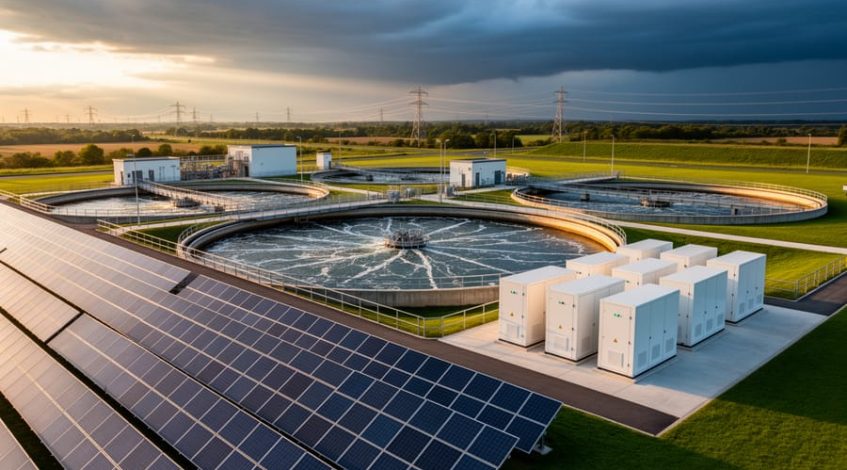
Every hour, critical sanitation infrastructure worldwide loses operational capacity due to power failures, creating public health risks and compliance violations that cost organizations millions annually. Zero waste energy systems—designed to eliminate energy loss while maintaining 100% operational reliability—have emerged as the definitive solution for mission-critical facilities that cannot afford downtime.
Traditional backup power systems waste up to 40% of their energy capacity through inefficient conversion, standby losses, and poor integration with primary power sources. This inefficiency becomes catastrophic when wastewater treatment plants, pumping stations, and emergency sanitation facilities face extended grid outages. Modern zero waste energy approaches combine solar generation, advanced battery storage, and intelligent load management to ensure continuous operation while dramatically reducing both energy costs and environmental impact.
The business case proves compelling: facilities implementing integrated solar backup systems report 65-85% reductions in emergency power costs, complete elimination of diesel generator maintenance expenses, and guaranteed compliance with increasingly stringent environmental regulations. More significantly, these systems provide true resilience—not just backup power, but optimized energy management that reduces total operational costs whether the grid functions or fails.
Three factors drive the accelerating adoption of zero waste energy in critical sanitation infrastructure: regulatory pressure for carbon neutrality, escalating utility costs, and the proven reliability of commercial solar technology in emergency scenarios. Organizations that implement these systems gain immediate operational advantages: predictable energy expenses, enhanced community reputation, and elimination of the catastrophic risks associated with sanitation system failures.
The following technical framework and case studies demonstrate how forward-thinking facilities achieve zero waste energy status while ensuring uninterrupted sanitation services.
The Critical Energy Gap in Emergency Sanitation Systems
Power Dependencies in Modern Waste Management
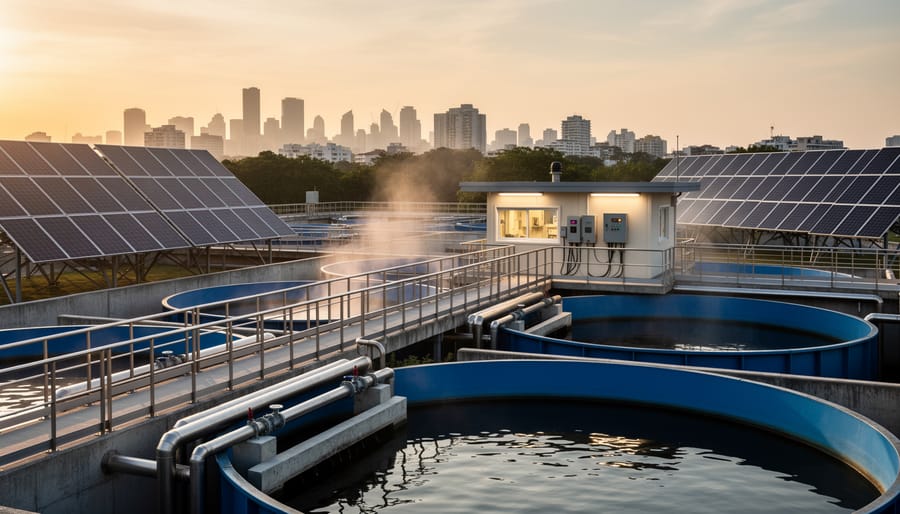
Modern sanitation facilities depend on consistent electrical power to maintain operational integrity and public health standards. Understanding these power requirements is essential for developing effective backup solutions and ensuring uninterrupted service delivery.
Wastewater treatment plants operate multiple pump systems that consume substantial energy throughout daily operations. Primary lift stations typically require 15-50 kW of continuous power to transport sewage from collection points to treatment facilities. Secondary pumps within treatment systems demand additional 10-30 kW for moving water through various processing stages. These pumps must operate continuously, as interruptions can lead to system backups, overflow conditions, and environmental contamination.
Treatment systems themselves present significant energy demands. Aeration systems, which introduce oxygen into wastewater to facilitate biological treatment processes, consume 40-60% of a typical treatment facility’s total energy budget. These systems often require 25-75 kW depending on facility size and treatment capacity. Membrane bioreactors and advanced filtration equipment add another layer of power dependency, operating at 5-20 kW for smaller installations.
Monitoring and control systems, while consuming less power individually at 2-5 kW, remain critical for maintaining treatment efficiency and regulatory compliance. These systems track water quality parameters, chemical dosing, and flow rates in real-time. Even brief power interruptions can compromise data integrity and automated safety protocols.
Emergency backup power becomes not merely a convenience but a regulatory requirement in many jurisdictions, with facilities needing reliable alternatives to maintain continuous operations during grid disruptions.
The True Cost of Energy Interruptions
When sanitation systems experience power interruptions during emergencies, the consequences extend far beyond inconvenience. The financial impact includes immediate repair costs averaging $15,000-$50,000 per incident, plus potential regulatory fines reaching $100,000 for environmental violations. Lost operational capacity can cost facilities $5,000-$20,000 per day in disrupted services.
Environmental damage accelerates rapidly when wastewater treatment systems fail. Untreated sewage releases pathogens, heavy metals, and nutrients into waterways, causing ecosystem degradation that persists for months. A single 24-hour outage at a mid-sized treatment facility can discharge up to 5 million gallons of inadequately treated effluent.
Public health risks escalate immediately, with contaminated water exposing communities to E. coli, hepatitis A, and other waterborne diseases. Emergency response costs compound as municipalities deploy alternative sanitation solutions, water quality monitoring, and public health interventions. Healthcare costs from outbreak management can exceed $500,000 in affected regions.
Implementing robust energy resilience strategies with solar backup systems eliminates these cascading costs. Facilities with continuous power maintain compliance, protect public health, and avoid the substantial financial burden of emergency remediation while supporting sustainable operations.
What Zero Waste Energy Actually Means for Sanitation Operations
Energy Efficiency vs. Zero Waste: Understanding the Difference
The term “zero waste energy” requires clarification, as it refers to minimizing energy loss rather than eliminating waste in the traditional sense. In solar system applications, particularly for critical infrastructure like sanitation facilities, this concept describes how efficiently a system converts, stores, and distributes power without unnecessary dissipation.
Energy efficiency measures how effectively a system converts sunlight into usable electricity and delivers it to connected loads. Modern photovoltaic panels achieve conversion rates of 18-22%, while the remaining energy is lost as heat—a physical limitation of current technology. However, the distinction lies in what happens after conversion. Traditional systems may lose additional power through inefficient inverters, poor cable sizing, or inadequate load management.
Zero waste energy optimization focuses on the balance-of-system components. Advanced inverters now operate at 97-98% efficiency, minimizing conversion losses between DC and AC power. Smart battery integration plays a crucial role by storing excess generation during peak sunlight hours and releasing it precisely when needed, preventing curtailment of available energy.
For mission-critical applications like emergency sanitation systems, this optimization ensures maximum utilization of every kilowatt-hour generated. Intelligent monitoring systems track real-time performance, identifying inefficiencies before they impact operations. Properly sized battery banks prevent both underutilization of solar capacity and energy dumping when batteries reach full charge.
The practical outcome for facility managers is a system that captures available solar energy and directs it purposefully, whether to immediate loads, storage, or grid export where applicable, eliminating waste through strategic design rather than theoretical perfection.
Solar Energy Capture and Utilization Rates
Modern photovoltaic systems have achieved remarkable efficiency gains, with commercial-grade solar panels now converting 19-23% of incoming solar radiation into usable electricity. When integrated into zero waste energy frameworks for sanitation infrastructure, these systems are engineered to maximize every kilowatt-hour generated, ensuring critical operations maintain continuity during grid disruptions.
Advanced energy management systems direct solar production through intelligent prioritization protocols. During peak sunlight hours, excess generation charges battery storage arrays while simultaneously powering wastewater treatment pumps, aeration systems, and monitoring equipment. High-efficiency inverters, typically operating at 96-98% conversion rates, minimize energy loss during DC-to-AC transformation, preserving more power for essential functions.
Recent installations demonstrate impressive capture rates. A municipal wastewater facility in Southern California documented 94% utilization of its 500kW solar array output, with energy distribution optimized across primary treatment pumps, UV disinfection units, and administrative operations. Battery storage systems with 90% round-trip efficiency ensure nighttime operations continue without grid dependence.
Performance monitoring reveals that properly designed systems generate 1,200-1,800 kWh annually per installed kilowatt in optimal locations. For sanitation facilities consuming 50-150 kWh daily, appropriately sized arrays can achieve energy independence while maintaining operational redundancy. Real-time monitoring platforms track generation versus consumption patterns, enabling facility managers to adjust operational schedules for maximum solar utilization. This data-driven approach transforms solar installations from supplementary power sources into primary infrastructure assets, delivering measurable returns through reduced utility expenses and enhanced operational resilience.
Solar-Powered Emergency Sanitation: Practical Applications
Wastewater Treatment Facilities
Wastewater treatment facilities represent critical infrastructure that cannot afford operational interruptions, making them ideal candidates for solar-powered backup systems. Municipal and industrial treatment plants increasingly integrate photovoltaic arrays with battery storage to maintain essential operations during grid failures, protecting public health and environmental compliance.
The most power-intensive components in treatment facilities—pump systems and aeration equipment—benefit significantly from solar backup solutions. Wastewater pumps must operate continuously to prevent sewage backups and potential environmental contamination. A mid-sized municipal facility in California implemented a 250 kW solar array coupled with 500 kWh of battery storage, ensuring 48 hours of autonomous operation for primary pumps and aeration blowers. This system proved invaluable during planned grid maintenance and unexpected outages, maintaining treatment standards without diesel generator emissions.
Industrial wastewater facilities face additional considerations, as treatment interruptions can halt production lines and trigger regulatory penalties. A food processing plant in Oregon installed solar backup systems specifically designed to power biological treatment aeration, which requires constant oxygen supply to sustain microbial activity. The 180 kW solar installation with intelligent load management reduced operational costs by 35 percent annually while providing critical resilience.
Treatment plants typically prioritize backup power for influent pumps, primary clarifiers, and essential aeration systems. Modern solar installations feature automated switchover capabilities, activating within milliseconds of grid failure to prevent process disruption. The investment in solar backup infrastructure delivers immediate risk mitigation while generating long-term energy savings, with many facilities achieving return on investment within seven years through combined utility savings and avoided compliance penalties.
Portable Sanitation and Field Operations
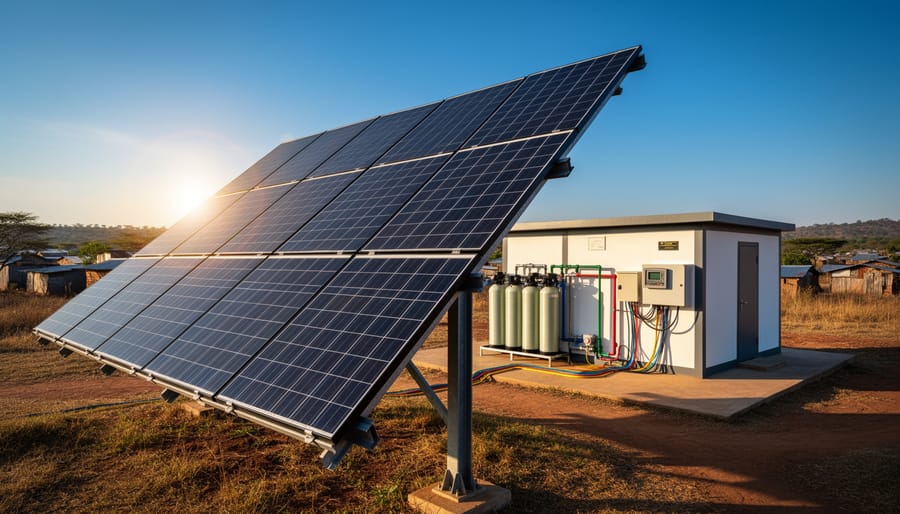
Solar-powered portable sanitation facilities represent a practical zero waste energy solution for temporary installations, disaster response scenarios, and remote industrial operations. These systems integrate photovoltaic panels with battery storage to power ventilation fans, lighting, water pumps, and waste treatment equipment without grid connection or diesel generators.
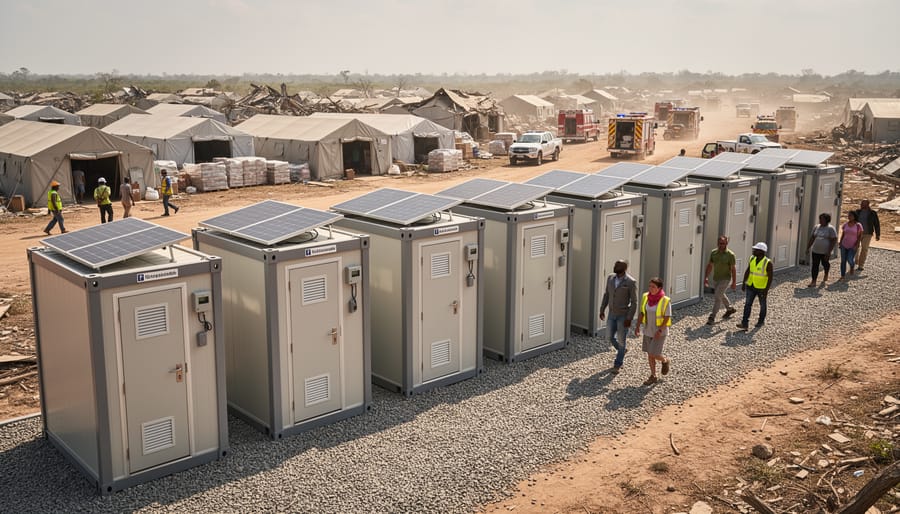
For disaster response units, solar-equipped sanitation facilities provide immediate operational capability in areas where infrastructure has been compromised. Emergency management agencies have successfully deployed containerized units featuring 400-watt solar arrays and 200Ah battery banks, maintaining continuous operation for water filtration, waste processing, and hygiene stations. These installations eliminate fuel supply chain dependencies while reducing deployment costs by approximately 40 percent compared to generator-powered alternatives.
Remote industrial sites benefit from permanent solar sanitation installations that support extended workforce operations. Mining operations and construction projects utilize solar-powered facilities with greywater recycling systems, reducing both energy consumption and water usage by 60 percent. The technology proves particularly valuable in locations where grid extension costs exceed $50,000 per mile.
Modern solar sanitation systems incorporate smart monitoring capabilities, providing facility managers with real-time data on energy production, battery status, and system performance. This remote oversight ensures reliability while minimizing maintenance requirements. Return on investment typically occurs within three to five years, with systems designed for 25-year operational lifespans delivering substantial long-term value for organizations prioritizing operational resilience and environmental responsibility.
Biogas and Waste-to-Energy Integration
Solar energy and biogas systems create powerful synergies in waste management facilities, establishing truly circular zero-waste energy operations. Modern treatment plants increasingly deploy this dual-approach strategy to maximize energy independence while minimizing environmental impact.
Biogas systems convert organic waste into renewable methane fuel through anaerobic digestion, providing consistent baseload power generation. However, these facilities require substantial electrical input for operations including mixing tanks, heating digesters, and running separation equipment. Solar photovoltaic arrays installed on facility rooftops and adjacent land parcels supply this operational electricity directly, reducing grid dependence while the biogas generators handle primary power needs.
This integration creates remarkable operational resilience. During daylight hours, solar panels power facility operations and charge battery storage systems. Simultaneously, biogas generators can reduce output, conserving fuel reserves. At night or during peak demand periods, biogas systems increase generation while batteries provide supplementary power. This redundant configuration ensures uninterrupted waste processing even during grid outages.
A wastewater treatment facility in Northern Europe demonstrates this approach effectively. Their 500 kW solar installation combined with biogas cogeneration achieves 95% energy self-sufficiency, with excess electricity exported to the grid generating additional revenue. The facility processes 40,000 tons of organic waste annually while maintaining continuous sanitation services regardless of external power availability. Return on investment calculations show payback within seven years, primarily through eliminated utility costs and renewable energy incentives.
Case Study: Commercial Facility Achieves 100% Uptime During Regional Power Failure
When a severe winter storm knocked out grid power across three counties in February 2023, the Riverside Municipal Wastewater Treatment Facility in Colorado continued operating without interruption, while neighboring facilities experienced critical service disruptions. The facility’s 250kW solar array with 400kWh battery storage system proved its value during the 72-hour regional blackout, delivering a textbook example of resilient infrastructure design.
The facility processes approximately 3.2 million gallons of wastewater daily, serving a population of 45,000 residents. Plant manager David Chen explained that critical operations including primary clarifiers, aeration systems, and monitoring equipment require consistent power to prevent environmental violations and public health hazards. The solar backup system automatically activated within milliseconds of grid failure, maintaining full operational capacity throughout the emergency period.
During the outage, the facility’s energy consumption averaged 180kW during peak treatment hours and dropped to 95kW during nighttime operations. The battery system provided power during evening and overnight periods, while the solar array recharged batteries during daylight hours despite cloud cover reducing generation to approximately 60 percent of typical output. System monitoring data confirmed that battery reserves never dropped below 35 percent capacity, providing substantial safety margins.
The financial performance of this installation demonstrates compelling returns on investment. The complete system, installed in 2021, cost $425,000 after applying federal tax incentives. Normal operations yield approximately $58,000 in annual energy savings through reduced grid consumption and demand charge reduction. However, the emergency performance revealed additional value often overlooked in standard ROI calculations.
Municipal officials estimate that a 72-hour operational shutdown would have cost approximately $280,000 in emergency response measures, regulatory fines, environmental remediation, and overtime labor. Adding reputational damage and potential legal liability, the actual avoided costs substantially exceeded this figure. When accounting for emergency resilience value, the system’s payback period shortened from 7.3 years to approximately 4.8 years.
Post-incident analysis revealed operational insights that influenced regional planning. The facility’s continuous operation enabled it to accept waste transfers from two adjacent facilities experiencing power loss, preventing untreated discharge into local waterways. This regional resilience benefit prompted county officials to prioritize solar backup installations at four additional critical infrastructure sites, with implementation scheduled for 2024. The Riverside case demonstrates that solar energy systems deliver value extending beyond routine operational savings, providing insurance against cascading infrastructure failures during regional emergencies.
Designing Zero-Waste Solar Systems for Sanitation Resilience
Load Assessment and Critical Function Prioritization
Establishing energy requirements begins with a comprehensive inventory of essential sanitation equipment that must remain operational during power disruptions. Critical systems typically include wastewater pumps, treatment aeration systems, control panels, monitoring equipment, and emergency lighting. Facility managers should document each component’s power consumption specifications, operating hours, and whether continuous or intermittent operation is necessary.
The calculation process requires determining the wattage of each device and estimating daily usage patterns. For example, a primary wastewater pump rated at 2,500 watts operating 12 hours daily consumes 30 kilowatt-hours. Add a safety margin of 20-30 percent to account for system inefficiencies and unexpected demand surges.
Prioritization frameworks help allocate limited backup power resources effectively. Categorize equipment into three tiers: essential functions that prevent immediate health hazards, important systems maintaining basic sanitation services, and supplementary equipment that enhances operations but isn’t critical. This structured approach ensures solar backup systems are properly sized to support minimum viable operations during extended outages.
Consider seasonal variations in both energy production and consumption patterns. Winter months may reduce solar generation capacity while increasing pump runtime due to precipitation. Conducting this thorough assessment enables accurate system specification and prevents costly over-design or dangerous under-capacity situations.
Battery Storage and Autonomy Requirements
Properly sizing battery storage systems is essential for maintaining continuous operation of critical infrastructure during extended periods without sunlight. For sanitation facilities, industry best practice recommends dimensioning batteries to support 3-5 days of autonomous operation, accounting for seasonal variations in solar generation and peak demand periods.
Capacity calculations must consider daily energy consumption patterns, depth of discharge limitations, and battery chemistry characteristics. Lithium-ion systems typically allow 80-90% depth of discharge, while lead-acid batteries require more conservative sizing at 50% to preserve longevity. Facility managers should conduct thorough load audits to identify base loads versus intermittent demands, ensuring storage capacity accommodates peak requirements while maintaining reserve margins.
Temperature management significantly impacts battery performance and lifespan. Storage systems located in climate-controlled environments deliver optimal efficiency and extended operational life, reducing total cost of ownership. Advanced monitoring systems enable real-time tracking of charge cycles, state of health, and remaining capacity, allowing proactive maintenance scheduling. By integrating weather forecasting data with battery management systems, facilities can optimize charging strategies and maintain readiness for emergency situations while maximizing the utilization of stored solar energy.
Smart Monitoring and Load Management
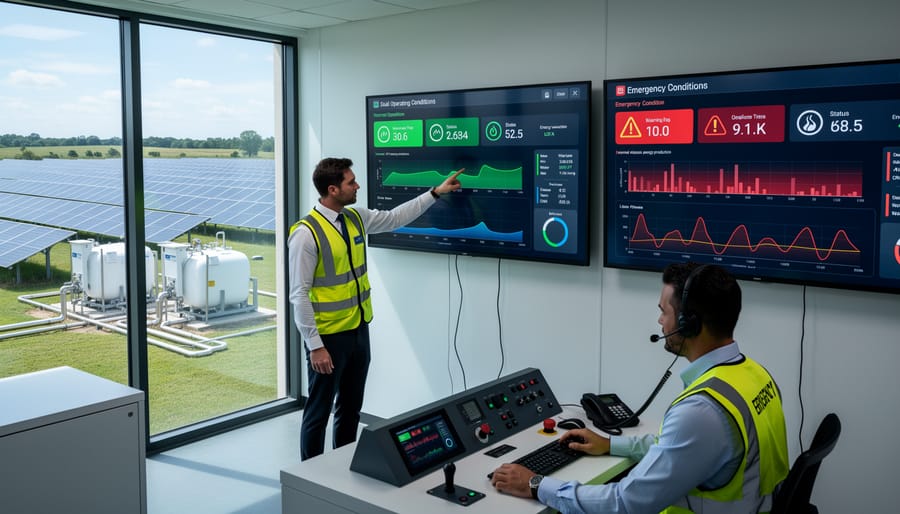
Advanced monitoring systems represent a critical component in zero waste energy architectures for sanitation facilities. These automated platforms continuously analyze power generation, storage capacity, and consumption patterns across all connected equipment. By implementing smart grid integration, facility managers gain real-time visibility into energy flows and can establish priority hierarchies for critical sanitation functions.
The technology employs intelligent load-shedding algorithms that automatically redirect power during peak demand or reduced generation periods. Essential systems like wastewater pumps and treatment processes receive priority allocation, while non-critical functions scale back temporarily. A Brisbane water treatment plant demonstrated this capability during a recent weather event, maintaining 100% operational capacity for primary treatment while reducing administrative building consumption by 40%. This dynamic resource allocation eliminates energy waste while ensuring public health infrastructure remains fully functional, delivering measurable cost savings and enhanced resilience for facility operators.
Financial and Regulatory Considerations for Government and Commercial Buyers
Investment Returns and Payback Periods
Zero waste energy systems deliver measurable financial returns through multiple revenue streams and cost avoidance mechanisms. Typical payback periods for commercial solar installations with energy recovery systems range from 5 to 8 years, depending on facility size, energy consumption patterns, and local electricity rates.
Energy savings constitute the primary return driver. Facilities implementing comprehensive zero waste energy solutions typically reduce grid electricity consumption by 60-80%, translating to annual savings of $50,000 to $500,000 for mid-sized commercial operations. Heat recovery systems add another 15-25% efficiency gain, particularly valuable in operations requiring both cooling and heating.
Avoided downtime costs represent a critical but often underestimated benefit. For facilities where power interruptions affect critical sanitation infrastructure, backup solar capacity prevents losses averaging $10,000 to $100,000 per incident. Manufacturing facilities and healthcare institutions particularly benefit from this operational continuity.
Government incentives significantly accelerate returns. Investment tax credits currently offset 30% of installation costs in many jurisdictions, while accelerated depreciation schedules allow businesses to recover investments faster. Additional state and local rebates can reduce upfront costs by another 10-20%.
Performance-based incentives provide ongoing revenue through renewable energy certificates and net metering programs, generating $5,000 to $25,000 annually for commercial installations. When combined with avoided carbon taxes and sustainability reporting benefits, the total return profile strengthens considerably. Forward-thinking organizations increasingly view these systems as strategic infrastructure investments rather than simple cost centers, recognizing their role in operational resilience and competitive positioning.
Compliance with Emergency Preparedness Regulations
Regulatory frameworks across numerous jurisdictions mandate uninterrupted sanitation services during emergencies, creating legal obligations for facility operators to maintain backup power systems. Solar energy solutions with integrated battery storage provide a compliant pathway to meet these requirements while advancing sustainability objectives.
Health departments and environmental protection agencies typically require wastewater treatment facilities, hospitals, food processing plants, and other critical infrastructure to demonstrate 24-72 hours of operational capability during grid outages. Traditional diesel generators have fulfilled this role historically, but solar backup systems now offer equivalent or superior reliability without fuel supply chain vulnerabilities. When properly sized, photovoltaic arrays combined with battery banks can power essential sanitation equipment including pumps, aerators, and control systems throughout extended outages.
Documentation requirements for emergency preparedness plans become straightforward with solar installations. Facilities can demonstrate compliance through system specifications, battery capacity calculations, and performance monitoring data that proves sufficient energy reserves. Unlike fuel-based systems requiring periodic testing and maintenance logs, solar solutions provide continuous operational verification through digital monitoring platforms.
Several municipal water authorities have successfully passed regulatory audits after implementing solar backup systems. A California wastewater facility documented 96-hour autonomous operation capability, exceeding the state’s 72-hour requirement while eliminating quarterly generator testing costs. Similarly, food processing facilities subject to FDA inspection have integrated solar systems into their Hazard Analysis and Critical Control Points plans, satisfying both energy security and environmental compliance objectives simultaneously. This dual compliance advantage positions solar technology as the preferred solution for forward-thinking organizations navigating increasingly stringent emergency preparedness standards.
Zero-waste solar energy represents a strategic imperative for organizations committed to maintaining sanitation resilience in an era of increasing infrastructure vulnerabilities. The convergence of environmental responsibility, operational continuity, and economic efficiency makes solar-powered backup systems an essential component of comprehensive facility management. As demonstrated through municipal implementations and commercial applications, these systems deliver measurable returns while safeguarding critical operations against grid disruptions.
Decision-makers must recognize that the question is no longer whether to integrate renewable backup power, but rather how quickly implementation can begin. The financial case—combining utility savings, reduced maintenance costs, and extended equipment lifespan—typically justifies investment within three to seven years, while the operational benefits begin immediately upon system activation.
Organizations should initiate their zero-waste solar journey by conducting a comprehensive energy audit of existing sanitation infrastructure. This assessment identifies current power consumption patterns, evaluates backup power requirements, and determines optimal solar array sizing. Engaging with experienced solar integrators who specialize in mission-critical applications ensures proper system design and compliance with relevant standards.
The next step involves developing a phased implementation roadmap that aligns with capital planning cycles and operational priorities. Starting with pilot installations at high-priority facilities allows organizations to validate performance metrics before scaling across multiple sites. Establishing clear performance benchmarks and monitoring protocols ensures systems deliver expected resilience and efficiency gains.
The time to act is now—sanitation continuity demands proactive infrastructure investment rather than reactive crisis management.