
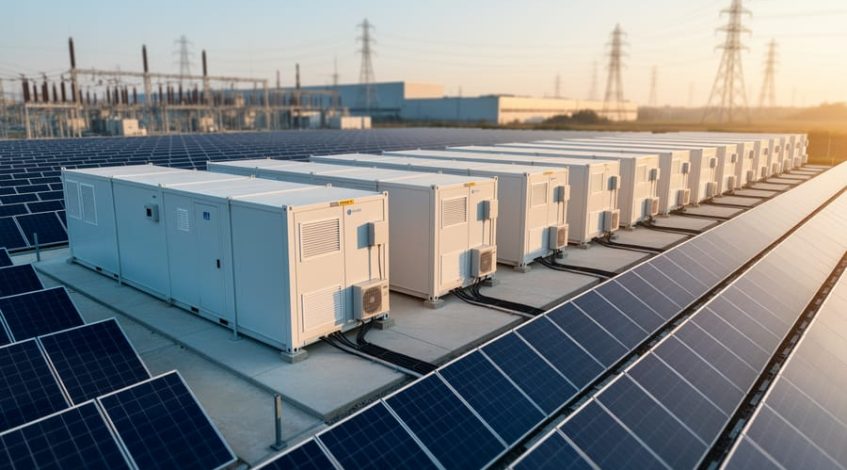
Industrial energy storage represents the critical next evolution for facilities already operating or planning industrial solar power systems. The technology transforms solar from an intermittent power source into a controllable, dispatchable asset that directly impacts operational efficiency and bottom-line costs.
Calculate your optimal storage capacity by analyzing three key data points: your facility’s load profile during non-solar hours, peak demand charges on your current utility bills, and your solar generation curve throughout the day. Most industrial operations discover that 2-4 hours of storage capacity addresses 70-85% of demand charge exposure while maximizing solar self-consumption rates.
Evaluate battery chemistry options based on your specific operational requirements rather than theoretical specifications. Lithium-ion systems deliver higher round-trip efficiency at 90-95% and require minimal footprint, making them ideal for space-constrained facilities. Flow batteries excel in operations requiring daily deep discharge cycles exceeding ten years, despite lower efficiency ratings of 65-75%.
Quantify financial returns by modeling three distinct value streams: demand charge reduction through peak shaving, time-of-use optimization by shifting stored solar energy to high-rate periods, and ancillary revenue from grid services programs where available. Manufacturing facilities typically achieve payback periods of 5-7 years when combining all three revenue streams, with demand charge savings alone often justifying 60-70% of system costs.
Implement staged deployment strategies for risk mitigation and capital efficiency. Begin with a smaller storage system scaled to address your highest-value use case, then expand capacity as operational data validates performance assumptions and reveals additional optimization opportunities. This approach allows refinement of control algorithms and integration protocols before committing full capital investment.
The Industrial Energy Storage Imperative
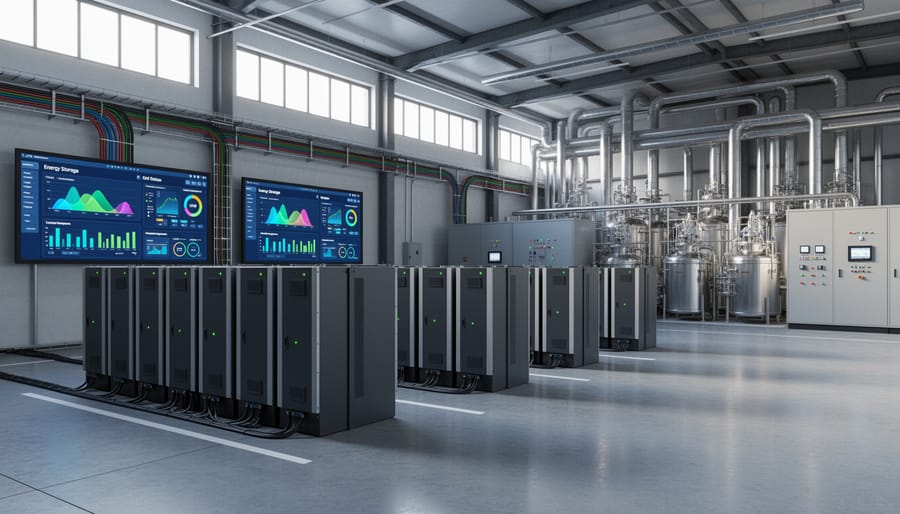
The Cost of Solar Without Storage
While solar energy transforms business operations across industries, facilities relying solely on photovoltaic systems without storage face significant financial challenges that impact their bottom line. Understanding these costs is essential for making informed infrastructure decisions.
Peak demand charges represent one of the most substantial hidden costs. Industrial electricity rates often include charges based on the highest power draw during billing periods. When solar production drops during cloudy conditions or after sunset, facilities must draw from the grid at maximum capacity, triggering expensive demand charges that can account for 30-70% of monthly electricity bills. Without storage to buffer these spikes, businesses cannot effectively manage their load profiles.
Production downtime presents another critical vulnerability. Manufacturing and processing facilities operating beyond daylight hours or requiring 24/7 operations face direct productivity losses when solar generation ceases. This dependency on grid power during peak rate periods significantly erodes the cost savings that solar installations initially promise.
Missed energy arbitrage opportunities further compound financial losses. Excess solar production during midday low-rate periods typically feeds back to the grid at minimal compensation, while evening operations require purchasing expensive peak-rate electricity. This mismatch prevents facilities from capturing the full value of their solar investment. Industry analyses indicate that solar-only systems typically realize only 40-60% of their potential economic value compared to integrated storage solutions, leaving substantial savings unrealized and extending payback periods considerably.
What Industrial Energy Storage Actually Does
Industrial energy storage systems serve four primary functions that directly impact operational efficiency and cost management. Load shifting represents the most common application, where facilities charge batteries during off-peak hours when electricity rates are lowest and discharge during expensive peak periods. This strategic timing can reduce energy costs by 20-40% for facilities with significant rate differentials between peak and off-peak hours.
Demand charge reduction addresses one of the most significant expenses on commercial utility bills. By deploying stored energy during high-consumption periods, facilities can flatten their demand curves and avoid costly demand charges that often account for 30-50% of total electricity expenses. Manufacturing plants and data centers typically see the fastest return on investment through this application alone.
Backup power functionality ensures business continuity during grid outages. Unlike traditional diesel generators, battery systems provide instantaneous power without switching delays, preventing equipment damage and production disruptions. Advanced systems can seamlessly transition between grid-connected and island modes, maintaining critical operations for hours or even days depending on capacity.
Grid services participation creates additional revenue streams by allowing facilities to provide frequency regulation, voltage support, or capacity reserves to utilities. Forward-thinking facility managers increasingly view storage systems as revenue-generating assets rather than simple capital expenditures. Real-world applications demonstrate that facilities can offset 10-25% of storage system costs through participation in wholesale energy markets or utility demand response programs, accelerating payback periods while supporting grid stability.
Battery Technologies for Industrial Applications
Lithium-Ion: The Industrial Standard
Lithium-ion technology has become the dominant choice for industrial energy storage, capturing approximately 90% of the grid-scale battery market. This preference stems from several quantifiable advantages that directly impact operational performance and return on investment.
The technology offers exceptional energy density, typically ranging from 150-250 Wh/kg, allowing facilities to store substantial power within a relatively compact footprint. This space efficiency proves particularly valuable for industrial sites where real estate carries significant opportunity costs. A 1 MWh lithium-ion system occupies roughly one-third the space of comparable lead-acid alternatives.
Cycle life represents another compelling factor. Modern lithium-ion systems deliver 3,000-10,000 charge-discharge cycles depending on depth of discharge and operating conditions. For facilities performing daily cycling with solar integration, this translates to 10-15 years of productive service before capacity degradation requires replacement, establishing a clear timeframe for ROI calculations.
Response time capabilities distinguish lithium-ion in demand charge management applications. These systems can transition from standby to full discharge in milliseconds, enabling precise peak shaving that directly reduces utility bills. One manufacturing facility in California documented $180,000 in annual savings by deploying a 500 kW lithium-ion system to manage demand charges during production peaks.
Manufacturing scale has driven costs down 89% since 2010, with current installed costs averaging $300-500 per kWh for commercial-scale systems. This cost trajectory, combined with available federal tax credits and utility incentives, has shortened payback periods to 5-7 years for most industrial applications involving solar integration and demand management.
Alternative Storage Technologies Worth Considering
While lithium-ion systems dominate industrial energy storage discussions, several alternative technologies merit serious consideration for specific operational contexts. Understanding when these alternatives deliver superior performance or economic value enables more strategic storage investments aligned with facility requirements.
Flow batteries, particularly vanadium redox systems, excel in applications requiring deep discharge cycles and extended duration storage. Unlike lithium-ion, flow batteries separate power capacity from energy capacity, allowing independent scaling of each parameter. Industrial facilities with predictable, long-duration discharge requirements—such as shift-based manufacturing operations or agricultural processing facilities—benefit from flow battery economics. Their 20-year operational lifespan and near-unlimited cycling capability offset higher upfront costs. A cement production facility in South Australia successfully implemented a 200kWh flow battery system that provides 8-hour discharge capacity during peak rate periods, achieving payback within seven years through demand charge reductions.
Advanced lead-acid systems, including sealed and absorbed glass mat variants, remain viable for facilities with moderate cycling requirements and constrained capital budgets. Their established supply chains, straightforward recycling infrastructure, and proven reliability make them practical for backup power applications and smaller-scale solar integration projects. Distribution centers requiring 2-4 hour backup capacity often find lead-acid solutions 30-40 percent more cost-effective than lithium alternatives.
Emerging technologies including solid-state batteries and thermal storage systems integrated with next-generation solar technologies show promise for specific industrial applications. Compressed air energy storage suits facilities with existing compressed air infrastructure, converting equipment from energy consumer to storage asset. Gravitational storage systems offer entirely mechanical solutions for operations prioritizing safety and environmental considerations. Evaluating these alternatives against operational profiles, duty cycles, and financial parameters ensures optimal technology selection rather than defaulting to mainstream solutions.
Sizing Your Industrial Storage System
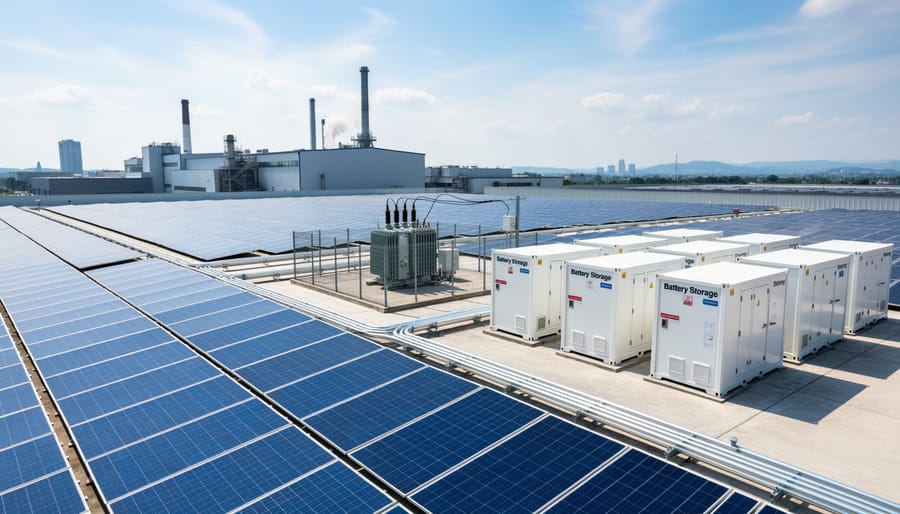
Load Analysis and Energy Profiling
Effective industrial energy storage implementation begins with comprehensive load analysis—a systematic evaluation of your facility’s energy consumption patterns over time. This process involves collecting interval meter data, typically at 15-minute increments over a minimum 12-month period, to capture seasonal variations and operational cycles specific to your production schedule.
The methodology identifies three critical parameters: baseline consumption, peak demand periods, and load variability. Peak demand analysis reveals when your facility draws maximum power from the grid, often triggering expensive demand charges that can represent 30-50% of monthly electricity costs. Modern data analytics platforms can overlay production schedules, weather patterns, and historical consumption to pinpoint optimization opportunities.
Energy profiling quantifies storage requirements by evaluating specific operational goals. For demand charge reduction, the analysis calculates battery capacity needed to shave peaks below utility thresholds. For backup power applications, runtime requirements during outages determine storage size. When paired with solar generation, particularly given recent solar panel efficiency improvements, load profiling identifies optimal charge-discharge cycles that maximize self-consumption.
Real-world application: A food processing facility in Queensland used 12-month load analysis to discover that 40% of demand charges occurred during just six hours monthly. This insight justified a 500kWh battery system sized precisely to eliminate those peak periods, delivering an 18-month payback period. Accurate load profiling transforms energy storage from a conceptual solution into a quantifiable investment with measurable returns.
Balancing Capacity with Investment
Determining the optimal storage capacity requires a methodical analysis that balances upfront investment against measurable returns. The most successful implementations begin with a comprehensive financial model that accounts for multiple revenue streams and value propositions.
Start by calculating potential demand charge savings, which often represent the largest financial benefit. Review 12-24 months of utility bills to identify peak demand patterns and associated charges. A properly sized system can reduce demand charges by 30-70%, depending on your facility’s load profile. Multiply the monthly demand charge reduction by your contracted rate to establish baseline savings.
Energy arbitrage opportunities add another revenue layer. Calculate the differential between off-peak charging rates and peak discharge rates, then multiply by your anticipated daily cycling capacity. In regions with time-of-use rates exceeding $0.15/kWh differential, arbitrage can contribute 20-40% of total system value.
Resilience value requires a different calculation approach. Estimate the cost of downtime per hour for critical operations, then determine how many hours of backup power justify the investment. Manufacturing facilities typically value resilience at $50,000-$500,000 per outage event avoided.
For example, a food processing facility in California installed a 500 kWh system for $375,000. Annual demand charge savings of $68,000, energy arbitrage revenue of $22,000, and avoided downtime value of $15,000 annually yielded a payback period of 3.6 years. When combined with available incentives reducing initial costs by 30%, payback shortened to 2.5 years, delivering strong returns throughout the system’s 10-15 year lifespan.
Operational Strategies for Solar-Storage Systems
Peak Shaving and Demand Charge Management
Industrial facilities typically face substantial demand charges—fees based on their highest power consumption during specific intervals, often 15 or 30 minutes. These charges can represent 30-70% of total electricity costs, making peak shaving one of the most financially impactful applications of energy storage systems.
Battery storage systems strategically discharge during peak demand periods, reducing the facility’s draw from the grid and lowering maximum demand thresholds. When sensors detect consumption approaching predetermined limits, the system automatically supplements grid power with stored energy, effectively flattening demand spikes. This automated response happens in milliseconds, requiring no manual intervention from operations staff.
The savings potential is considerable. A manufacturing facility with a 2 MW demand peak might reduce that threshold by 500-800 kW using appropriately sized storage, potentially saving $50,000-120,000 annually depending on utility rate structures. Return on investment typically occurs within 3-7 years, with systems designed for 10-15 year operational lifespans.
Operational programming requires careful load profile analysis. Facility managers must work with system integrators to identify recurring demand patterns, seasonal variations, and production schedules. The storage management system learns these patterns and adjusts discharge timing accordingly. Integration with building management systems allows the storage to anticipate major equipment startups—such as compressors, chillers, or production line ramp-ups—and proactively offset their grid impact.
For facilities with solar installations, combining generation forecasting with demand charge management creates additional optimization opportunities, charging batteries during high solar output periods and strategically deploying stored energy when both demand and grid rates peak simultaneously.
Self-Consumption Optimization
Self-consumption optimization represents one of the most compelling financial benefits of industrial energy storage systems. By strategically storing excess solar generation during peak production hours and deploying that energy when facility demand exceeds solar output, businesses can dramatically reduce their reliance on grid electricity and avoid expensive demand charges.
Intelligent battery management systems analyze real-time solar production data, facility load profiles, and electricity pricing structures to determine optimal charge and discharge schedules. This automated dispatch ensures maximum utilization of self-generated solar power rather than exporting excess energy to the grid at wholesale rates while purchasing power back at retail prices during evening operations.
A manufacturing facility in California achieved 78% self-consumption of its solar generation after implementing a 500 kWh battery system, compared to just 42% without storage. This optimization eliminated approximately $180,000 in annual energy procurement costs while reducing grid dependency by 35%. The system paid for itself in under four years through combined demand charge reduction and increased solar utilization.
For operations with predictable energy patterns, advanced algorithms can forecast daily production and consumption cycles, preemptively managing storage capacity to ensure availability during critical high-demand periods. This proactive approach maximizes the economic value of every kilowatt-hour generated on-site.
Grid Services and Revenue Stacking
Industrial energy storage systems can generate revenue beyond basic energy cost savings by participating in grid services markets. Ancillary services represent a significant opportunity, allowing facilities to provide frequency regulation, voltage support, and spinning reserves to grid operators. These services help maintain grid stability and command premium payments, particularly during peak demand periods.
Demand response programs enable industrial facilities to reduce consumption or discharge stored energy during grid stress events, earning incentive payments from utilities or independent system operators. Many regions offer structured programs with predictable payment schedules, making revenue forecasting more reliable for financial planning.
Capacity markets provide another revenue stream by compensating storage operators for guaranteeing available power during critical periods. Forward capacity auctions allow facilities to commit storage resources years in advance, creating long-term revenue certainty.
This revenue stacking approach—combining multiple income sources—significantly improves project economics. For example, a manufacturing facility in PJM territory recently achieved a 4.2-year payback by layering frequency regulation revenues with demand charge reduction and capacity market payments. The key is understanding local market structures and ensuring storage systems meet technical requirements for participation while maintaining operational flexibility for primary on-site functions.
Integration Considerations and System Design
Electrical Architecture and Interconnection
The electrical configuration of industrial solar-storage systems requires careful analysis of several interconnected factors that directly impact system performance and cost-effectiveness. The fundamental decision between AC and DC coupling represents a critical choice that influences installation costs, energy conversion efficiency, and operational flexibility.
DC-coupled systems connect batteries directly to the solar array’s DC side before inversion, reducing conversion losses and typically achieving 4-8% higher round-trip efficiency. This configuration proves particularly advantageous for new installations where solar and storage deploy simultaneously. AC-coupled systems, conversely, connect battery storage after the solar inverter, offering greater modularity and simplified retrofitting to existing solar infrastructure. For facilities expanding existing arrays, AC coupling often reduces integration complexity and upfront costs.
Inverter sizing demands precise calculation balancing peak demand requirements against capital expenditure. Industry best practice typically sizes inverters at 110-130% of battery nameplate capacity to accommodate both discharge and simultaneous solar generation. Under-sizing risks curtailing system output during high-demand periods, while excessive over-sizing unnecessarily increases equipment costs without proportional benefit.
Electrical panel capacity assessment frequently reveals existing infrastructure limitations. Many industrial facilities discover main service panels lack sufficient capacity for storage integration, necessitating upgrades that can represent 15-25% of total project costs. Early electrical infrastructure evaluation prevents budget surprises and timeline delays.
Utility interconnection requirements vary significantly by jurisdiction and utility provider. Most industrial storage installations require updated interconnection agreements addressing export capabilities, islanding protocols, and grid support functions. Processing timelines range from 60 days to six months, making early utility engagement essential for project scheduling. Facilities should anticipate technical reviews addressing power quality, protection schemes, and potentially demand response participation requirements that can unlock additional revenue streams.
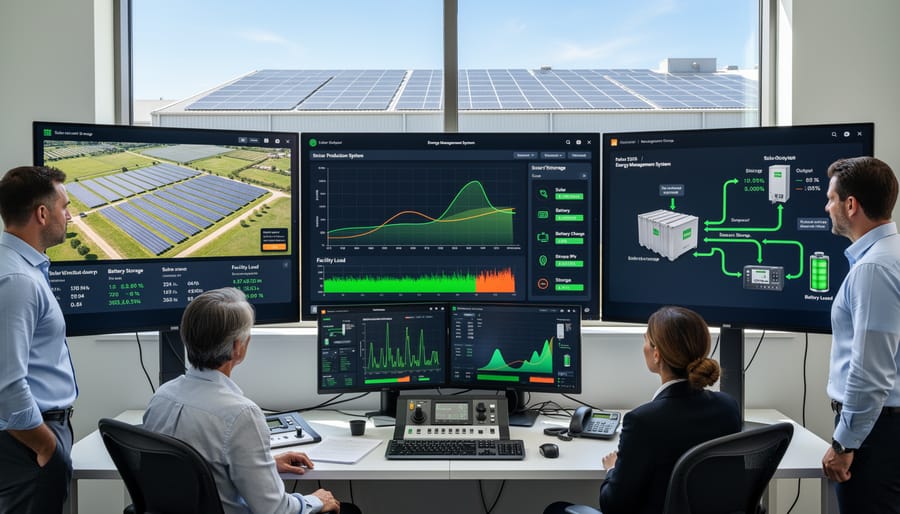
Monitoring and Control Systems
Intelligent energy management systems serve as the operational backbone of industrial energy storage installations, coordinating multiple energy flows to maximize system performance and financial returns. These platforms continuously monitor solar production patterns, facility energy demand, battery charge status, and utility rate structures to make real-time dispatch decisions that reduce costs and optimize asset utilization.
Modern monitoring systems provide facility managers with comprehensive visibility into energy operations through cloud-based dashboards that display production metrics, consumption trends, and cost savings in accessible formats. These platforms automatically adjust charging and discharging schedules based on forecasted weather conditions, anticipated facility loads, and time-of-use electricity pricing to ensure batteries dispatch stored energy during peak-rate periods when savings are greatest.
Advanced systems incorporate predictive analytics and machine learning algorithms that improve performance over time by identifying consumption patterns and refining operational strategies. One manufacturing facility implementing such controls achieved a 23% improvement in demand charge reduction compared to basic timer-based scheduling, demonstrating the tangible value of intelligent coordination. For decision-makers evaluating storage investments, sophisticated monitoring capabilities directly impact ROI by ensuring systems operate at peak efficiency while providing the data transparency necessary for ongoing performance verification and optimization.
Financial Incentives and Project Economics
Industrial energy storage projects benefit from a robust landscape of financial incentives that significantly enhance return on investment and accelerate payback periods. Understanding these mechanisms is essential for building compelling business cases and securing stakeholder approval.
The federal Investment Tax Credit (ITC) currently allows businesses to claim 30% of qualified energy storage system costs when paired with solar installations. This substantial credit applies to equipment, installation, and interconnection expenses, reducing upfront capital requirements considerably. Standalone storage systems can also qualify for the ITC under recent legislative updates, provided they meet specific charging criteria. Combined with reducing industrial operating costs through demand charge management and time-of-use optimization, these incentives create compelling economics.
The Modified Accelerated Cost Recovery System (MACRS) allows five-year accelerated depreciation for energy storage assets, enabling businesses to recover investment costs more quickly through tax deductions. This depreciation schedule typically recovers approximately 85% of the system cost over five years, providing significant cash flow benefits during the early operational period.
State-level programs vary considerably but often provide additional support. California’s Self-Generation Incentive Program (SGIP) offers rebates up to $350 per kilowatt-hour for qualifying storage systems, while Massachusetts includes storage in its Solar Massachusetts Renewable Target (SMART) program with adder payments. New York’s Energy Storage Incentive Program provides performance-based incentives, and similar programs exist in Oregon, New Jersey, and other progressive energy states.
Utility incentive programs represent another important revenue stream. Many utilities offer demand response payments for storage systems that can discharge during peak events, capacity payments for grid support services, and interconnection cost-sharing programs. Forward-thinking facilities can stack these incentives with federal benefits, creating project economics that achieve payback periods as short as three to five years while providing 20-plus years of operational benefits.
Real-World Performance: Industrial Case Studies
A 450,000-square-foot automotive parts manufacturing facility in Michigan implemented a 2.5 MW solar array paired with a 3 MWh lithium-ion battery storage system in 2021. The facility operates two production shifts daily with substantial electricity demand during peak hours. Prior to the solar-storage installation, annual energy costs exceeded $1.2 million, with demand charges accounting for nearly 40% of the total.
The integrated system now provides approximately 35% of the facility’s annual electricity consumption. The battery system performs multiple functions: storing excess solar generation during mid-day periods, discharging during afternoon peak demand windows, and providing power quality support for sensitive manufacturing equipment. Performance data from the first 24 months demonstrates average monthly savings of $28,000, comprised of reduced energy purchases and a 62% reduction in demand charges. The system achieved a simple payback period of 6.8 years, factoring in federal investment tax credits and state-level incentives. Beyond financial metrics, the facility documented a 23% reduction in production downtime attributed to power quality issues, translating to measurable productivity gains.
Operations managers reported that battery backup capabilities proved invaluable during three grid outages in the implementation period. The system maintained critical production lines for an average of 4.2 hours per incident, preventing an estimated $180,000 in lost production and spoiled inventory. The facility also qualified for a reduced insurance premium due to enhanced operational resilience.
A cold storage and distribution center in California presents a different application profile. This 200,000-square-foot facility installed a 1.8 MW solar system with 2.4 MWh of storage capacity in 2020. Refrigeration loads create consistent 24-hour demand, making energy storage particularly effective. The system leverages California’s time-of-use rate structures by charging batteries during super off-peak hours and solar production periods, then discharging during expensive on-peak windows.
Performance tracking reveals that the storage system shifted 78% of grid purchases to lowest-cost periods, reducing electricity costs by $186,000 annually. The facility enrolled in a demand response program, generating an additional $42,000 in annual revenue by allowing the utility to dispatch stored energy during critical grid events. Combined with environmental benefits and corporate sustainability goals, the project achieved stakeholder approval despite a longer 8.2-year payback period.
Both facilities emphasized the importance of proper system sizing, accurate load forecasting, and experienced integration partners. Regular monitoring and optimization adjustments during the first year proved essential to maximizing performance and achieving projected returns.
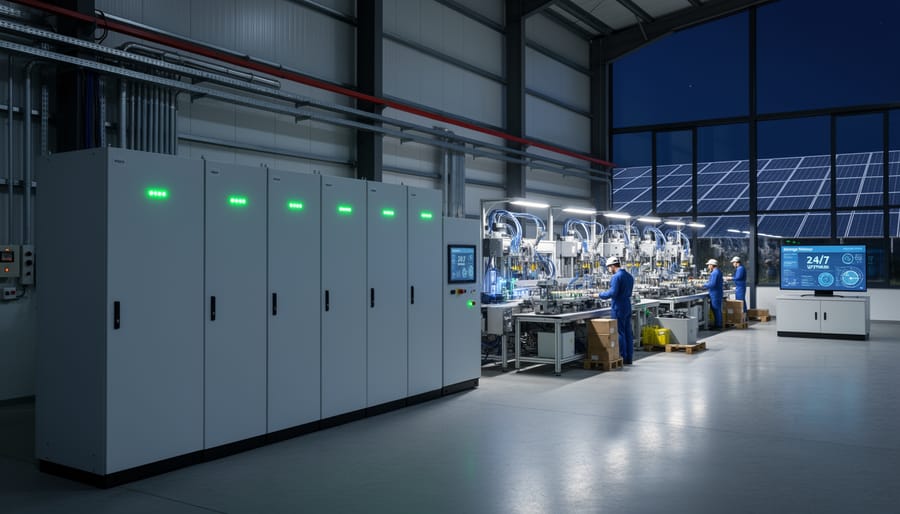
Industrial energy storage represents the essential evolution that transforms solar power from a supplemental daytime energy source into a comprehensive, around-the-clock strategic asset. For facility managers and decision-makers, the integration of battery systems with solar installations delivers measurable competitive advantages: reduced demand charges, enhanced grid independence, improved power quality, and protection against utility rate volatility. These benefits translate directly to operational cost savings and predictable energy expenses over system lifespans extending 15 to 20 years.
The facilities already implementing solar-storage solutions demonstrate compelling returns on investment, with many achieving payback periods between five and eight years when factoring in demand charge reduction, energy arbitrage, and available incentives. Beyond financial metrics, these systems provide operational resilience that keeps production lines running during grid disturbances and positions organizations as sustainability leaders in their sectors.
For decision-makers evaluating storage solutions, the path forward begins with a thorough energy audit to identify consumption patterns, peak demand periods, and grid dependency vulnerabilities. Engaging qualified engineering firms to conduct feasibility studies ensures proper system sizing and technology selection aligned with your operational requirements. Request detailed financial modeling that includes all incentive programs, utility rate structures, and long-term maintenance considerations.
The transition to integrated solar-storage systems requires careful planning, but the strategic value extends well beyond energy cost reduction. Forward-thinking organizations recognize that energy independence, operational continuity, and environmental stewardship represent fundamental competitive advantages in an increasingly sustainability-focused marketplace. The question is no longer whether to implement industrial energy storage, but rather how quickly your facility can capitalize on this transformative technology.