
OT vulnerability management is the systematic process of identifying, assessing, prioritizing, and remediating security weaknesses in operational technology systems that control physical processes and equipment. In solar facilities, this means protecting the supervisory control and data acquisition (SCADA) systems, inverters, monitoring platforms, and network infrastructure that keep your installation generating power safely and efficiently.
The stakes for solar operators have never been higher. A single unpatched vulnerability in your OT environment can lead to production downtime, equipment damage, or unauthorized access to critical systems. Unlike traditional IT networks that can be taken offline for maintenance, solar installations run continuously, making vulnerability management both essential and challenging. The consequences extend beyond operational disruption. A compromised solar facility can cascade into grid instability, financial losses from interrupted generation, and potential safety hazards.
What makes OT vulnerability management distinct from conventional IT security is the unique nature of solar infrastructure. Many inverters and control systems use proprietary protocols, run on legacy firmware, and cannot be patched without careful coordination to avoid production losses. These systems were often designed decades ago with minimal security features, long before cyber threats became a primary concern. Today’s solar facilities blend aging equipment with modern connected devices, creating a complex attack surface that requires specialized management approaches.
The challenge intensifies as solar installations expand and integrate with smart grid technologies. Each connection point, whether to utility networks, remote monitoring platforms, or third-party service providers, introduces potential entry vectors for threats. Effective vulnerability management in this context requires understanding both the technology stack and the operational constraints that govern solar production.
This article explains how OT vulnerability management works in solar operations, the specific components that require attention, and practical implementation strategies that balance security with continuous generation. You’ll learn to identify critical vulnerabilities in your solar infrastructure, prioritize remediation efforts based on actual risk, and build a sustainable program that protects your investment without compromising uptime or performance.
What Is OT Vulnerability Management?
OT vulnerability management is a systematic approach to identifying, assessing, and remediating security weaknesses in the operational technology systems that control and monitor physical processes within solar installations. Unlike traditional IT security that protects data and business systems, OT vulnerability management focuses on the specialized hardware and software that directly operates solar arrays, including inverters, monitoring systems, SCADA platforms, and programmable logic controllers, ensuring these critical components remain secure against cyber threats while maintaining continuous energy production.
Solar installations rely on an interconnected network of OT devices that communicate constantly to optimize energy generation, manage grid connections, and report performance data. These systems were historically designed for reliability and uptime rather than security, operating in isolated environments where external threats seemed distant. However, as solar facilities have embraced remote monitoring, cloud connectivity, and integration with broader energy management systems, they’ve inherited the security challenges of connected infrastructure without always gaining equivalent protection.
- Operational Technology (OT)
- Hardware and software that monitors and controls physical devices and processes in solar installations, such as inverters, meters, and array positioning systems. OT systems prioritize availability and real-time operation over traditional IT security measures.
- Vulnerability
- A weakness or flaw in OT system software, firmware, or configuration that attackers could exploit to disrupt operations, steal data, or gain unauthorized control of solar equipment.
- Patch Governance
- The structured process of testing, approving, and deploying security updates to OT systems without causing operational disruption or equipment downtime in production environments.
- SCADA (Supervisory Control and Data Acquisition)
- Industrial control systems that gather real-time data from solar installations and enable operators to monitor performance and control equipment remotely across distributed facilities.
- Attack Surface
- The total number of points where an unauthorized user could attempt to enter or extract data from solar OT systems, expanding with each connected device, network interface, and remote access point.
The vulnerability of solar OT systems stems from several factors. Many devices run embedded operating systems with limited security features, making them difficult to protect with conventional tools. Manufacturers often prioritize functionality over security, shipping products with default credentials, unencrypted communications, or outdated software components. Equipment lifecycles in solar installations can span 20 to 25 years, meaning devices deployed today may still be operating long after their original security measures become obsolete.
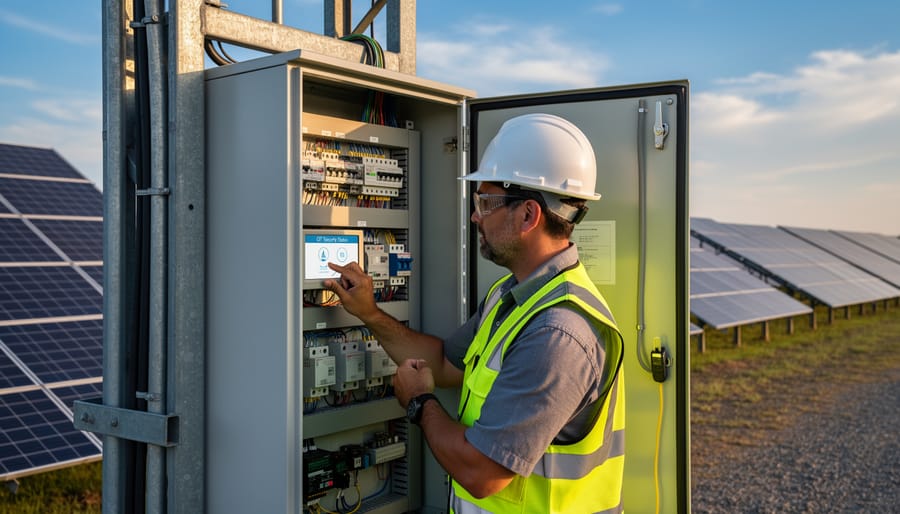
OT vulnerability management protects critical energy infrastructure by creating a continuous cycle of discovery, assessment, and remediation. The process begins with comprehensive visibility into every connected device across solar installations, then systematically identifies which systems contain known security flaws. Security teams can prioritize vulnerabilities based on their potential impact on energy production and the likelihood of exploitation, then apply appropriate countermeasures through patches, configuration changes, or compensating controls that maintain both security and operational continuity.
How OT Vulnerability Management Works
Asset Discovery and Inventory
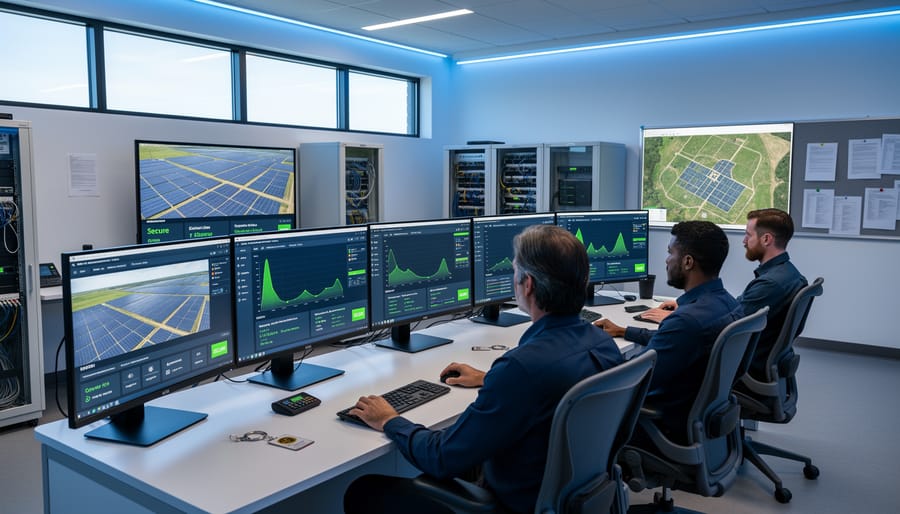
Asset discovery forms the foundation of vulnerability management for solar installations. Operators must first identify every connected device across their portfolio, from string inverters and central inverters to revenue-grade meters, programmable logic controllers (PLCs), remote terminal units (RTUs), and the communication gateways that enable smart monitoring. This inventory process typically combines automated network discovery tools with manual documentation of air-gapped systems and legacy equipment that may not respond to standard scanning protocols.
Effective inventory management captures critical details for each asset: manufacturer and model, firmware version, network location, operational criticality, and communication protocols in use. Solar operators should document whether devices support secure update mechanisms, their end-of-life status, and any known compatibility constraints. Many commercial installations discover they have hundreds or thousands of OT endpoints when they complete their first comprehensive inventory, revealing a far larger attack surface than initially assumed. Maintaining this living inventory as installations expand or equipment is replaced ensures vulnerability assessments remain accurate and complete.
Vulnerability Assessment and Scanning
Vulnerability assessment in solar OT environments demands specialized techniques that balance thorough security evaluation with zero tolerance for production disruption. Unlike IT systems that can be temporarily taken offline, solar arrays generate revenue 24/7, making traditional aggressive scanning methods unacceptable.
Passive scanning represents the safest initial approach. Network traffic analysis tools monitor communication between inverters, SCADA systems, and controllers without sending active probes that might trigger equipment shutdowns or erroneous fault codes. This baseline assessment identifies device fingerprints, firmware versions, and communication protocols, all critical data for vulnerability mapping without touching production hardware.
When active scanning becomes necessary, solar operators must implement strict protocols. Scheduled assessments occur during low-production hours, typically before dawn, with technicians on standby to verify equipment response. Throttled scan rates prevent network congestion that could delay critical control commands. Manufacturers provide approved scanning parameters for their specific inverter models and monitoring platforms, though testing these procedures in a lab environment first, much like organizations test SCADA defenses safely before deploying to production systems, reduces field risk substantially.
Vulnerability databases specifically tailored to OT equipment, such as ICS-CERT advisories and vendor security bulletins, cross-reference discovered firmware versions against known CVEs. This matching process quantifies actual risk exposure rather than relying on theoretical vulnerability counts, focusing remediation efforts where real threats intersect with your specific solar hardware configuration.
Prioritization and Risk Scoring
Not every vulnerability poses equal risk to solar operations. A critical flaw in a public-facing web portal differs significantly from one in a SCADA controller managing a 50MW array. Effective prioritization weighs three core factors: operational criticality (does this device control energy production or revenue metering?), exploitability (is there active malware targeting this vulnerability?), and business impact (would exploitation halt generation or expose sensitive operational data?).
Most solar operators adapt the CVSS v3.1 scoring framework as a foundation, then layer in context-specific modifiers. A vulnerability rated 7.5 in IT security might warrant immediate action if it affects inverter firmware but could be scheduled for routine patching if it exists in a non-critical monitoring interface. The framework should account for production schedules, patching during peak generation hours carries different risk than addressing the same flaw during planned maintenance windows.
Leading operators score vulnerabilities on a 1-100 scale combining base severity, asset criticality, and threat intelligence, aligning with 2024 standards for energy infrastructure protection. This produces a prioritized queue: patches affecting revenue-critical systems and actively exploited vulnerabilities rise to the top, while low-risk flaws in isolated devices can follow normal maintenance cycles without compromising security posture.
Patch Governance and Remediation
Effective patch governance begins with a controlled test environment that mirrors production solar OT systems. Before deploying any patch to live inverters or control systems, operators must validate it in an isolated lab setting using identical hardware and firmware versions. This testing phase typically spans 2-4 weeks and includes load simulation under various operating conditions, peak production, grid disturbances, and communication failures, to identify conflicts before they disrupt energy generation.
The deployment phase follows a phased rollout strategy. Start with a pilot site representing a small percentage of total capacity, monitor performance metrics for 7-10 days, then expand gradually to additional installations. Each phase requires documented change management approval, scheduled maintenance windows during low-production periods, and tested rollback procedures ready for immediate execution if issues arise.
Maintain detailed patch logs recording what was deployed, when, on which systems, and by whom. This documentation proves essential for compliance audits and troubleshooting future issues. For critical vulnerabilities requiring urgent remediation, establish emergency change protocols that compress the timeline while preserving essential testing and approval gates, never skip validation entirely, even under pressure.
Types and Components of Solar OT Vulnerability Management
Network-Based Vulnerability Management
Network-based vulnerability management monitors the communication patterns and data flows between solar OT devices without directly accessing individual components. This approach captures network packets, analyzes protocol behaviors, and identifies anomalies in how inverters, controllers, and monitoring systems interact. For solar installations, network-based tools excel at detecting unauthorized access attempts, identifying misconfigured devices, and spotting unusual communication patterns that may indicate compromised equipment.
The passive nature of network monitoring makes it particularly valuable for production environments where you can’t afford downtime. Deploy network sensors at strategic points in your solar infrastructure, typically at network boundaries, between facility segments, and upstream of critical control systems. These sensors build baseline profiles of normal device behavior, flagging deviations that warrant investigation without interrupting energy generation.
Agent-Based Assessment
Agent-based assessment deploys lightweight software agents directly onto compatible OT devices to continuously monitor system health, configuration changes, and vulnerability status from within. For solar installations, this approach works well with modern inverters, energy management systems, and industrial PCs that support agent deployment without compromising performance.
The primary advantage is real-time visibility into device-level security posture, including unauthorized software changes, configuration drift, and emerging vulnerabilities. However, many legacy solar controllers and proprietary equipment cannot run third-party agents, requiring operators to carefully evaluate device compatibility before deployment.
When implementing agent-based assessment, test thoroughly in non-production environments first. Ensure agents consume minimal resources and include automated failsafe mechanisms to prevent interference with critical energy production functions. This approach complements network-based and passive monitoring methods for comprehensive coverage.
Passive Monitoring and Analysis
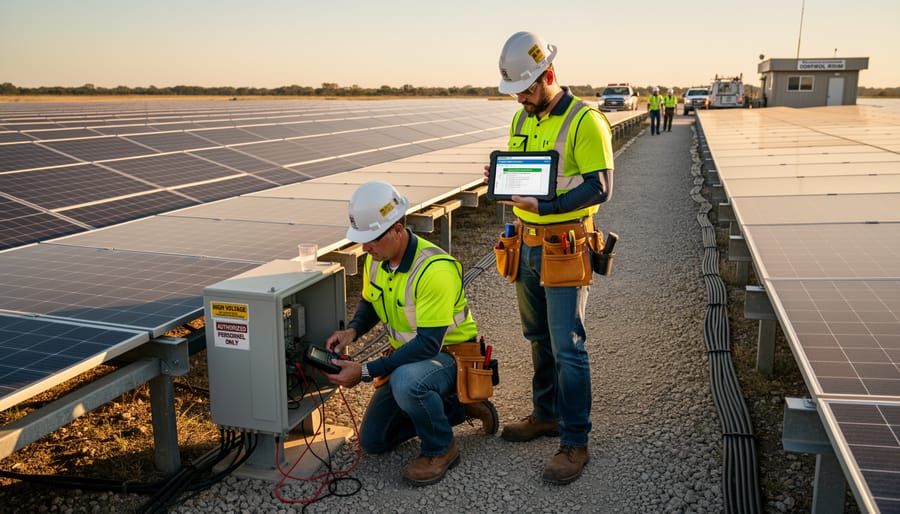
Passive monitoring observes network traffic and device communications without actively scanning or touching OT equipment, a critical advantage for solar installations where production continuity cannot be compromised. This approach captures data packets flowing between inverters, controllers, and SCADA systems, analyzing them for behavioral anomalies, protocol violations, and potential security issues. Since passive tools never inject packets or probe devices, they carry zero risk of disrupting solar generation.
For facilities with legacy equipment lacking modern security features, passive monitoring provides the only viable assessment method. The technique identifies vulnerabilities by detecting outdated protocols, unencrypted communications, or abnormal device behavior patterns. Modern passive solutions combine traffic analysis with threat intelligence feeds to flag known exploit signatures and suspicious activity. While less granular than agent-based scanning, passive monitoring delivers continuous visibility across distributed solar arrays without the operational risks or compatibility concerns of active assessment methods, making it ideal for risk-averse operators prioritizing uptime.
Common Use Cases for Solar OT Vulnerability Management
Protecting Large-Scale Commercial Solar Arrays
Large-scale commercial solar arrays spanning multiple megawatts face unique vulnerability management challenges due to their distributed infrastructure and complex OT ecosystems. A typical 5-10 MW installation might have 50-100 networked devices including string inverters, central inverters, weather stations, and communication gateways, each representing a potential entry point for attackers.
These installations require continuous vulnerability monitoring because downtime directly impacts revenue. A single day of interrupted production on a 5 MW array can cost $2,000-$5,000 in lost energy sales, making proactive vulnerability management a clear ROI proposition.
Consider a 12 MW commercial rooftop portfolio in Southern California that implemented comprehensive OT vulnerability management in 2025. The program discovered 47 unpatched vulnerabilities across inverter firmware and SCADA systems within the first assessment. By prioritizing critical patches and implementing network segmentation, the facility reduced its attack surface by 73% without disrupting operations. When a zero-day vulnerability affecting their inverter model emerged six months later, their monitoring system detected the exposure within hours, enabling rapid remediation before exploitation.
For arrays of this scale, vulnerability management transitions from optional to essential infrastructure protection, directly supporting both security posture and financial performance.
Government and Critical Infrastructure Compliance
Government solar installations face heightened security requirements due to their classification as critical infrastructure. Federal facilities and state-owned solar arrays must comply with frameworks like NIST 800-82 for industrial control systems, NERC CIP standards for grid-connected assets, and agency-specific cybersecurity directives that mandate continuous vulnerability monitoring and documented remediation.
OT vulnerability management provides the audit trail and risk documentation these agencies require. Every identified vulnerability, risk assessment, and patch deployment gets logged for compliance reporting. When regulators ask for evidence of security controls, vulnerability management systems generate the reports showing due diligence.
Government solar operators typically implement quarterly vulnerability scans as a baseline, with continuous monitoring for internet-facing components. They prioritize patches addressing known exploits and maintain segregated networks between OT and IT systems. Many agencies now mandate vulnerability disclosure programs where equipment vendors must report security flaws within defined timeframes.
The compliance burden extends to contractors maintaining government solar installations. Third-party service providers need documented vulnerability management processes before accessing federal OT networks, creating accountability throughout the supply chain.
Industrial Solar Integration
Industrial solar installations integrated with manufacturing and processing operations present unique vulnerability management challenges. When solar OT systems connect to existing SCADA networks, PLCs, and production control systems, a vulnerability in one domain can cascade across the entire facility.
Manufacturing plants using solar power must maintain separate network segments for solar OT and industrial control systems while managing both through unified vulnerability assessments. A critical vulnerability in a solar inverter controller could provide an entry point to production systems, potentially disrupting both energy generation and manufacturing operations. This interconnection requires coordinated patch testing that accounts for dependencies between solar and industrial systems.
Facilities often face competing priorities when scheduling maintenance windows. Production managers need continuous uptime while security teams require downtime for patch deployment. Effective vulnerability management in these environments demands cross-functional coordination between solar operations, manufacturing IT, and facility management teams. Establishing clear protocols for emergency patching versus scheduled maintenance becomes essential when a vulnerability threatens both energy production and manufacturing continuity.
Risk scoring must consider the cumulative impact of vulnerabilities affecting both solar generation and industrial processes, often requiring customized assessment frameworks that account for unique operational dependencies.
Key Challenges in Solar OT Vulnerability Management
Solar operators face distinct challenges when implementing vulnerability management programs, obstacles that differ significantly from traditional IT environments. Understanding these barriers helps organizations develop realistic implementation strategies and secure appropriate resources.
Legacy equipment poses the most persistent challenge in solar OT vulnerability management. Many installations rely on inverters, controllers, and monitoring systems that are five to fifteen years old, designed before modern cybersecurity became a priority. These devices often lack basic security features, run outdated firmware that manufacturers no longer support, and cannot accept patches without complete hardware replacement. A 2025 survey found that 62% of commercial solar installations contain at least one critical OT component for which no security updates exist.
The operational continuity imperative creates a second major barrier. Solar installations generate revenue only when producing electricity, and any downtime directly impacts financial performance. Facility managers reasonably fear that vulnerability scanning might crash production systems or that patch deployment could cause extended outages. This risk-averse culture makes it difficult to implement necessary security measures, even when vulnerabilities threaten long-term operational stability. Testing patches in lab environments before production deployment requires resources many operators lack.
Resource constraints compound these technical challenges:
- Shortage of professionals with both OT security expertise and solar industry knowledge
- Limited budgets that prioritize production optimization over security infrastructure
- Lack of dedicated security teams for facilities managing multiple distributed solar sites
- Inadequate visibility into OT network architecture and device inventories
The complexity of solar OT environments adds another layer of difficulty. A single commercial installation might contain equipment from eight different manufacturers, each with proprietary protocols and patch management processes. Coordinating vulnerability assessments across this heterogeneous landscape requires specialized tools and expertise that many organizations struggle to access.
Regulatory uncertainty further complicates vulnerability management planning. While government solar installations face clear compliance requirements, commercial operators often lack definitive guidance on security standards, making it difficult to justify investments or prioritize specific vulnerabilities. This ambiguity extends to questions about liability for customer data protection when solar monitoring systems contain sensitive information.
Finally, the disconnect between IT and OT teams creates organizational barriers. Security professionals trained in traditional IT environments may not understand operational constraints in solar production, while OT engineers often lack cybersecurity expertise. Bridging this gap requires cross-functional collaboration that many organizations have not yet established.
Best Practices for Effective Patch Governance
Successful patch governance in solar OT environments requires a structured approach that protects infrastructure without disrupting energy production. Start by establishing a dedicated test environment that mirrors your production systems. Before deploying any patch to live inverters or SCADA systems, validate it on identical hardware running the same firmware versions. This practice, used by major commercial solar operators, prevents the critical errors that can halt production across entire arrays.
Implement a change advisory board specific to OT systems, separate from IT patch management. Solar production equipment operates on different cycles than office systems, you cannot simply push patches during “off hours” when the sun is your operational constraint. Your board should include operations managers who understand production schedules, maintenance technicians familiar with equipment behavior, and security professionals who assess vulnerability severity. Schedule patches during planned maintenance windows or low-production periods, and never during peak generation hours unless addressing an actively exploited vulnerability.
Adopt a risk-based approach rather than patching everything immediately. Not all vulnerabilities pose equal threats to solar operations. A critical vulnerability in an internet-facing monitoring portal demands faster action than a low-severity issue in an air-gapped control system. Score patches based on three factors: the vulnerability’s CVSS rating, the affected system’s criticality to power generation, and whether the vulnerability is being actively exploited in energy sector attacks.
Maintain detailed documentation of every patch deployed, including the business justification, test results, rollback procedures, and actual deployment outcomes. This documentation proves invaluable for audits, troubleshooting future issues, and meeting ESG compliance requirements that increasingly scrutinize operational security practices.
Create vendor relationships that support your security timeline, not theirs. Many solar equipment manufacturers release patches on their schedule without considering your operational needs. Negotiate service agreements that include advance notification of security patches, extended testing periods for critical updates, and technical support during deployment. For legacy equipment where vendors no longer provide patches, document compensating controls such as network segmentation and enhanced monitoring.
Keep rollback plans ready for every patch deployment. Even thoroughly tested updates can cause unexpected issues in production environments. Successful solar operators maintain previous firmware versions, document rollback procedures, and ensure technical staff can execute them within minutes if generation is affected.
Frequently Asked Questions
Managing vulnerability programs in operational technology environments raises practical questions for solar operators evaluating these security measures. Understanding the investment requirements, implementation realities, and operational considerations helps facilities make informed decisions about protecting their solar infrastructure.
What does implementing OT vulnerability management typically cost for a solar installation?
Costs vary significantly based on installation size and complexity, but commercial solar facilities typically invest between $15,000 and $75,000 annually for comprehensive vulnerability management programs including software, services, and internal resources. Many operators find this represents less than 0.5% of their total operational budget while protecting assets worth millions.
How long does it take to implement a vulnerability management program?
Most solar operations complete initial implementation within 60 to 90 days, including asset discovery, baseline vulnerability assessment, and establishing patch governance processes. Full program maturity with continuous monitoring and optimized workflows typically requires 6 to 12 months.
Will vulnerability scanning disrupt our solar production operations?
Modern passive monitoring and carefully scheduled active scanning minimize operational impact, with most assessment activities occurring during low-production periods or using non-intrusive techniques. Properly implemented programs typically cause zero unplanned downtime.
What staffing is required to manage an OT vulnerability program?
Smaller installations often allocate 10-15 hours monthly from existing IT or operations staff, while larger facilities may dedicate a full-time resource or engage managed security service providers. Cross-training existing personnel on OT-specific security practices proves more practical than hiring specialized security staff for most solar operators.
The return on investment becomes measurable through several concrete outcomes that justify the program costs. Operators track reduced incident response expenses, avoided downtime costs, improved insurance premiums, and maintained compliance status. Facilities that experience even a single prevented security incident typically recover their annual vulnerability management investment many times over, given that production interruptions at multi-megawatt installations can cost thousands per hour in lost revenue and remediation expenses.
Integration with existing systems addresses another frequent concern for solar operators working with established infrastructure. Most vulnerability management platforms connect through standard network protocols and APIs, allowing deployment without replacing current SCADA systems, inverter management software, or monitoring tools. The programs layer security visibility over existing operations rather than requiring wholesale technology changes, which keeps implementation practical for facilities with legacy equipment still delivering reliable performance.
Success measurement focuses on reducing exposure rather than achieving perfect security scores. Leading solar operators track metrics like time-to-patch for critical vulnerabilities, percentage of assets with current security baselines, and mean time to detect new threats. Realistic programs aim for continuous improvement in these areas rather than eliminating all vulnerabilities immediately, recognizing that operational technology environments require balanced approaches that protect production while strengthening security posture over time.

uses
Solar OT vulnerability management serves multiple critical functions across the renewable energy sector. Commercial solar operators deploy these programs to maintain continuous energy production while protecting revenue-generating assets from cyber threats that could disrupt operations or damage equipment. Portfolio managers overseeing distributed solar installations use vulnerability management to ensure consistent security posture across multiple sites, reducing the risk of cascading failures that could impact overall generation capacity.
Energy service companies leverage OT vulnerability management when integrating solar systems into existing industrial facilities, ensuring that new renewable infrastructure doesn’t introduce security gaps into established operational technology environments. Insurance providers increasingly require documented vulnerability management programs as part of cyber risk assessments for commercial solar policies, making it essential for obtaining comprehensive coverage.
Compliance-driven organizations, particularly government entities and critical infrastructure operators, implement these programs to meet regulatory requirements while demonstrating due diligence in protecting public energy assets. Finally, asset owners use vulnerability management data during mergers and acquisitions to assess the security posture of potential solar investments and avoid inheriting unmanaged cyber risks.
As solar installations grow more connected and integral to our energy infrastructure, OT vulnerability management has shifted from optional best practice to operational necessity. The threats facing solar OT systems in 2026 aren’t theoretical, they’re active, evolving, and targeting the very systems that keep commercial solar operations running.
The ROI of comprehensive vulnerability management extends far beyond avoided security incidents. Organizations implementing structured patch governance and continuous monitoring protect revenue streams by preventing outages, maintain compliance with increasingly stringent regulations, and extend equipment lifespan through proactive system health monitoring. A single avoided compromise can justify years of vulnerability management investment.
Yet many solar operators still operate with incomplete asset visibility, reactive patching approaches, and limited threat intelligence specific to their OT environment. The gap between security requirements and implemented controls continues widening as solar infrastructure expands faster than security programs mature.
Start with an honest assessment of your current capabilities. Do you have complete inventory of all OT devices across your solar installations? Can you identify and prioritize vulnerabilities within your operational constraints? Have you established patch governance processes that balance security needs with production requirements?
The organizations thriving in 2026’s threat environment aren’t necessarily those with the largest security budgets, they’re the ones who recognized vulnerability management as foundational infrastructure protection and built systematic, sustainable programs around their operational realities. Your solar investments deserve the same rigor you apply to production optimization and financial planning.